来自专辑
踝关节扭伤
Treatment
Almost all ankle sprains can be treated without surgery. Even a complete ligament tear can heal without surgical repair if it is immobilized appropriately.
A three-phase program guides treatment for all ankle sprains—from mild to severe:
- Phase 1 includes resting, protecting the ankle and reducing the swelling.
- Phase 2 includes restoring range of motion, strength and flexibility.
- Phase 3 includes maintenance exercises and the gradual return to activities that do not require turning or twisting the ankle. This will be followed later by being able to do activities that require sharp, sudden turns (cutting activities)—such as tennis, basketball, or football.
This three-phase treatment program may take just 2 weeks to complete for minor sprains, or up to 6 to 12 weeks for more severe injuries.
治疗
几乎所有的脚踝扭伤都可以不用手术治疗。如果适当地固定,即使是完全的韧带撕裂也可以在不进行手术修复的情况下愈合。
所有踝关节扭伤的治疗由轻到重分为三个阶段:
- 第一阶段包括休息、保护脚踝和减少肿胀。
- 第二阶段包括恢复运动范围、力量和灵活性。
- 第三阶段包括维持训练和逐渐恢复不需要转动或扭转脚踝的活动。之后,可以做一些需要扭转的运动(剪切活动),比如网球、篮球或足球。
对于轻度扭伤,此三阶段治疗计划可能仅需2周即可完成,对于较严重的损伤,则可能需要6至12周才能完成。
Home Treatments
For milder sprains, your doctor may recommend simple home treatment.
The RICE protocol. Follow the RICE protocol as soon as possible after your injury:
- Rest your ankle by not walking on it.
- Ice should be immediately applied to keep the swelling down. It can be used for 20 to 30 minutes, three or four times daily. Do not apply ice directly to your skin.
- Compression dressings, bandages or ace-wraps will immobilize and support your injured ankle.
- Elevate your ankle above the level of your heart as often as possible during the first 48 hours.
Medication. Nonsteroidal anti-inflammatory drugs (NSAIDs) such as ibuprofen and naproxen can help control pain and swelling. Because they improve function by both reducing swelling and controlling pain, they are a better option for mild sprains than narcotic pain medicines.
家庭治疗
对于轻度扭伤,医生可能建议您进行简单的家庭治疗。
RICE原则。受伤后应尽快执行RICE规程:
- 尽量不要走路,以使脚踝休息。
- 应立即冰敷以防止肿胀。每天使用三到四次,每次20到30分钟。不要直接把冰敷在皮肤上。
- 加压敷料,绷带或脚踝支撑带固定并支撑受伤的脚踝。
- 在最初48小时内,尽可能将脚踝抬高至心脏上方。
药物治疗。非甾体类消炎药(NSAIDs),如布洛芬和萘普生可以帮助控制疼痛和肿胀,通过减轻肿胀和控制疼痛来改善功能,所以对于轻度扭伤来说,它们是比麻醉性止痛药更好的选择。
Nonsurgical Treatment
Some sprains will require treatment in addition to the RICE protocol and medications.
Crutches. In most cases, swelling and pain will last from 2 to 3 days. Walking may be difficult during this time and your doctor may recommend that you use crutches as needed.
Immobilization. During the early phase of healing, it is important to support your ankle and protect it from sudden movements. For a Grade 2 sprain, a removable plastic device such as a cast-boot or air stirrup-type brace can provide support. Grade 3 sprains may require a short leg cast or cast-brace for 2 to 3 weeks.

An air stirrup-type ankle brace.
Your doctor may encourage you to put some weight on your ankle while it is protected. This can help with healing.
医生会鼓励在脚踝受到保护的情况下增加一些负重。这有助于康复。
非手术治疗
除RICE原则和药物外,有些扭伤还需要治疗。
拐杖。在大多数情况下,肿胀和疼痛会持续2到3天。在这段时间走路可能会很困难,医生建议根据需要使用拐杖。
固定。在康复的早期阶段,重要的是要支撑脚踝并保护脚踝以防突然运动。对于2级扭伤,可以使用可拆卸的塑料装置(如铸靴或空气箍筋式支架)提供支撑。3级扭伤可能需要短腿石膏支撑2到3周。
Physical therapy. Rehabilitation exercises are used to prevent stiffness, increase ankle strength, and prevent chronic ankle problems.
- Early motion. To prevent stiffness, your doctor or physical therapist will provide you with exercises that involve range-of-motion or controlled movements of your ankle without resistance.
- Strengthening exercises. Once you can bear weight without increased pain or swelling, exercises to strengthen the muscles and tendons in the front and back of your leg and foot will be added to your treatment plan. Water exercises may be used if land-based strengthening exercises, such as toe-raising, are too painful. Exercises with resistance are added as tolerated.
- Proprioception (balance) training. Poor balance often leads to repeat sprains and ankle instability. A good example of a balance exercise is standing on the affected foot with the opposite foot raised and eyes closed. Balance boards are often used in this stage of rehabilitation.
- Endurance and agility exercises. Once you are pain-free, other exercises may be added, such as agility drills. Running in progressively smaller figures-of-8 is excellent for agility and calf and ankle strength. The goal is to increase strength and range of motion as balance improves over time.
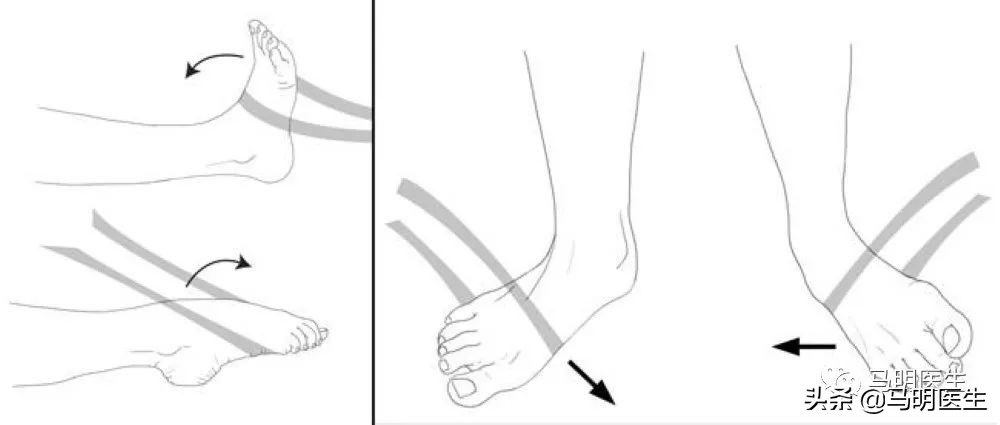
Once you are pain-free, resistance exercises may be added to your therapy program.一旦不再感到疼痛,抗阻训练会加入到治疗计划中。
物理治疗。康复运动是用来防止僵硬,增加脚踝力量,并防止慢性脚踝问题。
- 早期的运动。为了防止僵硬,医生或物理治疗师会提供运动范围或无阻力控制脚踝运动的锻炼。
- 强化练习。一旦能在不增加疼痛和肿胀的情况下承受体重,加强腿部和脚部前后肌肉和肌腱的锻炼将被加入到治疗计划中。如果在陆地上的力量训练(如抬脚趾)很痛苦的话,可以在水中运动。在容许的情况下增加有抵抗力的运动。
- 本体感觉(平衡)培训。不平衡常常导致反复扭伤和踝关节不稳定。一个很好的平衡练习的例子是,闭上眼睛,用患脚站立,另一只脚抬起。平衡板常用于这一阶段的康复。
- 耐力和敏捷性训练。一旦不再感到疼痛,其他的练习可能会增加,比如敏捷练习。以逐渐变小的8字形步伐跑步对敏捷性、小腿和脚踝力量都有极好的效果。随着时间的推移,平衡能力的提高,目标是增加力量和活动范围。
Surgical Treatment
Surgical treatment for ankle sprains is rare. Surgery is reserved for injuries that fail to respond to nonsurgical treatment, and for patients who experience persistent ankle instability after months of rehabilitation and nonsurgical treatment.
手术治疗
手术治疗踝关节扭伤很少见。手术常用于非手术治疗无效的损伤,以及经过数月的康复和非手术治疗后出现持续性踝关节不稳定的患者。

This x-ray shows extreme instability of the ankle.X光片显示脚踝极度不稳定。
Surgical options may include:
- Arthroscopy. During arthroscopy, your doctor uses a small camera, called an arthroscope, to look inside your ankle joint. Miniature instruments are used to remove any loose fragments of bone or cartilage, or parts of the ligament that may be caught in the joint.
- Reconstruction. Your doctor may be able to repair the torn ligament with stitches or sutures. In some cases, he or she will reconstruct the damaged ligament by replacing it with a tissue graft obtained from other ligaments and/or tendons found in the foot and around the ankle.
Immobilization. There is typically a period of immobilization following surgery for an ankle sprain. Your doctor may apply a cast or protective boot to protect the repaired or reconstructed ligament. Be sure to follow your doctor's instructions about how long to wear the protective device; if you remove it too soon, a simple misstep can re-tear the fixed ligament.
Rehabilitation. Rehabilitation after surgery involves time and attention to restore strength and range of motion so you can return to pre-injury function. The length of time you can expect to spend recovering depends upon the extent of injury and the amount of surgery that was done. Rehabilitation may take from weeks to months.
手术方法包括:
- 关节镜。在关节镜手术中,医生会使用关节镜来检查踝关节内部,微型器械被用来移除任何疏松的骨头或软骨碎片,或可能卡在关节中的部分韧带。
- 重建。医生可能会用缝针或缝合线来修复撕裂的韧带。在某些情况下,会用从脚踝周围的其他韧带和/或肌腱中获得的组织移植物来重建受损的韧带。
固定。踝关节扭伤手术后通常会有一段固定的时间。医生可能会用石膏或保护靴来保护修复或重建的韧带。一定要按照医生的指示戴够保护装置的时间; 如果摘除得太早,一个简单的失误就会再次撕裂固定韧带。
康复。手术后需要时间和精力来恢复力量和活动范围,这样才可能恢复到受伤前的功能。恢复的时间长短取决于受伤的程度和手术的情况。康复可能需要几周到几个月的时间。