哎,多少人把婚姻过成了你死我活、成王败寇、贬低羞辱、嘲讽挑刺、竞争敌对、百般提防、付出一点就觉得吃亏、极尽可能压榨对方以实现个人“最大化预期收益”的零和博弈......
In this season of weddings, it’s good to remember that it’s all downhill from here. After the toasts and conga lines, the All-Clad omelet pans and honeymoon sex begins the real work of living together until you die.
在这一繁忙结婚旺季,想到艰辛战役即将结束,接下来将会一路坦途,会让人心下甚慰。在祝酒、康茄舞、All-Clad煎蛋盘和蜜月*爱性**之后,真正的共同生活任务将会开启,直至你们死亡。
This is doable but challenging. You will hear a lot of advice about compromising and using “I” sentences instead of “you” (as in, “I feel sad when I see that we have no money,” vs. “You are terrible with money and are going to ruin us”). All good advice. But there’s another way to approach spousal negotiations and it’s called game theory.
这是可行的,但却不容易。你会听到很多关于妥协的建议,以及使用“我”而非“你”开头的句子。(比如,“当我看到我们没钱时,我感到很悲伤”,而不是“你简直毫无理财能力,你会毁了我们的。”)这些都是很好的建议,但是,面对配偶之间的协商,还有另外一种方法,即,博弈论。
Game theory is the study of how we make decisions in strategic situations. Classic examples: the Cuban missile crisis (PDF), soccer penalty kicks, and the first scene of The Dark Knight. When you find yourself debating whether to wait for the bus another minute or give up and walk, you’re facing a game-theory dilemma. Same when you’re browsing the profiles on a dating site.
博弈论,研究的是我们在战略情形下如何制定决策。经典例子包括:古巴导弹危机、足球罚球,以及《蝙蝠侠黑暗骑士》的开篇场景。当你发现你自己在纠结于是再等一分钟公交车,还是不等了,索性步行时,你就正处于一个博弈论困境。当你在浏览约会网站上的人员信息时,也同样如此。
At this very moment, Iran, Israel and the U.S. are playing a three-way game of chicken involving cyber warfare and potential nuclear annihilation.
当前,伊朗、以色列和美国正在玩一个三方玩家的胆小鬼博弈,该博弈中涉及到网络战争和潜在的核毁灭。
To see how this relates to an average marriage, replace, for a moment, Ahmadinejad and Obama with Joel and Lisa. And replace Iran’s uranium enrichment facilities with Joel and Lisa’s refrigerator, which has been empty for three days. Husband and wife are in a standoff, neither one backing down. They’ve been ordering in from Gino’s Pizza every night this week, and they’ve never had such indigestion in their lives. But God help Joel if he’s going to go to the supermarket; he’s gone food shopping the last five Saturdays while Lisa played tennis. Lisa’s not going, either—she does everything around the house, including folding Joel’s underwear and paying the bills, which means unless Joel wants to memorize their online banking password and dig his dirty clothes out from under the bed, he’s going to be the one hauling his sorry self to the ShopRite. Lisa can wait. She’s waited this long.
要看这和普通婚姻有和关系,那么,让我们暂时先把艾哈迈迪-内贾德和奥巴马替换成为Joel 和 Lisa。把伊朗的铀浓缩设施替换为 Joel 和 Lisa的冰箱,而且这个冰箱已经接连三天空空如也了。
夫妻二人目前正僵持不下,双方皆不退让。这周,他们一直都在叫 Gino’s Pizza 的披萨外卖,而且都经历了前所未有的消化不良。但 Joel是不会去超市的。过去五个周六,一直是Joel去超市采购食物,而Lisa则一直在打网球。Lisa也不会去。因为家里的大小事情都是她在做。包括叠Joel的*裤内**、支付账单等。也就是说,除非Joel愿意背下来自己的网上银行密码、愿意从床下面把自己的脏衣服刨出来,否则Joel就必须要去ShopRite超市。Lisa可以等,反正都已经等了这么久。
Let’s draw a matrix for this case:
让我们来为这一情形画一个收益矩阵。
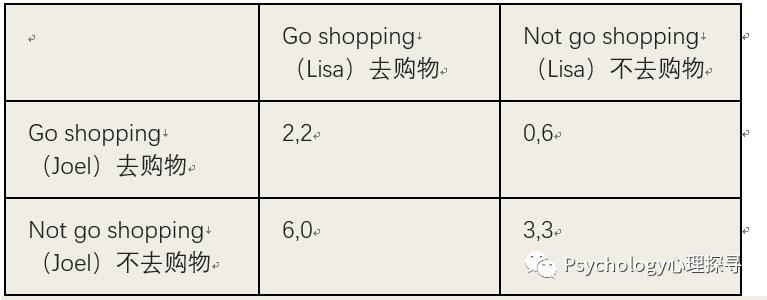
Scoring: 评分机制:
Eat homemade dinner/在家做晚饭 +3
Eat pizza/吃披萨 +1
Go shopping/去购物 -1
Feel unfair/感到不公平 -1
Feel lucky/感到幸运 +1
Do things you want/做自己想做的事 +2
Columns are Lisa’s strategy and rows are Joel’s strategy
“列”为Lisa的策略;“行”为Joel的策略。In this example, Lisa and Joel both didn’t put themselves in others shoes. Therefore, they both thought they used the strategy of (6,0) and (0,6) but they were actually using the strategy of (3,3) that neither of them going food shopping. In this dilemma, (3,3) is also the best response for them. However, in marriage, this is obviously not the “best result possible”, because they could have a better life if they have homemade dinner everyday.
在这一例子中,Lisa 和 Joel都没有将自己放在对方位置上考虑。因此,他们都认为他们采用的(6,0) 和 (0,6)的策略,但实际上他们却是采用的(3,3)的策略,在这一策略中,两个人都选择不去购物。这一博弈困境中,(3,3)同时也是最佳策略。但是,在婚姻中,这很明显并非“可能最佳的结果”,因为如果他们每天都能在家中吃晚饭,这会对他们的生活质量有益。
Perhaps you’re thinking you guys are more mature than Joel and Lisa, right? You never stand firm, waiting for the other to back down. You don’t guilt each other into calling your parents, or pretend you don’t notice the stack of dishes growing moldy in the sink. You would never, in a million years, treat your spouse like an opponent in an elaborate game of chess in which the winner gets to lie on the couch and watch Mad Men while the loser puts the kids to bed.
可能你在想,你们要比他们两个成熟得多,对吧?你们从来不态度坚决,等待对方退让。你们也不会内疚操纵对方,让对方打电话给你父母,也不会假装没有注意到水槽里面堆叠的碗碟已经开始发霉。你绝对不会像是对待一场复杂棋局中的对手一样去对待自己的配偶,赢家可以懒洋洋躺在沙发上看《广告狂人》,输家则需要负责哄孩子睡觉。
Forgive me if I don’t believe you. What I suspect is more likely is that you and he/she have a little Joel and Lisa in you, and that you’re not above engaging in brinksmanship, or scheming to finally triumph in an ongoing argument, or strategizing to get what you want. I’ll bet you play these games more than you admit, and sometimes, without even realizing you’re doing it.
如果我不相信你,请原谅我。我觉得更可能的情形是:你们身上都有一点“Joel”和“Lisa”的影子;你们也会开展边缘战术,或想方设法在一场持续的争论中获得最终的胜利,或费尽心机谋划以得到自己想要的结果。我打赌,你们玩这些游戏的次数要远远超过你承认的次数,而且有时你甚至都没有意识到你在这样做。
So why not learn to play the game like a pro? Here are a few things game theory and marriage have in common:
那么,为什么不学着像个专业人士一样去玩这些游戏呢?以下是博弈论与婚姻之间的一些相同之处:
–They both require more than one person.–They both involve people who are trying to further their own gains but are limited by the presence of another person.–They both offer the possibility of a “cooperative strategy,” in which two parties work together to come up with a reasonable solution, and a “noncooperative strategy,” where it’s every man for himself.–In both, the noncooperative option is often the most tempting, but could result in death, whereas the cooperative option is annoying, but rarely fatal.
- 二者都需要不止一个玩家(注:博弈分类中其实也包含单人博弈);
- 二者之中的参与者都会试图想要进一步增加自己的收益,但这一收益却因对方存在而受到限制;
- 二者都提供一个“合作型策略”的可能性,即,双方共同提出一个合理的“解”;以及一个“非合作策略”的可能性,即,人人为己。
- 在二者之中,“非合作策略”选项通常是最诱人的,但可能会导致死亡;而“合作性策略”虽然不怎么受欢迎,但却很少产生致命后果。
To cooperate or not to cooperate? To budge or stand your ground? To say “OK, fine” or “not a chance”? These are questions married people find themselves asking with surprising frequency. Ideally, the answer is always cooperate, budge, and say OK. But in practice, when there’s baggage involved and a history together and scars from past relationships, getting to that point takes effort.
合作,还是不合作?退让,还是坚守阵地?说“好吧”,还是“没门儿!”?这些都是已婚人士发现自己经常自问的问题,而且这种问题出现的频率令自己都感到惊讶。理想情形下,答案始终都是合作、退让和说“好吧”。但实际上,当存在着往昔经历,以及过去感情中的伤痕时,选择这些选项,则并非易事。
In a survey of married people my co-author and I conducted for our book, It’s Not You, It’s the Dishes, we posed the open-ended question, “What’s the hardest part about being married?” Sure enough, most of the answers related to cooperating, or, more specifically, to not wanting to cooperate:
在为我们的书籍《并非因为你,而是刷碗》所开展的一项对已婚人士的调查中,我的合著作者与我提出了一个开放式问题:“婚姻中,最艰难的部分是什么?”不出意外,大多数回答都是关于合作,或,更确切地说,不愿意合作。
“Learning to live with another person in the house.”“Having to compromise.”“Different points of view.”“Making myself less of a priority.”“Not always getting my way.”“Agreeing to disagree.”“Seeing eye to eye in raising children.”“Negotiating different goals.”“I can’t do everything I want when I want to.”“Toilet seat.”
“学着与另一个人在一个屋檐下生活。”
“不得不妥协。”
“不同的视角。”
“将自己的优先程度降低。”
“无法总是按照自己的想法做事情。”
“求同存异。”
“在孩子养育方式上达成一致。”
“协商不同目标。”
“无法总是做自己想做的事情。”
“马桶圈”。
The great thing about game theory is that it tackles situations in which you can’t have it all, but you’d like to at least achieve the best results possible. Note those three magic words: best results possible. That’s not the same as “getting what I want” or being “right,” two scenarios most of us would admittedly prefer. But if game theory teaches us anything, it’s that relationships aren’t about having it all, they’re about having all you can under the circumstances. In your marriage, those circumstances include the obvious, though often overlooked, fact that there’s another person involved: your spouse—a spouse who also happens to be after his or her own best results.
博弈论的好处在于,它处理的是你无法全盘皆赢,但却想要至少获得最佳可能结果的情形。注意到这三个神奇的词:最佳 可能 结果。这并不等同于“得到我想要的”,或“我是正确的”,这两个场景是我们大多数人都承认更倾向的。但如果博弈论教给我们任何事情,那就是,“关系”并非是关于成王败寇,而是在特定客观情形下尽可能得到最佳结果。在你的婚姻中,这些客观情形也包括这样一个显而易见却常常被忽略的事实:这个游戏中,还有另外一个玩家存在,即,你的配偶,而且你的配偶也碰巧在追求自己的最佳结果。
As the economist Thomas Schelling says of game theory (and which, I think, is a great definition of marriage): “Two or more individuals have choices to make, preferences regarding the outcomes, and some knowledge of the choices available to each other and of each other’s preferences. The outcome depends on the choices that both of them make ... There is no independently ‘best’ choice that one can make; it depends on what the others do.”
如经济学家 Thomas Schelling对博弈论的解读(而且我也认为这是对婚姻的极佳解读):“两个或以上的个体做出一些选择、对结果都有着各自的偏好、对对方可能做出的选择和偏好有着一定程度的了解。博弈结果取决于双方所做出的选择。一个人单方面无法独立做出一个“最佳”选择,它始终取决于对方的选择。”
With that in mind, here are three strategies game theory offers for improving the outcomes of potential conflicts with your spouse:
基于这一点,当面对婚姻中潜在矛盾,想要获得更佳结果时,以下是从博弈论中可以借鉴的3个策略:
1. Think ahead. How will he react to what I’m about to do or say? And how should that reaction influence my behavior right now?
2. Learn from the past. How did she react the last time I did this? How can I do things differently now to avoid the same outcome?
3. Put yourself in his shoes. This doesn’t mean considering what you would do if you were him, but what he would do if he were him, which he is.
1. 事先思考。对于我将要做的行动和说的话,他会作何反应?这一反应对我的行为将会有怎样的影响?
2. 以往昔为鉴。上次我这样做的时候她是如何反应的?这次我能如何改变做法,以避免跟上次相同的结果?
3. 设身处地从对方角度考虑。这并不是指思考如果你是他,你会怎么做,而是,如果他是他(而且他也的确是他),他会怎么做。
This sounds like such reasonable advice, yet in the heat of the moment, so many of us routinely do the opposite. Getting back to Joel and Lisa and their refrigerator standoff: they’re not even trying to put themselves in each other’s shoes, and they’re forgetting that they’re both super-stubborn. Instead, they’re playing a game of chicken, also known as brinksmanship, with the refrigerator, where the potential outcome is never again eating a home-cooked meal (never mind, hating each other). A noncooperative strategy would ensure that very result. But a cooperative strategy would lead to meatloaf, roast chicken, quinoa salad, romantic dinners, and all sorts of other great stuff that married people can enjoy if they put their minds to it.
这听起来是挺有道理的,但在情绪白热化之时,我们很多人都会习惯性地选择截然相反的做法。再回到 Joel和Lisa的冰箱僵局:他们甚至都没有试图将自己置于对方的角度,而且他们也忘记了他们都超级固执。
关于冰箱,他们开展的是一场“胆小鬼博弈”,也被称为边缘策略。在这一博弈中,潜在的结果就是永远都不会再吃到家里做的饭菜(更不用说,彼此讨厌。)
一个“非合作型策略”会确保这一结果的发生。
但“合作型策略”,则会带来肉饼、烤鸡、藜麦色拉、浪漫晚餐,以及其他任何有心经营婚姻的夫妻会享有的一切美好事物。
That strategy involves changing the rules of the game by devising incentives so both Joel and Lisa are more motivated to cooperate than to have the last word. Let’s say they assign each other specific shopping weeks and put it in their Google calendars. The penalty for defecting—or not shopping when it’s your turn—is controlling the TV all week。
要开展合作型策略,需要改变游戏规则,制定激励因素,让Joel和Lisa更愿意合作,而非一定要一争高下。我们假设,他们向彼此分配了具体的采购周,并标注在各自的谷歌日历中。而对于背叛(即,轮到自己购物却不去购物)的惩罚,则是对方控制电视一周。
Now, a new matrix looks like below:
现在,一个新的收益矩阵如下

Scoring: add penalty for not going shopping -4
评分:加上不去购物的惩罚:-4In this situation, the best response for them would be that both of them going shopping. Actually, the benefit they get from this strategy is even higher. This is because they take turns going food shopping, and both of them still get half of the Saturdays free to do something they want to do while always having ingredients in their fridge.
这一情形下,最佳策略则是两个人都去购物。实际上,他们从这一策略中的收益甚至会更高。因为,当他们轮流采购事物,两个人每周六总是还会有半天的自由支配时间,同时,冰箱里面也总是会有健康食材。
Whatever penalty they choose, it simply has to be more unpleasant than food shopping. Mowing the lawn, changing diapers, Skyping with the Australian relatives, booking plane tickets, making school lunches, programming the coffee maker, cleaning the toilets, weeding, picking up the dry cleaning, sharpening the knives, going to IKEA, changing light bulbs, doing the taxes, saying hi to the neighbor, attending a PTA meeting—these are just a few a things that come to mind. And that’s the beauty of marriage: now there’s someone else to do the chores for you. Mazel tov!
无论他们选择哪种惩罚,都必须要比食物采购更令人生厌。修整草坪、换尿布,和澳大利亚的亲戚视频通话、订机票、做学校午餐、给咖啡机编程序、清理马桶、除草、收衣服、磨刀、去宜家、换灯泡、报税、和邻居打招呼、参加家长会等,目前想到的就这些。二者也是婚姻的美妙之处——现在有另外一个人来为你做这些杂事了。恭喜你!