一、连词
1、连词的含义:连接词与词、短语与短语、或引导从句的虚词叫连词(连接词)。连词在句子中只起连接作用,一般不充当句子成分。如:
Boys and girls,take your seats please!(连接两名词)
He is either in the office or in the classroom.(连接短语)
I like playing tennis, while my brother likes playing football.(连接分句)
She can't go because she is ill.(引导状语从句)
His only condition was that we should keep the place clean.(引导名词性从句)
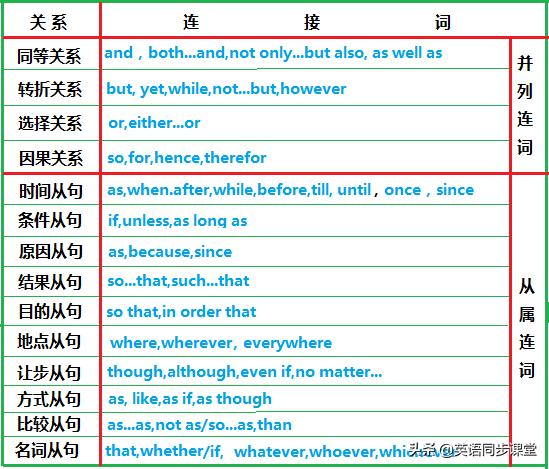
2、连词的分类:连词分为并列连词和从属连词两种。
1、并列连词连接并列的词、短语、从句或句子。常见的并列连接词有:and(和),but(但是),yet(可是),or(或者,否则),nor(也不), so(所以), however(然而,无论如何),for(因为),still(可是),as well as(也),both..and...(...和...), not only ...but also...(不但…而且…), either… or…(或…或…),neither… nor…(既不…也不…)等。
2、从属连接词用于引导从句,常见的从属连接词有:
when(当…时候), while(正当…时候), after(在…之后), before(在…之前), since(自从), until(直到), although/though(虽然), if(假如), as(如…一样;由于), as …as…(和…一样), as far as(就…而言), as long as(只要), as soon as(一…就…), even if(即使), because(因为), unless (除非), than(比…), whether (是否…), in order that…(为了), so…that…(如此…以致), so that…(以便), now that…(现在既然), by the time…(到…时候), every time…(每当), as if…(仿佛),no matter when(或whenever)(无论何时),no matter where(或wherever)(无论在哪里)等。
3、注释
1)某些副词有人称作“连接副词”如:however然而,then而且,再者,therefore因此,thus因此,从而,otherwise否则,要不然,nevertheless然而,beside况且,除此之外;hence因此,所以;moreover而且,也. 不过严格的说,这些词不是连词,而是副词。在口语和书面语中,使用时还是稍有区别的,尤其是用于两句子中间时。如;
We all tried our best; however, we lost the game./We all tried our best. However, we lost the game.我们都已尽了最大的努力,不过我们还是输了。
She 's been very busy at work and then there was all that trouble with her son.
I had a headache;therefore I could not go to your party./I had a headache, and therefore I could not go to your party.我头疼,因此不能去参加你的聚会。
The composition is a not well written,and moreover,there are many spelling mistakes in it.这篇作文写得不好,而且还有许多拼写错误.
I don't like skating; moreover,the ice is too thin.我不喜欢滑冰,而且冰又太薄.
It is very late; hence you must go to bed.时间已经很晚了,因此你必须睡觉去。
He sold his farm and thus he had enough money for his journey./He sold his farm. Thus,he had enough money for his journey.他卖掉了农场,这样他就有足够的钱旅行了。
I don't really want to go .Besides, it's too late.我并不真的想去,而且现在太晚了。
一般来说,这些词要么作为插入语,用逗号隔开,此时前后两句作为单独的句子,中间用句号或分号。要么与and连用,前后两句作为一个完整的句子,两分句中间用逗号。
2)关于各个连词的具体用法后面并列句和复合句专题还会作详细的介绍。
4、词语辨析
(1) because、as、since、for 的用法: because (因为)表示原因的语气最强,常表示必然的因果关系,从句一般放在主句后面;另外,回答 why 的问句只能用 because . as (因为)表示一般的因果关系,语气比 because 弱,说明比较明显的原因,它引导的从句可以放在句首也可以放在句尾。 since (既然)表示对方已经知道、无需加以说明的原因或事实。 for (因为)是并列连词,语气较弱,用来补充说明理由或提供一种解释。如:He is not at school today because he is seriously ill.(他今天没有上学因为他病得厉害)/ As all of you have got here, now, let’s go to the zoo.(既然大伙儿都到了我们就去动物园吧)/ I will ask Lin Tao to go with me since you are very busy.(既然你很忙我就叫林涛和我一起去吧)/ We must be off now for the match starts at 7:00.(我们得走了因为比赛在七点开始)
(2) if、whether 的区别:表示“是否”时, if 和 whether 同义,引导宾语从句,另外, whether 还可以引导主语从句、表语从句(以及同位语从句)等名词性从句或者让步状语从句;而if还可以表示“如果”,引导条件状语从句,(主句与从句遵循主将从现的原则)。如:I don’t know if/whether he will arrive on time.(我不知道他是不是会按时到达)/ I will ring you up if he arrives on time.(如果他按时到达我会给你打电话的)
[注意]下列情况只能用 whether 不能用 if :①引导主语从句,②引导表语从句,③引导从句作介词宾语,④引导不定式短语,⑤引导让步状语从句,⑥在动词 discuss 之后,⑦在 wonder / not sure 之后,⑧在 if 与 whether 含义易混时。如: Whether it is a fine day next Sunday is still a question.(下个星期天是不是个好天还是个问题)(引导主语从句) / Please ask him whether to go there with a raincoat or not.(请问一下带不带雨衣去那儿)(作动词的宾语) / Hainan is the place to be, whether it’s summer or winter.(海南是个该去的地方无论冬夏)(引导让步状语从句)/ Please let me know whether you need my help.(请告诉我你是否需要我的帮助)(引导宾语从句)(如果换成if则还可能表示“如果你需要我的帮助请告知”)
(3) while、when、as 的用法区别: while 常表示一个较长的动作,它引导的从句动作与主句的动作是同时发生的、是平行的; when 可以表示较短的动作也可以表示较长的动作,主句和从句的动作可以同时发生也可以先后发生; as 与上两词同义,可替换 while 和 when , 表示主句和从句的动作同时发生,常译为“一边……一边……”。如:Please do not trouble me while I am writing my homework.(我写作业时请不要打扰我)/ I’ll go home when I have finished my job.(我干完了活儿就回去)/ They were running quickly across the road when they heard the sound of a truck coming.(他们正快速地穿过马路忽然听到了卡车开来的声音)/ As we walked in the dark street, we sang songs and talked loudly.(当我们在黑洞洞的街上走路时我们高声地唱歌说话)
(4) till/until 与 not…till/until 的区别:前者表示一个延续性的动作,后者表示一个才开始的动作。如:I will stay here and watch the baby until you return.(我会呆在这里看着娃娃直到你回来)(stay这个动作一直进行到你return) / They won’t go on working until they get what they think is reasonable .(他们要到获得了他们认为合理的东西时才会继续干下去的)
另外 till 与 until 基本可以互换,但是在句首时只能用 until ,不能用 till . 如: Until the last minute of the match we kept playing.(我们坚持到比赛的最后一分钟)/ Not until he had finished his work did he go home.(直到做完工作他才回家)(倒装句)
(5) though 与 although 的区别:两个词都表示“虽然”,均不可以与 but 同时使用,但在句中可加 still 或 yet 连用。 although “尽管、虽然”仅作连词,比较正式,一般可以换为 though ; though “虽然、尽管、即使”,还可以与 even 连用(= even if ),表示“即使、纵然”,作副词时意思是“然而、不过”,不能放在句首。如:He passed the exams although illness prevented him from going to classes.(尽管疾病使他无法上课但是他还是通过了考试)/ she won’t leave the TV set,even though her husband is waiting for her for the supper.(她不愿离开电视机虽然丈夫在等她吃饭)/ It was a quiet party. I had a good time, though .(这是个不热闹的聚会尽管如此我还是玩得很开心)
(6) prefer to…rather than… 与 prefer…to… 的区别: prefer to…rather than… 后面都是用动词原形, prefer…to… 都是用动名词或名词。如:I prefer English to Japanese.(与日语相比我更喜欢英语)/ I prefer to learn English rather than learn Japanese. (与日语相比我更喜欢学英语)
二、感叹词
1.意义:表示说话时的喜怒哀乐等情绪的词,感叹词不充当句子成分,但在意义上与句子有关联,而且后面的句子往往是说明产生这种情绪的原因。感叹词后面可用逗号或感叹号,但语气较强时,多用感叹号。如:
Wow! What a big cake!哇,好大一个蛋糕啊!
Oh,dear! What a terrible cough!天哪,你咳嗽的很厉害呀!
常见感叹词有:

2.用法:一些最常用的感叹词用法。
1)oh,表示惊讶,兴趣,悲伤,痛苦,懊恼等。如:Oh,yes,he likes rock music.(兴趣)哦,对了,他喜欢摇滚乐。/Oh, I'm sorry.(悲伤)/Oh, please don't ask me any more.(痛苦)/Oh, it's you.(惊讶)
2)wow,表示惊讶,兴奋如:Wow! That's a big score.(惊讶)哇,比分差距好大呀。Wow! That sounds really cool.(兴奋)哇,听起来好酷啊。
3)hi,hey,hello表示打招呼或问候。如;Hi, Li Lei, Good morning!(打招呼)/Hey,stop!(唤起注意)/Hello, nice to meet you.(打招呼)你好,见到你很高兴。
4)ah 表示惊喜,欢喜,后悔,怜悯,要求等。如; Ah, here is the thing I'm looking for.(喜悦)啊,这正是我要找的东西。/Ah, how beautiful!(赞赏)啊,真美。/Ah, how pitiful!(怜悯)唉,好可怜!
5)aha表示惊喜,满意,嘲弄等。如:Aha, now I guess right.(得意)哈哈,我猜对了吧。
6)well表示迟疑,同意,欣慰,惊异以及重开话题。如; Well,I'm not sure yet.(迟疑)嗯.....,我还定不下来。/well, here comes the bus.(快慰) 好了,公车总算来了。/well, what's the problem?(转移话题)哎,有什么问题吗?
7)ouch/ow表示疼痛,不满。如:Ouch,My tooth still hurts.(疼痛)哎呦,我的雅还疼呢。/Ouch,What are you doing?(不满)艾玛,你干什么?
8)why表示惊奇或不足为奇。如:Why, you are ahead of time too!(惊奇)怎么,你也提前完成了。/----Could I use you bathroom? 可以用下浴盆吗?----Why, of course. You don't need to ask.(不足为奇)当然可以,这还用问!
9)come表示鼓励,劝导,命令,指责,不耐烦等。如:Come,speak out, don't be afraid.(鼓励)大胆说出来吧,不用害怕。/Come, come,Alice. you must be patient.好了,爱丽丝,你得忍耐点。
10)oh dear, dear me, my goodness表示惊异,难过,痛苦,不耐烦等,如:Oh dear,what shall I do?(难过)哎呀,我该怎么办呢?/Oh dear,I can't sleep at all.(痛苦)天哪,我怎么也睡不着。/Dear me, I didn't know you are so clever!(惊异)哎呦,没想到你这么聪明。/ My goodness! How could you do that!(惊异)我的天哪,你怎么能那样做呢!