Although many neurotransmitter/ neuromodulator agonists and antagonists have been investigated for their ability to control eye growth, very few laboratory discoveries have been translated into clinical therapies. The most widely used pharmaceutical agent, atropine, was championed almost 40 years ago by Bedrossian and subsequently became the subject of numerous clinical trials and scientific scrutiny. In 2006, Chua et al. published the results of the Atropine in the Treatment Of Myopia (ATOM) study. This was a two-year, comprehensive, randomized, placebo-controlled, double-blind trial of 346 Asian children to determine the effectiveness and safety of daily 1% atropine eye drops for the prevention of myopia progression. ATOM was significant in that it was one of the first clinical trials with double-blind and placebo-controlled groups, which provided a much more objective measurement of the effects of atropine for human myopia. The outcomes revealed that atropine significantly reduced the mean progression of myopic refractive error: 84% of placebo- treated children experienced myopic progression of -0.5 D or more, while only 34% of atropine-treated children experienced the same (Figure1). No serious adverse effects were reported, but the common side-effects – photophobia, glare, allergic reaction, and headaches caused by blurred vision. In addition, a subset of children experienced a “rebound effect”, in which myopia returned and progressed much more rapidly after atropine-treatment had ceased . Chia et al. repeated the ATOM study (ATOM2), using lower concentrations of atropine (0.5%, 0.1%, and 0.01%) for two years, and found that the drug retained most of its efficacy at these lower concentrations. The “rebound effect” was also still present in the higher-concentration treatment groups (0.5% and 0.1%).
虽然许多神经递质/神经调节激动剂和拮抗剂已被证实其控制眼球生长的作用,但很少有转化为临床治疗的。最广泛使用的药物是阿托品,在40年前被Bedrossian提出,随后成为无数临床试验和科学研究的对象。2006年,Chua等发表了阿托品治疗近视(ATOM)的研究结果,这是一项为期两年的综合、随机、安慰剂对照、双盲试验,对346名亚洲儿童进行的研究,以确定每日1%阿托品滴眼液预防近视进展的有效性和安全性。ATOM的重要意义在于,它是第一批使用双盲和安慰剂对照的临床试验,为阿托品治疗近视的效果提供了客观的依据。结果显示,阿托品显著降低了近视的进展: 接受安慰剂治疗的儿童近视进展-0.5 D以上为84%,而接受阿托品治疗的儿童近视进展-0.5 D以上的为34%(图1)。常见的副作用:畏光,眩光,过敏反应,和由视力模糊引起的头痛,没有严重的副作用报告。此外,有一部分儿童经历了“反弹效应”,即阿托品治疗停止后,近视复发和进展更快。Chia等人重复了ATOM研究(ATOM2),使用较低浓度的阿托品(0.5%、0.1%和0.01%)2年,发现该药物在较低浓度下仍保留了大部分疗效,但高浓度组(0.5%和0.1%)也存在“反弹效应”。
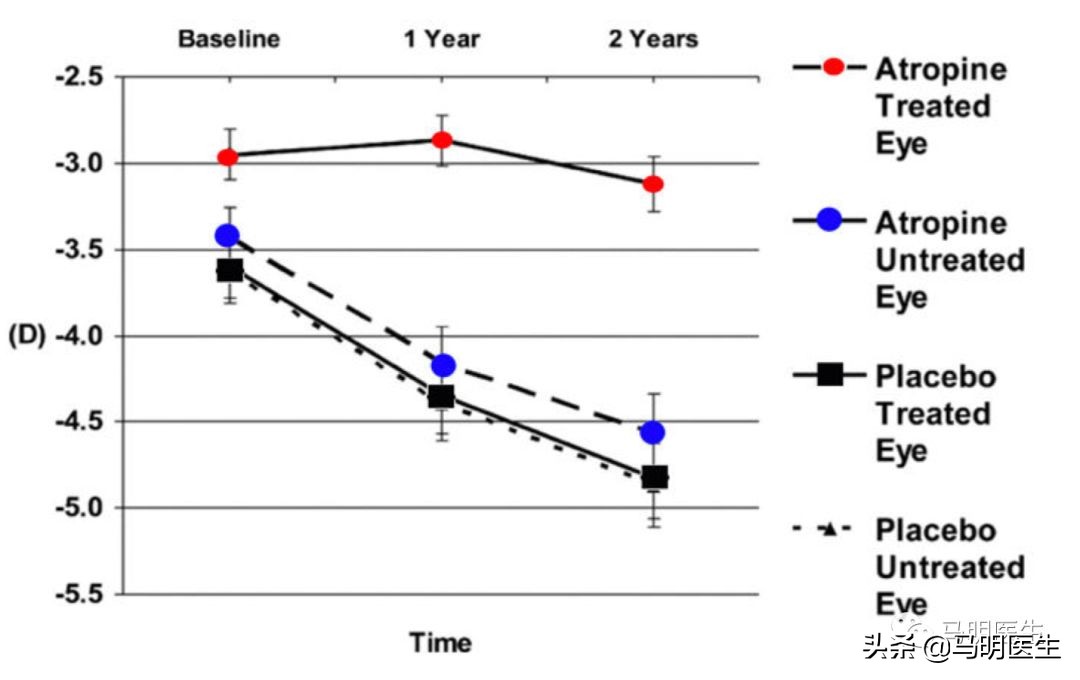
Figure 1. The effect of 1% atropine and placebo on the progression of myopic refractive error in children over the course of two years. Reproduced from Chua, W. H. et al.
图1. 两年时间,1%阿托品和安慰剂对儿童近视进展的影响。 转自Chua,W. H.等。
In an attempt to address the rebound effect, the study was repeated, but with a different treatment schedule. Children were treated with 0.5%, 0.1%, or 0.01% atropine for two years, and then treatment was discontinued for one year to see whether rebound would occur. Treatment was restarted only in children who experienced myopic progression of -0.50 diopters or more in at least one eye, and then continued for another two years.
为了解决反弹的影响,采用不同的治疗方案重复了该研究。用0.5%,0.1%或0.01%的阿托品治疗儿童两年,然后停止治疗一年,看是否会发生反弹。在至少有一只眼的近视进展达到-0.50D以上的儿童中重新开始治疗,再继续治疗两年。
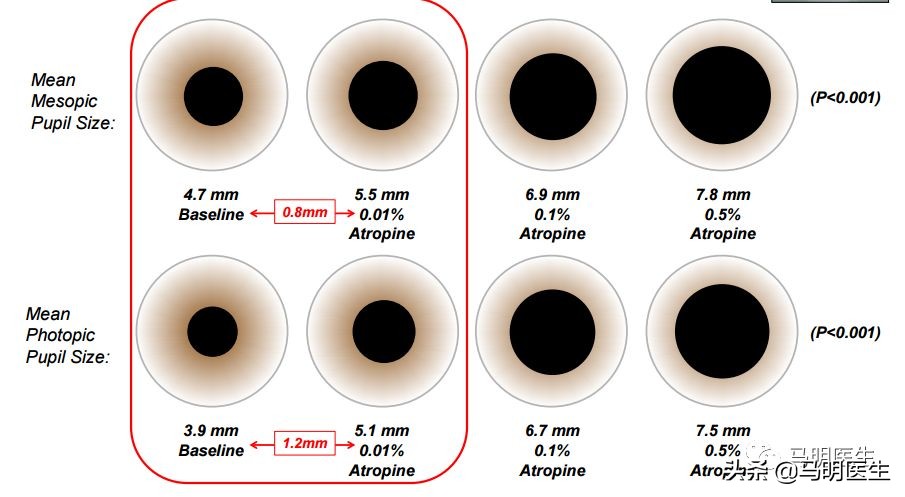
It was found that there was an inverse dose-related increase in myopia by the end of phase 2 (period with no treatment – ‘wash-out’) caused by rebound, resulting in the greatest effect of the 0.01% treatment group. Children requiring a second round of atropine-treatment were 24%, 59%, and 68% for the 0.01%, 0.1%, and 0.5% groups, respectively. Results from the second round of treatment confirmed that the most effectiveconcentration of atropine was 0.01%; children treated with 0.01% atropine had the least rebound during the wash-out period, but still experienced significant inhibition of myopia-progression during treatment (Figure 2).Side-effects for the 0.01%-treatment group were mild – only minimal pupillary dilation, minimal loss of accommodation, and no significant loss of near-vision – compared with those at the higher concentrations.
研究发现,由引起反弹到第2期末(没有治疗的–“洗脱期”)的近视与剂量呈反向增加,0.01%治疗组的效果最大。对于0.01%,0.1%和0.5%的组,需要第二轮阿托品治疗的儿童分别为24%,59%和68%。第二轮治疗的结果证实,最有效的阿托品浓度为0.01%。 0.01%阿托品治疗的儿童在洗脱期间反弹最少,治疗过程中对近视有明显抑制(图2)。与高浓度组相比,0.01%治疗组的副作用轻微——只有轻微的瞳孔扩张、调节欠佳,没有明显的近视力损失。
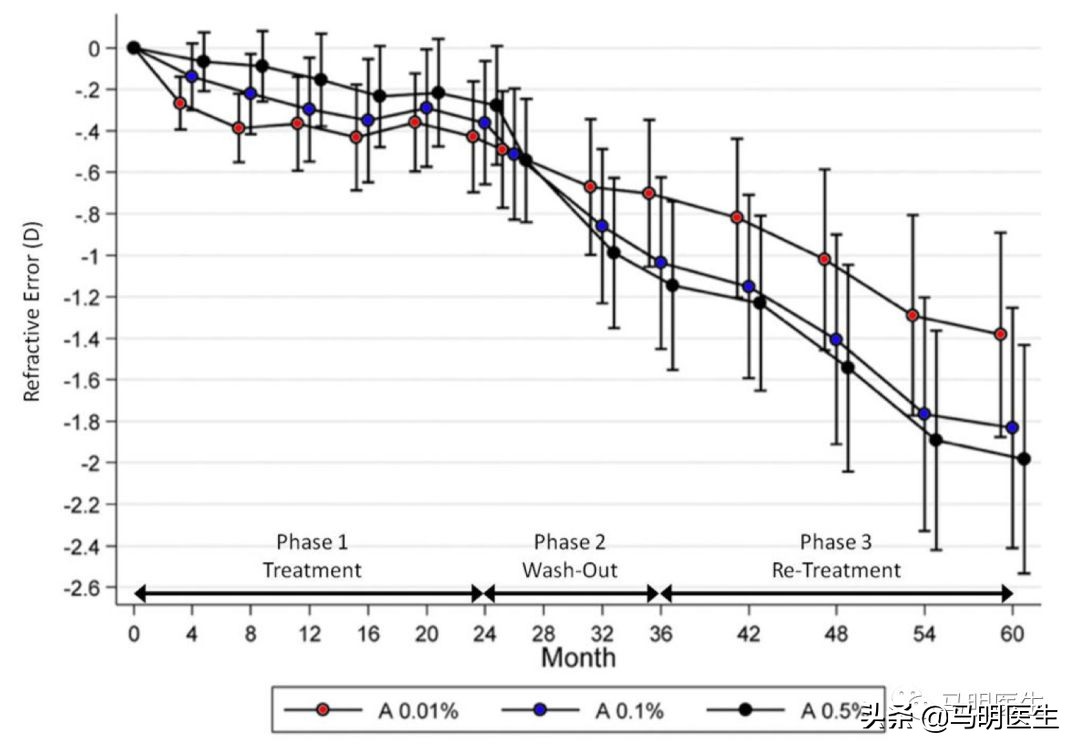
Figure 2. Mean change in refractive error over time within different treatment groups (atropine 0.01%, 0.1%, and 0.5%). Error bars represent 1 standard deviation. Reproduced from Chia, A., Lu, Q. S. & Tan, D. (2016).
图2。不同治疗组屈光不正随时间的平均变化(阿托品分别为0.01%、0.1%和0.5%)。误差条表示1个标准差。转载自Chia, A。Lu, Q. S. & Tan, D.(2016)