“Osborn”波是什么?是不是有点懵?
那么它的另一个名字“J波”是不是就熟悉啦?
² 那什么是J波呢?(心电图参考本文最后一幅图)
J波是指QRS综合波结束和ST段起始的结合点(J点)抬高≥0.1mV,时程≥20ms,圆顶样或驼峰样向上偏离基线的波,是整体心室肌除极结束和复极开始的一个标志点,被广泛接受的形成机制是心室提前复极引起。
于1938年在冻伤患者心电图中被首次发现,被称为电流损伤波。
² 什么情况下会出现J波?
生理性J波:检出率为2.5%~18.2%
病理性J波:
低温
高钙血症
急性心肌梗死
脑外伤
急性心包炎
甚至与猝死密切相关
下面这篇文章对J波描述的比较详细,可以百度搜索,查看原文。

再来看一篇最新的文献,在线发表在anesthesiology上的一篇病例报道吧。
译文:
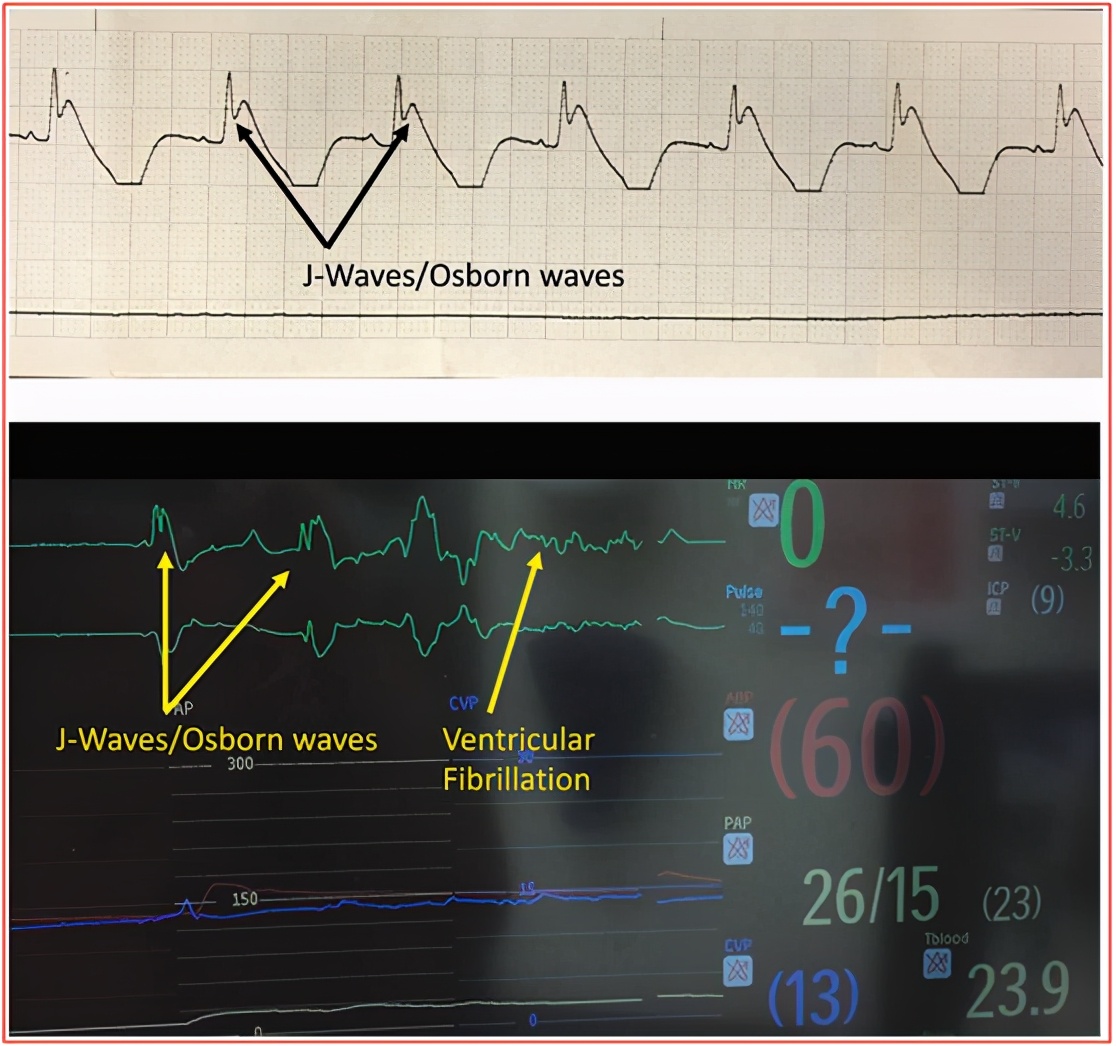
一位65岁女性接受主动脉夹层修补术,在24°C时出现上述心电图。J波或Osborn波(心电图导联II,速度25 mm/s)是发生在J点或QRS波群与ST段交界处的心电图异常正偏移。
在体温过低(通常低于32℃)、蛛网膜下腔出血、血管痉挛性心绞痛和Brugada综合征的患者中可以观察到J点升高。
波幅与低温的严重程度相关,低温延长了复极,导致第2期折返和心室纤颤的可能性。
Osborn波代表心外膜和心内膜钾通道电流差异引起的心电图改变。
在护理体温过低的患者时,无论是作为治疗辅助手段,如心脏骤停、心脏手术后的目标体温管理,还是由于意外环境暴露,心电图都提供了有关体温过低严重程度和影响的重要信息。
如前所述,Osborn波可能并不预示恶性室性心律失常即将发生,其存在可能与心脏骤停后更有利的结局有关。
对于孤立的Osborn波,复温或避免低温足以解决心电图问题。
恶性室性心律失常的治疗需要及时进行心脏除颤。快速复温(高于32°C,可能包括使用积极的措施,如体外循环)是除颤成功最常需要的。
原文为
A 65-yr-old woman undergoing repair of an aortic dissection developed the above electrocardiogram at 24°C. J waves, or Osborn waves (electrocardiogram lead II, speed 25 mm/s), are abnormal positive deflections of the electrocardiogram that occur at the J point or the junction between the QRS complex and the ST segment. J-point elevations may be observed in patients with hypothermia (generally less than 32°C), subarachnoid hemorrhage, vasospastic angina, and Brugada Syndrome.1 The wave amplitude correlates to the severity of the hypothermia, which prolongs repolarization leading to phase 2 reentry and the potential for ventricular fibrillation. Osborn waves represent the electrocardiographic changes created by the differences between epicardial and endocardial potassium channel currents. Supplemental Digital Content (http://links.lww.com/ALN/C540; electrocardiogram lead II, speed 25 mm/s) demonstrates Osborn waves and development of ventricular fibrillation.
When caring for patients with hypothermia, whether used as a therapeutic adjunct such as for targeted temperature management after cardiac arrest, cardiac surgery, or owing to accidental environmental exposure, the electrocardiogram provides important information regarding the severity and effects of hypothermia. As was previously thought, Osborn waves may not portend the imminent development of malignant ventricular arrhythmias, and their presence may be associated with a more favorable outcome after cardiac arrest.2,3 In the case of isolated Osborn waves, rewarming or avoidance of hypothermia is sufficient for the resolution of the electrocardiogram. Treatment of malignant ventricular arrhythmias requires prompt cardiac defibrillation. Rapid rewarming (to greater than 32°C and which may include the use of aggressive measures such as cardiopulmonary bypass) is most often required for defibrillation to be successful.