老年患者术后认知功能障碍的发生率较高,危害大,国内外都展开了大量的研究。但到目前为止,仍然有很多未知需要在以后的研究中探索,那么目前这方面的研究现状如何呢?让我们一起看一下这篇发表在Turk J Anaesthesiol Reanim. 2019 Dec;47(6):439-447. 的综述。
摘要译文
老年人术后认知功能障碍的研究现状
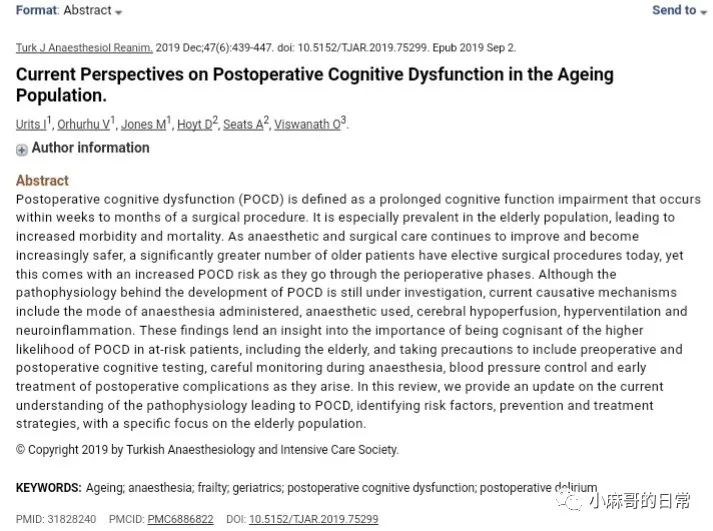
术后认知功能障碍(POCD)是指手术后数周至数月内发生的一种长期认知功能障碍。它在老年人*特中**别普遍,导致发病率和死亡率增加。随着麻醉和外科护理的不断改善和越来越安全,如今有越来越多的老年患者进行择期外科手术,但随着他们经历围手术期,POCD的风险也在增加。POCD的病理生理学研究仍在进行中,目前研究认为POCD的主要可能的发病机制包括麻醉方式、麻醉剂的使用、脑灌注不足、过度通气和神经炎症。这些发现揭示了认识到易发生POCD的高危患者(包括老年人)的重要性,并采取预防措施,包括术前和术后认知测试、麻醉期间的仔细监测,血压控制和术后并发症的早期治疗。在这篇综述中,我们提供了对导致POCD的病理生理学的最新了解,特别是针对老年人群确定其危险因素,预防和治疗策略。
关键词:
衰老;麻醉;虚弱;老年医学;术后认知功能障碍;术后谵妄
原文摘要
Current Perspectives on Postoperative Cognitive Dysfunction in the Ageing Population.
Postoperative cognitive dysfunction (POCD) is defined as a prolonged cognitive function impairment that occurs within weeks to months of a surgical procedure. It is especially prevalent in the elderly population, leading to increased morbidity and mortality. As anaesthetic and surgical care continues to improve and become increasingly safer, a significantly greater number of older patients have elective surgical procedures today, yet this comes with an increased POCD risk as they go through the perioperative phases. Although the pathophysiology behind the development of POCD is still under investigation, current causative mechanisms include the mode of anaesthesia administered, anaesthetic used, cerebral hypoperfusion, hyperventilation and neuroinflammation. These findings lend an insight into the importance of being cognisant of the higher likelihood of POCD in at-risk patients, including the elderly, and taking precautions to include preoperative and postoperative cognitive testing, careful monitoring during anaesthesia, blood pressure control and early treatment of postoperative complications as they arise. In this review, we provide an update on the current understanding of the pathophysiology leading to POCD, identifying risk factors, prevention and treatment strategies, with a specific focus on the elderly population.
KEYWORDS:
Ageing; anaesthesia; frailty; geriatrics; postoperative cognitive dysfunction; postoperative delirium