礼器,是古代中国贵族在举行祭祀、宴飨、征伐及丧葬等礼仪活动中使用的器物。用来表明使用者的身份、等级与权力。礼器是在原始社会晚期随着氏族贵族的出现而产生的 。如在山西襄汾陶寺遗址的龙山文化大墓中,出土有彩绘龙盘及鼍鼓,在良渚文化的一些大墓中,出土有玉琮、玉璧等。进入商周社会后,礼器有了很大的发展,成为“礼治”的象征,用以调节王权内部的秩序,从而维护社会稳定。这时的礼器包括玉器、青铜器及服饰。玉礼器有璧、琮、圭、璋等。青铜礼器种类数量众多,工艺精美,最为重要,种类有食器(如煮肉盛肉的鼎、盛饭的簋)、酒器(如饮酒器爵,盛酒器尊、壶)、水器(如盥洗器盘、匜)、乐器(如钟、铙)和杂器(罐、箕形器、方形器)。进入秦汉社会后期,*会混社**乱,礼崩乐坏,礼仪文明难以为继,从而使青铜礼器逐渐淡出了历史舞台。
藏品介绍
中文名称:玉钺礼器
英文名称:Jade tomahawk sacrificial vessel
类别:玉器(和田青玉)
规格:一件
品相:美品
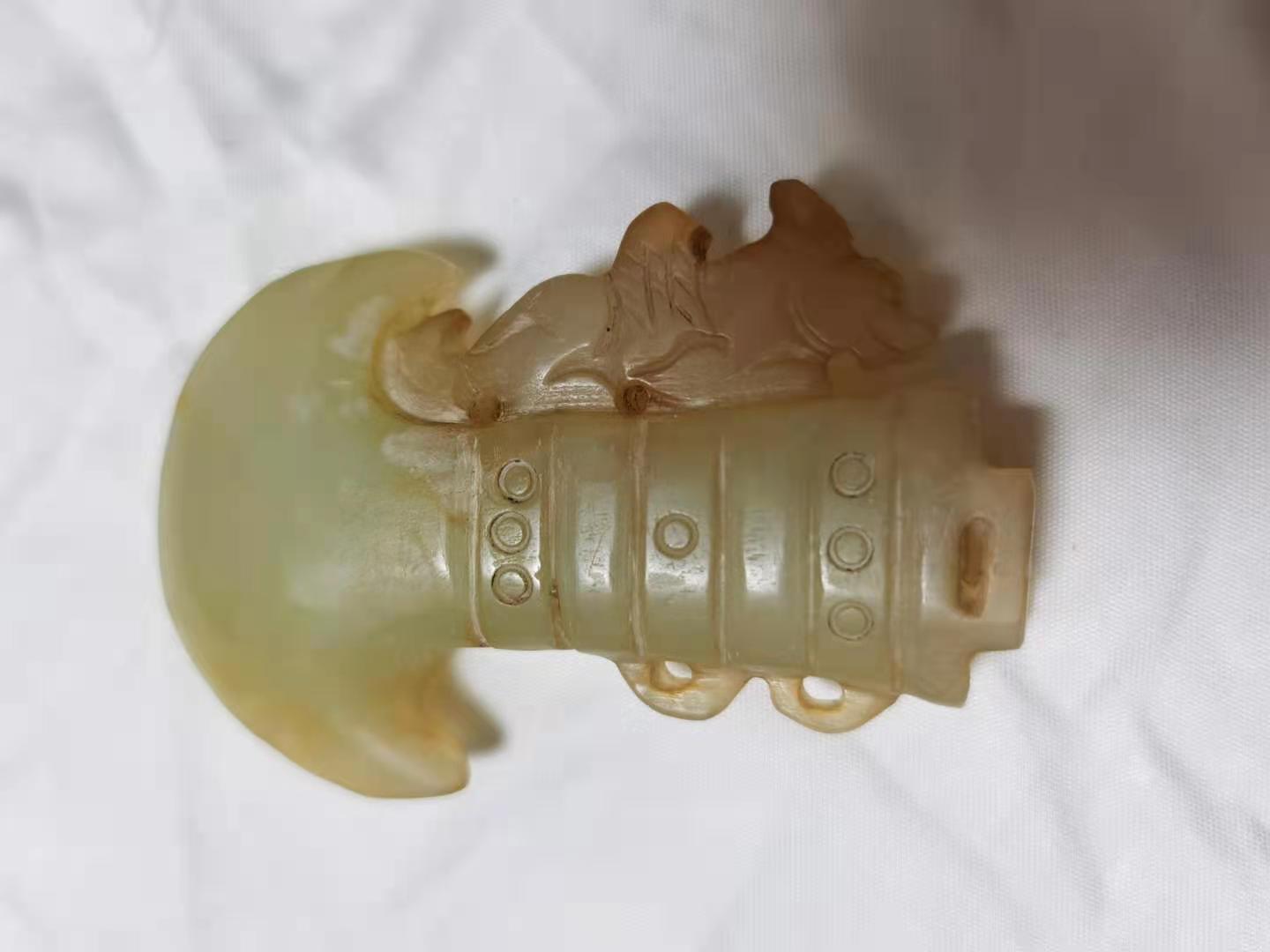
在玉器礼器中不仅仅只有玉璧玉琮一类,还有玉剑玉钺,这类兵器类礼器。
在中国上古时期,钺作为一种礼仪用器,用以象征军事统帅权。据《史记·殷本纪》记载,商纣王封周文王为西伯,赐他“弓矢斧钺,使得征伐”。又如《史记·周本纪》在描绘周武王指挥牧野之战时,“左杖黄钺,右秉白旄以麾”。钺作为军事统帅权的象征,在出土材料中也得到佐证。
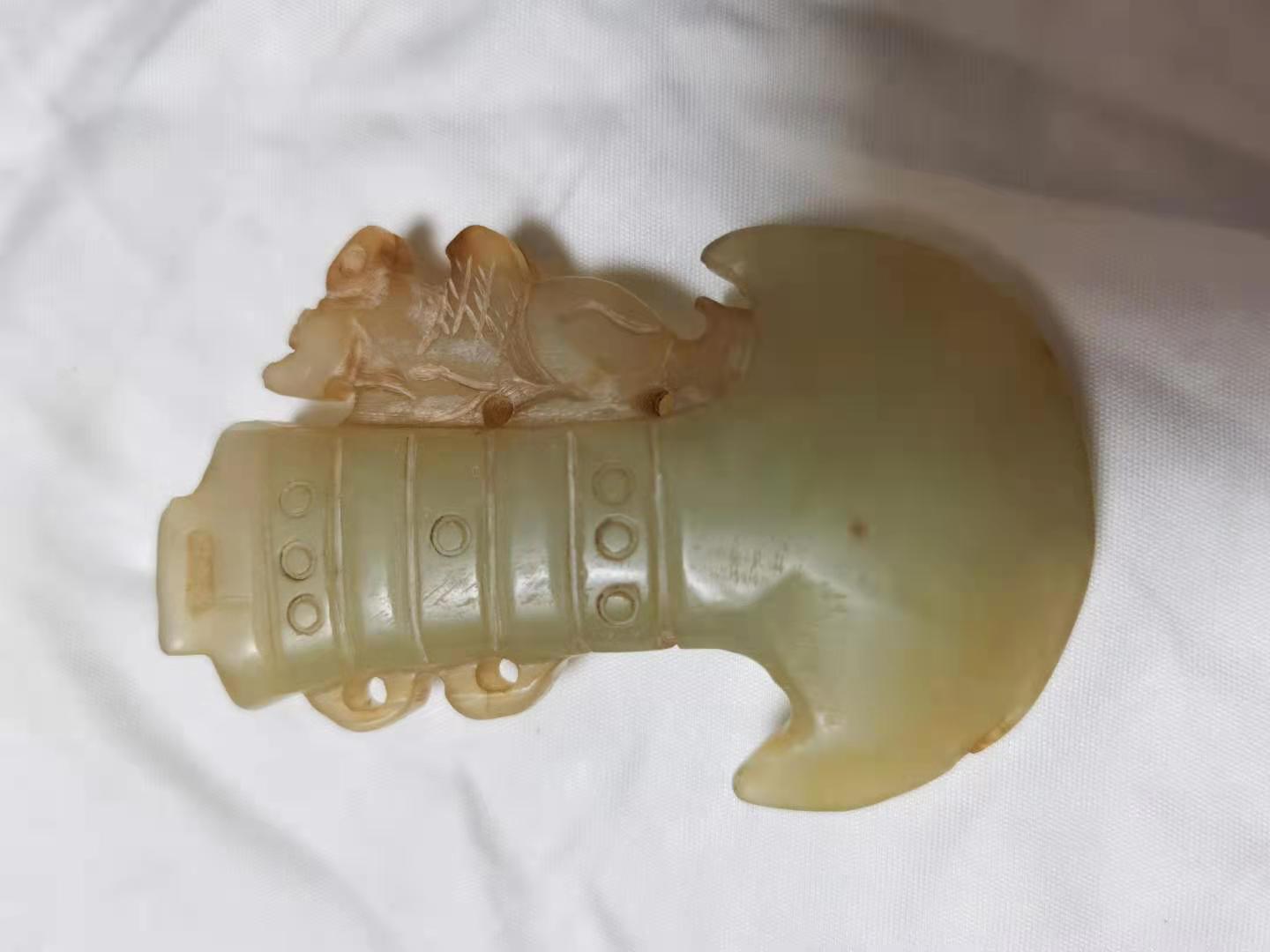
玉钺是对短兵相接时近身搏杀*器武**石钺的玉礼化,一向被认为是“以玉为兵”军事指挥权的象征。太湖流域最早的玉钺出现在距今6000年左右的崧泽文化早期,良渚文化时期,经过长期演变的玉钺遂与新贵的玉琮、玉璧一起,成为最重要的玉礼器。
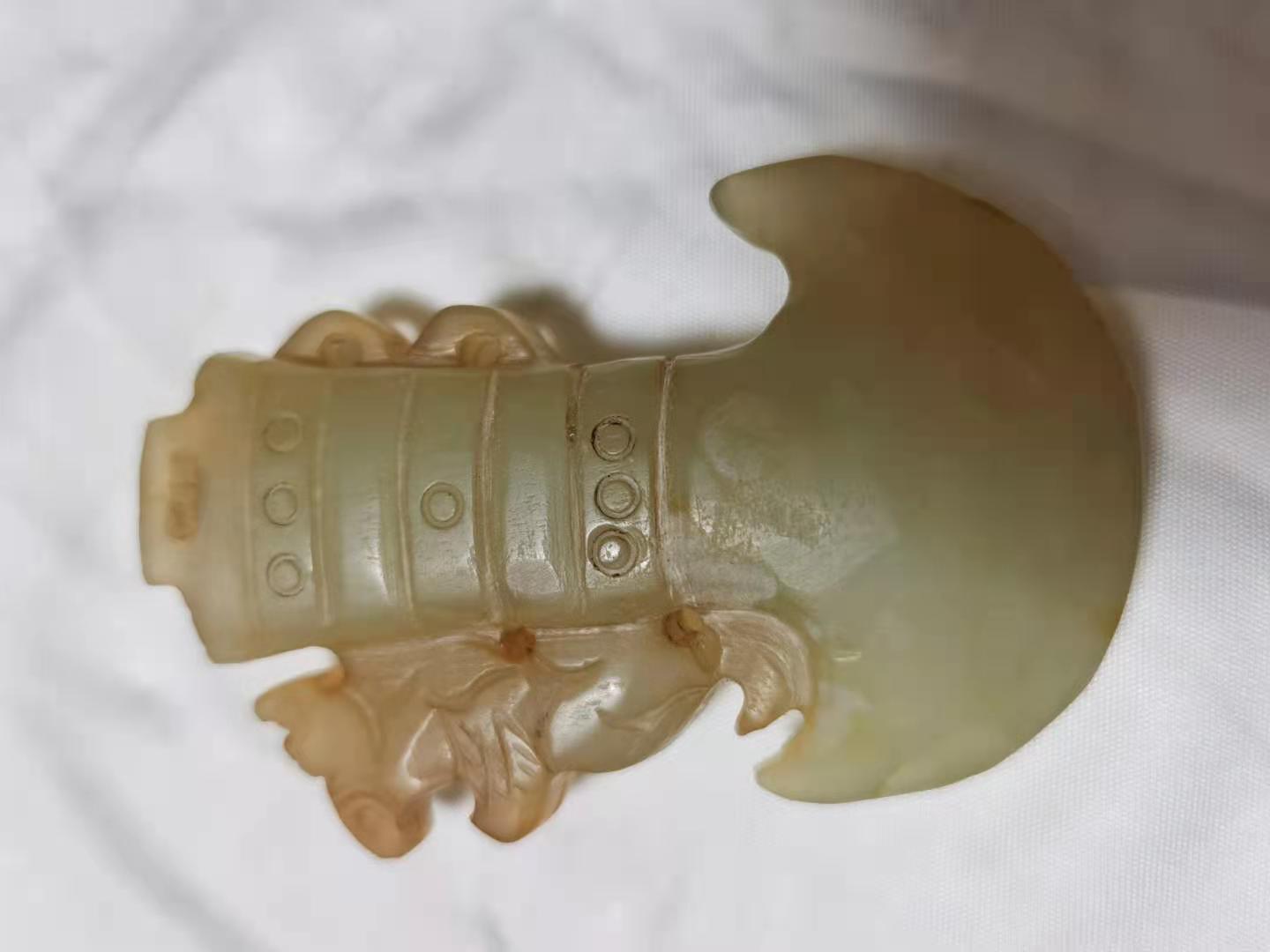
这把玉钺相对与良渚文化时期的玉钺工艺更复杂,纹饰更精美,从这虎纹身上的刻痕可以看出来属于汉八刀工艺,符合汉代时期的风格。
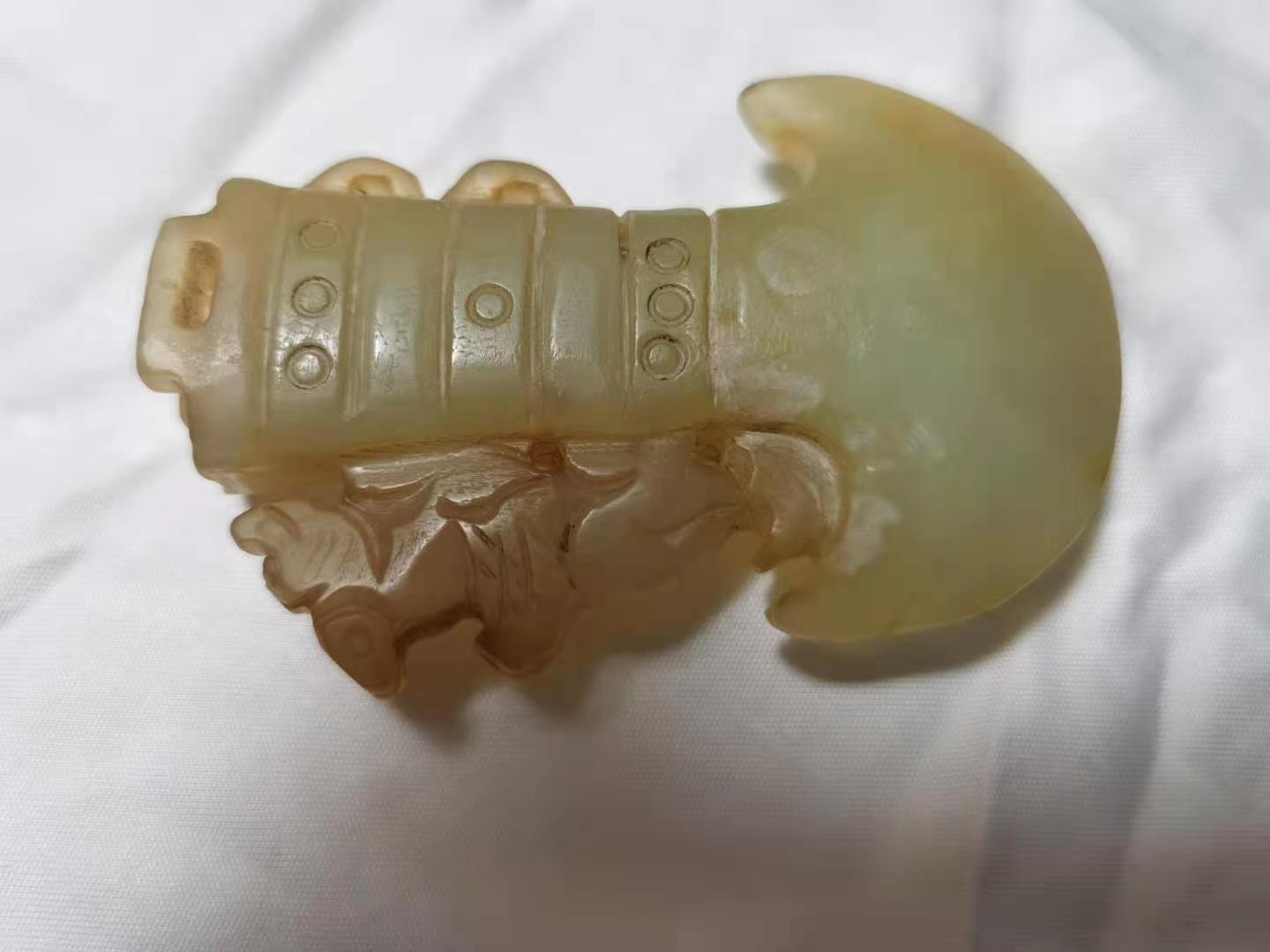
玉钺象征着军权,故而雕刻虎纹以示权威,在古代老虎就象征着勇士,一般由将军佩戴,就有了虎父无犬子,也出了虎符这类军事之物,而此虎背上还披着类似于鞍的披甲,更显其神威。
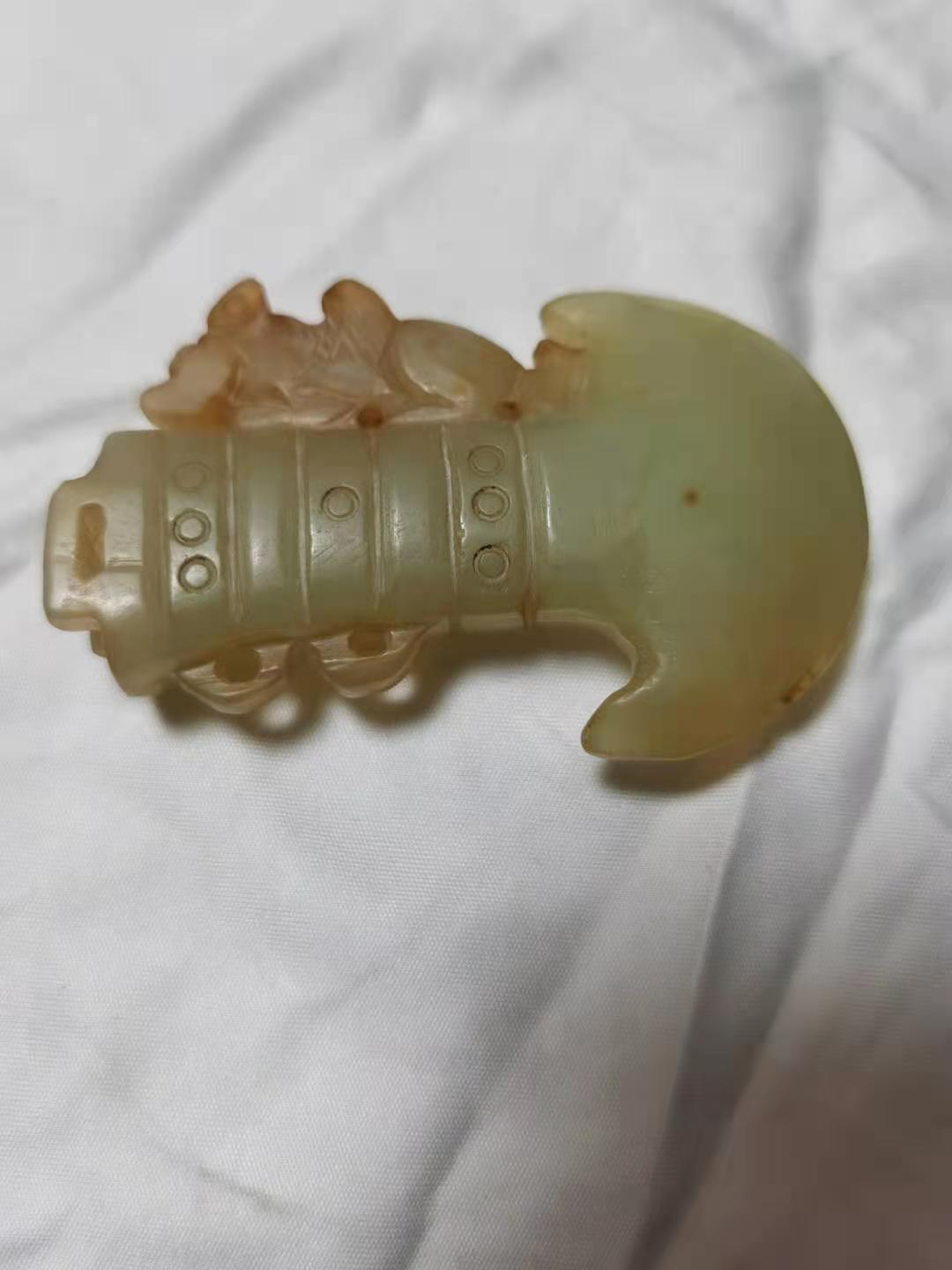
光泽是玉石对光反射的能力。和田玉光泽属油脂光泽,这种光泽很柔和,不强也是不弱,即没有强光的晶灵感,也没有弱光的蜡质感。古人称和田玉“温润而泽”,就是它的光泽带有很旨的油脂性,给人以滋润的感觉。
透明度是玉石允许可见光透过的程度,主要与玉石对光的吸收强弱有关,矿物学上一般分为透明、半透明、不透明3种。鉴定透明度要把玉磨光,在一定厚度下看透视其它物体情况,分透明体、半透明体、微透明体、非透明体等4个级别。和田玉属于微透明体,在一般进取度下,能透过光,但看不清透过物像。
一般来讲透明度高的也叫作水头足,虽然水头足可以烘托玉石的质地、颜色,但并非所有透明度高的就是好玉。和田玉在一般厚度下就属于半透明—微透明体,虽然能够透过光线,但看不清物体。这种透明度增强了和田玉光泽的温润之感,故而和田玉器在雕刻时不宜琢制太薄。
这对件玉钺无论是光泽还是透明度都已经达到了巅峰,润感十足,汉八刀工艺,年代久远,由于其权威性的用途,注定其存世量稀少。
和田玉具有不可再生性和稀缺性,政府早已经封矿,就连*疆新**本地也没有和田玉出售了,拿的都是外来的,韩料俄罗斯料,正宗的*疆新**和田玉已经非常罕见了,随着需求越来越旺,供给越来越少,价格走势不言自明。新闻媒体早就报道过和田玉,疯狂的石头十年涨幅千倍,导致越来越多的收藏者关注和田玉,正所谓黄金有价玉无价,就连皇上的玉玺都是和田玉所制成的,可见其珍贵程度,这件和田玉越,无论从雕工光泽,都是十分开门的,来自2000年前的古玉玉钺,存世罕见,具有极高的历史研究价值,以及收藏价值。
英文翻译:Ritual ware was used by the ancient Chinese aristocrats in ceremonial activities such as sacrificial ceremony, banquet, expedition and funeral. Used to indicate the identity, rank, and power of the user. Sacrificial vessels were produced in the late primitive society with the appearance of the clan nobility. For example, painted dragon plates, Chinese characters, and Chinese characters, and Chinese characters, and Chinese characters, and Chinese characters, are found in the large tombs of Longshan Culture at the ruins of Xiangfen Pottery Temple in Shanxi Province. After entering the Shang and Zhou dynasties, ritual ware developed greatly and became a symbol of "rule of etiquette", which was used to regulate the internal order of the royal power and thus maintain social stability. At this time, including jade articles, bronze articles and clothing. The jade articles are bi, cong, GUI and Zhang, etc. Types of bronze ritual vessels are numerous, exquisite technology, the most important types of food (such as the boiling pot of meat, the rice bowl of GUI jie), wine (such as drinking wine, wine sheng chun, pot), water (such as lavatory pan, yi), Musical Instruments (e.g., bells, cymbals) and mixed (pot, basket shape, square). In the late period of Qin and Han dynasties, the society was in chaos, etiquette and music collapsed, and etiquette civilization could not be sustained, so that bronze ritual ware gradually faded out of the historical stage.
The collection is introduced
Chinese name: Jade tomahawk Gift ware
He English name: Jade Tomahawk and ancientvessel
Category: Jade (Hetian jade)
Specification: one piece
Appearance: Beautiful
There are not only jade jade cong and large yue among the jade gifts, but also jade sword and tomahawk, such weapons.
In ancient China, Tomahawk was used as a ceremonial instrument to symbolize the power of military commander. According to the Records of the Yin Dynasty, King Zhou of the Shang Dynasty granted King Wen of the Zhou Dynasty the title of Xi Bo and gave him "bow, axe, axe, and axe for conquers". Another example is "Records of history · Zhouben Ji", which describes king Wu's battle of Muye, "Huang Yao on the left, Bai MAO on the right". Tomahawk, as a symbol of military power, is also supported in the excavated materials.
Jade tomahawk, a weapon used in hand-to-hand combat, has always been regarded as a symbol of military command "taking jade as a soldier". The earliest jade tomahawk in the Taihu Basin appeared in the early Songze culture about 6000 years ago. During the Liangzhu culture period, the jade tomahawk evolved for a long time and became the most important jade ritual ware together with the newly expensive jade cong and jade jade.
This jade tomahawk is more complex than the jade tomahawk in Liangzhu culture period, with more exquisite decorative patterns. From the marks on the tiger tattoo, we can see that it belongs to the Han Eight-blade craft, which conforms to the style of the Han Dynasty.
Jade tomahawk was a symbol of military power, so tiger pattern was carved to show authority. In ancient times, tiger was a symbol of brave men and was generally worn by generals. Thus, tiger's father was like a dog's son, and such military things as tiger symbols were also produced.
Luster is the ability of jade to reflect light. Hetian jade luster belongs to the oil luster, this kind of luster is very soft, is not strong is not weak, that is, there is no strong crystal inspiration, there is no wax texture of weak light. The ancients called hetian jade "warm and moist", that is, its luster with a very purpose of oil, give a person a feeling of moisture.
Transparency is the extent to which jade allows visible light to pass through, mainly related to the intensity of light absorption of jade, mineralogy is generally divided into transparent, translucent, opaque 3 kinds. To identify the transparency of the jade polished, under a certain thickness to see the perspective of other objects, divided into transparent body, semi-transparent body, micro transparent body, non transparent body and so on 4 levels. Hetian jade belongs to a slightly transparent body, in the general degree of progress, can see through the light, but not clearly through the image.
Generally speaking, high transparency is also called shuitou foot, although shuitou foot can foil the texture of jade, color, but not all high transparency is good jade. Hetian jade in the general thickness is a translucent - micro - transparent body, although can pass through the light, but can not see the object. This transparency enhances the warmth of the hetian jade, which should not be cut too thin when carved.
This pair of jade tomahawk has reached its peak in both luster and transparency, with full embellishment. Due to its authoritative use, the craftsmanship of Han Badao is very old, which is doomed to be rare in the world.
Hetian jade is non-renewable and rare, the government has already closed the mine, even xinjiang local also did not sell hetian jade, take is foreign, Korea material Russia material, authentic Xinjiang Hetian jade has been very rare, with more and more demand, supply is less and less, the price trend is self-evident. The news media have reported that hetian jade, crazy stone ten years or one thousand times, lead to more and more attention of collectors hetian jade, is the so-called jade is better than gold or silver, even the emperor's decree is made of hetian jade, visible its precious degree, this hetian jade is, no matter from carver luster, is very open, GuYuYu ye-tomahawk from 2000 years ago, only rare, has a very high collection value.