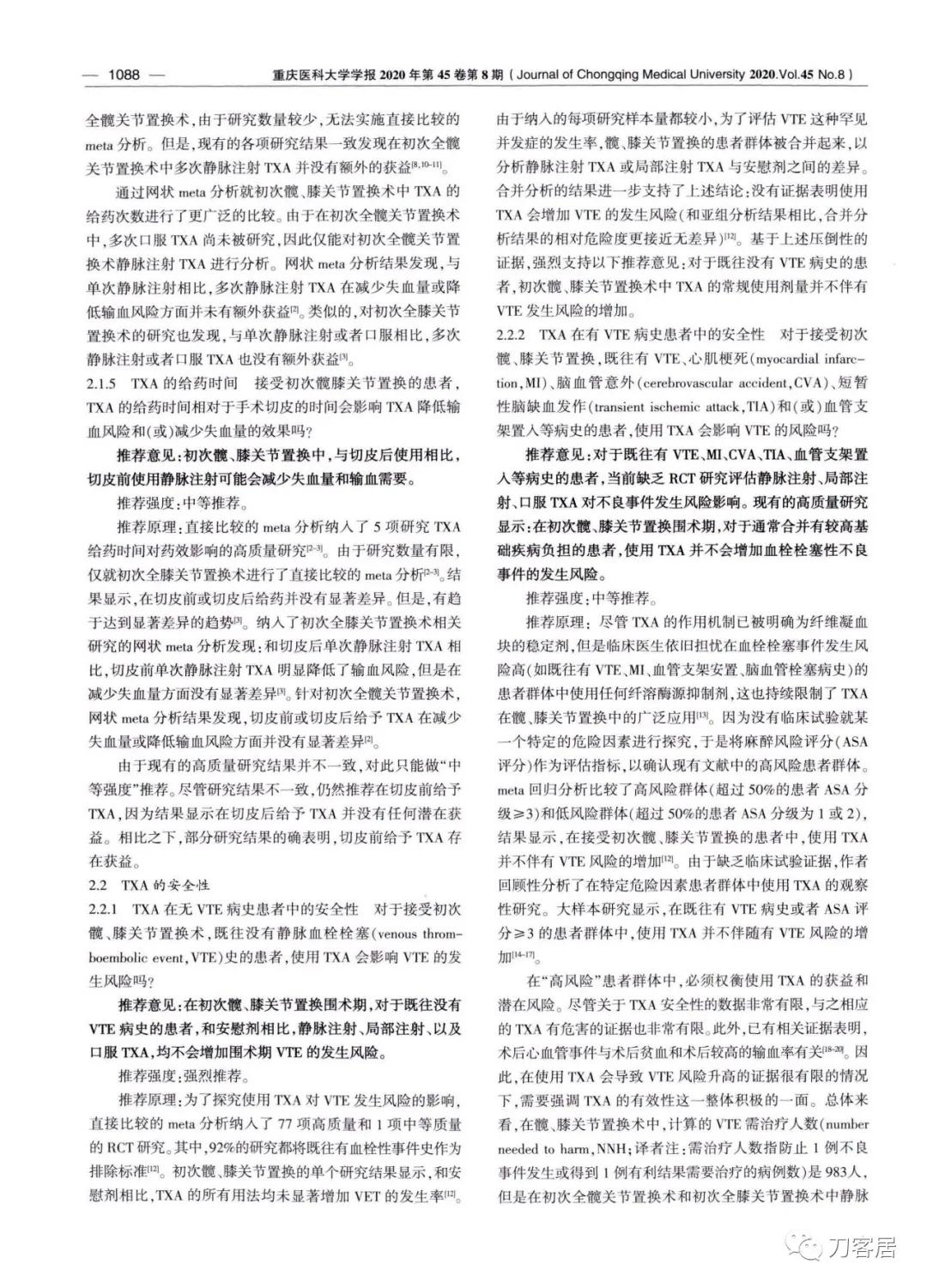
氨甲环酸(TXA)在全关节置换术(TJA)中的应用:美国髋膝关节外科医师协会(AAHKS)、美国区域麻醉和疼痛医学会(ASRA)、美国骨科医师学会 (AAOS)、髋关节协会(THS)和膝关节协会(TKS)共用临床实践指南
翻译:刘英科,马文龙;审校:马真胜
编者注: 氨甲环酸在关节外科已广泛使用,但在脊柱手术中使用很少,美国FDA以及药品说明书中,不推荐椎管内局部使用。国外尚无专家共识或者循证指南推荐氨甲环酸用于脊柱外科手术局部止血用。但《中国骨科手术加速康复围手术期氨甲环酸与抗凝血药应用的专家共识》中,对于创伤、关节和脊柱外科,都推荐了局部使用,而且《中国骨科手术加速康复围手术期氨甲环酸与抗凝血药应用的专家共识》中推荐脊柱外科手术局部使用氨甲环酸的证据源于两篇北京协和医院发表的文献,没有提供国外机构或者作者的是否有脊柱外科手术局部使用氨甲环酸的文献:
Xu D, Zhuang Q, Li Z, et al. A randomized controlled trial on the effects of collagen sponge and topical tranexamic acid in posterior spinal fusion surgeries. J Orthop Surg Res, 2017, 12(1): 166.(北京协和医院骨科)
Ren Z, Li S, Sheng L, et al. Topical use of tranexamic acid can effectively decrease hidden blood loss during posterior lumbar spinal fusion surgery: A retrospective study. Medicine (Baltimore), 2017, 96(42): e8233. (北京协和医院骨科)
中科院文献情报中心2020年将Medicine杂志,定义为高预警杂志,名列第3, 被国内多家医院和高校列入黑名单,就是因为灌水(假数据)文章太多(MEDICINE杂志被禁: https://www.360qikan.com/xunxi/5924.html)。
为了认真学习和质疑《中国骨科手术加速康复围手术期氨甲环酸与抗凝血药应用的专家共识》,我觉得有必要认真学习一下国外关节外科常用的指南。循证指南与专家共识不在一个层级,循证指南的价值远远大于专家共识,在整个指南编辑5级体系中,专家共识的可信度与个案报道同级别,属于可信度最低的,而循证指南里强烈推荐条目属于可信度最高的。
2018年美国髋膝关节外科医师协会(AAHKS)、美国区域麻醉和疼痛医学会(ASRA)、美国骨科医师学会(AAOS)、髋关节协会(THS)和膝关节协会(TKS)共同推出的《 氨甲环酸在全关节置换术中的应用:临床实践指南》 就属于目前关于氨甲环酸在骨科手术中应用的最高级别的循证医学指南。
该指南的英文版网上免费可以获取全文,国内也有学者对其进行了翻译和解读:
- 尹玉玲,李箭,付维力. 2018 年美国关节置换术使用氨甲环酸的临床实践指南解读. 中华关节外科杂志(电子版), 2019;13(1):93-98(华西医院骨科翻译版)
- 吴向东,朱正霖,陈虹,李雨键,黄伟. 2018 AAHKS/AAOS/ASRA/AKS/AHS 临床实践指南:氨甲环酸在初次髋膝关节置换中的应用. 重庆医科大学学报,2020;45(8):1085-1090. (重庆医科大学翻译版)(收稿日期2019-07-18)
也欢迎各位读者,对于我们的翻译,与上述两个单位的翻译进行比对,对于我们翻译的不足之处予以指出,我们在翻译过程中,有些语句,为了能保证地道和流畅的用中文表达,也参考了上述两篇解读,应该不算抄袭。请各位批评指正。
下面就整个循证指南,我个人理解和总结如下:
- 该指南仅限于初次髋膝关节全关节置换,不涉及翻修、肿瘤和感染等关节置换。
- 使用氨甲环酸确实能够有效降低初次髋膝全关节置换术的出血量和输血风险。
- 静脉、口服、局部使用以及静脉加局部联合使用氨甲环酸,效果都一样,没有差别,所以氨甲环酸药品只有静脉和口服使用两种剂型。
- 氨甲环酸的剂量大小(大剂量或小剂量)对降低出血量和围手术期输血需求无统计学差异。
- 多次静脉或口服氨甲环酸,与单次静脉或口服使用氨甲环酸的止血效果无显著差异。也就是说多次用药方法无统计学意义。
- 术前使用氨甲环酸比术后给药更有优势。
- 无深静脉血栓病史的患者,静脉、局部和口服使用氨甲环酸不会增加发生深静脉血栓的风险。
- 合并症(静脉血栓、心肌梗死、脑血管意外、短暂性脑缺血发作、血管支架植入病史等)较多的患者使用氨甲环酸并未增加初次全关节置换术围术期不良血栓栓塞事件的风险。
- 现有证据并不支持氨甲环酸会增加发生动脉血栓的风险。
- 所有的条目和主要文献,都经过了多个不同学术组织的审核和评议,均获得这些学术组织的认可。
- 所有指南参与者披露与该指南制定无利益相关
- 美国FDA规定,氨甲环酸只能用于预防血友病患者和月经过多患者的牙齿出血。其他用法,都是超说明书使用,医生在用药前有责任明确该药的FDA许可状态。
全文译文如下:
引 言
髋关节和膝关节置换术是骨科常规手术,通常与术后急性贫血有关,在许多情况下需要异体或自体输血。一些技术已用于降低术后失血和输血的风险。氨甲环酸(TXA)是一种抗纤维蛋白溶解药,它从根本上改变了全关节置换术(TJA)中的血液管理,输血已不太常见。
虽然TXA已广泛应用于全髋关节置换术(THA)和全膝关节置换术(TKA),但尚未成为标准。TXA在髋关节和膝关节置换术中的应用已有大量文献报道,但缺乏对现有证据的全面回顾分析以提供临床指导。因此,美国髋膝关节外科医师协会(The American Association of Hip and Knee Surgeons, AAHKS)、美国骨科医师学会(The American Academy of Orthopaedic Surgeons, AAOS)、髋关节学会(The Hip Society, THS)、膝关节学会(The Knee Society, TKS)和美国区域麻醉和疼痛医学会(The American Society of Regional Anesthesia and Pain Medicine, ASRA)共同制定初次全关节置换术(TJA)中使用TXA的循证指南。该指南的目的在于通过多学科循证方法规范TXA使用,改善骨科手术患者的治疗,减少实践操作中的差异。
这些临床实践指南旨在解决初次全关节置换术(TJA)中与TXA疗效和安全性有关的常见和重要问题。采用《AAOS临床实践指南和系统评价》方法,指南编辑委员会成员完成一系列直接Meta分析和网状Meta分析,以支持临床实践指南[1]。与《AAOS临床实践指南和系统评价方法》相一致,对于每个问题,我们给予一条推荐建议,分析推荐强度,阐述给出此推荐建议和强度的理由[1]。此临床实践指南基于现有证据,因此随着未来更多研究进展,可能需要进一步更新。
Introduction
Hip and knee arthroplasties are routine orthopaedic procedures commonly associated with acute postoperative anemia, and in many cases requires an allogeneic or autologous blood transfusion. Several techniques have been used to limit postoperative blood loss and risk of transfusion. Tranexamic acid (TXA) is an antifibrinolytic agent that has fundamentally changed blood management in total joint arthroplasty (TJA) by making transfusion an infrequent event.
Although TXA is widely used in total hip arthroplasty (THA) and total knee arthroplasty (TKA), it has not yet become the standard of care. A significant body of literature has been compiled on the use of TXA in hip and knee arthroplasty but a comprehensive review and analysis of the existing evidence to provide clinical guidance is lacking. Therefore, The American Association of Hip and Knee Surgeons (AAHKS), The American Academy of Orthopaedic Surgeons (AAOS), The Hip Society (THS), The Knee Society (TKS) and The American Society of Regional Anesthesia and Pain Medicine (ASRA) have worked together to develop evidence-based guidelines on the use of TXA in primary TJA. The purpose of these guidelines is to improve the treatment of orthopaedic surgical patients and reduce practice variation by promoting a multi-disciplinary evidence-based approach on the use of TXA.
The combined clinical practice guidelines are meant to address common and important questions related to the efficacy and safety of TXA in primary TJA. Utilizing the AAOS Clinical Practice Guidelines and Systematic Review Methodology, the committee members completed a series of direct meta-analyses and network meta-analyses to support the clinical practice guidelines.1 For each question, we have provided a recommendation, assessed the strength of the recommendation, and elaborated on the rationale of the recommendation, which should be interpreted in accordance with the AAOS Clinical Practice Guidelines and Systematic Review Methodology.1 The current clinical practice guidelines were based on the available evidence, so future updates may become necessary as additional literature becomes available with future research.
问题1: 对于接受初次全关节置换术(TJA)的患者,与安慰剂相比,TXA采取何种给药方法,可降低输血风险或减少失血量?
Guideline Question 1: For patients undergoing primary TJA, what method of administration of TXA, compared to placebo, reduces the risk of transfusion and/or reduces blood loss?
建议: 与安慰剂相比,针对具体患者个体化的静脉(IV)、局部使用和口服TXA以及联合使用TXA都可有效减少初次全关节置换术(TJA)围手术期的失血量和输血需求。
Response/Recommendation: Administration of intravenous (IV), topical, and oral TXA as well as combinations of individual formulations of TXA are all effective strategies when compared to placebo for reducing calculated blood loss and the need for transfusion during the perioperative episode of a primary TJA.
推荐强度: 强
Strength of Recommendation: Strong
依据:
一项中等质量研究和82项高质量研究的直接meta分析为TXA在初次髋关节和膝关节置换术围术期降低失血风险和输血需求提供了重要支持证据[2,3]。随后的网状meta分析支持TXA的血液保护特性[2,3]。
全髋关节置换术
直接meta分析表明,静脉和局部使用TXA在减少失血量方面表现基本一致[2]。与安慰剂相比,静脉和局部使用TXA分别降低了60%和71%的输血风险[2]。小剂量静脉使用(<20mg/kg或≤1g)、大剂量静脉使用(≥20mg/kg或>1g)、大剂量局部使用(>1.5g)、口服、静脉/局部联合使用TXA均可降低失血风险[2]。相应地,网状meta分析表明,小剂量静脉使用、大剂量静脉使用、大剂量局部使用、小剂量局部使用和静脉/局部联合使用TXA均可显著降低输血风险[2]。
由于缺乏直接比较口服TXA与安慰剂的研究,在直接meta分析中无法得出结论[2]。通过网状meta分析对口服TXA进行间接比较,结果表明,与安慰剂相比,口服TXA可显著降低失血量[2]。尽管在网状meta分析中,口服TXA降低输血风险的作用与其他TXA剂型用法相当,但与安慰剂相比,口服TXA组并未降低输血风险。这种不一致源于网状meta分析依赖于间接比较且可用研究结果数量有限。 在网状meta分析中,小剂量(≤1.5g)局部使用TXA也有类似的局限性[2],与安慰剂相比,小剂量局部使用TXA并未显著减少失血,但确实降低了输血风险[2]。
全膝关节置换术
直接meta分析表明,静脉和局部使用TXA均可降低初次TKA围术期失血量[3]。与安慰剂相比,局部使用和口服TXA可使输血风险分别降低66%和61%[3]。与安慰剂相比,切皮前或切皮后单次静脉使用TXA可降低81%或55%的输血风险[3],多次静脉使用TXA可降低75%的输血风险[3]。网状meta分析表明,小剂量静脉使用、大剂量静脉使用、小剂量局部使用、大剂量局部使用和口服TXA以及静脉/局部和静脉/口服联合使用TXA均可减少全膝关节置换术(TKA)围术期的失血和输血风险[3]。
The direct meta-analysis of one moderate quality and 82 high quality studies provided significant evidence for the ability of TXA to reduce the risk of blood loss and need for transfusion during the perioperative episode of primary hip and knee arthroplasties.2,3 Subsequent network meta-analysis supported the blood-sparing properties of TXA.2,3
Rationale:
Total Hip Arthroplasty
Intravenous and topical TXA have been shown with limited heterogeneity in direct meta-analysis to reduce blood loss.2 Similarly, IV and topical TXA were found to reduce the risk of transfusion compared to placebo by 60% and 71%, respectively.2 Network meta-analysis of low dose IV (<20mg/kg or ≤ 1g), high dose IV (≥ 20mg/kg or > 1g), high dose topical (>1.5g), oral, and combined IV/topical TXA reduced the risk for blood loss compared to placebo.2 Correspondingly, network meta-analysis demonstrated low dose IV, high dose IV, high dose topical, low dose topical, and combined IV/topical TXA to significantly reduce the risk of transfusion.2
Due to a lack of studies directly comparing oral TXA with placebo, no conclusions could be derived in the direct meta-analysis.2 Network meta-analysis was performed to provide an indirect comparison of oral TXA, which demonstrated significantly reduced blood loss compared to placebo.2 Although oral TXA was shown to be equivalent regarding risk of transfusion to all other formulations of TXA in the network meta-analysis, oral TXA did not reduce the risk of transfusion compared to placebo. The inconsistency is the result of the network relying on indirect comparisons and a limited number of studies. Similar limitations were observed for lower doses (≤1.5g) of topical TXA in the network meta-analysis.2 In the analysis, low dose topical TXA did not significantly reduce blood loss but did reduce the risk of transfusion compared to placebo.2
Total Knee Arthroplasty
Intravenous and topical TXA consistently demonstrated in direct meta-analysis the ability to reduce blood loss during the perioperative episode of a primary TKA.3 Topical and oral TXA reduced the risk of transfusion by 66% and 61% for each respective formulation of TXA when compared to placebo.3 Intravenous TXA administered as a single dose either before or after incision, reduced the risk of transfusion by either 81% or 55% compared to placebo.3 When multiple doses of IV TXA were administered, the observed reduction in transfusion was 75% compared to placebo.3 Subsequent network meta-analysis demonstrated low dose IV, high dose IV, low dose topical, high dose topical, and oral TXA as well as combinations of IV/topical and IV/oral TXA to reduce blood loss and risk of transfusion during the perioperative episode of a TKA.3
问题2:
对于接受初次全关节置换术(TJA)的患者,不同给药方法间相比较,何种TXA给药方法更能降低输血风险或减少失血?
建议:
研究分析并未发现哪种TXA给药方法有明显优势。在初次全关节置换术(TJA)围术期,所有给药方法均可有效降低失血量和输血风险,并且效果差不多。
推荐强度: 强
依据:
31项高质量直接meta分析研究并没有发现某一特定TXA给药方法在降低初次髋关节和膝关节置换术围术期失血风险和输血需求方面[2,3] 优于其他方法,网状meta分析对TXA给药方法之间进行更广泛的比较性研究,没有证据表明哪种用药方法更优[4,5]。
全髋关节置换术
多个随机临床试验的直接meta分析表明,静脉使用和局部使用TXA在降低输血风险方面没有差异[2]。网状meta分析表明小剂量静脉用药(<20mg/kg或≤1g)、大剂量静脉用药(≥20mg/kg或>1g)、小剂量局部用药(≤1.5g)、大剂量局部用药(>1.5g)、口服和静脉/局部联合使用TXA之间进行直接和间接比较[2]。在减少失血方面,未发现各TXA给药方法间有显著差异[2]。在输血风险方面,网状meta分析可观察到类似的结果,但也有例外,静脉和局部联合使用TXA与口服TXA效果相当,却优于小剂量静脉、大剂量静脉、小剂量局部和大剂量局部使用TXA[2]。然而,此例外结果,可能系由有限的研究数量偏倚,而非真的优于其他TXA用药方法所致。
全膝关节置换术
直接比较静脉使用TXA和局部使用、口服或静脉/局部联合使用TXA,发现输血风险没有差异[3]。与THA的网状meta分析类似,直接和间接比较小剂量静脉、大剂量静脉、小剂量局部、大剂量局部用药,口服TXA以及静脉/局部联合用药和静脉/口服联合使用TXA,结果显示各种给药途径在血液保护方面并没有显著差异[3]。与大剂量静脉用药或静脉/局部联合使用TXA相比,小剂量静脉使用TXA的输血风险更高,这可能系由剂量反应或研究数量有限所致[3]。
Guideline Question 2:
For patients undergoing primary TJA, what method of administration of TXA, compared to a different method of administration, reduces the risk of transfusion and/or reduces blood loss?
Response/Recommendation:
The analysis of studies did not identify a clearly superior method, or combinations of methods, for the administration of TXA. All methods of administration effectively demonstrate equivalent efficacy at reducing calculated blood loss and the risk of transfusion during the perioperative episode of a primary TJA.
Strength of Recommendation: Strong
Rationale:
The direct meta-analysis of 31 high quality studies provided no evidence to favor any specific method of TXA to reduce the risk of blood loss and need for transfusion during the perioperative episode of primary hip and knee arthroplasties.2,3 Subsequent network meta-analysis included a more expansive comparison between the methods of TXA administration with no evidence to clearly support a superior method of administration.4,5
Total Hip Arthroplasty
Intravenous and topical TXA have been compared together in multiple randomized clinical trials, which through direct meta-analysis showed no difference in the risk of transfusion.2 Network meta-analysis provided the opportunity to perform direct and indirect comparisons between low dose IV (< 20mg/kg or ≤1g), high dose IV (≥20mg/kg or > 1g), low dose topical (≤ 1.5g), high dose topical (> 1.5g), oral, and combined IV/topical TXA.2 In terms of the ability to reduce blood loss, no method of TXA administration was found to provide a significantly different outcome.2 Similar results in the network meta-analysis were observed for risk of transfusion with the exception that a combination of IV and topical TXA was equivalent to oral TXA but superior to low dose IV, high dose IV, low dose topical, and high dose topical TXA.2 However, the inconsistent result regarding combined IV/topical TXA likely represents bias from a limited number of studies and not superiority to other methods of TXA administration.
Total Knee Arthroplasty
Direct comparisons were performed between IV TXA and topical, oral, or combined IV/topical TXA, which found no difference in the risk of transfusion.3 Similar to the network meta-analysis of THA, direct and indirect comparisons were performed between low dose IV, high dose IV, low dose topical, high dose topical, and oral TXA as well as combinations of IV/topical and IV/oral TXA that resulted in no difference in their blood sparing properties.3 The significant differences between methods of TXA administration were observed in respect to the risk of transfusion being higher for low dose IV TXA compared to high dose IV or combined IV/topical TXA, which could represent a dose response or the limited number of studies.3
问题3:
对于接受初次全关节置换术(TJA)的患者,静脉用药或局部使用TXA的剂量是否会影响输血风险或减少失血?
建议:
在初次全关节置换术(TJA)中使用的TXA剂量范围内,未发现TXA剂量对降低失血量或围术期输血需求有显著影响。
推荐强度: 强
依据:
由于研究数量有限,无法对6份高质量文献进行直接meta分析,因为这些文献仅研究了静脉或局部使用TXA的剂量效应[2,3]。只有2项已发表的研究发现不同剂量TXA之间存在差异,并且支持使用大剂量静脉或局部使用TXA[4,5]。然而,在初次全膝关节置换术(TKA)失血量或输血风险方面, 2项不同研究对比局部使用低剂量TXA(1.5g)和高剂量TXA(3g), 结果并不存在统计学差异[6,7]。此外,2篇全髋关节置换术(THA)或全膝关节置换术(TKA)中静脉使用TXA的文章并不支持大剂量静脉使用TXA[8,9]。静脉或局部使用TXA的剂量效应网状meta分析表明,支持大剂量TXA降低输血风险或失血量的证据有限[2,3]。
尽管静脉使用TXA的剂量效应仅在全膝关节置换术(TKA)输血风险中有所体现,但这并不排除静脉或局部使用TXA剂量效应的存在。就现在的初次全髋关节置换术(THA)或全膝关节置换术(TKA)以及失血水平来说,所用TXA剂量不足以产生剂量效应。初次全髋关节置换术(THA)或全膝关节置换术(TKA)的网状meta分析中,静脉使用TXA单次剂量为10mg/kg,三次用剂量为15mg/kg,而局部使用TXA剂量为0.5g至3g[2,3]。
静脉使用氨甲环酸
网状meta分析表明髋关节或膝关节置换术后,静脉使用大剂量 (≥ 20mg/kg或>1g)TXA并不比小剂量(<20mg/kg或≤1g)TXA有更好的预防出血作用[4,5]。网状meta分析发现有剂量效应,静脉使用大剂量TXA的初次全膝关节置换术(TKA)输血风险降低,但初次全髋关节置换术(THA)中未发现类似结果[2,3]。其它证据表明,单次与多次静脉使用TXA相比无显著差异,这进一步支持了以下观点,即 临床上不一定需要增加静脉使用 TXA的剂量以促进髋关节或膝关节置换术中的血液保护作用[2-3] 。
局部使用氨甲环酸
直接meta分析和网状meta分析结果均表明,局部使用小剂量(≤1.5g)和大剂量(>1.5g)TXA之间无统计学差异[2-3]。对于降低髋关节或膝关节置换手术失血或输血风险,局部使用小剂量或大剂量TXA未见有剂量依赖效应[2,3]。
Guideline Question 3:
For patients undergoing primary TJA, does the dose amount of IV or topical TXA affect the risk of transfusion and/or reduction in blood loss?
Response/Recommendation:
Within the context of the TXA doses used in primary TJA, the dose amount of TXA was not found to significantly affect its reduction of calculated blood loss or the need for transfusion during the perioperative episode of a primary TJA.
Strength of Recommendation: Strong
Rationale:
Due to a limited number of studies, direct meta-analysis could not be performed on the six high quality publications that solely investigated the dose effect of either IV or topical TXA.2,3 Only two of the published studies observed a difference in favor of higher doses of IV or topical TXA.4,5 However, two different studies investigating the same comparative doses of topical TXA (1.5g and 3g) in primary TKA did not observe a difference in calculated blood loss or risk of transfusion with higher doses of topical TXA.6,7 Additionally, two publications of IV TXA in THA or TKA did not favor higher doses of IV TXA.8,9 When a network meta-analysis was performed regarding the dose effect of IV or topical TXA, it demonstrated limited evidence for a reduction in either transfusion risk or calculated blood loss with higher doses of TXA.2,3
Although a dose response has only been observed in the analysis of TKA for IV TXA with the risk of transfusion, it does not preclude the presence of a dose response for IV or topical TXA. The anticipated dose response is likely not present at the levels of blood loss or the doses of TXA utilized for primary THA or TKA. In the network meta-analysis of primary THA and TKA, the range of IV TXA doses were 10 mg/kg and three doses of 15 mg/kg while for topical TXA doses the range was between 0.5g and 3g.2,3
Intravenous Tranexamic Acid
Network meta-analysis demonstrates no additional reduction in blood loss following a hip or knee arthroplasty with high dose IV (≥ 20mg/kg or > 1g) TXA compared to low dose IV (< 20mg/kg or ≤ 1g) TXA.4,5 A dose response was observed in the network meta-analysis with a reduced risk of transfusion for higher doses of TXA in primary TKA, but similar results were not found for primary THA.2,3 Additional evidence shows no significant difference comparing single-dose and multiple doses of IV TXA, which further supports the notion that higher doses of IV TXA are not necessarily clinically needed to improve the blood-sparing effects in the setting of hip or knee arthroplasties.2-3
Topical Tranexamic Acid
Direct meta-analysis and network meta-analysis consistently reported no statistical difference between low dose (≤ 1.5g) and high dose (> 1.5g) topical TXA.2-3 A dose response was not observed for either blood loss or risk of transfusion regarding low dose or high dose topical TXA following hip or knee arthroplasty.2,3
问题4:
对于接受初次全关节置换术(TJA)的患者,与单次静脉用药相比,多次静脉使用或多次口服TXA是否能降低输血风险或减少失血?
建议:
与单次静脉使用或口服TXA相比,多次静脉使用或多次口服TXA不会显著改变初次全关节置换术(TJA)围术期的失血量和输血需求。
推荐强度: 强
依据:
对6项高质量研究进行直接meta分析,比较初次全膝关节置换术(TKA)期间单次和多次静脉使用TXA,结果表明单次与多次静脉使用TXA并没有区别[3]。由于研究数量有限,不能对初次全髋关节置换术(THA)进行直接meta分析。然而现有的个体研究结果一致表明,在初次全髋关节置换术(THA)中,多次静脉使用TXA并没有额外的益处[8,10,11]。
通过网状meta分析对初次髋关节和膝关节置换术进行了扩展比较。在初次全髋关节置换术(THA)中没有研究多次口服TXA的文献,因此分析仅适用于初次全髋关节置换术(THA)中的静脉使用TXA。网状meta分析显示,与单次相比,多次静脉使用TXA在降低失血或输血风险方面并没有额外益处[5]。同样,初次全膝关节置换术的结果表明,与单次静脉注射或口服TXA相比,多次静脉使用或多次口服TXA没有任何益处[3]。
Guideline Question 4:
For patients undergoing primary TJA, do multiple doses of IV or oral TXA, compared to a single dose, reduce the risk of transfusion and/or reduce blood loss?
Response/Recommendation:
Administration of multiple doses of IV or oral TXA compared to a single dose of IV or oral TXA does not significantly alter the amount of calculated blood loss and need for transfusion during the perioperative episode of a primary TJA.
Strength of Recommendation: Strong
Rationale:
Direct meta-analysis was performed using six high quality studies to compare between a single dose and multiple doses of IV TXA during primary TKA, which demonstrated no additional benefit for multiple doses of IV TXA.3 Due to a limited number of studies, direct meta-analysis could not be performed for primary THA. However, the results of the available individual studies consistently demonstrate no additional benefit for multiple doses of IV TXA inprimary THA.8,10,11
An expanded comparison was performed through a network meta-analysis on primary hip and knee arthroplasties. Multiple doses of oral TXA have not been studied in primary THA, thus analysis was only available for IV TXA in primary THA. Network meta-analysis showed no additional benefit in terms of blood loss or risk of transfusion for multiple doses of IV TXA compared with a single dose.5 Similarly, the results for primary TKA supported no benefit for multiple doses of IV or oral TXA compared to a single dose of either IV or oral TXA.3
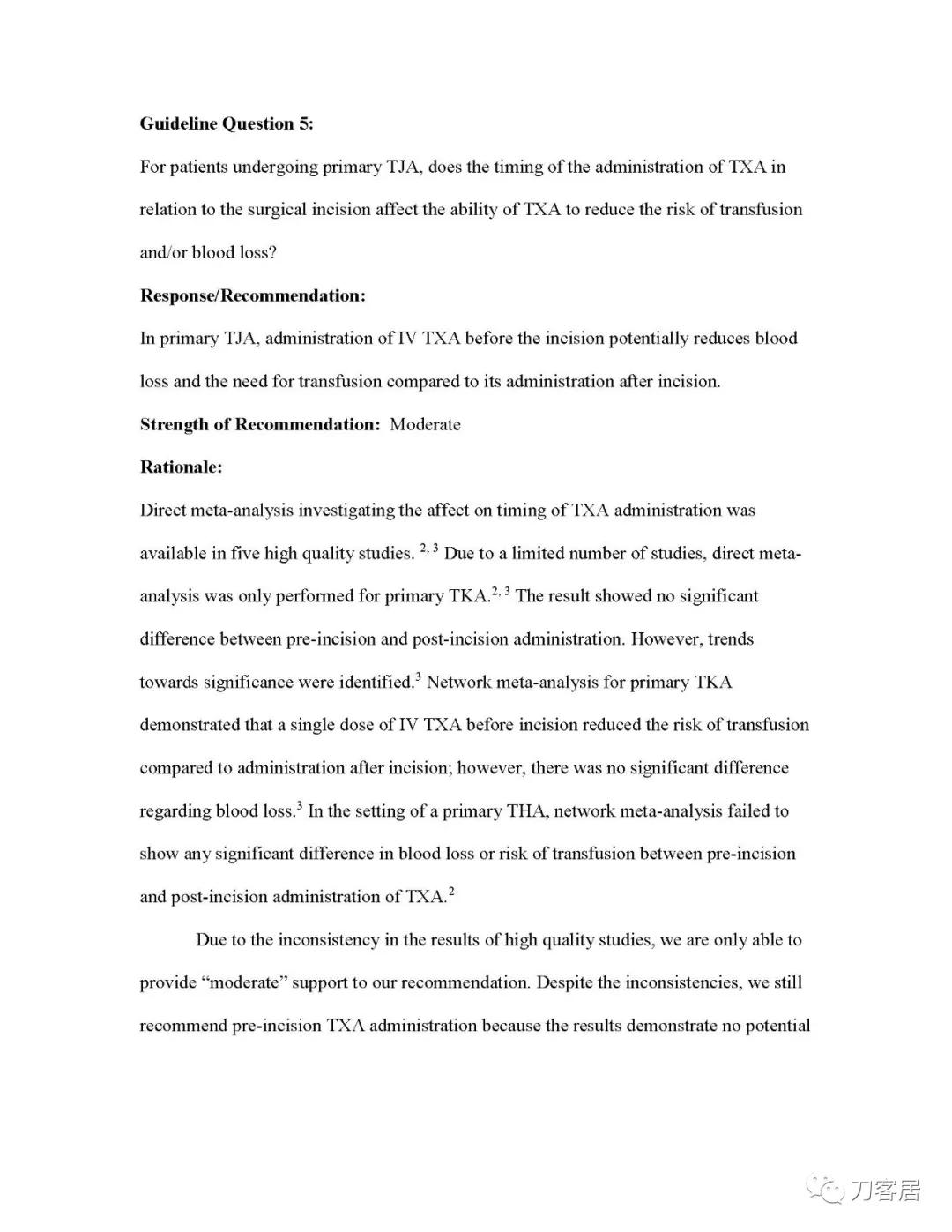
问题5:
对于接受初次全关节置换术(TJA)的患者,切皮前或切皮后TXA给药时机是否会影响TXA降低输血和/或失血风险的能力?
建议:
在初次全关节置换术(TJA)中,与切皮后给药相比,切皮前静脉使用TXA在减少失血和输血需求方面更有优势。
推荐强度: 中等
依据:
5项高质量研究可直接meta分析TXA给药时间的影响[2,3]。由于研究数量有限,仅对初次全膝关节置换术(TKA)进行直接meta分析[2,3]。结果显示切皮前和切皮后给药没有显著差异,但有显著性差异的趋势还是比较明显的 [3]。初次全膝关节置换术(TKA)的网状meta分析表明,与切皮后给药相比,切皮前单次静脉使用TXA可降低输血风险;然而在降低失血量方面没有显著性差异[3]。对于初次全髋关节置换术(THA),网状meta分析未显示切皮前和切皮后静脉使用TXA在减少失血量或降低输血风险方面有任何显著差异[2]。
由于高质量研究结果不一致,我们只能对我们的建议提供“中度”支持。尽管不一致,我们仍然建议切皮前使用TXA,因为结果表明切皮后给药没有潜在益处。相反在一些分析中,切皮前给药确实有益处。
Guideline Question 5:
For patients undergoing primary TJA, does the timing of the administration of TXA in relation to the surgical incision affect the ability of TXA to reduce the risk of transfusion and/or blood loss?
Response/Recommendation:
In primary TJA, administration of IV TXA before the incision potentially reduces blood loss and the need for transfusion compared to its administration after incision.
Strength of Recommendation: Moderate
Rationale:
Direct meta-analysis investigating the affect on timing of TXA administration was available in five high quality studies.2,3 Due to a limited number of studies, direct meta-analysis was only performed for primary TKA.2,3 The result showed no significant difference between pre-incision and post-incision administration. However, trends towards significance were identified.3 Network meta-analysis for primary TKA demonstrated that a single dose of IV TXA before incision reduced the risk of transfusion compared to administration after incision; however, there was no significant difference regarding blood loss.3 In the setting of a primary THA, network meta-analysis failed to show any significant difference in blood loss or risk of transfusion between pre-incision and post-incision administration of TXA.2
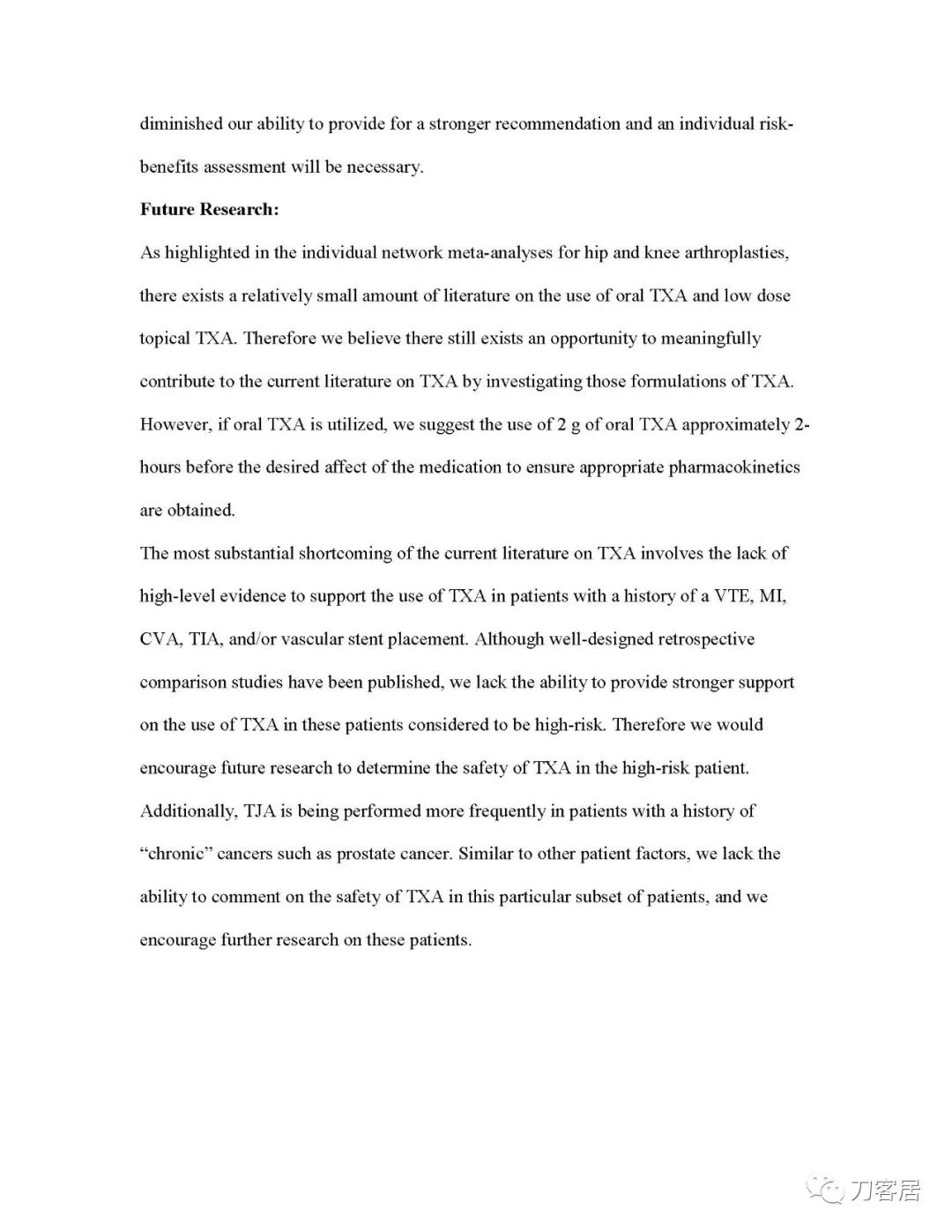
Due to the inconsistency in the results of high quality studies, we are only able to provide “moderate” support to our recommendation. Despite the inconsistencies, we still recommend pre-incision TXA administration because the results demonstrate no potential benefit for post-incision administration. In contrast, pre-incision administration does demonstrate benefit in some of the analyses.
问题6:
对于接受初次全关节置换术(TJA)且无静脉血栓栓塞(VTE)病史的患者,TXA治疗是否会影响VTE的风险?
建议:
与安慰剂相比,无VTE病史的患者在初次TJA围术期静脉、局部使用和口服TXA不会增加发生VTE的风险。
推荐强度:强
依据:
利用77项高质量和1项中等质量的随机临床研究,对TXA给药对VTE风险的影响进行直接meta分析。其中,92%的研究将有静脉血栓栓塞病史作为排除标准[12]。髋关节和膝关节置换术单个研究结果表明,与安慰剂相比,所有TXA给药方法均未显著增加VTE发生率。由于纳入每个研究的样本量较小,因此将髋关节和膝关节置换术人群合并起来,分析静脉和局部使用TXA之间的差异,以评价罕见并发症(如VTE)的发生率[12]。合并分析的结果进一步支持上述结论,即没有证据表明使用TXA会增加VTE的风险(合并分析结果的相对风险性比亚组分析更接近“无差异”)[12]。鉴于这一强有力的证据,我们“强烈”支持对于无VTE病史的患者,髋关节和膝关节置换术TXA的常用剂量与VTE风险增加无关。
Guideline Question 6:
For patients undergoing primary TJA without a history of a venous thromboembolic event (VTE), does the treatment with TXA affect the risk of VTE?
Response/Recommendation:
Administration of IV, topical, and oral TXA in patients without a known history of a VTE does not increase the risk of developing a VTE compared to placebo during the perioperative episode of a primary TJA.
Strength of Recommendation: Strong
Rationale:
Direct meta-analysis investigating the impact of TXA administration on the risk of VTE was performed utilizing 77 high and one moderate quality randomized clinical trial. Of those, 92% of the studies utilized history of a thromboembolic event as an exclusion criterium.12 Individual results for hip and knee arthroplasty demonstrated no significant difference between all methods of TXA administration compared to placebo.12 Since individual studies included were noted to be comprised of small sample sizes, the hip and knee arthroplasty populations were combined to analyze for differences between IV and topical application of TXA in order to comment on the incidence of rare complications like VTE.12 This combined analysis further supports the group’s conclusion that there is no evidence of increased risk of VTE with TXA administration (combined results had a relative risk closer to “no difference” than the subgroup analysis).12 Given this overwhelming evidence, we provide “strong” support to our recommendation that TXA administration at doses typically utilized in hip and knee arthroplasty is not associated with an increased risk of VTE for patients without a known history of VTE.
问题7:
对于有静脉血栓栓塞(VTE)、心肌梗死(MI)、脑血管意外(CVA)、短暂性脑缺血发作(TIA)和/或血管支架置入病史,接受初次全关节置换术(TJA)的患者,TXA治疗是否会影响VTE的风险?
建议:
对于已知有静脉血栓栓塞(VTE)、心肌梗死(MI)、脑血管意外(CVA)、短暂性脑缺血发作(TIA)和/或血管支架置入史的患者,关于静脉、局部使用和口服TXA不良反应风险的随机临床研究很少。现有的高质量文献中,合并症较多的患者使用TXA并未增加初次全关节置换术(TJA)围术期不良血栓栓塞事件的风险。
推荐强度: 中等
依据:
尽管已明确TXA对纤维蛋白凝血块有稳定作用,但临床医生对以往发生过血栓栓塞的“高危”患者(例如,既往VTE史、带血管支架的MI病史、脑血管闭塞性疾病)使用任何抗纤维蛋白溶解药物仍存在担忧,这限制了TXA在髋关节和膝关节置换术中的广泛应用[13]。由于没有临床研究调查特定的危险因素,因此用美国麻醉医师协会(ASA)身体状况评分系统对现有文献中的“高危”患者进行识别。在一项meta回归分析中,比较高风险人群(超过50%的患ASA评分≥3)和低风险人群(超过50%的患者ASA评分为1或2),结果显示初次髋关节或膝关节置换术患者发生VTE的风险没有增加[12]。由于缺乏实验证据,我们还分析了特定危险因素患者使用TXA的观察性研究。大数据研究表明有VTE或ASA评分≥3的患者使用TXA不会增加VTE的风险[14-17]。
在“高危”患者群中,我们必须综合考虑使用氨甲环酸(TXA)的益处和潜在风险。尽管缺少氨甲环酸(TXA)安全性的数据,但也缺乏相应的有害证据。此外,有证据表明,术后心血管并发症主要与贫血和高输血率有关[18-20]。 因此,在没有足够的证据证明氨甲环酸(TXA)会增加VTE风险的情况下,我们应该强调氨甲环酸(TXA)的整体有效性。总之,所有全髋关节置换术(THA)和全膝关节置换术(TKA)患者中,需要预防静脉血栓栓塞(VTE)的人数为983名,而需要静脉使用氨甲环酸(TXA)以防止输血的患者分别只有4名和3名 [12]。虽然现有数据限制了氨甲环酸(TXA)在“高危”人群中推广使用,但对每个已知特定危险因素的患者都应该个体化对待,在决定使用或停用TXA时进行多学科会诊和讨论。
Guideline Question 7:
For patients undergoing primary TJA with a history of a VTE, myocardial infarction (MI), cerebrovascular accident (CVA), transient ischemic attack (TIA), and/or vascular stent placement, does the treatment with TXA affect the risk of VTE?
Response/Recommendation:
There is a paucity of randomized clinical trials on the risk of adverse effects of IV, topical, and oral TXA in patients with known history of a VTE, MI, CVA, TIA, and/or vascular stent placement. The existing high quality literature regarding administration of TXA in patients of generally higher comorbidity burden does not suggest increased risk of adverse thromboembolic events during the perioperative episode of a primary TJA.
Strength of Recommendation: Moderate
Rationale:
Despite an established proposed mechanism of action for TXA as a fibrin clot stabilizer, clinician concerns remain over the use of any antifibrinolytic medication in patients considered at “high-risk” for thromboembolic events (e.g., previous history of VTE, MI with vascular stents, cerebral vascularocclusive disease) which continues to limit the widespread adoption of TXA use in hip and knee arthroplasty.13 Since no clinical trials have investigated specific risk factors, the American Society of Anesthesiologists (ASA) physical status classification system was used as a proxy to identify “high-risk” patients among the literature available. In a meta-regression analysis comparing a population of patients with greater than 50% ASA status ≥3 to another population with patients of greater than 50% ASA status 1 or 2, the results demonstrated no increase in the risk of VTE for patients undergoing a primary hip or knee arthroplasty.12 Due to the absence of experimental evidence, we also reviewed observational studies on the topic of TXA administration in patients with specific risk factors. Large database studies suggest TXA administration in patients with a history of VTE or ASA status of ≥ 3 does not experience an increased risk of VTE.14-17
In the “high-risk” patient population, we must consider the summation of the benefits and potential risks of administering TXA. Despite limited data on the safety of TXA, we wish to highlight a parallel lack of evidence for harm. Additionally, evidence has demonstrated that postoperative cardiovascular complications are associated with anemia and high blood transfusion rates.18-20 Therefore we wish to highlight the overall positive summation of data on TXA efficacy in the context of limited evidence for added risk with the use of TXA. In sum, the calculation of the number needed to harm for VTE among the total joint population was 983 patients, but the number needed to treated with IV TXA in THA and TKA to prevent a transfusion was only 4 and 3 patients, respectively.12 Although the available data limits for stronger advocacy and more widespread use in those at “high-risk”, each patient with known risks factors should be considered individually and we advocate for a multidisciplinary approach when deciding whether to withhold or administer TXA.
问题8:
接受初次全关节置换术(TJA)的患者,TXA治疗是否会影响发生动脉血栓栓塞(ATE)的风险?
建议:
静脉、局部和口服使用TXA与发生ATE风险的临床随机对照研究很少。与安慰剂相比,初次全关节置换术(TJA)围术期,现有证据并不支持TXA会增加发生ATE的风险。
推荐强度:中等
依据:
初次髋关节或膝关节置换术后动脉血栓栓塞(ATE)非常罕见,并且在随机临床对照研究中很少报道,因为大多数ATE高危因素患者通常并不纳入研究。在一项研究动静脉血栓栓塞的直接meta分析中,仅有9篇文献报告了ATE的发生 [12]。由于研究数量有限,作者对髋关节和膝关节置换术数据合并后进行直接meta分析。结果表明与安慰剂相比,静脉或局部使用TXA,发生ATE的风险无统计学差异[12]。
尽管直接meta分析仅限于高质量的研究,但我们只能为我们的建议提供“中度”支持。由于缺乏数据,缺少专门对ATE并发症的研究,以及现有研究中排除了已知ATE高危因素的患者,所以降低了推荐强度,对每个个体的风险收益需要进行全面评估。
Guideline Question 8:
For patients undergoing primary TJA, does the treatment with TXA affect the risk of arterial thromboembolic events (ATE)?
Response/Recommendation:
There is a paucity of randomized clinical trials on the risk of ATE due to the administration of TXA intravenously, topically, and orally. However, the existing evidence does not suggest that TXA increases the risk of developing an ATE compared to placebo during the perioperative episode of a primary TJA.
Strength of Recommendation: Moderate
Rationale:
Arterial thromboembolic events following primary hip or knee arthroplasty are exceptionally infrequent complications and are rarely reported in the randomized clinical trials as most patients who have known risk factors for these events are often excluded from these types of studies. In a direct meta-analysis investigating arterial and venous thromboembolic events, only 9 studies reported the incidence of ATE.12 Due to the limited number of studies, the authors performed combined hip and knee arthroplasty direct meta-analysis only. The results demonstrated no statistical difference in the risk of ATE between IV or topical TXA and placebo.12
Although the direct meta-analysis was limited to high-quality studies, we are only able to provide “moderate” support to our recommendation. The combination of paucity of data, lack of studies specifically designed to investigate the complication of ATE, and exclusion of patients with known risk factors among those studies that were available, diminished our ability to provide for a stronger recommendation and an individual risk-benefits assessment will be necessary.
展望:
正如髋关节和膝关节置换术每个网状meta分析所强调的,口服TXA和小剂量局部使用TXA的文献相对较少。因此,我们相信仍然有机会通过研究TXA的不同剂型,对目前有关TXA的研究做出有意义的贡献。然而,如果口服TXA,我们建议药物起效前约2小时口服2g TXA,以确保药物适时发挥作用。
目前关于TXA的文献最主要的不足是缺乏高水平的证据支持在有静脉血栓栓塞(VTE)、心肌梗死(MI)、脑血管意外(CVA)、短暂性脑缺血发作(TIA)和/或血管支架置入史的患者中使用TXA。虽然已有设计良好的回顾性比较研究发表,但我们缺少对这些高危患者使用TXA提供更有力支持的能力。因此,我们鼓励未来有更多研究以明确TXA在高危患者中的安全性。此外,全关节置换术(TJA)在有前列腺癌等“慢性”癌症病史的患者中更为常见。与其他患者因素类似,我们缺少评估TXA在这一特定患者群中安全性的能力,我们鼓励对这些患者作进一步的研究。
Future Research:
As highlighted in the individual network meta-analyses for hip and knee arthroplasties, there exists a relatively small amount of literature on the use of oral TXA and low dose topical TXA. Therefore we believe there still exists an opportunity to meaningfully contribute to the current literature on TXA by investigating those formulations of TXA. However, if oral TXA is utilized, we suggest the use of 2g of oral TXA approximately 2-hours before the desired affect of the medication to ensure appropriate pharmacokinetics are obtained.
The most substantial shortcoming of the current literature on TXA involves the lack of high-level evidence to support the use of TXA in patients with a history of a VTE, MI, CVA, TIA, and/or vascular stent placement. Although well-designed retrospective comparison studies have been published, we lack the ability to provide stronger support on the use of TXA in these patients considered to be high-risk. Therefore we would encourage future research to determine the safety of TXA in the high-risk patient. Additionally, TJA is being performed more frequently in patients with a history of “chronic” cancers such as prostate cancer. Similar to other patient factors, we lack the ability to comment on the safety of TXA in this particular subset of patients, and we encourage further research on these patients.
同行评审过程:
在编辑委员会制定临床实践指南后,美国髋膝关节外科医师协会(AAHKS)、美国区域麻醉和疼痛医学会(ASRA)和髋关节和膝关节协会的委员会对其进行了同行评审。美国骨科医师学会(AAOS)循证质量和价值委员会审核该临床实践指南并予以认可。此外,对支持该临床实践指南制定的3篇初次髋关节和膝关节置换术中TXA有效性和安全性直接和网状meta分析的文献,也进行了同行评审。
Peer Review Process:
Following the committee’s formulation of the Clinical Practice Guideline draft, it underwent a peer review by the board of directors from AAHKS, ASRA, and the Hip and Knee Societies. The AAOS Evidence-Based Quality and Value Committee reviewed the Clinical Practice Guideline draft for endorsement. Additionally, the three publications of the direct and network meta-analyses on the efficacy and safety of TXA in primary hip and knee arthroplasties that supported the formulation of the Clinical Practice Guideline have undergone peer review for publication.
披露声明:
临床实践指南的所有作者或撰稿人已根据公开的AAOS骨科披露计划提供披露声明。所有作者和贡献者均证明,所有披露均与临床实践指南无关。
Disclosure Requirement:
All authors or contributors to the Clinical Practice Guideline have provided a disclosure statement in accordance with the publicly available AAOS Orthopaedic Disclosure Program. All authors and contributors attest none of the disclosures present are relevant to the Clinical Practice Guidelines.
FDA许可声明:
氨甲环酸是本临床实践指南中描述的一种药物,美国食品和药物管理局(FDA)只批准用于预防血友病患者和月经过多患者的牙齿出血。根据FDA的规定,处方医生有责任在临床用药前确定所有药物的FDA许可状态。
FDA Clearance Statement:
Tranexamic acid is a drug described in this Clinical Practice Guideline that has only been approved by the Food and Drug Administration (FDA) for dental bleeding prophylaxis in hemophilic patients and menorrhagia. According to the FDA, it is the prescribing physician's responsibility to ascertain the FDA clearance status for all medications prior to use in a clinical setting.
致谢:
感谢美国髋膝关节外科医师协会(AAHKS)提供资金和行政支持。感谢美国骨科医师学会(AAOS)研究、质量和科学事务部的Jayson Murray、Peter Shores和Kyle Mullen,感谢他们在分析和指导方面提供帮助。最后,感谢美国髋膝关节外科医师协会(AAHKS)、美国区域麻醉和疼痛医学会(ASRA)以及髋关节和膝关节协会的领导在组织支持方面提供帮助。
Acknowledgements:
We would like to thank AAHKS for providing the funding and administrative support. We would like to thank Jayson Murray, Peter Shores, and Kyle Mullen from the AAOS Department of Research, Quality, and Scientific Affairs for their assistance with the analysis and guidance. Lastly, we thank the leadership of the AAHKS, AAOS, ASRA, and The Hip and The Knee Societies for help with organizational support.
参考文献:略。
氨甲环酸(TXA)在全关节置换术(TJA)中的应用:美国髋膝关节外科医师协会(AAHKS)、美国区域麻醉和疼痛医学会(ASRA)、美国骨科医师学会 (AAOS)、髋关节协会(THS)和膝关节协会(TKS)共用临床实践指南原文截图:






尹玉玲,李箭,付维力. 2018 年美国关节置换术使用氨甲环酸的临床实践指南解读. 中华关节外科杂志(电子版), 2019;13(1):93-98(华西医院骨科翻译版)


吴向东,朱正霖,陈虹,李雨键,黄伟. 2018 AAHKS/AAOS/ASRA/AKS/AHS 临床实践指南:氨甲环酸在初次髋膝关节置换中的应用. 重庆医科大学学报,2020;45(8):1085-1090. (重庆医科大学翻译版)(收稿日期2019-07-18)