
分享兴趣,传播快乐,增长见闻,留下美好。
亲爱的您,
这里是LearingYard学苑!
今天小编为大家带来的是最新钱报(八十一),
具体为文献推文(期刊论文)
《Manufacturer rebate strategy under chain to chain
competition》 的精读
欢迎您的用心访问!
本期推文阅读时长大约5分钟,请您耐心阅读。
Share interest, spread happiness, increase knowledge, leave beautiful.
Dear you,
This is LearingYard Academy!
Today Xiaobian brings you the latest money report (81),
Specifically for the intensive reading of literature tweets (journal papers)
《 Manufacturer rebate strategy under chain to chain
competition》
Welcome your heart visit!
This tweet will take about 5 minutes to read, please be patient.
今天小编分享一篇期刊论文《 Manufacturer rebate strategy under chain to chain competition 》的基础模型部分,小编将从思维导图、精读内容、知识补充三个板块来介绍这一部分内容,请读者跟小编一起学习一下吧!
Today I share a journal paper "Manufacturer rebate strategy under chain to chain competition" in the literature review section, I will introduce this part of the content from the mind map, intensive reading content, knowledge supplement three panels, please readers to study it with me!
一、思维导图
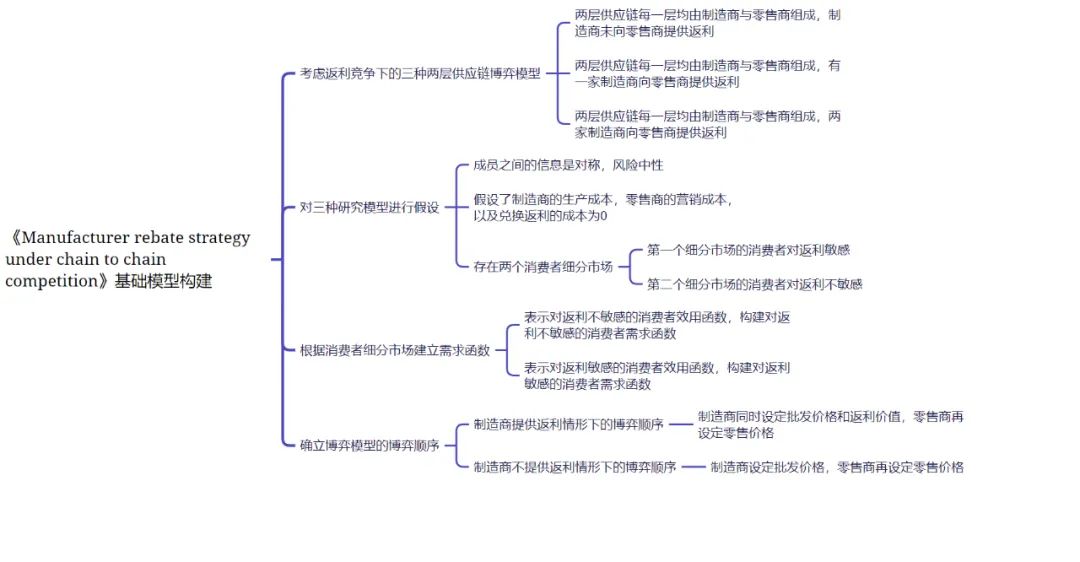
该篇文献的文献综述部分的思维导图部分如下图所示:
The mind map section of the literature review section of this piece of literature is shown below:
二、精读内容

学者这一部分的内容为模型构建部分,学者考虑了一个两层竞争的供应链系统,每层由一个制造商和一个零售商组成。制造商生产产品,并通过其独家零售商将其销售给消费者。在确定产品的批发价格时,制造商还考虑是否有能力向消费者提供返利。这两个市场的成员横向供应链上的制造商具有平等的市场地位,每条供应链上的制造商都是Stackelberg领导者。此外,供应链的每个成员都以最大化自身利益为决策基础。
The content of this part is the model building part. The scholars consider a two-tier competing supply chain system, with each tier consisting of a manufacturer and a retailer. The manufacturer manufactures the product and sells it to consumers through its exclusive retailer. In determining the wholesale price of a product, manufacturers also consider whether they can afford to offer rebates to consumers. The members of the two markets have an equal market position in the horizontal supply chain, with the manufacturers in each supply chain being Stackelberg leaders. In addition, each member of the supply chain bases its decisions on maximizing its own interests.
在模型构建中,首先,学者建立了三种不同情况下的模型,第一个模型为两层供应链上的成员均不提供返利,第二个模型为两层供应链上的成员有一个制造商向零售商提供返利,第三个模型为两层供应链上的成员两个制造商向两个零售商均提供返利竞争。
In the model construction, firstly, scholars establish three models under different conditions. The first model is that members of the two-tier supply chain do not provide rebates; the second model is that one manufacturer of the two-tier supply chain member provides rebates to retailers; the third model is that two manufacturers of the two-tier supply chain member provide rebates to both retailers.
其次,学者进行了研究假设,学者先假设了成员之间的信息是对称的,所有成员都是风险中性的。学者再假设了制造商的生产成本,零售商的营销成本,以及兑换返利的成本为0。此外,学者参照Chen et al.(2007)的研究,假设市场中存在两个消费者细分市场:第一个细分市场的消费者对返利敏感,第二个细分市场的消费者对返利不敏感。假设B (0< B <1)为市场上对返利敏感的消费者比例。基于以上假设,将对返利不敏感的消费者效用函数表示为:
Secondly, scholars made research assumptions. They first assumed that information among members was symmetric and all members were risk neutral. The scholars also assume that the production cost of the manufacturer, the marketing cost of the retailer, and the conversion rebate cost are 0. In addition, scholars refer to the research of Chen et al.(2007) and assume that there are two consumer segments in the market: consumers in the first segment are sensitive to rebates, while consumers in the second segment are not. Suppose B (0< B <1) is the proportion of consumers who are sensitive to rebates in the market. Based on the above assumptions, the consumer utility function insensitive to rebates is expressed as:

产品的零售价为pi, xi为对返利不敏感的消费者购买产品1的数量。γ代表两种产品的可替代性,也是两种产品的竞争强度。γ=0时,这表明两种产物没有替代品,两条链之间没有竞争。给定价格p1和价格p2,通过最大化效用函数我们可以得到对返利不敏感的消费者的需求函数:
The retail price of the product is pi, and xi is the quantity of product 1 purchased by consumers who are not sensitive to rebates. γ represents the fungibility of the two products, and also the intensity of competition between the two products. When gamma equals 0, that means there's no substitute for the two products, there's no competition between the two chains. Given price p1 and price p2, we can obtain the demand function of consumers who are not sensitive to rebates by maximizing the utility function:

代表对返利敏感的消费者函数描述为:
The consumer function representing rebate sensitivity is described as:

产品的返利值为r, yi对返利敏感的消费者购买产品的数量。给定p1,p2,r1,r2,最大化效用函数得到对返利敏感的消费者需求函数为:
The rebate value of the product is r, and yi is the number of products purchased by consumers sensitive to rebates. Given p1, p2, r1, r2, the consumer demand function sensitive to rebates can be written as follows:

然后学者参照以往学者的研究,假设了对返利敏感的消费者获得返利的概率:
Then, referring to previous studies, scholars assumed the probability that consumers sensitive to rebates would get rebates:

最后学者确定的博弈顺序为,首先,制造商决定是否同时提供返利。其次,制造商同时设定批发价格和返利价值。如果制造商决定不提供返利,返利值应为零。第三,零售商同时设定零售价格。学者在求解的过程中是分别按照两条供应链的博弈顺序来求解的。
Finally, the game order determined by scholars is as follows: First, the manufacturer decides whether to provide rebates at the same time. Second, manufacturers set both wholesale prices and rebate values. If the manufacturer decides not to provide a rebate, the rebate value shall be zero. Third, retailers also set retail prices. In the process of solving, scholars solve the problem according to the game order of the two supply chains respectively.
三、知识补充
1.什么是效用函数?
1. What is the utility function?
效用函数通常是用来表示消费者在消费中所获得的效用与所消费的商品组合之间数量关系的函数,以衡量消费者从消费既定的商品组合中所获得满足的程度。
Utility function is usually used to express the quantitative relationship between the utility consumers get in consumption and the combination of commodities they consume, so as to measure the degree of satisfaction consumers get from the consumption of a given combination of commodities.
2.如何通过效用函数求需求函数?
2. How to find demand function by utility function?
首先根据效用函数等于0,得到临界支付点,求得临界支付点就可以得出购买两种产品的最低支付意愿,再根据临界支付点的大小讨论得到需求函数。具体如何求解请参照参考文献[2]。
Firstly, the critical payment point is obtained according to the utility function equal to 0, and the minimum payment willingness to purchase two kinds of products can be obtained by obtaining the critical payment point. Then, the demand function is obtained by discussing the size of the critical payment point. Please refer to reference [2] for specific solutions.
今天的分享就到这里了。
如果您对今天的文章有独特的想法,
欢迎给我们留言,
让我们相约明天,
祝您今天过得开心快乐!
That's it for today's sharing.
If you have a unique idea about today’s article,
Welcome to leave us a message,
Let us meet tomorrow,
Have a nice day!
参考资料:有道翻译
参考文献:
[1] He H, Ai X, Wang G, et al. Manufacturer rebate strategy under chain to chain competition[J]. Journal of the Operational Research Society, 2022,1(01): 1-15.
[2]高鹏,聂佳佳,杜建国,陆玉梅.消费者后悔预期对IR市场进入策略的影响[J].管理工程学报,2018,32(04):178-185.
本文由LearningYard学苑整理并发出,如有侵权请在后台留言!
LearningYard学苑
文案 | Qian
排版 | Qian
审核 | Tian