编译 | 未玖
Nature, 20 January 2022, VOL 601, ISSUE 7893
《自然》2022年1月20日,第601卷,7893期
天文学 Astronomy
Star formation near the Sun is driven by expansion of the Local Bubble
局部气泡的扩张驱动太阳附近恒星形成
▲ 作者:Catherine Zucker, Alyssa A. Goodman, João Alves, Shmuel Bialy, Michael Foley, Joshua S. Speagle, et al.
▲ 链接:
https://www.nature.com/articles/s41586-021-04286-5
▲ 摘要
几十年来,我们已知道太阳位于一个局部气泡内,即一个由低密度、高温等离子体构成的空腔,周围环绕着一层寒冷的中性气体和尘埃。然而,由于局部星际介质的低分辨率模型,这个外壳的精确形状和范围、形成的动力和时间尺度以及它与附近恒星形成的关联仍不确定。
研究组利用新的空间和动力学约束,对太阳200 pc范围内致密气体和年轻恒星的三维位置、形状和运动进行了分析。他们发现,太阳附近几乎所有的恒星形成复合体都位于局部气泡的表面,它们的年轻恒星主要垂直于气泡表面向外扩张。
对这些年轻恒星轨迹的追踪支持了这样一种说法,即局部气泡起源于大约1400万年前发生在气泡中心附近的恒星诞生和死亡(超新星)的爆发。超新星产生的局部气泡膨胀将周围的星际介质卷起,形成一个扩张的外壳,该外壳现已碎裂并坍缩成附近最明显的分子云,从而为超新星驱动恒星形成理论提供了强有力的观测支持。
▲ Abstract
For decades we have known that the Sun lies within the Local Bubble, a cavity of low-density, high-temperature plasma surrounded by a shell of cold, neutral gas and dust. However, the precise shape and extent of this shell, the impetus and timescale for its formation, and its relationship to nearby star formation have remained uncertain, largely due to low-resolution models of the local interstellar medium. Here we report an analysis of the three-dimensional positions, shapes and motions of dense gas and young stars within 200 pc of the Sun, using new spatial and dynamical constraints. We find that nearly all of the star-forming complexes in the solar vicinity lie on the surface of the Local Bubble and that their young stars show outward expansion mainly perpendicular to the bubble’s surface. Tracebacks of these young stars’ motions support a picture in which the origin of the Local Bubble was a burst of stellar birth and then death (supernovae) taking place near the bubble’s centre beginning approximately 14 Myr ago. The expansion of the Local Bubble created by the supernovae swept up the ambient interstellar medium into an extended shell that has now fragmented and collapsed into the most prominent nearby molecular clouds, in turn providing robust observational support for the theory of supernova-driven star formation.
Black-hole-triggered star formation in the dwarf galaxy Henize 2-10
矮星系Henize 2-10中黑洞触发恒星形成
▲ 作者:Zachary Schutte & Amy E. Reines
▲ 链接:
https://www.nature.com/articles/s41586-021-04215-6
▲ 摘要
在一些有活动星系核的矮星系中,人们已观察到黑洞驱动的外流,它们可能在加热和喷出气体(从而抑制恒星形成)方面发挥作用,就像它们在较大的星系中所做的那样。黑洞外流能在多大程度上触发矮星系中的恒星形成尚不清楚,因为这一领域的工作以前主要集中在大质量星系上,观测证据很少。
Henize 2-10是一个矮星暴星系,此前有报道称其中心有一个大质量黑洞,但由于某些观测证据与超新星残骸一致,这种解释一直存在争议。在大约9 Mpc距离处有一个机会可了解中心区域,并确定是否有证据表明黑洞流出影响恒星形成。
研究组报道了Henize 2-10的光学观测结果,其线性分辨率为几秒差距。他们发现了一条约150 pc长的电离丝状物,将黑洞区域与一个最新恒星形成区域连接起来。光谱学揭示了一种类似正弦波的位置-速度结构,通过一个简单的进动双极流出进行描述。研究组得出结论,黑洞流出触发了恒星的形成。
▲ Abstract
Black-hole-driven outflows have been observed in some dwarf galaxies with active galactic nuclei, and probably play a role in heating and expelling gas (thereby suppressing star formation), as they do in larger galaxies. The extent to which black-hole outflows can trigger star formation in dwarf galaxies is unclear, because work in this area has previously focused on massive galaxies and the observational evidence is scarce. Henize 2-10 is a dwarf starburst galaxy previously reported to have a central massive black hole, although that interpretation has been disputed because some aspects of the observational evidence are also consistent with a supernova remnant. At a distance of approximately 9 Mpc, it presents an opportunity to resolve the central region and to determine if there is evidence for a black-hole outflow influencing star formation. Here we report optical observations of Henize 2-10 with a linear resolution of a few parsecs. We find an approximately 150-pc-long ionized filament connecting the region of the black hole with a site of recent star formation. Spectroscopy reveals a sinusoid-like position–velocity structure that is well described by a simple precessing bipolar outflow. We conclude that this black-hole outflow triggered the star formation.
物理学 Physics
Topological triple phase transition in non-Hermitian Floquet quasicrystals
非厄米-弗洛凯准晶体的拓扑三重相变
▲ 作者:Sebastian Weidemann, Mark Kremer, Stefano Longhi & Alexander Szameit
▲ 链接:
https://www.nature.com/articles/s41586-021-04253-0
▲ 摘要
相变连接着物质的不同状态,通常伴随着对称性的自发破坏。一个重要的相变类型是迁移率转变,其中著名的安德森局域化增加随机性会导致金属-绝缘体跃迁。凝聚态物理学中拓扑学的引入导致了拓扑相变和拓扑绝缘体材料的发现。
非厄米系统对称性的相变描述了向平均守恒能量和新拓扑相的转变。体电导率、拓扑学和非厄米对称破缺似乎源于不同的物理学,因此可能以分离的现象出现。然而,在非厄米准晶体中,这种转变可通过形成一个三重相变而相互关联。
研究组报道了一个三重相变的实验观察,其中改变单个参数的同时会引起局域化(金属-绝缘体)、拓扑和奇偶-时间对称破缺(能量)相变。物理学表现为时间驱动(弗洛凯)耗散准晶体。
研究组通过耦合光纤环路中的光子量子行走来实现他们的想法,并强调了非厄米准晶体合成物质中拓扑、对称破缺和迁移率相变的相互关联。该研究结果有望应用于相变器件,在其中可预测和控制体-边输运以及与环境的能量或粒子交换。
▲ Abstract
Phase transitions connect different states of matter and are often concomitant with the spontaneous breaking of symmetries. An important category of phase transitions is mobility transitions, among which is the well known Anderson localization, where increasing the randomness induces a metal–insulator transition. The introduction of topology in condensed-matter physics lead to the discovery of topological phase transitions and materials as topological insulators. Phase transitions in the symmetry of non-Hermitian systems describe the transition to on-average conserved energy and new topological phases. Bulk conductivity, topology and non-Hermitian symmetry breaking seemingly emerge from different physics and, thus, may appear as separable phenomena. However, in non-Hermitian quasicrystals, such transitions can be mutually interlinked by forming a triple phase transition. Here we report the experimental observation of a triple phase transition, where changing a single parameter simultaneously gives rise to a localization (metal–insulator), a topological and parity–time symmetry-breaking (energy) phase transition. The physics is manifested in a temporally driven (Floquet) dissipative quasicrystal. We implement our ideas via photonic quantum walks in coupled optical fibre loops. Our study highlights the intertwinement of topology, symmetry breaking and mobility phase transitions in non-Hermitian quasicrystalline synthetic matter. Our results may be applied in phase-change devices, in which the bulk and edge transport and the energy or particle exchange with the environment can be predicted and controlled.
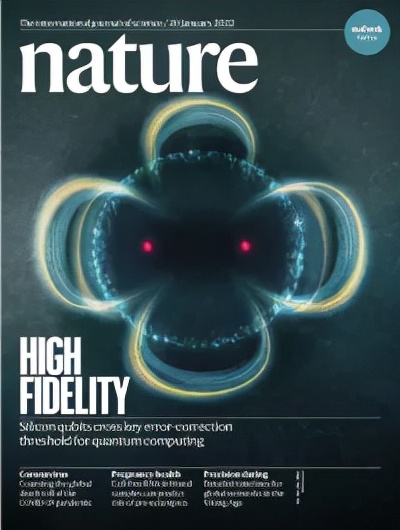
Quantum logic with spin qubits crossing the surface code threshold
超越表面码阈值的自旋比特量子逻辑
▲ 作者:Xiao Xue, Maximilian Russ, Nodar Samkharadze, Brennan Undseth, Amir Sammak, Giordano Scappucci, et al.
▲ 链接:
https://www.nature.com/articles/s41586-021-04273-w
▲ 摘要
量子比特的高保真控制对于量子算法的可靠执行和实现容错(纠正错误的速度快于错误发生的速度)至关重要。容错的核心要求用错误阈值表示。然而实际阈值取决于许多细节,一个常见目标是约1%误差阈值的表面码。
两比特门保真度超过99%一直是半导体自旋量子比特的主要目标。由于可以利用先进的半导体技术,这些量子比特有望扩展。
研究组报道了一种基于自旋的硅量子处理器,其单比特门和两比特门保真度都高于99.5%,通过门集断层扫描进行验证。当包含相邻量子比特的串扰和空转误差时,平均单比特门保真度仍保持在99%以上。
通过这个高保真门集,研究组使用变分量子本征求解器算法完成了计算分子基态能量的艰巨任务。半导体量子比特超越了两比特门保真度99%的阈值,身处高噪声的中等规模量子器件时代,在容错和可能的应用方面已争取到一席之地。
▲ Abstract
High-fidelity control of quantum bits is paramount for the reliable execution of quantum algorithms and for achieving fault tolerance—the ability to correct errors faster than they occur. The central requirement for fault tolerance is expressed in terms of an error threshold. Whereas the actual threshold depends on many details, a common target is the approximately 1% error threshold of the well-known surface code. Reaching two-qubit gate fidelities above 99% has been a long-standing major goal for semiconductor spin qubits. These qubits are promising for scaling, as they can leverage advanced semiconductor technology. Here we report a spin-based quantum processor in silicon with single-qubit and two-qubit gate fidelities, all of which are above 99.5%, extracted from gate-set tomography. The average single-qubit gate fidelities remain above 99% when including crosstalk and idling errors on the neighbouring qubit. Using this high-fidelity gate set, we execute the demanding task of calculating molecular ground-state energies using a variational quantum eigensolver algorithm. Having surpassed the 99% barrier for the two-qubit gate fidelity, semiconductor qubits are well positioned on the path to fault tolerance and to possible applications in the era of noisy intermediate-scale quantum devices.
Fast universal quantum gate above the fault-tolerance threshold in silicon
硅中超越容错阈值的快速通用量子门
▲ 作者:Akito Noiri, Kenta Takeda, Takashi Nakajima, Takashi Kobayashi, Amir Sammak, Giordano Scappucci, et al.
▲ 链接:
https://www.nature.com/articles/s41586-021-04182-y
▲ 摘要
能够解决难题的容错量子计算机依赖于量子纠错。表面码是最有前途的纠错码之一,它要求通用门保真度超过99%的纠错阈值。
在众多量子位平台中,只有超导电路、捕获离子和金刚石中的氮空位中心能满足这一要求。硅中的电子自旋量子位因其纳米制造能力而颇有潜力应用于大规模量子计算机,但由于运行缓慢,两比特门保真度被限制在98%。
研究组通过使用微磁感应梯度场和可调谐双量子位耦合的快速电子控制,在硅自旋量子位中实现了99.5%的两比特门保真度和99.8%的单比特门保真度。他们确定了量子位的旋转速度和耦合强度,稳健地实现了高保真门。
使用该通用门集,研究组成功实现了Deutsch-Jozsa和Grover搜索算法。研究结果表明,通用门保真度超越了容错阈值,并有望实现可扩展硅量子计算机。
▲ Abstract
Fault-tolerant quantum computers that can solve hard problems rely on quantum error correction. One of the most promising error correction codes is the surface code, which requires universal gate fidelities exceeding an error correction threshold of 99 per cent. Among the many qubit platforms, only superconducting circuits, trapped ions and nitrogen-vacancy centres in diamond have delivered this requirement. Electron spin qubits in silicon are particularly promising for a large-scale quantum computer owing to their nanofabrication capability, but the two-qubit gate fidelity has been limited to 98 per cent owing to the slow operation. Here we demonstrate a two-qubit gate fidelity of 99.5 per cent, along with single-qubit gate fidelities of 99.8 per cent, in silicon spin qubits by fast electrical control using a micromagnet-induced gradient field and a tunable two-qubit coupling. We identify the qubit rotation speed and coupling strength where we robustly achieve high-fidelity gates. We realize Deutsch–Jozsa and Grover search algorithms with high success rates using our universal gate set. Our results demonstrate universal gate fidelity beyond the fault-tolerance threshold and may enable scalable silicon quantum computers.
地球科学 Earth Science
Historical glacier change on Svalbard predicts doubling of mass loss by 2100
2100年斯瓦尔巴群岛的冰川质量损失将翻倍
▲ 作者:Emily C. Geyman, Ward J. J. van Pelt, Adam C. Maloof, Harald Faste Aas & Jack Kohler
▲ 链接:
https://www.nature.com/articles/s41586-021-04314-4
▲ 摘要
冰川和冰盖的融化约占目前海平面上升的三分之一,超过了体积更大的格陵兰岛或南极冰原所造成的损失。北极斯瓦尔巴群岛的空间气候梯度比下个世纪预测的现世气候变化要大,它是一个自然实验室,用于限制冰川的气候敏感性并预测其对未来变暖的反应。
研究组将历史冰川和现代冰川的观测联系起来,预测21世纪冰川变薄的速度将是1936-2010年的两倍多。利用1936和1938年的历史航拍图像存档,他们通过运动结构摄影测量法重建了斯瓦尔巴群岛上1594条冰川的三维几何形状。
研究组将这些重建数据与现代冰川海拔数据进行比较,得出了70多年时间跨度内质量平衡的空间模式,使人们能够通过年际和年代际变化的噪声,来量化诸如温度和降水等变量如何控制冰川的损失。
研究组发现融化速率对温度有很强的依赖性,即平均夏季温度每升高1℃,面积归一化质量平衡每年减少0.28 m的水当量。最后,研究组设计了一个时空替代方案,将他们的历史冰川观测与气候预测相结合,并对斯瓦尔巴群岛的21世纪冰川变化做出一级预测。
▲ Abstract
The melting of glaciers and ice caps accounts for about one-third of current sea-level rise, exceeding the mass loss from the more voluminous Greenland or Antarctic Ice Sheets. The Arctic archipelago of Svalbard, which hosts spatial climate gradients that are larger than the expected temporal climate shifts over the next century, is a natural laboratory to constrain the climate sensitivity of glaciers and predict their response to future warming. Here we link historical and modern glacier observations to predict that twenty-first century glacier thinning rates will more than double those from 1936 to 2010. Making use of an archive of historical aerial imagery from 1936 and 1938, we use structure-from-motion photogrammetry to reconstruct the three-dimensional geometry of 1,594 glaciers across Svalbard. We compare these reconstructions to modern ice elevation data to derive the spatial pattern of mass balance over a more than 70-year timespan, enabling us to see through the noise of annual and decadal variability to quantify how variables such as temperature and precipitation control ice loss. We find a robust temperature dependence of melt rates, whereby a 1 °C rise in mean summer temperature corresponds to a decrease in area-normalized mass balance of −0.28 m yr−1 of water equivalent. Finally, we design a space-for-time substitution to combine our historical glacier observations with climate projections and make first-order predictions of twenty-first century glacier change across Svalbard.