
The Pseudoscience of Beauty Products
美容护肤产品的伪科学
导读
Timothy Caulfield是北美地区著名的“伪科学斗士”,写过揭秘伪科学的书,做过电视节目。他本人是法学教授,专供健康方面的法律和政策。喜欢怼那些为各种产品代言的明星们,这次他盯上了各种美容护肤产品,他想揭秘一下这些东西到底管不管用。
去年,我决定采取一种全新的皮肤保养方法,当然这对于那些明星们可能很稀松平常,人家可能每天都在这么做。 我这一方面是为了“面子”,另一方面也算一个科学实验吧。 我就是想看看这些“高科技”养颜美容产品管不管用,到底值不值那么多钱。

Timothy Caulfield本人,是不是有点眼熟?出现在很多科学类电视节目中,以反伪科学著名
通过一个在加拿大Calgary(加拿大第四大城市)上班的皮肤科医生朋友我认识了Marie,Marie在我这个医生朋友单位旁边开了一家叫“skin science”的诊所。Maire的诊所,不是传统意义上的诊所,其实是提供让人提升外表以及肤质的美容服务和产品的。Marie带着我参观了一下他们的诊所,边带我参观,边跟我强调说,“我其实是一个skin coach”(性质类似私人健身教练,skin coach针对皮肤给出个性化的建议)。Marie有微生物学的学位,人特别好,当然皮肤也是一点儿瑕疵都没有。

Marie 诊所里的皮肤分析设备
Marie的办公室是一个全白世界:白桌子,白墙,白椅子,白设备。 她用长的好像星际迷航里企业号星舰舰桥上的东西的一种设备,给我的面部拍了照,她根据这些照片提供的信息,来推荐治疗方法。机器生成了一系列的我的面部的彩色照片,而且是看起来不是很让人愉悦那种,每一张都会突出我皮肤一种属性,像皱纹状况,潮红度,阳光损伤度,毛孔状况。
这台机器是看起来让人印象深刻,从诊所回来后,我费了好大的劲去挖掘关于这个机器的信息:很遗憾,没有找到一个关于这个机器的临床价值的独立分析。在生产机器的厂家的网站上找到了一些信息,“厂家在设备上部署了皮肤质地分析软件来帮助商家推销各种品牌的化妆品,可以有效的帮助各种皮肤护理服务增加销量,但是从来不是用来做临床试验的。” 文字透露出来的意思似乎很明显,那就是厂家,把这个设备作为促销工具。所以我们有理由怀疑之前诊所给出的结果的意义以及准确性。
不过,设备给皮肤拍照,然后评估皮肤的状况的逻辑还算讲的通,我也就跟着Marie的步调继续走了。
分析的结果有好有坏,好消息是:我皱纹方面条件还不错,对于我这个年龄段以及人种来说,我的皱纹比95%的人都少。坏消息是:“你的毛孔是,我八年来见过的最差的毛孔”,Marie一边摇头,一边告诉我。听了这话,我恨不得立马跑出去用工业级的溶液来搓脸。
最后,我从Marie的诊室带着一袋子的高端美容产品满载而归: 一个用来缓解皮肤老化的清洁去角质凝胶,另外一个控制细菌的清洁露,还有一个专为粗糙毛孔设计的晚霜,以及一个兼具有防晒作用的日霜。给出来的“解决方案”就是,每天早晚使用这些产品,连续使用三个月。
美容产业,毋庸置疑是一个巨大的产业。 它保罗万象,从美白牙膏,到号称能提升发质价格昂贵的洗发露, 名人代言的化妆品,香水,还有一箩筐的其他时髦产品。还有数不尽的健身,瘦身秘笈。我无意于去分析每一款名人代言的号称有美容效果的产品。 这些产品可谓无穷无尽,但是你只需要明白美丽产业是一股与名人,以及那些以名人为中心的媒体紧密共生的文化力量就够了。这个产业的体量,以及影响力,对每个想获取到这个产业真相的人,都是巨大的挑战。
我尝试寻找能够对这些宣称美容,抗衰老效果的产品提供独立见解的专家。 但是这比想象的难的多。很多专家,其实不是独立的科学家,而是在诊所行医的皮肤科医生。他们从蓬勃发展的美容产业获益。 这并不是说,医生故意的吹嘘美容产品的效果,但是这种利益冲突会影响研究展示以及解读的方式,没有人愿意说自己做的事业其实是骗人的。
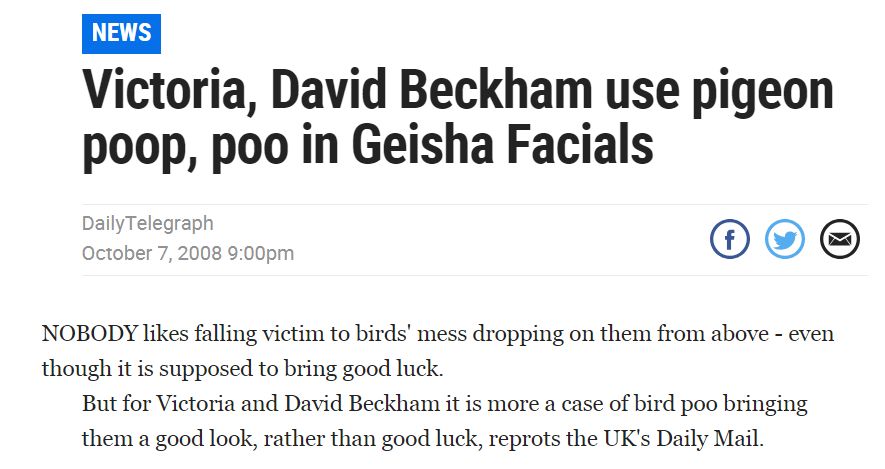
贝克汉姆夫妇用“鸟粪”护肤的新闻
另外,目前缺少独立研究者的相关研究成果。很多美容产品,根本没有相关数据,或者只有产品推广者做的一些小规模的研究。在某种程度上,这是可以理解的,政府研究机构,比如说像美国国立卫生院,加拿大国立卫生院这样的机构,没有兴趣对这些产品去做大规模的双盲有安慰剂控制组的研究,比如说贝克汉姆夫妇用的鸟粪面霜,相应也没有多少科学结论得出。
更糟的是,大众媒体对这些新上架的美容产品基本上从不批评。虽然确实也有不少优秀客观的媒体在报道美容产业(经常是批评),但是绝大多数的媒体文章还是鼓吹他们的宣称的效果,用一些模糊的形容词比如说像“重换新生”,“光彩照人”。很难找到一些令人信服的证据或者专业信息,大都是个人的一些说词(这个不用多说,也知道不靠谱)。这些文章里被引用的所谓的专家,大都是美容产业从业人员,或者没有学术背景的人。举一个例子,有个经常被各种文章,广告引用的“专家”,是一个出名的女性健康杂志的专栏作家,她自己标榜的的一堆头衔是“eco-advisor”(经济咨询师) , “television personality”(经常在电视上抛头露面的人),“restaurateur”(开饭店的),这简历听起来倒是有意思,但是都算不上可以有资格对美容产品做理性分析的背景。
出版商们也不会卖那种说美容产品根本不管用的杂志。也因此,要想获得真实的可靠的关于抗衰老,美颜产品的信息,几乎不可能。在这里存在着一股让事实扭曲的合力:化妆品制造商,销售商要赚取高额利润,大规模伪科学,忽悠人的广告的狂轰滥炸,独立研究和信息的缺失,消费者对这些宣传效果的强烈需求。这些力量交织在在一起,编制了一个幻想:这些产品和疗法是有效的。我给这种现象起了个名字“beauty-industry efficacy bias”(美容行业效果偏差), 简称“BIEB”。
因为这个偏差的存在,我们应该对那些宣传的语言,时刻保持警惕,因为那些广告里说的“临床证明有效”,“皮肤专家认证”没有任何意义,因为鬼知道他们真正的含义是什么。什么样的研究证明这个产品是临床证明得了?是不是厂家问问几个买家就算临床证明? 千万别被这样的广告词忽悠了,特别是因为BIEB的存在,让客观分析不可能存在的情况下。
除了 这个BIEB问题,历史经验告诉我们,持怀疑观点的一方几乎总是笑到了最后。就像之前那些流行的减肥套餐一样,经过一段时间的充分暴露,那些曾经令人振奋的抗衰老产品根本达不到他们宣称的效果。
这里面明星们,从各个方面讲都处在这个巨大的护肤,抗衰老产业的核心位置。有调查统计,全球护肤市场是一个800亿美元的产业,而整个抗衰老产业到2015年可能会达到3000亿美元的产值。明星们为我们的皮肤该是什么样的树立了一个标杆。明星们人也毫无意外的成为了最受欢迎的护肤品营销工具。他们通过自己的护肤,美容行为,向大众渗透这些未经科学证实的抗衰老,护肤信条。
随便浏览一下流行报纸和杂志,你就会看到大量的有问题的名人美颜秘籍。基本上那些时尚,名人,健康类的杂志都会提供一些护肤,延缓衰老的建议。很多报纸都有相关专栏。每时每刻都会有数以百计的美容建议出现在杂志摊上。所有这些报道,都跟可信证据无缘。对于美容建议来说,这基本是上一个科学真空区,你怎么说都行。

Demi Moore的 水蛭疗法
所以,那些名人参与的抗衰老的宣传活动,不管是稍微有点儿夸张,还是一派胡言,基本上都会去规避知情审查。比如很多报纸杂志,毫无科学根据的报道,kate Midddleton 用蜂毒面膜保持青春面孔的事情。类似的还有好多这种毫无可信度可言的故事:Demi Moore的著名的水蛭疗法(有的地方吹嘘说可以清洁血液,提升循环,加速组织愈合),Katie Holmes
的蜗牛疗法:蜗牛爬过的地方可以留下含有丰富蛋白质,抗氧化剂,透明质酸的分泌物,这些分泌物可以让皮肤光滑,重获新生。想必这些满脸趴的高贵昆虫们吃的都是有机蔬菜吧。

Katie Holmes的“蜗牛疗法”
我相信我们中大多数人不会对这些事情太当真的,这只不过是娱乐大众的花边新闻。只有那么一小部分人愿意花大价钱买这些净化蜗牛,昆虫毒液,甚至鸟屎。但是这些故事却塑造着我们对于容颜的看法,也造就了有钱就可以永葆青春的幻象。他们让人觉得返老还童是真实的。
这一年以来我一直不间断的用着这些从Calgary护肤诊所拿回来的护肤产品。这是目前为止我为了护肤做的最多的事了。这些日常用的东西,价格不菲,而且花费的时间也挺多,那么我的皮肤到底有没有得到可以度量的改善呢?
这回我没有回之前去的那家诊所,我找了另外一个皮肤科专家,我也没告诉他,这其实是一个事后的测试。用这个方法(也许是我个人之见)可以获得一个比较客观的评估。如果我皮肤有改善,那么任何的护肤专家都应该能体察到。我只告诉这家新的诊所的员工我对自己皮肤状况比较好奇,这也倒是真事,我确实想知道怎么做才能提升肤质。
这家诊所(我就把名字匿掉了),也有一台“星际迷航”设备,就跟之前在Calgary 那家一样。诊所员工跟之前一样给我面部拍了照。公平起见,也许这些设备之间参数上可能有些差异。但是前后两次比较大的差异,外部可见的,应该可以检测到。
结果呢?并不太令人满意。工作人员告诉我,跟同龄的同种族的人相比,我的皮肤在8项指标中的4项低于平均水平,其中包括,纹理,皱纹水平,两个指标没有变化,包括毛孔质量。
这位皮肤科专家在评估分析了我的皮肤状况之后,给我推荐了几种OTC的抗衰老产品,大概500美元,够6个月用的,他承诺这些产品可以明显的改善我的皮肤状况。
-完-
Timothy教授并不是有医学背景的专家,他的这个所谓“实验”,也算不上严谨的科学实验。但是教授的提出的一些整个美容产品行业存在的问题,是不容忽视的,Timothy教授言辞犀利地揭示了beauty products行业乱象,也以亲身经历告诉了我们这个行业普遍存在的夸大宣传、有效性评价标准与严谨科学实验的缺乏。在这样一个庞大且成熟的商业王国面前,我们该更理智的去看待“miracle in a jar”,毕竟“返老还童”只出现在童话里。与其期待奇迹的发生,规律的作息、认真清洁、坚持防晒与保湿等,才是护肤的根本
MD团队
英文原文
Last year, as part vanity project, part science experiment, I decided to adopt a new skin-care routine, something that an aging celebrity might use on a daily basis. My goal was to determine whether, in fact, a high-tech routine can make a difference. Are beauty products worth it?
A dermatologist friend introduced me to Marie, who ran a “skin science” clinic next to his office in Calgary, Canada. This was not a medical office, but a clinic that provided cosmetic services and products aimed at helping people enhance the look and condition of their skin. “I am, really, a skin coach,” Marie told me as she showed me around the office. She had a degree in microbiology, was infectiously good-natured, and had absolutely flawless skin.
Marie invited me into her all-white office: white table, white walls, white chairs, and white machinery. Using a machine that would be at home on the bridge of the starship Enterprise, she took a picture of my face that, she explained, would provide a host of information about the treatment she would recommend. The machine produced a series of colorful, and less-than-flattering, images of my face, each highlighting a particular skin property, such as wrinkles, redness, sun damage, and pore quality.
Now, this machine looked impressive, but despite the good bit of digging I did after the appointment, I could not find an independent analysis of its clinical value. The website for the company that manufactures the machine states, among other things, that the company has “deployed [their] complexion-analysis software as a sales tool to promote” brands of cosmetic products, that it “impressively increases business in all of your skin-care services,” and that the machine “was never intended for clinical trials.” Reading between the lines (or, actually, simply reading the lines), it seemed the company viewed this machine as a way to move product. So there were reasons to be dubious about the meaning and relevance of the results.
Still, the premise of the device, taking pictures of my face to assess its condition, was not far-fetched. I went with the flow.
The good news: My wrinkle situation was great. For my age and ethnicity, I had fewer wrinkles than about 95 percent of the population. The bad news: “You have the worst pores I have seen in over eight years,” Marie told me with a shake of her head. I stifled the sudden impulse to dash out of the room to scrub my face with an industrial-strength solvent.
I left Marie’s office with a bag full of high-end beauty products, including a cleansing-exfoliation gel that was designed to decongest aging skin, another cleaning lotion to control bacteria, a nighttime moisturizer that claims to be specifically designed for bad pores, and a morning moisturizer that doubles as a sunblock. The plan was to use these products morning and night for three months.
The beauty industry is, of course, massive. It involves everything from teeth-whitening toothpaste to ridiculously expensive shampoo that will transform your hair from “ordinary to extraordinary,” if you believe an advertisement for a product that contains white truffles and caviar and costs more than $60 for an 8.5-ounce bottle. It involves celebrity-endorsed cosmetics, perfumes, and a host of fashion products. And it involves numerous fitness and slimming gimmicks. I will make no attempt to undertake a comprehensive analysis of every allegedly beautifying product that is touched by a celebrity. The number is infinite. It’s enough to know that the beauty industry is a huge cultural force in a tight, symbiotic relationship with celebrities and the celebrity-oriented media. The size and influence of this industry creates challenges for anyone seeking to get to the truth about the products it makes and promotes.
In my research I worked hard to find experts who could provide a reasonably independent view of the alleged benefits of the myriad beauty and anti-aging products and services. This proved to be much more difficult than I anticipated. Many experts I found were not independent scientists, but dermatologists who also had a clinical practice and, as such, benefit (some greatly) from a thriving industry. I am not saying that physicians knowingly twist information about the efficacy of beauty treatments, but there is ample evidence that such conflicts of interest can have an impact on how research is presented and interpreted.
In addition, little literature produced by independent researchers is out there. For many beauty products, there seem to be either no data or only small studies produced by proponents of the product. To some degree, this is understandable. Government research entities, such as the U.S. National Institutes of Health or the Canadian Institutes of Health Research, have little interest in funding big double-blind placebo-controlled studies on the efficacy of, for instance, the bird-poop face cream used by David and Victoria Beckham. So there isn’t a lot of good science to draw on.
To make matters worse, the popular press is rarely critical of new beauty products. While I found many excellent and balanced media stories on beauty treatments (usually panning them), the vast majority of articles simply trumpet their alleged value, using vague descriptors such as revitalize and radiate. Rarely did I find any real evidence or expertise beyond personal testimonies (which I don’t need to remind you are not evidence). The so-called experts who are quoted in these stories are often part of the beauty industry or individuals with no research background. To cite just one example, a frequently quoted “expert” who is a beauty columnist for a well-known women’s-health magazine, and an advocate for all things pseudoscientific, describes herself as an eco-advisor, television personality, and restaurateur—interesting resume, for sure, but hardly a background that lends itself to a critical analysis of beauty products.
Publishers don’t generally sell magazines by reminding readers that nothing works. Consequently, getting straight answers about anti-aging and beauty products is nearly impossible. There exists a confluence of fact-twisting forces: lots of money to be made by manufacturers and providers, huge advertising campaigns that deploy vast quantities of pseudoscientific gobbledygook, a lack of independent research and information, and consumers who desperately want the products to do for them what is claimed. The cumulative impact of all these forces results in a massive bias toward representing a product or procedure as effective. I call this the “beauty-industry efficacy bias,” or BIEB for short. (Note: The link between the BIEB acronym and Justin Bieber’s nickname was not intentional, but it does work out well.)
Given the existence of the BIEB, we should always bring a furiously critical eye to the assessment of any claim made by Big Beauty. Phrases such as “clinically proven” or “dermatologist approved” have little meaning because they could refer to almost anything. For example, what kind of study led to the representation that a given product was clinically proven? Did the manufacturers simply ask a couple of buyers? Do not be fooled by this kind of language, particularly when the presence of the BIEB makes critical analysis of the claims unlikely.
In addition to the BIEB dilemma, history tells us that a skeptical position is almost always correct. As with trendy diets, after a bit of time it almost invariably becomes clear that the alleged benefits associated with some new, exciting anti-aging beauty product can’t live up to the hype.
In many ways, celebrity culture sits at the center of the massive skin-care and anti-aging industry. Some estimates put the global skin-care market at approximately $80 billion, and it has been suggested that the entire anti-aging industry will be worth almost $300 billion by 2015. Celebrity culture helps to set the benchmark for how our skin is supposed to look. Celebrities are increasingly used to market skin-care products. And through their well-publicized beauty rituals, they help to perpetuate an assortment of anti-aging and skin-care beliefs—the vast majority of which are unscientific and completely unproven.
A cursory scan of popular newspapers and magazines turns up an overwhelming number of questionable celebrity beauty tips. Virtually every magazine with a focus on fashion, celebrities, health, or fitness offers regular advice on skin care and combating aging. Most newspapers have a weekly style or beauty section. At any given moment, probably hundreds of beauty-related recommendations are sitting on the average midsize magazine stand. And all these stories are almost completely devoid of any reference to credible evidence. Beauty advice is a science-free zone. Anything goes.
It is no surprise, then, that celebrity anti-aging activities, whether mildly nutty or utterly senseless, usually evade informed scrutiny. For example, many newspapers and magazines reported, often without a single reference to science, that Kate Middleton used a bee-venom facial as a needle-free shortcut to youthful, line-free skin. A similarly uncritical attitude characterized stories about Demi Moore’s famous leech therapy (which, as one source boasts, “cleanses the blood, improves circulation, and boosts tissue healing”) and the use of snails on the face, favored by celebs such as Katie Holmes, that, as reported by Glamour, leave a trail of “mucus that’s packed with proteins, antioxidants, and hyaluronic acid, which leaves the skin looking glowy and refreshed.” Apparently, the face-crawling gastropods are fed only organic vegetables.
I realize that most of us don’t take these stories too seriously. They are fun and entertaining diversions. Only a small segment of the public is willing to pay the ridiculous prices demanded by purveyors for purifying snails, insect poison, and nightingale excrement. But these stories help to frame how we think about beauty, and they foster the illusion that celebrity status (and wealth) provides access to magically effective anti-aging treatments. They make it seem as if there is something that can be done.
I have been using the products provided at my visit to the skin-care clinic in Calgary relatively faithfully during the past year. This is the most, by far, that I have ever done for my skin. The products used in the routine were expensive and the commitment of time considerable. So are there any measurable improvements?
Instead of going back to the original Calgary clinic, I decide to go to a different dermatologist, one who has no idea that this is an “after” test. This strategy, or so my thinking goes, will help to ensure a relatively objective assessment. If my skin has improved, it should be noticeable by any skin-care expert. I simply tell the staff at the new clinic that I am curious about the condition of my skin, which is absolutely true, and that I want to know what can be done to improve it.
The new clinic, which will remain nameless, has the identical Star Trekmachine that was used to assess my skin in Calgary one year ago. The clinic staff takes pictures of my face just as the first staff did. To be fair, I suppose there may be calibration differences between the machines. But any significant difference, one that would be visible to the outside world—which is, after all, the whole point—should be detectable.
The results? Not impressive. Compared to people of my age and ethnicity, I’m told, my skin actually got worse on four of the eight assessment criteria, including texture and the all-important wrinkle category. My skin scores are about the same (within a few percentage points) on two of the criteria, including pores.
After the dermatologist finishes reviewing my skin analysis, he recommends several over-the-counter anti-aging products, at the cost of more than $500 for a six-month supply. These products and potions will dramatically improve my skin situation, he promises.
-END-
双语MD的健康科普
Trusted Advice For A Healthy Life

长按二维码,关注我们