
分享兴趣,传播快乐,增长见闻,留下美好。
亲爱的您,
这里是LearingYard学苑!
今天小编为大家带来博士论文《电子商务供应链物流服务模式优化策略研究》精读(6),
欢迎您的用心访问!
本期推文阅读时长大约5分钟,请您耐心阅读。
Share interests, spread happiness, increase knowledge, and leave behind beauty.
Dear you,
this is LearningYard Academy!
Today, Xiaobian brings you the intensive reading of the doctoral dissertation "Research on the Optimization Strategy of E-commerce Supply Chain Logistics Service Mode" (6),
welcome your visit carefully!
This tweet will take about 5 minutes to read . Please read it patiently.
内容提要
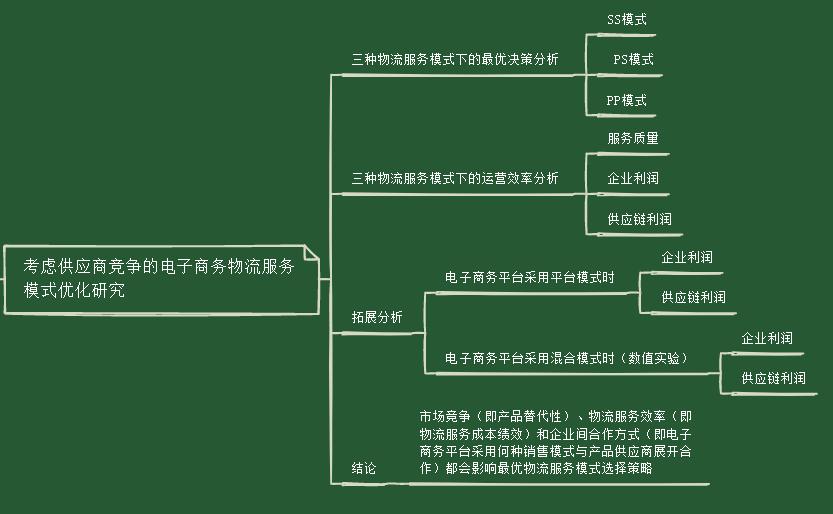
亲爱的读者大家好,今天小编将从思维导图、精读内容、知识补充三个板块为大家带来博士论文《电子商务供应链物流服务模式优化策略研究》的第四章考虑供应商竞争的电子商务物流服务模式优化研究,快来跟随小编一起学习吧!
Hello dear readers, today, Today, I will bring you the fourth chapter of the doctoral dissertation "e-commerce supply chain logistics service model optimization strategy research" from the three sections of mind map, intensive reading content, and knowledge supplement to optimize the e-commerce logistics service model considering supplier competition, Come and follow the editor to learn!
正文
01
思维导图
02
精读内容
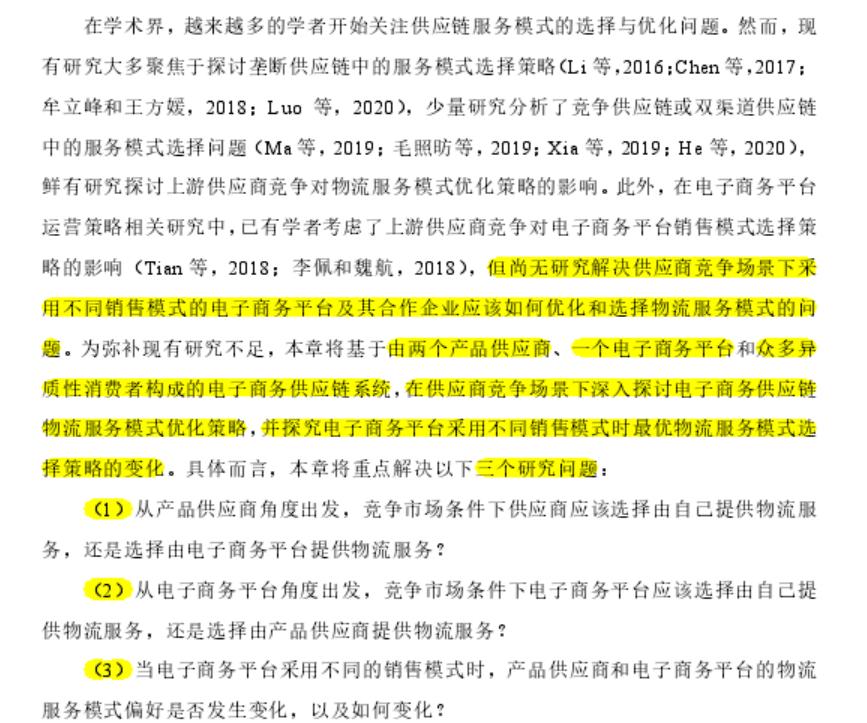
作者在引言中首先介绍了根据销售模式的不同可以将电子商务平台划分为转售型平台、开放型平台和混合型平台三种类型。在学术界,越来越多的学者开始关注供应链服务模式的选择与优化问题,但尚无研究解决供应商竞争场景下采用不同销售模式的电子商务平台及其合作企业应该如何优化和选择物流服务模式的问题,因此在本章中,作者主要探讨了在供应商竞争场景下深入探讨电子商务供应链物流服务模式优化策略,并探究电子商务平台采用不同销售模式时最优物流服务模式选择策略的变化。
In the introduction, the authors firstly introduced that e-commerce platforms can be classified into three types according to the sales model: resale, open and hybrid platforms.In academic circles, more and more scholars have started to pay attention to the selection and optimization of supply chain service models, but no research has yet addressed the issue of how to optimize and select logistics service models for e-commerce platforms and their partner companies that adopt different sales models in a supplier competition scenario. strategies in the supplier competition scenario, and explore the changes of optimal logistics service model selection strategies when e-commerce platforms adopt different sales models.
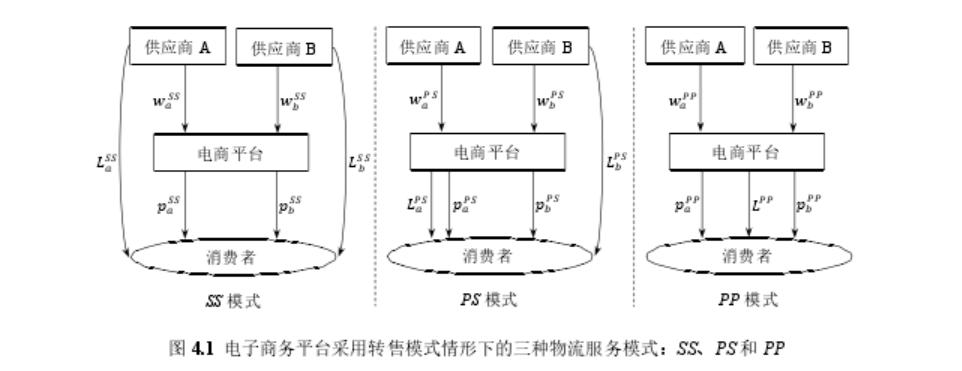
接下来构建模型,给出了模型中涉及到的参数,介绍了市场中存在三种潜在的物流服务模式。
SS(Supplier-supplier)模式:供应商和供应商分别为产品与产品提供物流服务。
PS(Platform-supplier)模式:电子商务平台为产品提供物流服务,供应商为产品提供物流服务。
PP(Platform-platform)模式:电子商务平台同时为产品和产品提供物流服务。
Next, the model is constructed, the parameters involved in the model are given, and three potential models of logistics services exist in the market are introduced.
SS (Supplier-supplier) model: Suppliers and vendors provide logistics services for products and products, respectively.
PS (Platform-supplier) model: E-commerce platform provides logistics services for the product and the supplier provides logistics services for the product.
PP (Platform-platform) model: E-commerce platform provides logistics services for both products and products.
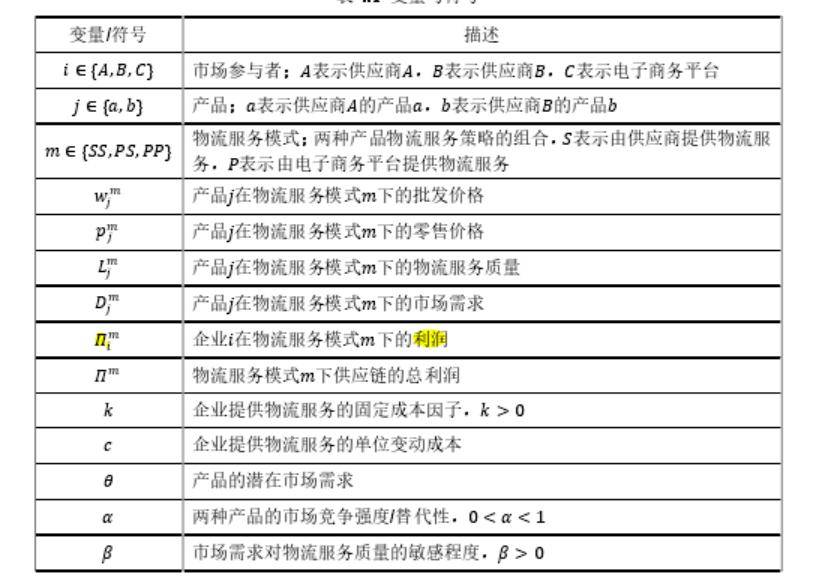
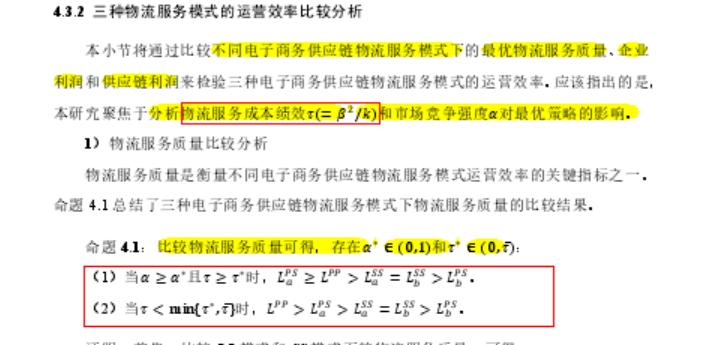
基于以上的模型设定和假设,作者分别在三种不同的物流服务模式下采用逆向归纳法求解,均衡状态下的物流服务质量、批发价格和零售价格,并根据公式分析服务质量和服务成本对价格、需求等的影响。之后通过比较不同电子商务供应链物流服务模式下的最优物流服务质量、企业利润和供应链利润来检验三种电子商务供应链物流服务模式的运营效率。
作者依次分析了四种情景的利润函数和最优价格、物流服务质量等不同因素的函数。并通过比较这些因素来检验供应链的运营效率,比较RS、RP、MS 和 MP 情境下的这些因素的大小,分析不同情景下的最优决策,。
Based on the above model settings and assumptions, the authors use the inverse induction method to solve, respectively, the logistics service quality, wholesale price and retail price in equilibrium under three different logistics service models, and analyze the effects of service quality and service cost on price and demand, etc. according to the formula. After that, the operational efficiency of three e-commerce supply chain logistics service models is examined by comparing the optimal logistics service quality, enterprise profit and supply chain profit under different e-commerce supply chain logistics service models.
The authors analyze the profit functions of the four scenarios and the functions of different factors such as optimal price and logistics service quality in turn. And by comparing these factors to examine the operational efficiency of the supply chain, the magnitude of these factors in RS, RP, MS and MP scenarios are compared to analyze the optimal decision in different scenarios.
最后作者又对主模型进行拓展,拓展研究了电子商务平台采用平台模式情形下的最优物流服务模式选择策略。此外还分析了电子商务平台采用混合模式情形下的最优物流服务模式选择策略,主要是针对供应商利润、电子平台利润、供应链整体利润分析。最后基于以上分析对本章的研究成果进行了总结。
Finally, the authors extend the main model to study the optimal logistics service model selection strategy in the case of e-commerce platform using the platform model. In addition, the optimal logistics service model selection strategy under the case of mixed mode of e-commerce platform is analyzed, mainly for supplier profit, e-platform profit, and overall supply chain profit. Finally, the research results of this chapter are summarized based on the above analysis.
03
知识补充
在这一章中涉及到了三种不同的电子商务平台,以及提到了双重边际效应,那这些名词是什么意思呢?
转售型平台: 通过向终端消费者转售从上游供应商处购买的产品来盈利。
开放型平台: 通过向上游供应商提供产品直销渠道和配套服务以赚取佣金和服务费。
混合型平台: 既作为传统零售商转售从上游供应商处购买的产品,又为上游供应商提供产品直销渠道和增值服务。
双重边际效应:信息不对称的情况下,由于供应链双方片面追求自身利益最大化,而导致供应链的整体效应低于供应链双方之和的现象。
In this chapter, three different types of e-commerce platforms are covered, as well as the mention of double margins, so what do these terms mean?
Resale Platform: Earn by reselling products purchased from upstream suppliers to end consumers.
Open Platform: Earn commissions and service fees by providing direct sales channels and ancillary services to upstream suppliers.
Hybrid platform: reselling products purchased from upstream suppliers as a traditional retailer and providing direct sales channels and value-added services to upstream suppliers.
Double marginal effect: The phenomenon that the overall effect of the supply chain is lower than the sum of the two sides of the supply chain due to the one-sided pursuit of self-interest maximization by both sides of the supply chain under the situation of information asymmetry.
今天的分享就到这里了。
如果您对今天的文章有独特的想法,
欢迎给我们留言,
让我们相约明天。
祝您今天过得开心快乐!
That's all for today's sharing.
If you have a unique idea for today’s article,
please leave us a message,
and let us meet tomorrow.
I wish you a happy day !
参考资料:Deepl翻译
参考文献:覃雪莲. 电子商务供应链物流服务模式优化策略研究[D].华中科技大学,2021.