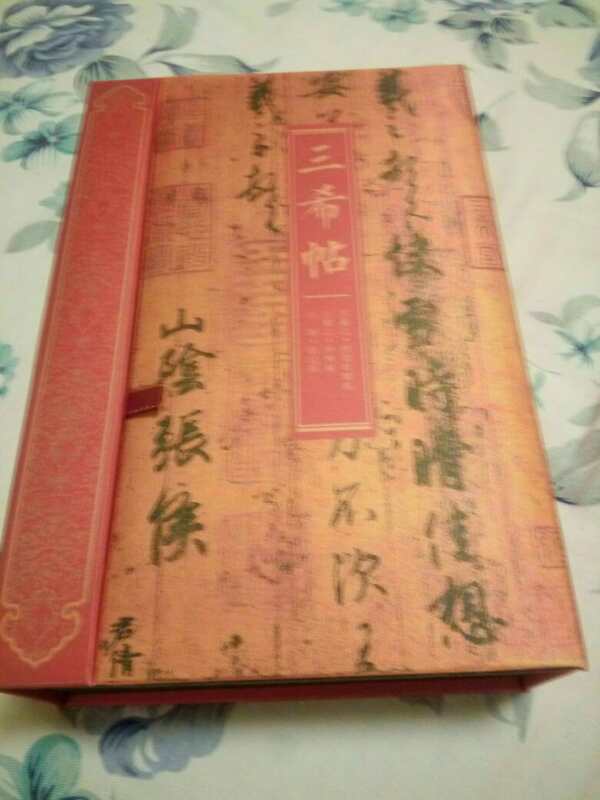
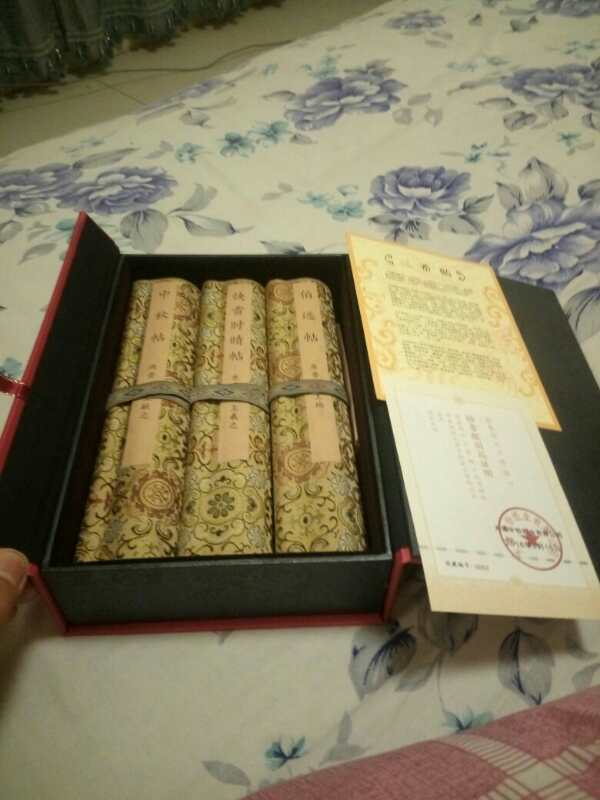
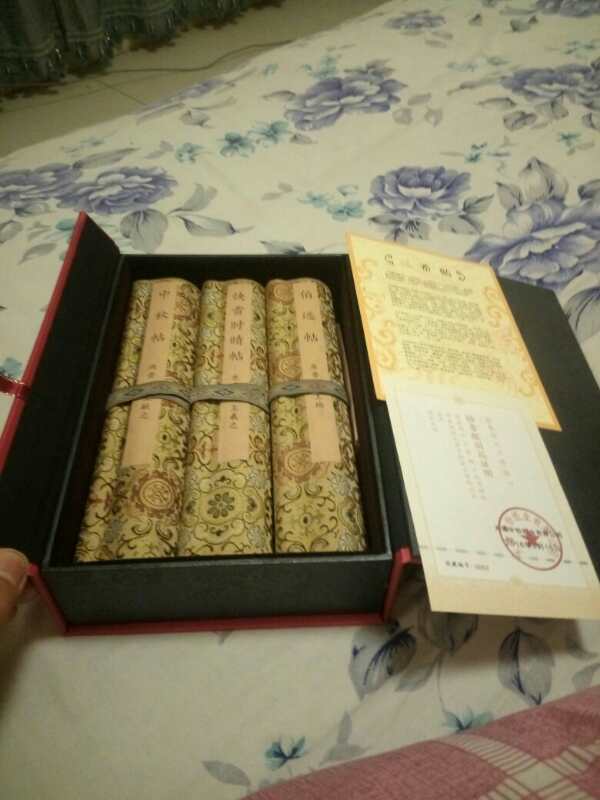
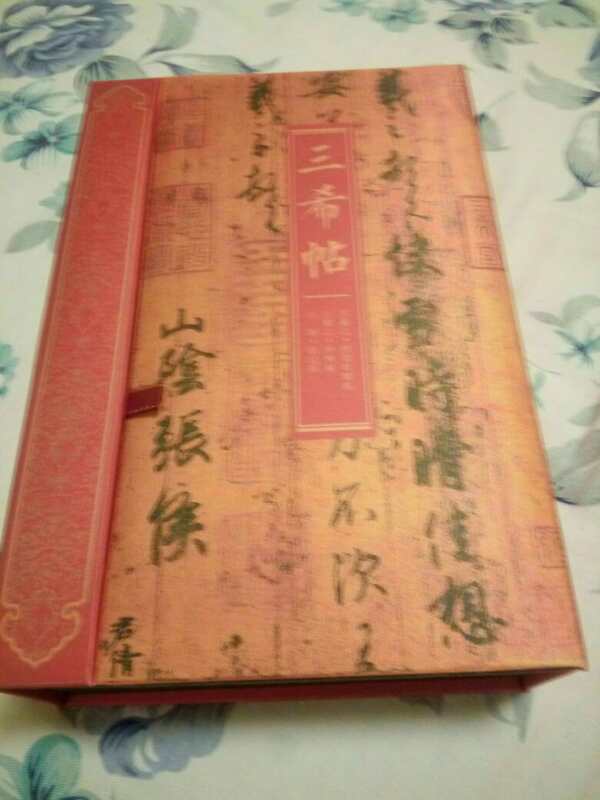
‘三希帖’是晋朝书法家王羲之的《快雪时晴帖》(行书),王献之的《中秋帖》(草书),王珣的《伯远帖》(行书),这三幅代表了中国书法艺术的最高水平的书法字帖。
藏品介绍
中文名称:三希帖
英文名称:3 and 1
类别:书法
规格:快雪时晴帖,伯远帖,中秋帖,三帖成套
羲之顿首。快雪时晴。佳想安善。未果。為结。力不次。王羲之顿首。
山阴张侯。君倩。
《快雪时晴帖》是晋朝书法家王羲之的书法作品,以行书写成。帖纵23cm;横14.8cm ,行书四行,二十八字。《快雪时晴帖》是一封书札,其内容是作者写他在大雪初晴时的愉快心情及对亲人的问候。
珣顿首顿首,伯远胜业情期群从之宝。自以羸患, 志在优游。始获此出意不克申。分别如昨永为畴古。远隔岭峤,不相瞻临。
《伯远帖》是东晋王珣(350-401年)书写的一封信,纸本,行书,5行共47字,纵25.1cm,横17.2cm。卷首上方为乾隆时所钤“内府图书”,下方为“游六艺圃”是乾隆所用闲章。“江左风华”左侧有乾隆“观书为乐”闲章。卷前引首有乾隆御书:“江左风华”四大字,上有“乾隆御笔”一玺。并御题:“唐人真迹已不可多得,况晋人耶!内府所藏右军快雪帖,大令中秋帖,皆希世之珍。今又得王珣此幅茧纸家风信堪并美!几余清赏亦临池一助也。御识。”钤“乾隆宸翰”、“涵虚朗鉴”二玺。前隔水御书:“家学世范,草圣有传,宣和书谱”12字。下有:“乾隆宸翰”、“几暇临池”、“耽书是宿缘”三玺。字上有乾隆晚年常用的“五福五代堂古稀天子宝”。又御识:“乾隆丙寅春月,获王珣此帖,遂与快雪中秋二迹并藏养心殿温室中,颜曰:‘三希堂’,御笔又识”,钤“乾”、“隆”二玺。后隔水上有明董其昌跋,后有乾隆御绘枯枝文石,并识:“王珣帖与其昌跋皆可宝玩,即装池侧理亦光润堪爱,漫制枯枝文石以配之。乾隆丙寅春正,长春书屋御识”,钤“几暇怡情”一玺。后有“墨云”一玺。卷尾敕董邦达绘图,邦达有记,又有沈德潜书“三希堂歌”。卷后有董其昌、王肯堂题记。本幅前后有古半印二,漫漶不可识。清代所钤宝玺有:“石渠宝笈”、“乾隆鉴赏”、“乾隆御览之宝”、“三希堂精鉴玺”、“宜子孙”、“养心殿鉴藏宝”诸玺。除此之外还有乾隆的“八征耄念之宝”,“太上皇帝之宝”,“御赏”,“内府书画之宝”,“神怡性灵”,“研露”。收传印记上钤有“郭氏觯斋秘笈之印”,“范阳郭氏珍藏书画”。
中秋不復不得相,還爲即甚省如,何然勝人何慶,等大軍。
《中秋帖》传为晋王献之书(又传宋朝画家米芾所临摹)纸本,手卷,纵27cm,横11.9cm。卷前引首清高宗弘历行书题“至宝”两字。前隔水乾隆御题一段。帖正文右上乾隆御题签“晋王献之中秋帖”一行。卷后有明董其昌、项元汴,清乾隆题跋,其中附乾隆帝、丁观鹏绘画各一段。卷前后及隔水钤有宋北京“宣和”内府、南宋内府,明项元汴、吴廷,清内府等鉴藏印。
王羲之(303年—361年,一作321年—379年),字逸少,东晋时期著名书法家,有“书圣”之称。琅琊临沂人,后迁会稽山阴(今浙江绍兴),晚年隐居剡县金庭。历任秘书郞、宁远将军、江州刺史,后为会稽内史,领右将军。其书法兼善隶、草、楷、行各体,精研体势,心摹手追,广采众长,备精诸体,冶于一炉,摆脱了汉魏笔风,自成一家,影响深远。风格平和自然,笔势委婉含蓄,遒美健秀。代表作《兰亭序》被誉为“天下第一行书”。在书法史上,他与其子王献之合称为“二王”。
王珣(349年-400年6月24日),字元琳 ,小字法护 ,琅玡临沂(今山东省临沂市)人,丞相王导之孙,中领军王洽之子,东晋大臣、书法家。王珣与殷仲堪,徐邈、王恭、郗恢等均以才学文章受知于雅好典籍的孝武帝司马曜,累官左仆射,加征虏将军,并领太子詹事,安帝隆安元年(公元397年)迁尚书令,加散骑常侍,寻以病卒,终年五十二岁,谥号献穆。董其昌称其“潇洒古澹,东晋风流,宛然在眼。”
王献之(344年-386年),字子敬,小名官奴,汉族,祖籍山东临沂,生于会稽山阴(今浙江绍兴),书圣王羲之第七子。东晋著名书法家、诗人、画家,晋简文帝司马昱之婿。官至中书令,为与族弟王珉区分,人称“大令”,与其父王羲之并称为“二王”。
此三帖书法是中国书法之最,价值不可估量,用‘价值连城’来形容一点也不为过。
英文翻译:The three xietie calligraphers in jin dynasty, wang xizhi's "quick snow when qing tie" (running script), wang xian-zhi's "Mid-Autumn festival tie" (cursive script), wang xun's "bo yuan tie" (running script), these three pieces represent the highest level of Chinese calligraphy.
Xi zhi stroked his head. When it snows, it clears. Good wants good. Not if really. For the knot. No time. Wang xizhi hit his head.
Sanyin zhanghou. Jun qian.
"Quick snow when qing tie" is a calligraphy work of wang xizhi, a calligrapher in the jin dynasty. Post longitudinal 23 cm; 14.8cm across, four lines, 28 words. "Quick snow" is a letter, the content of which is the author wrote in the snow when the first clear mood and his greetings to loved ones.
Xun dun head, bo yuan shengye group from the treasure. We will win the battle and aim for the best. This is the beginning of the out of the idea. As yesterday for domain ancient. Distant ridge, do not look forward to.
Po yuan post is a letter written by wang xun (350-401) in the eastern jin dynasty. The upper part of the scroll is qianlong's "inner library", and the lower part is "you liu yi pu", which is qianlong's stamp. "Jiang zuo fenghua" left qianlong "view book for music" chapter. Volume before the introduction of qianlong royal book: "jiang left fenghua" four characters, on the "qianlong imperial pen" a sign. And the imperial title: "the original works of the tang dynasty have been rare, jin people! < / p > < p > the house hid right army fast snow post, make the Mid-Autumn post, all the treasure of the world. Today also got wang xun this piece of cocoon paper letter worthy and beautiful! A few yuqing also linchi a help. Knowledge." "Qianlong chenhan", "han xuelang jian" two seals. Before the separation of water royal book: "the family study world fan, grass saint has a biography, xuanhe book spectrum" 12 words. Under: "qianlong chenhan", "several free time pool", "in writing is the fate of the three seals. On the word has qianlong's old age commonly used "wufu wudai tang guxi tianzi bao". Also royal knowledge: "qianlong bingyin spring moon, get wang xun this post, then with fast snow Mid-Autumn two trace and Tibet yangxin hall greenhouse, yan said: 'three xitang', the imperial pen and knowledge", the "stem", "long" two seals. < / p > < p > after the water is separated by the Ming dong qichang postscript, after the qianlong royal painting of dead branches and stones, and know: "wang xun post and its chang postscript can play, that is, the side of the pond also guangrunkan love, diffuse system of dead branches and stones to match. Qianlong bingyin spring is, changchun library royal knowledge ", zheng "several leisure delight" a sign. After "mo yun" a seal. The end chi dong bangda drawing, bangda has a record, and shen deqian book "three hitang song." After the volume of dong qichang, wang kantang inscription. This picture of the before and after two and a half seal, ManHuan do not know. The imperial seals of the qing dynasty are: "shiqu baoji", "qianlong appreciation",
"Qianlong imperial treasure", "sanxitang fine seal", "appropriate descendants", "yangxin dian jian treasure" seals. Besides, there are qianlong's "treasure of eight signs of being aged", "treasure of emperor taishanghuangdi", "royal appreciation", "treasure of painting and calligraphy in the inner mansion", "spirit of the spirit", "research dew". Accept the mark on the eagle has "the kwok vessels lent secret seal", "cherished a 22-year-old young man, the calligraphy and painting".
The Mid-Autumn festival is no longer phase, also for that is very province such as, how to win people he qing, such as the army.
The biography of the Mid-Autumn festival post is a book presented by the king of jin (and copied by the painter mi fu of song dynasty). Volume before the introduction of the first emperor gaozong hong li book title "treasure" two words. Qianlong before the water imperial title a paragraph. On the right of the main body of the qianlong royal signature "jin wang's Mid-Autumn festival post" line. After the volume of the Ming dong qichang, xiang yuanbian, qianlong inscriptions, which attached to the qianlong emperor, ding guanpeng painting a section. Before and after the volume and the separation of water eagle has song Beijing "xuanhe" inner house, the southern song dynasty inner house, Ming xiang yuanbian, wu ting, qing dynasty inner house and so on.
Wang xizhi (303 -- 361 years, a masterpiece of 321 -- 379 years) was a famous calligrapher in the eastern jin dynasty with few characters. Langya linyi, later moved to kuaijishanyin (today's zhejiang shaoxing), the old age of seclusion in shan county jinting. Secretary lang, ningyuan general, jiangzhou military history, after the jai internal history, leading the right general. His calligraphy also good script, grass, kai, line of each body, precision research body potential, the heart of the hand to catch up with, a wide range of long, fine body preparation, in a furnace, cast off the han and wei pen style, its own, far-reaching influence. The style is gentle and natural, the style is euphemistic and subtle, and the style is simple and beautiful. The masterpiece "lanting preface" is known as "the first line in the world". In the history of calligraphy, he and his son wang xianzhi were called "two Kings".
Wang xun (349-400 June 24), styled yuan Lin, little styled fa hu, native of linyi (present linyi city, shandong province), grandson of the prime minister wang dao, son of the central leader wang qa, minister of the eastern jin dynasty, calligrapher. Wang xun, Yin zhongkan, xu miao, wang gong, xi hui and so on are known in the classic books of xiaowu emperor sima yiu, tired officials left shot, a commando general, and led the crown prince zhan, long in the first year of an emperor (AD 397) to move to the order of the shang dynasty, a sanqi chang, to seek the sick, the year 52 years old, the posthumous name of xianmu. Dong qichang called it "natural and unfettered ancient Dan, eastern jin dynasty romantic, wan ran in the eye."
Wang xian-zhi (344-386), styled zi jing, was a minor official slave of the han nationality. The eastern jin dynasty famous calligrapher, poet, painter, jin jian wen di simayu husband. In order to distinguish it from his brother wang min, he called it "da ling" and his father wang xizhi called it "two Kings".
These three pieces of calligraphy are the most valuable calligraphy in China.