Roman numerals are represented by seven different symbols: I , V , X , L , C , D and M .
Symbol       Value
I             1
V             5
X             10
L             50
C             100
D             500
M             1000

罗马数字
For example, 2 is written as II in Roman numeral, just two one's added together. 12 is written as XII , which is simply X + II . The number 27 is written as XXVII , which is XX + V + II .
Roman numerals are usually written largest to smallest from left to right. However, the numeral for four is not IIII . Instead, the number four is written as IV . Because the one is before the five we subtract it making four. The same principle applies to the number nine, which is written as IX . There are six instances where subtraction is used:
- I can be placed before V (5) and X (10) to make 4 and 9.
- X can be placed before L (50) and C (100) to make 40 and 90.
- C can be placed before D (500) and M (1000) to make 400 and 900.
Given an integer, convert it to a roman numeral.
Example 1:
Input: num = 3
Output: "III"
Example 2:
Input: num = 4
Output: "IV"
Example 3:
Input: num = 9
Output: "IX"
Example 4:
Input: num = 58
Output: "LVIII"
Explanation: L = 50, V = 5, III = 3.
Example 5:
Input: num = 1994
Output: "MCMXCIV"
Explanation: M = 1000, CM = 900, XC = 90 and IV = 4.
Constraints:
- 1 <= num <= 3999
【思路】这个题一方面是了解了一下罗马数字的规则,另一方面注意限制条件,输入数字并不是很大,意味着处理起来的情况不会特别复杂,超过四千可能就会增加新的复杂度。这样的话对规则进行显性定义,然后遍历数字对于规则的匹配程度就可以完成这道题了。

思考间隔,下面是参考示例
【参考示例】
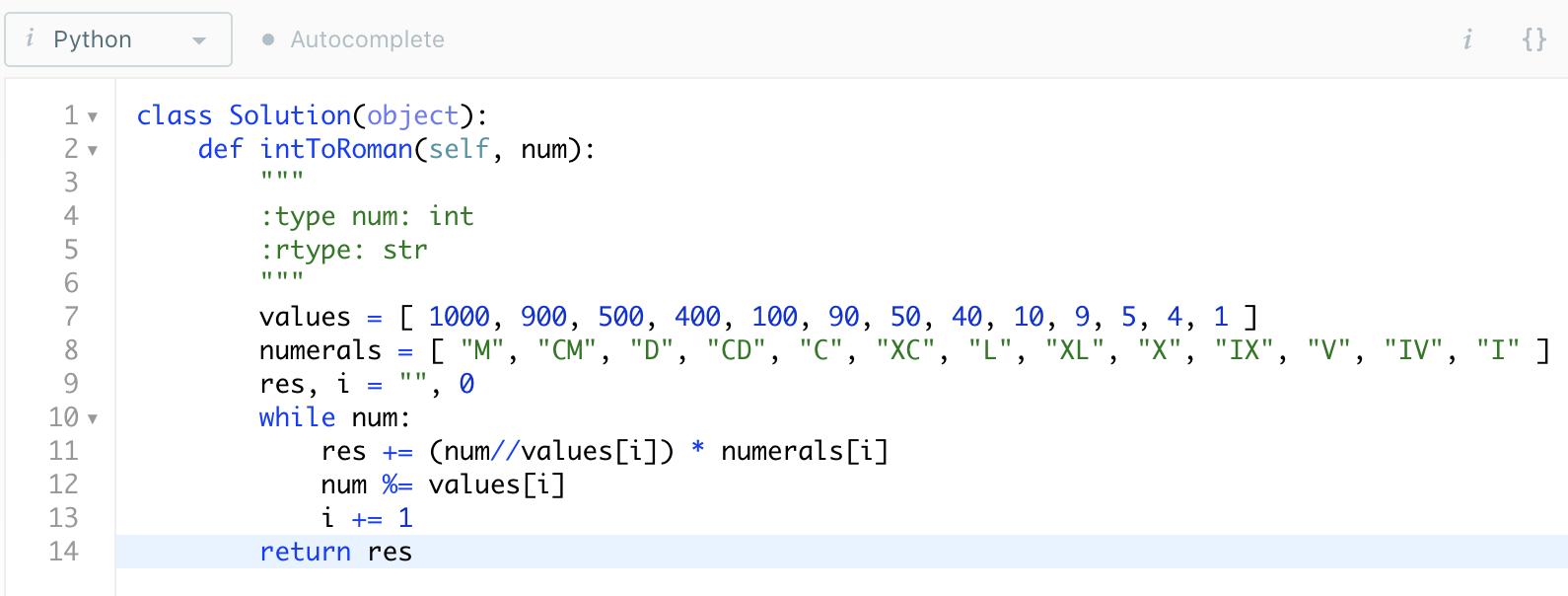
参考示例
有问题欢迎在评论区讨论,就这个题而言,改进的地方还是很多的。