原文:https://wiithaa.com/circular-design/circular-design-what-is-it/
作者:Brieuc SAFFRÉ
整理翻译:Joe ,版权归原作者所有,转载请注明出处。
什么是循环设计?
Circular design, what is it?
Over the past few years, waste management and upcycling, along with the growth of the circular economy have become fundamental societal issues. However, the question of design, or circular design, is still being sidelined. And yet it is a cornerstone issue in achieving the economic, social, and environmental transition that many countries need today.
在过去的几年中,废物处理和回收再利用,循环经济的增长已经成为基本的社会问题。然而,设计的问题,或者循环设计的问题,仍然被搁置。而且,这是实现许多国家今天所需要的经济、社会和环境转变的基础问题。
“Design became a tool of consumerism”
“设计成了消费主义的工具”
This is the hypothesis with which Tim Brown, co-founder of the famous California based design firm IDEO, started his TED talk in 2009
(https://youtu.be/UAinLaT42xY). Industrial design is a relatively new field of study, especially in Europe, where it started in the late 1800’s. The Bahaus school of design was one of the protagonists putting forth the notion of usefulness, “the style must fit the use”. Then, the focus was set on combining esthetics with utility and technique
(https://en.wikipedia.org/wiki/Bauhaus#Impact).This trend marked the beginning of the rise of industrial design.
蒂姆·布朗——加州著名设计公司IDEO的联合创始人,2009年,他在TED的演讲中谈道。工业设计是一个相对较新的研究领域,特别是在欧洲,它开始于19世纪末。包豪斯设计学派是提出实用性概念的倡导者之一,“风格必须适合用途”。注重美学与实用技术的结合。这一趋势标志着工业设计的兴起。
As the field of design developed, and as is most noticeable in the products created in the 2000’s, it started being increasingly more focused on creating strong esthetic identities, or even creating trends, while sidelining the societal utility of the products designed for society and people. Holistic design is often overlooked. Contrary to the trends seen during the Turn of the Century, in which the progress of humankind was a strong focus for designers, today’s industrial design glides over political and societal intentions because it is constrained by ever increasing sales targets.
随着设计领域的不断发展,最引人注目的是在2000年创造的产品,它开始越来越注重创造强烈的审美认同,甚至创造趋势,而忽视了为社会和人们设计的产品的社会效用。整体设计常常被忽视。在世纪之交,人类的进步是设计师们关注的焦点,与之相反,今天的工业设计却因为受到不断增长的销售目标的限制而超越了政治和社会意图。
视频地址:https://youtu.be/UAinLaT42xY(VPN)
The pressure to sell has forced designers to favor the attractiveness of the product and user experience, while only glancing at the longer-term impact of their design choices. It has to be noted that many products were conceived without the help of a designer, which is not a cause for blame, but the facts are here: when such choices are made,
the results are often much worse.
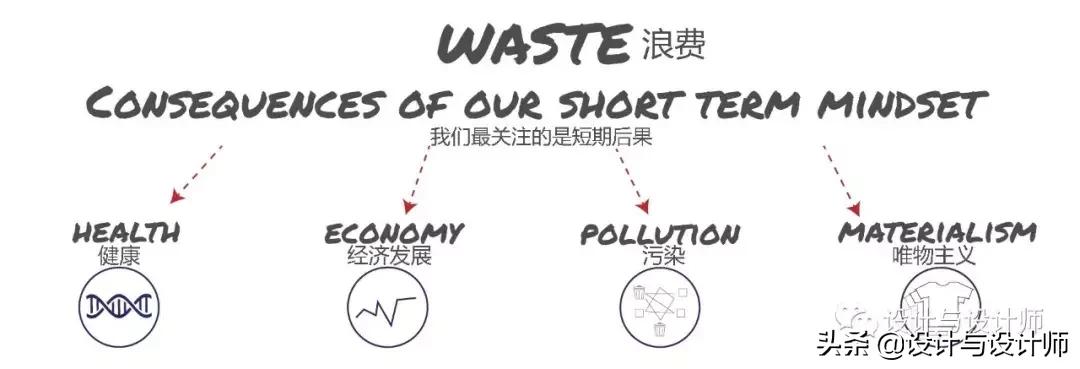
(https://www.francetvinfo.fr/monde/environnement/video-envoye-special-a-teste-le-tri-selectif-dans-les-fast-foods-sur-votre-plateau-mcdo-qu-est-ce-qui-sera-recycle_2986777.html) Furthermore, many objects, packaging, components, or products are wasted at different times during the lifetime of a product. And this has consequences:
产品的销售压力迫使设计师更倾向于关注产品的吸引力和用户体验,从而只是关注了设计选择的长期影响。需要指出的是,很多产品都是在没有设计师的帮助下构思出来的,虽然这并不能构成指责的主要原因,但事实是:当做出这样的选择时,其结果往往更糟。此外,许多对象、包装、组件或产品在产品生命周期的不同时间被浪费。这就产生了后果:
- — First, from the point of view of resources, this leads us to continually extract new resources when we know that most metals, for example, are becoming increasingly scarcer. This makes no economic sense. Our excessive materialism is nonsensical.
- — 首先,从资源的角度来看,当我们知道大多数金属资源变得越来越稀缺时,这就直接导致我们不断地开采新的资源。这其实在经济上毫无意义。过分的物质主义是荒谬的。
- — Further, from a health perspective, waste also have consequences: the plastic waste polluting the oceans has adverse consequences on marine life, and can be found in most of the products we buy every day, thus having multiple types of repercussions on the food chain.
- — 其次,从健康的角度来看,生活垃圾也产生不良后果:污染海洋的塑料垃圾对海洋生物产生负面影响,我们每天购买的大多数产品中都含有塑料垃圾,从而对食物链产生多种影响。
- — Finally, from a pollution standpoint, most of the unprocessed waste creates additional pollution. For example, coffee grounds emit methane as it decomposes, a greenhouse gas that is several times more harmful to the atmosphere then carbon dioxide is.
- — 最后,从污染的角度来看,大部分未经处理的废物造成额外的污染。例如,咖啡渣在分解时会释放出甲烷,这种温室气体对大气的危害是二氧化碳的好几倍。
The automotive industry provides a relevant illustration of these repercussions. If we look at automobile design and the industry in which it operates, we can see that today, cars can no longer be repaired by their owners, motors are too complex, some components are hidden or very hard to reach. This is due to the economic model of the company manufacturing the cars, for which revenue relies heavily on maintenance and repairs of the cars, rather than on the sale itself, which is priced close to production costs. Therefore, for the company to be viable, it needs to design cars that cannot be repaired by the neighborhood mechanic, so as to ensure its monopoly over the management of the car’s life.
汽车工业提供了这些影响的相关例证。如果我们观察汽车设计和它所处的行业,我们可以了解到,今天的汽车已经不能再由车主自行修理了,发动机构造太复杂了,一些零部件被隐藏起来或者实在很难触及到。这是由于汽车公司生产汽车的经济模式,其收入很大程度上依赖于汽车的保养和维修,而不是销售本身,后者的定价接近生产成本。因此,公司要想生存,就需要设计出普通技工无法维修的汽车,从而保证了对汽车寿命管理的垄断。
80% of a product’s environmental impact is determined during its design stage
产品80%的环境影响是在设计阶段决定的
These strategic decisions, which designers have to include in their design, have long term impact. Indeed, the European Commission estimated that 80% of a product’s environmental impact is determined during its design stage (Ecodesign your Future)
(http://www.buildup.eu/sites/default/files/content/Brochure-Ecodesign-Your-Future-15022012.pdf). Whether it is raw material extraction, manufacturing, distribution, or even the product’s use, the environmental impact of the choices made during the design phase are numerous. Design methods and cycle analysis are useful tools to identify improvement opportunities, but you seldom find products that reach a perfect mark at every step of their lifecycle.
这些战略决策,将产生长期影响,设计师必须在他们的设计中考虑。事实上,欧盟委员会估计80%的产品对环境的影响是在其设计阶段(Ecodesign your Future)决定的。无论是原材料的提取、制造、分销,还是产品的使用,在设计阶段所做的选择对环境的影响是巨大的。设计方法和周期分析是识别改进机会的有用工具,但你很少会发现产品在其生命周期的每一步都能达到完美的效果。
Even eco-designed products often don’t consider the end of the product’s life cycle and/or of its different components (raw material, pieces, packaging…). Regardless of this trend, it’s important to note that we throw away 80% of what we purchase within 6 months of buying it (data from Richard Girling’s book, Rubbish!: (Dirt on our hands and crisis ahead)(https://www.penguin.com.au/books/rubbish-9781903919446).How can we overlook this crucial stage – the end of the lifecycle – when designing a product?
即使是绿色设计的产品通常也不会考虑产品生命周期的结束和/或产品的不同部件(原材料、部件、包装……)。不管这种趋势如何,值得注意的是,我们在购买后的6个月内扔掉了80%的东西(数据来自Richard Girling的书,Rubbish !):(我们手上的尘土和面前的危机)。在设计产品时,我们如何能忽略——生命周期的结束这个关键阶段?
The case of biodegradable plastic bags for produce provides a good example of poor consideration of all the different steps in the life cycle. Even if companies designed these bags to minimize the impact of daily consumption on waste production, the fact that so few city dwellers have the possibility to compost their biodegradable waste does not minimize the waste stream, nor does it make this product virtuous. There is also the example of the McDonald’s tray(https://www.francetvinfo.fr/monde/environnement/video-envoye-special-a-teste-le-tri-selectif-dans-les-fast-foods-sur-votre-plateau-mcdo-qu-est-ce-qui-sera-recycle_2986777.html), on which all the elements are recyclable. However, these products are never recycled because of technological of economical reasons.
生物可降解塑料袋的例子很好地说明了对生命周期中所有不同步骤的考虑不足。即使初衷是设计这些袋子以减少日常消费产生的垃圾对环境的影响,但事实上很少有城市居民能够把可生物降解的垃圾堆肥化,因此并不能从根本地减少浪费流,也并没有使真正这种产品成为良性产品。还有一个例子是:麦当劳托盘,托盘所有的元素都是可回收的。然而,由于技术和经济的原因,这些产品永远不会被回收。
A good intention does not automatically solve the problem. One has to consider the connections between the elements and the consequences of a choice, or a behavior on the other elements.
好的意图并不能自动解决问题。必须考虑元素之间的连接和选择的后果,或其他元素的行为。
Designing for the user… and the system that surrounds it
为用户和围绕它的系统进行设计
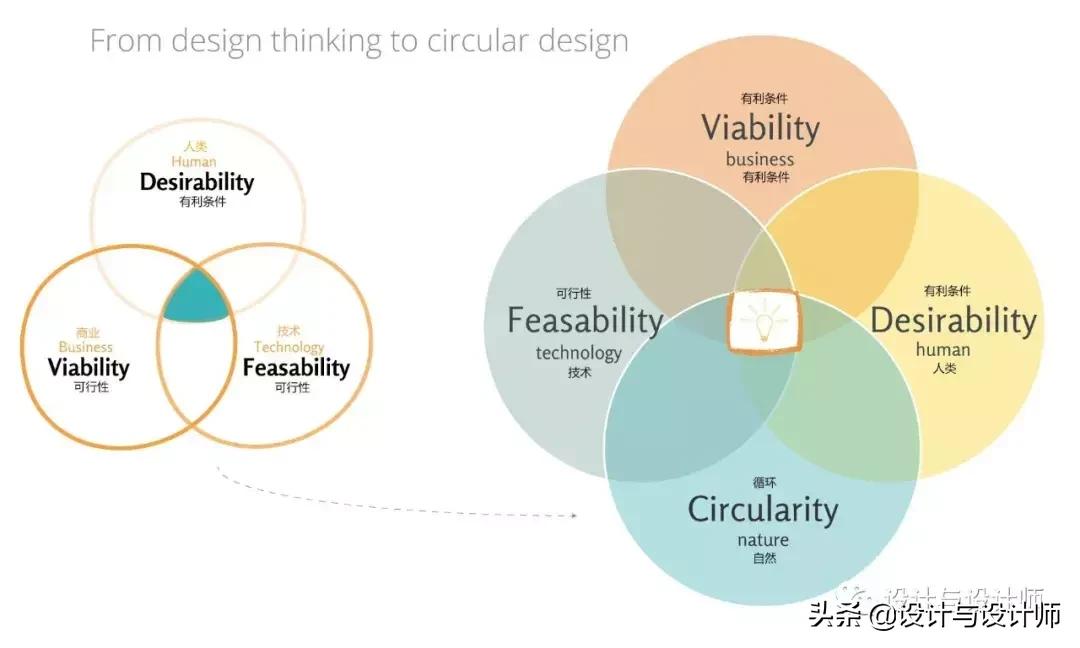
Since design thinking has started gaining traction in the 2000’s, with the creation of the first d.schools
(https://vimeo.com/44192908), the three aspects of economic viability, technical feasibility, and attractiveness to the user have become an efficient frame of reference, which is increasingly more used in the industry. Countless startups, like Airbnb, Sunrise, Kickstarter, or Pinterest have been successfully
created by designers(https://vimeo.com/23275754), and many established companies have also improved their business by relying more heavily on designers (Schneider Electric, Decathlon…).
从2000年开始,随着第一个d.schools的诞生,设计思维开始受到重视。学校、经济可行性、技术可行性、用户吸引力这三个方面已经成为一种有效的参考框架,越来越多的应用于行业当中。无数的创业公司,如Airbnb、Sunrise、Kickstarter、Pinterest,都是由设计师们成功创建的,许多老牌公司也通过更加重视设计师来提升业务水平(如施耐德电气、迪卡侬等)。
By focusing on the user’s needs, designers let organizations exceed their goals. By implementing a process fostering continued improvement, the products have a better image, and are increasingly more recommended by peer networks, makings them the big successes of the past few years.
通过关注用户需求,设计师让公司超额实现了他们的目标。通过实施促进持续改进的过程,让产品有了更好的形象,并且越来越多地受到同行的关注,这使得它们在过去几年里取得了巨大的成功。
And, as we see today, the environmental situation of our planet is becoming more worrisome every day, without needing to waste time citing facts and reports.As we have seen, design choices play a notable part, which is why designers have a role to play.In addition to focusing on the user experience quality,designers now also have to consider the system surrounding the user
(https://wiithaa.com/circular-design/design-tool-bolster-circular-economy/).This means: with what materials?What type of energies?What manufacturing process? Distribution process? Use? And above all else, what becomes of these streams once the product or service, or any of its parts, has reached the end of its life cycle?
而且,正如我们今天所看到的,我们居住星球的环境状况正日益令人担忧,这不需要浪费时间引用事实和报告来验证。如我们所见,设计选择扮演了一个显著的角色,这就是为什么设计师也要扮演一个角色。除了关注用户体验的质量之外,设计师还需要考虑用户周围的系统。这意味着:用什么材料?产生什么样的能量?什么样的制造流程?什么样的分配流程?如何使用?最重要的是,一旦产品或服务以及其任何部分达到其生命周期的终点,这些数据将会变成什么呢?
By adding a 4th sphere, one representing the circular nature of design and including the notions of resources, ecosystems, biomimetics, coupled with the design thinking frame of reference, circular design automatically opens up new possibilities for discovery and new economic, social, and environmental opportunities.
通过增加第四个领域,一个代表设计的循环性质,包括资源、生态系统、仿生学概念,再加上设计的参考框架呈现,循环设计自动为发现新的经济,社会,环境的契机提供新的可能性。
“The next big thing in design is circular”
循环设计是设计的下一个风口
By purpose, the circular design is to learn by doing, especially considering how many corrections need to be done.The continual improvement process incentivizes incremental improvements, and quickly leads to improving the ecosystems, and to do better.By looking at the big picture, the system in all of its complexities, rather than focusing on the final product or service, the designer, who is also
a key player of the 21st Century according to Dominique Sciamma
(https://vimeo.com/142737917), realizes what his or her impact is, and how to avoid creating a negative impact or how to make a positive one for the user, the company and the ecosystem.He or she takes into consideration the landscape, its climate, the available skills, the readily available resources…
循环设计的用途是通过实践来学习,特别是考虑到过程中需要做多少修正。在不断改进的过程中激励渐进的改善,并迅速导致生态系统的改善,并做得更好。根据Dominique Sciamma的说法,从总体上看,系统的所有复杂性,并不是最终的产品或服务,设计师-也是21世纪的关键参与者-意识到他或她能产生什么影响,以及如何避免产生负面影响,他或她考虑到了景观、气候、可利用的技能、现成的资源等如何为用户、公司和生态系统带来积极的影响。
To better understand and analyze this type of data, Wiithaa developed a suite of tools via the Circulabto(https://circulab.eu/)
facilitate circular design projects.Considering all of the complexities of a situation lets a designer anticipate what will be at stake and design for the long run.
为了更好地理解和分析这类数据,Wiithaa通过Circulab开发了一套工具,以促进循环设计项目。考虑到所有复杂的情况,让设计师可以预测到将有什么弊端,同时进行长远的设计规划。
As soon as you start seeing waste as a design flaw rather than and end in and of itself, you start shining a whole new light on the stream of resources.Working towards, and attaining zero waste at the design stage optimizes what already exists, and lets you do more with fewer resources, as is recommended by the frugal innovation movement
(https://www.diateino.com/fr/56_navi-radjou),
or the famousLow Tech Lab(http://lowtechlab.org/).Doing more with what is already around us allows us to reach a high level of resiliency in the territories and organizations by multiplying local cooperation and stream loops.By involving local stakeholders, a designer can also turn the end user into a key player, who is aware of the consequences of his or her choices.
一旦你开始把浪费看作是一个设计缺陷,而不是以它作为设计的终结,你就会开始在资源流中闪耀出全新的光芒。在设计阶段努力实现零浪费,可以优化现有的工作,让你用更少的资源做更多的事情,这是节俭的创新运动或著名的低技术实验室推荐的。在我们周围做更多的事情,使我们能够在领土和组织中达到高度的复原力,使当地的合作与溪流循环倍增。通过让本地民众参与,设计人员还可以让最终用户变成关键角色,后者知道他或她所做的选择产生的后果。
Even if his statements aren’t as far reaching as the ones above, Tim Brown, during the launch of the Circular Design Guide
(http://circulardesignguide.com/), readily admitted that
the next design revolution will be circular design.
(https://youtu.be/yAvkM7B7BBs)
蒂姆·布朗在《循环设计指南》的发布会上欣然承认,下一场设计革命将是循环设计。即使他的声明不像上面所说的那么深远。
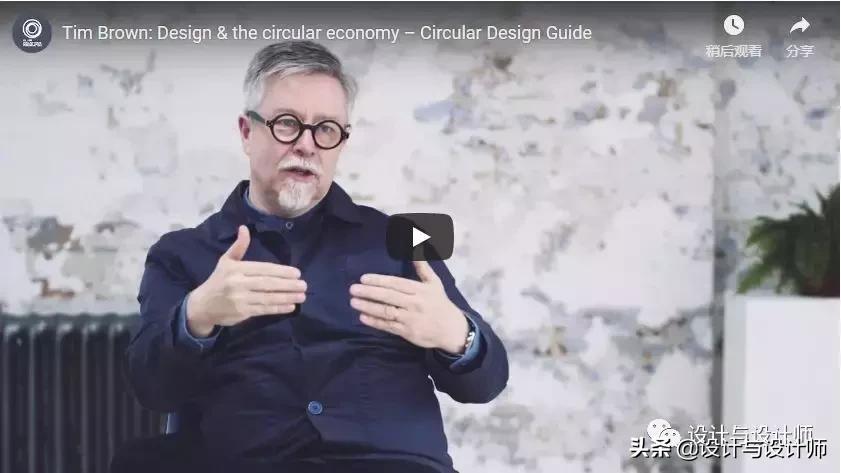
视频地址:https://youtu.be/yAvkM7B7BBs(VPN)
The different principles of circular design
循环设计的不同原则
Even though circular design is rather new, and not often taught in design schools today, it is still possible to outline several key principles:
虽然循环设计是一个非常新的概念,而且在当今的设计院校里也不经常教授,但仍然有可能概括出几个关键的原则:
> Prioritizing the use of local and/or readily available resources, to minimize energy consumption linked to the extraction, supply, and manufacturing processes, and to reduce the amount of actual waste. The designer must therefore observe and create from the resources available to him or her, especially if they have a low value today.
优先使用当地现成资源,尽量减少与开采、供应和生产过程有关的能源消耗,并减少实际浪费。因此,设计者必须观察并利用可用的资源进行观察和创造,特别是在目前这些资源的价值很低的情况下。
This is what Shoey Shoes
(http://thomasleech.co.uk/shoey-shoes/xpa46lh6mdiwi6p6ecr20hjr4a7psu)does.The brand created by a student from the Royal College of Art, makes leather shoes for kids exclusively from leather scraps. At the industrial lever, the French company Circouleur
(https://activer-economie-circulaire.com/podcast/mailys-grau-circouleur/), which reuses leftover paint cans, is also a good example.
这就是Shoey Shoes的作用。该品牌由一名来自皇家艺术学院的学生创立,专门用皮革废料为孩子们制作皮鞋。在工业层面,法国的Circouleur公司对剩余油漆罐进行再利用。也是一个很好的例子。
> Optimizing resources and energy consumption can be achieved via different means. For example, on average, a car spends 96% of its life parked. It’s hard to picture waste as stemming from single user ownership, but it exists, and it is not useful. By switching to a needs-based use model, it is possible to increase the objects level of use and also diminish the number of such objects circulating on the market. This is exactly what several auto makers and the city of Paris are working on to replace the Autolib
(http://www.europe1.fr/economie/renault-et-paris-annoncent-un-partenariat-mercredi-pour-remplacer-autolib-3701096). Resources can also be optimized at the end of a product’s life cycle, when the company has anticipated that phase. This is what the Dutch brand Mud Jeans has done by leasing its jeans on a monthly basis
(http://www.europe1.fr/economie/renault-et-paris-annoncent-un-partenariat-mercredi-pour-remplacer-autolib-3701096). The practice allows for the reintegration of the raw material, as opposed to extracting new material. The inverted logistics process can also be looked at to optimize transportation streams. La Poste’s Recygo service(https://www.recygo.fr/). is a good example of optimizing and recreating economic, social, and environmental value. Last but not least, the example of Adopt an office perfectly illustrates this example
(https://activer-economie-circulaire.com/podcast/christophe-cote-adopte-bureau/) by making durable, well made, top of the line office furniture more accessible than cheap products.
优化资源和能源消耗可以通过不同的方式来实现。例如,,一辆车一生中平均有96%的时间是闲置着的。事实上很难将浪费描述为源自单个用户所有权,但它确实存在,而且没有用处。通过切换到基于需求的使用模型,可以增加对象的使用级别,同时减少市场上流通的此类对象的数量。这正是几家汽车制造商和巴黎市政府正在努力取代Autolib的原因。资源也可以在产品生命周期结束时进行优化,此时公司已经预见到了这一阶段。这就是荷兰品牌MudJeans通过每月租赁其牛仔裤所做的事情。这一做法允许重新整合原材料,而不是开采新材料。逆向物流过程也可以用来优化运输流。La Poste的再利用服务是优化和再造经济、社会和环境价值的一个很好的例子。最后但并非最不重要的,采用办公室的例子完美地说明了这个例子,使耐用,制作精良的顶级办公家具比便宜的产品更容易获得。
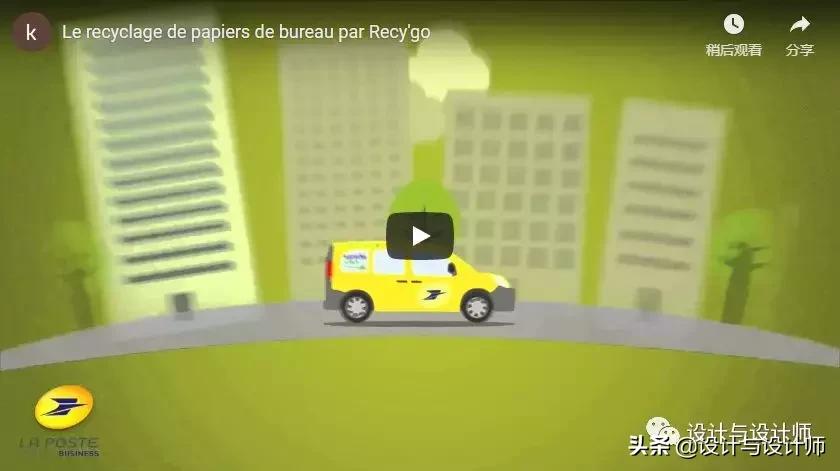
视频地址:https://youtu.be/g7nAQpzyIY4(VPN)
> Product durability, repairability, or upcycling possibilities.
Built-in obsolescence has been formally condemned by many NGOs
(https://www.halteobsolescence.org/) over the past few years. however, it is often considered to be an important pillar of the business models of large players in the economy today. We mentioned it before for the automobile industry, but the example of smartphones is equally as striking. These products could technically be used for 7 years. However, their average lifespan in France is only 18 months long. Most manufacturers encourage people to change their devices by suggesting updates that challenge the hardware’s capacity, so that the product becomes hard to use and obsolete.
Fairphone(https://www.fairphone.com/en/) is an interesting initiative for several reasons: beyond the modular nature of their devices making repairs easy, their phones are designed to last and seem much more solid than most phones.
产品耐久性,可维修性,或升级循环的可能性。在过去的几年里,许多非政府组织已经正式谴责了内置的过时功能。然而,它通常被认为是大型玩家在今天的经济中商业模式的一个重要支柱。之前我们提到过汽车行业,但智能手机的例子同样引人注目。这些产品技术实际上可以使用7年。然而,他们在法国的平均寿命只有18个月。大多数制造商鼓励人们更换他们的设备,建议更新硬件的性能,从而使产品变得难以使用和过时。Fairphone是一个有趣的项目,原因有几个:除了便于维修的模块化设备外,他们的手机设计得很耐用,而且看起来比大多数手机结实得多。
> Taking apart and repurposing the product. If the product can be taken apart or repurposed, other uses may be considered in order to create additional value. Renault is known for its Choisy-le-Roi manufacturing facility specialized in remanufacturing
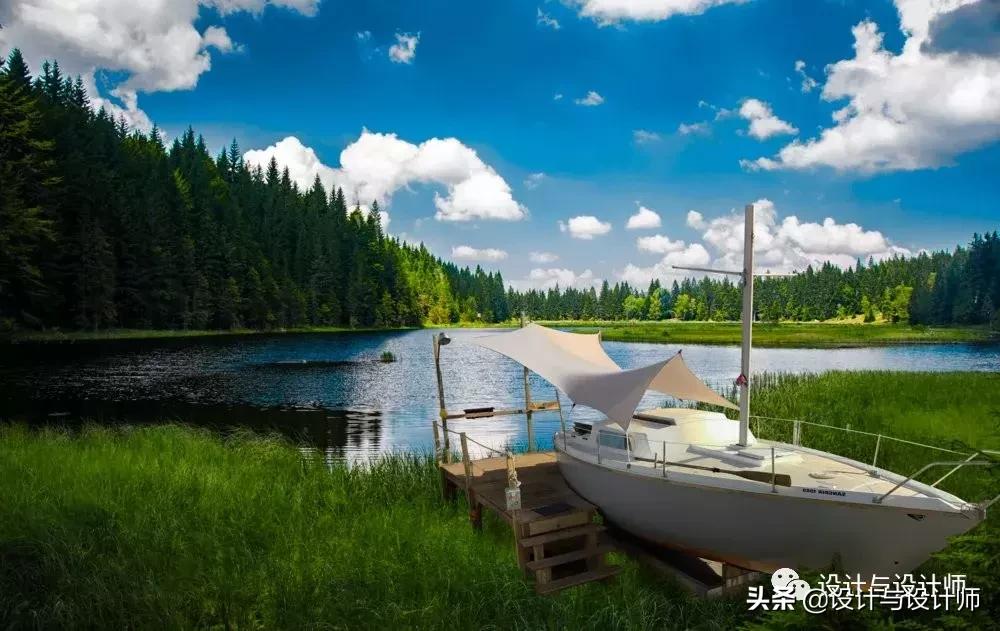
(https://www.ellenmacarthurfoundation.org/news/the-circular-economy-applied-to-the-automotive-industry-2), which means taking objects apart and repackaging the parts. This process creates an opportunity to resell spare parts 30 to 50% cheaper than new parts, and saves up to 88% of water, 80% of energy, and 86% of the chemicals needed to manufacture a part. Carwatt(http://www.carwatt.net/) offers the possibility to switch from a combustion engine to an all-electric engine, knowing that the impact of manufacturing a new car is often higher than the impact the car will have during its lifespan. At the end of its lifespan, a product can also be repurposed to serve new uses. The young Nantes based startup Bâtho
(https://activer-economie-circulaire.com/podcast/didier-toque-batho/) collects old sailboats to transform them into unique houses. This process finances the boat’s reprocessing, prevents boats from being simply abandoned, and saves on construction materials in the region.
对产品进行拆解和再利用。如果产品可以被拆卸或重新使用,就可以考虑用作其他用途,以创造额外的价值。雷诺(Renault)以其Choisy-le-Roi制造工厂而闻名,这家工厂专门从事产品再制造,也就是把产品拆解,重新对零部件进行包装。这一过程创造了一个机会,以比新零件便宜30 - 50%的价格转售拆借下的零部件,同时节省了88%的水、80%的能源和86%的制造零部件所需的化学品。Carwatt提供了从内燃机转向全电动发动机的可能性,因为它知道制造一辆新车的影响往往比汽车在使用寿命中产生的影响要大。在其面临报废之时,产品还可以重新定位为其他新的用途。年轻的南特创业公司Batho收集旧帆船,并把它们改造成风格独特的房屋。这个过程为船只的再加工提供资金,防止船只被简单地遗弃,并节省了该地区的建筑材料。
> Absence of waste during the product or service’s lifespan as well as for its parts. Indeed, waste that cannot be reused at the end of a life cycle is seen as a design flaw and calls for a change in design or a better foresight of what that component will become. The objective of biodegradability or regenerating ecosystems must always be taken into account. Contrary to most products today, the objective is to avoid using harmful substances, to protect the product’s users, but also to let the product go back to the ecosystem at the end of its life. The Freitag t-shirt example
(https://www.freitag.ch/fr/e720) is a particularly interesting one, because it is entirely made of
biodegradable fibers(https://www.freitag.ch/fr/fabric/resource), which means it can decompose in just a few months when buried in the ground, without damaging the soil. Similarly, Ecovative
(https://www.ecovativedesign.com/) manufactures packaging reinforcements from fungus mycelium, which are biodegradable once the product reaches the consumer.
在产品或服务的使用寿命和部件的使用寿命中没有浪费。事实上,等到产品濒临报废时不能重复利用的组件应该被视为设计缺陷,需要改变设计或系统性地预见该组件未来的可能性。必须始终考虑以可生物降解或再生生态系统目标。与今天的大多数产品相反,其目标是避免使用有害物质,保护使用者,但也是为了让产品在生命结束时回归生态系统。弗雷塔格T恤(Freitag t-shirt)是一个特别有趣的例子,因为它完全是由可生物降解的纤维制成的,这意味着它在埋在地下几个月内就能分解,并且不会破坏土壤。同样,Ecovative公司从真菌菌丝体中提取的生产包装增强剂,一旦产品到达消费者手中,菌丝体就会被生物降解。
> finally, a continuous improvement process. The raw material streams, product uses, or user behaviors may change according to design modifications, which is why it is important to integrate them so as to improve the user experience and create new continuous value loops.
Beyond its practical aspects, circular design has become crucial to many companies. Plastic pollution in the oceans serves as a particularly vivid example:
even HSBC recommends that Coca-Cola overhauls its product distribution strategy.(https://www.latribune.fr/entreprises-finance/industrie/agroalimentaire-biens-de-consommation-luxe/plastique-hsbc-suggere-a-coca-cola-de-revenir-aux-bouteilles-reutilisables-792947.html)
最后,持续改进的过程。原材料流、产品使用或用户行为可能会随着设计修改而发生变化,这就是为什么必须将它们集成起来,以改善用户体验,并创造出新的连续价值循环。除了它的实际方面,循环设计对许多公司至关重要。海洋中的塑料污染就是一个特别生动的例子:就连汇丰银行也建议可口可乐公司对其产品分销策略进行全面改革。
During this transformation, brands and companies must go back to their core values,(https://www.slideshare.net/wiithaa/en-quoi-la-raison-dtre-dune-entreprise-facilitetelle-la-transition-vers-lconomie-circulaire) so they can create a strategy that will create the most positive impact and successfully reconcile economic prosperity with the regeneration of ecosystems. It is important to make this process obvious to the teams, partners, but also to the users and ecosystem, by giving meaning to the company and its actions.
在这一转型过程中,品牌和企业必须回归其核心价值,这样才能制定出一种战略,产生最积极的影响,并成功地将经济繁荣与生态系统的再生协调起来。通过赋予公司及其行动意义,让团队、合作伙伴、用户和生态系统都能清楚地看到这一过程,这一点很重要。
Circular design, by bringing the subject of resources to the forefront, also creates an opportunity to integrate an increasingly more important strategic dimensions in an ever-changing world.
循环设计通过将资源这一主题放在首位,也创造了在不断变化的世界中整合越来越重要的战略维度的机会。
In conclusion, doesn’t circular design seem to be the right combination of respecting life’s way and the designer’s creative abilities to allow companies to respect the natural ecosystem?
综上所述,循环设计难道不是尊重生活方式和设计师的创意能力,让公司尊重自然生态系统的最佳组合吗?
原文:https://wiithaa.com/circular-design/circular-design-what-is-it/
作者:Brieuc SAFFRÉ(Linkedin:https://www.linkedin.com/in/brieucsaffre/)
整理翻译:Joe ,版权归原作者所有,转载请注明出处。
本文翻译已获得作者授权
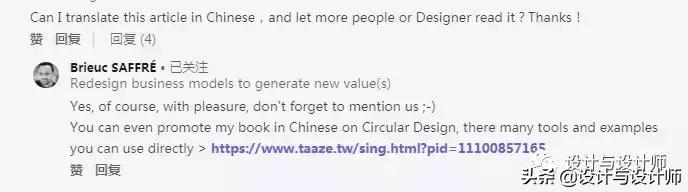
授权截图
作者著作
《啟動循環經濟:自然與經濟的共存之道
ACTIVER L’ÉCONOMIE CIRCULAIRE ──COMMENT RECONCILIER L’ECONOMIE ET LA NATURE》

购买地址:https://www.taaze.tw/sing.html?pid=11100857165
免责申明:公众号宗旨是收集好的资料分享,非盈利性质。部分内容来源于网络或网友自主投稿编辑整 理,版权归原作者所有,其内容为作者个人观点,并不代表本公众号赞同其观点和对其真实性负责。如您(单位或个人)认为本公众号某部分内容有侵权嫌疑,请通知我们,我们将第一时间予以更改或删除。