全 浸 阅 读 = Total Immerse Dynamic eReading=TID E
“People"
Running as religion
India’s champion sprinter, known as “The Flying Sikh”

♜全浸导读:
他从国家纷争中出走,他赤脚从血泊中逃跑,印下一路脚印;他跑到世界纪录顶端,他又跑回出走的地方;为了两个国家的荣誉,为了原谅,为了信仰,他,是飞翔的短跑冠军。。。
p1
BEFORE HIS best race, at the British Empire and Commonwealth Games in Cardiff in 1958, Milkha Singh was under far too much stress to sleep. That day he prayed, touched his forehead to the ground and promised to do his best; but the honour of India, he told God, was in His hands. This was, after all, the new India, independent of Britain for only a decade, striving to win gold in games where, as a part of empire, it had never done before.
☂ Opening:critical moment in a life
▷prayed,touched his forehead to the ground and promised to do his best:a promise to whom? A promise To one’s god is a the most committed and devoted one
p2
On the track for the 440-yard sprint, Malcolm Spence of South Africa, the world-record holder, was the man he was watching. But if he ran as he planned to, Spence was no danger. He shot from the start as fast as possible, led in the final straight, thought Spence was nowhere near but then, in a second, sensed him over his shoulder. At the line, with six inches between them, Spence failed to pass him, and he won the gold. The stadium erupted. As the Indian national anthem was played and the tricolour ascended, it seemed that 100,000 Englishmen rose to their feet. The sister of Jawaharlal Nehru, the prime minister, hugged him afterwards, telling him that he had made India the pride of the world.
☂ The climax scene of a runner, the thrilling in the running track

p3
Those Britishers who stood to salute him, however, knew almost nothing about him. To them he was just an exotic person, a village boy with a Sikh top-knot who ran with his arms gracefully waving and usually went barefoot, though for international meetings he wore shoes. They did not know that, for him, running was not a sport. It was everything, his religion, his beloved, life.
▷Topknot-a knot of hair arranged on the top of the head
☂ Running is his very everything

p4
As a child, a farmer’s son, he ran to escape the poverty of Gobindpura, in Punjab, and to get an education. The school was 10km away, across sands that burned so hot in summer that he and his friends would have to jump between cooling pads of grass. But at the age of 14 or 15 in the year of Partition, 1947, he ran to save his very life. The state of Punjab was being split then between India and Pakistan, and crowds of Muslim outsiders—not the gentle Muslims he knew as neighbours—suddenly arrived in the village. They began killing, leaving the mutilated bodies for dogs, and ordered his family to convert to Islam or die. One night they came, with swords and axes, to slash his parents’ throats and hack his siblings to death. His father, dying, shouted: “Run, Milkha, run! Bhaag, Milkha, bhaag!” He raced for the forest, crying.
▷Mutilate-inflict a violent and disfiguring injury on
☂ He ran to save his very life: Running away from the Cruel reality and his bloody childhood memory


p5
There followed a time of scrapes, when he hopped trains as a refugee, shoeless and starving, and became a petty thief, running from the police. Eventually the army took him on. There he discovered running of a new kind, with coaching, races over set lengths, and prizes. The first race he won rewarded him with nourishment, a daily glass of milk. The first track he saw, decked with flags, enchanted him. In his first cross-country (“What is cross-country?”) he got stomach cramps and sat down whenever they gripped him, but still came sixth out of 400 runners.
▷Scrape-embarrassing or difficult predicament
▷Cross-country:the sport of cross-country running
▷Cramp-painful involuntary contraction of a muscle or muscles, typically caused by fatigue or strain
☂ Every hero got a "scar" on the body

p6
Sixth was good; first was better. So began the hard, necessary work, six hours a day. He ran in fatigue time, when other jawans were doing chores, and at night, when they were playing cards. He laboured up steep hillsides and across loose sand to build his leg muscles, and honed his upper body with weights. He ran until he filled a bucket with his sweat, until he urinated blood or collapsed with exhaustion and had to go to the hospital. He took his body to the limit out of pride, and for India. His coaches and his doctors remonstrated every time, but it was no good. He would imagine a crowded stadium, the wild applause, his burst across the finish line, the Indian flag rising—and exhaust himself all over again.
▷Jawan-a male police constable or soldier
☂ Endavour

p7
Iron discipline paid off. He took four golds at the Asian games, besides the gold in Cardiff, and won more than 70 of his 80 international races. In 1956, at his first Olympics in Melbourne, he was eliminated in the heats but did not waste the trip. He asked the American gold medallist in the 400 metres, Charles Jenkins, to share his training schedule, and for the next four years a chit of paper with Jenkins’s world-record time, 46.7 seconds, was propped beside his picture of Guru Nanak as the focus of his prayers.
▷Eliminate in the heats-lose in the preliminary contest
☂ Sweat will be paid

p8
In 1960, at the Rome Olympics, his time was 45.6. It was an Indian national record but not, alas, the world record, because he did not win that 400-metre sprint. Though he led for the first 200 metres or so, he then slowed, glanced back, and could not regain his rhythm. Three runners passed him. It was Spence who, by 0.1 of a second, pipped him for the bronze. It was the worst day of his life, excepting only that day when his parents had been killed. Even the national record he had set then was electrically retimed to 45.73, and in 1998 a policeman broke it. By then he had long retired from competition, unable ever to forgive himself for that lapse in Rome.
▷Lapse-failure
☂ A step to the gate

p9
He did, however, manage to forgive others. In 1960 he was invited to Lahore for a meeting that would pit him against Pakistan’s champion sprinter, Abdul Khaliq. At first, he refused to go. How could he? His childhood home was there now, still soaked with blood. It was Nehru who convinced him that there needed to be friendship between the two new, raw nations, so he went. The moment he crossed the border, to his surprise, he was welcomed with flags and flowers. And when he won his race, the Pakistani prime minister whispered to him, in Punjabi, that he had not run that day; he had actually flown. “Pakistan bestows on you”, he said, “the title of ‘The Flying Sikh’.”
▷Nehru:1889–1964), Indian statesman, prime minister 1947–64; known as Pandit Nehru. Nehru was elected leader of the Indian National Congress in 1929. He was imprisoned nine times by the British for his nationalist campaigns, but went on to become the first prime minister of independent India
☂ manage to forgive

p10
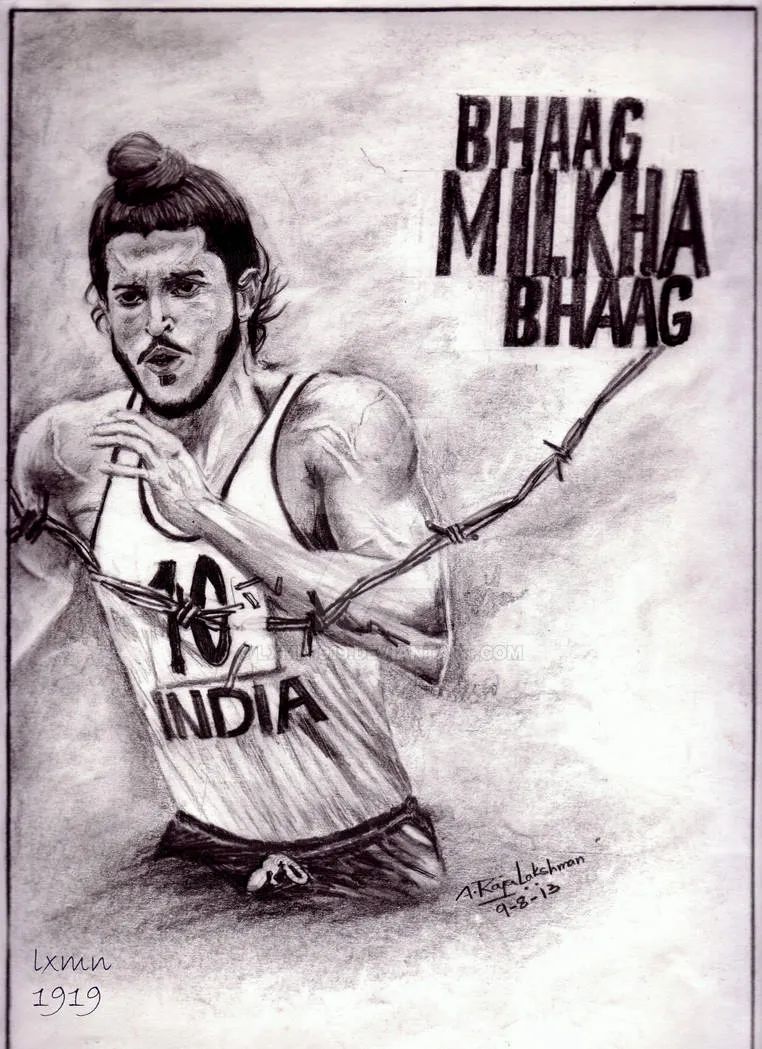
He took it up joyfully, and so did his fans. It gave wings to his celebrity, which peaked in 2013 with a top-grossing Bollywood film of his life. In retrospect “The Flying Sikh” was perhaps his favourite honour, though he had also received the Padma Shri, India’s fourth-highest for civilians. (He was scornful of more common awards, like the Arjuna, that were handed out to almost anyone like prasad in a temple.) As an athlete, he had run for nothing more than his country and his countrymen’s applause. And, despite everything that had happened, he had two countries. Wherever he ran, he said, both India and Pakistan ran with him. It was as if in Milkha Singh, for brief seconds, they found unity again. ■
▷ Prasad-a devotional offering made to a god, typically consisting of food that is later shared among devotees.

☂ A flying Sikh ran out from the killing of country conflicts, ran out of blood, and ran out of hate; ultimately he ran cross-country, ran for both countries, and ran for forgiveness; nothing is more meaningful than running itself, it is his love, his religion, and his everything.
