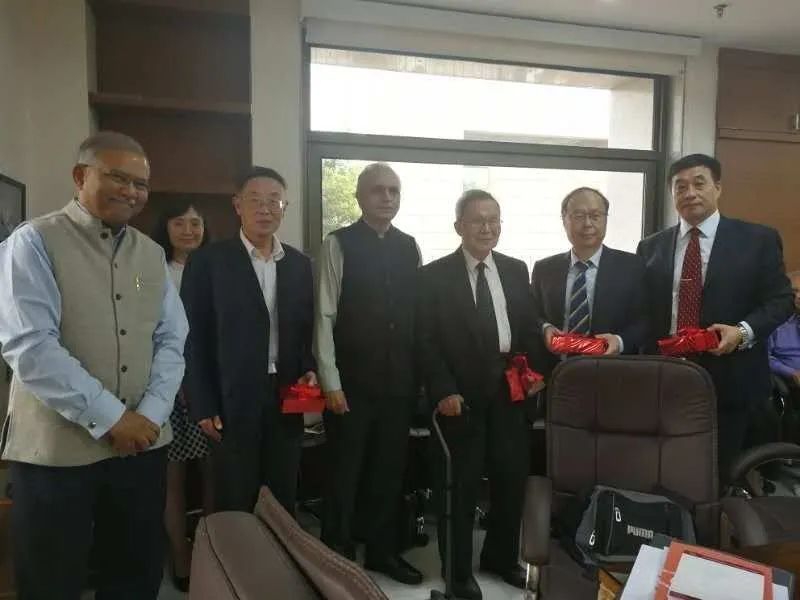
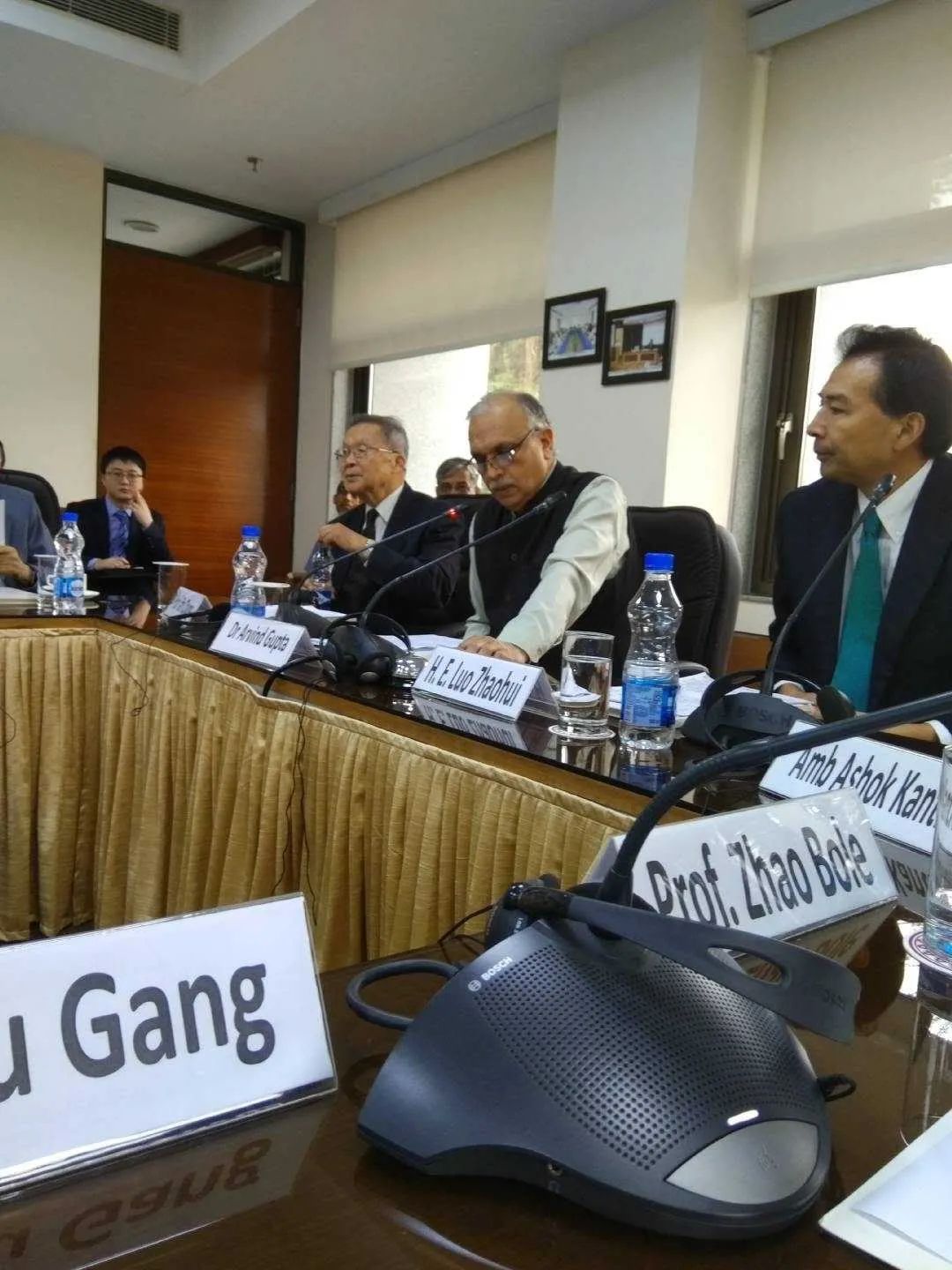
编者按:中印是两个文明古国,也是世界上人口最多的国家。拳头不是解决问题的办法。中印合作所创造的利益与价值远远超越地缘政治现实。中印合作一次就双赢一次,不是中国赢两次,而是中印各赢一次。合作越多,双赢机会就越多。中印合作的机会在于消费市场,两国的市场力量将为亚洲塑造未来。十九大后不久,印度辨喜基金会与中国驻印度大使馆于2017年11月上旬在新德里举办了中印关系研讨会。印度智库专家及政府高层人员参加会议。华东师范大学国际问题研究所所长陆钢作为中方三位学者之一应邀出席。中国驻印度大使罗照辉出席会议并发表重要讲话。陆钢的发言主题是中印如何开展“一带一路”市场合作,其发言稿一直放在辨喜基金会的网站上。印方还为发言稿配图,是华东师大校园矗立着的毛主席塑像。
这次印度政府下架中国100多款App,但发言稿还在网站上,可参见原文链接 http://www.vifindia.org/article/2017/november/21/china-india-cooperation-opportunity-building-the-asian-common-market
发言稿
中印合作机遇:构建亚洲市场共同体
我很高兴来到这里,与大家进行有关中印双边关系的讨论。我演讲的主题是:中印合作机遇:构建亚洲市场共同体。我将就中印两国如何合作构建亚洲市场共同体进行探讨,以加深两国的共识与协调,形成两国坚实的合作基础。
首先,我想围绕“一带一路”倡议进行讨论。中国提出“一带一路”倡议,旨在与周边国家展开交流合作。不过这是一个倡议,还是以自愿形式为主,周边国家根据自己的利益需求选择参与与否。从历史发展的角度来看,正如新加坡国立大学李光耀公共政策学院院长马凯硕先生说过的“亚洲人民觉醒的新时代已经到来”。
“一带一路”沿线国家以亚洲国家为主,这条道路唤醒了亚洲人民,引导亚洲人民重返世界主流之路。“一带一路”合作圈的核心国家主要位于亚洲地区,印度就是其中之一。印度和中国是推动亚洲经济发展的两大中心。印度没有理由不加入。如果没有印度的加盟,“一带一路”可以推进,但是不完整的,原因如下:
任何促进地区繁荣的倡议都要首先解决该地区人民生存、发展和人民幸福的问题。中国和印度作为世界人口大国,共拥有27亿人口,相当于要解决地球上三分之一人口的生计问题。
如何解决人口大国的发展问题。答案就是要发展市场经济和建立开放市场。“一带一路”倡议因而成为一个机遇。在此,我提出“一带一路”国际市场的概念,换句话说,这也就是亚洲市场共同体。
根据亚当·斯密的观点,构成市场有三大要素:消费者的数量,消费者购买力以及消费者购买欲望。中国人口基数本身已经构成了巨大的市场总量,而印度人口更是超过了“一带一路”沿线国家的人口总和。如果中印两国相互合作开拓市场,就能奠定亚洲市场共同体的基础。
中国经济的快速发展已使其成为全球第二大经济体。中国的发展也带动了亚太地区经济的进步,同时也强有力地推动了世界经济的增长。中国已经具备建立地区国际市场的基本要素,同时也能解决消费品的市场供应问题。中国国内拥有巨大的能源市场同时还紧跟国际发展,已经具备建立区域国际市场的充分条件。
其次,中国将开放国内市场,使其成为“一带一路”国际市场的主要国家。中国已经意识到开放国际市场的重要性,这不仅有助于减少贸易不平衡,而且有助于提高中国在国际经济体系中的发言权。明年中国将举办世界进口博览会,习*平近**总书记有望出席。
基于“一带一路”倡议的背景,中国市场将对沿线国家给予优先权。印度是“一带一路”沿线的重要国家之一。我认为中国会高度重视印度在亚洲市场共同体中的角色和地位。借助于中国巨大的市场和多样化的需求,印度产品一定会在中国大受欢迎。当然,由于我国走市场经济道路,政府只能在高层决策和制度安排中发挥作用。中国和印度的市场经济参与者应该根据市场经济的法则发挥更多的作用。
中印两国的学者应该具备战略眼光,为两国关系提供长期可持续的发展。两国共同建立亚洲市场将为中印关系产生促进作用。这种合作关系类似于法德之间的交往合作。法国和德国之间的友好合作构建了欧洲市场共同体。
中印合作可以分为以下三个阶段:
初始阶段,处于自然的市场经济阶段。亚洲市场的发展重心应该是选择经济发达、国际化程度高、市场秩序好和辐射能力强的地区。处于长三角地区的上海无疑是首选。基于亚洲市场共同体的背景,只要印度政府积极与中国进行沟通,印度企业和商品进入上海都会大为便利。当然,印度产品及其业务能否在上海取得成功取决于市场竞争。但是,政府、媒体以及学界三者之间的良性互动能正向引导消费者的购买行为。
中级阶段,地方政府和市场经济相结合。在印度产品和企业逐渐进入中国市场形成冲击后,中印两国的政府、商会、跨国公司和第三方组织如非政府组织、智库和高校之间可以经常进行磋商,并讨论市场规则、制定市场标准。这些规则和标准将构成亚洲市场共同的基本规则和标准。
最终阶段,中印两国政府共同倡导该提议的阶段。应在中级阶段亚洲市场的发展日趋成熟,亚洲市场共同体的倡议也将上升到中央政府的层面。该倡议作为“一带一路”倡议的主要部分,是从切实可行的社会基层发展而来的。亚洲市场共同的关键要素以及标准准则已经基本满足。因此,可以通过中印两国政府共同发起建立亚洲市场共同体的形式提出一个整体的概念。与“和平共处五项”基本原则一样,亚洲市场共同体的概念也将随着中印双方共同接受而成为国际关系的普遍原则。类似法国和德国,“一带一路”背景下的亚洲市场共同体可以作为中印两国共同倡导的亚洲愿景。随着越来越多沿线国家的加入,最终能实现”一带一路”国际市场。
印度拥有很多优势产业及产品,如抗癌药、印度电影、印度软件、瑜伽等等。华东师范大学拥有印度的软件产业园,印度的电影产业在八十年代席卷中国,到目前为止,我们这个年龄阶段的人仍然记忆犹新。
附英文原稿
【Vifindia】China-India Cooperation Opportunity: Building the Asian CommonMarket
(Reproduction of a talk delivered by LuGang, Director, IIS Conference, East China Normal University (ECNU), Shanghaiat a Sino-Indian Seminar, held at the VIF on 06 Nov 2017)
I am delighted to be here and attend thediscussion of the bilateral relationship between China and India. The topic ofmy speech is ‘China-India Cooperation Opportunity: Building the Asian CommonMarket’, and I will explore how to cooperate to build the Asian common marketfor China and India, which would strengthen their bilateral consensus andcoordination and form the strong base of bilateral relationship.
First of all, let me talk something about"the Belt and Road."
The Belt and Road is an initiative, which Chinahopes that the countries along the route will respond and join it accordingly.Since it is an initiative, then there is selectivity. According the judgment oftheir own national interests, they can choose to join or not to join. However,from the perspective of historical development, the new era of the Asian peopleawaken has arrived. Ma Kai-shu, dean of the Lee Kuan Yew School of PublicPolicy at the National University of Singapore, has mentioned it.
As the countries along the Belt and Roadare mostly Asian countries, so it is the road that awakening the Asian people.It is also the road that the Asian people return to the mainstream of theworld. The core circle of friends of "the Belt and Road" is basicallyAsian countries, and India is one of them. India and China constitute the twomajor centers of Asia to boost the economic development in Asia. India has noreason not to participate the initiative. Without India's participate on,"the Belt and the Road" can go forward, but it seems to be notperfect. why?
Any initiative to promote prosperity in theregion must first solve the problems of the survival, development and happinessof the people in the region. China and India, the world's most populousnations, have solved the problem of the life of 2.7 billion people, equal tosolve the problem of living more than one-third of the world's population.
How to solve the development of thepopulous nation? The answer is, it needs the development of a market economyand the establishment of an open market economy.
The " Belt and Road"is an opportunity. Therefore, I put forward the concept of the internationalmarket of the Belt and Road". In other words, it is the Asian Common Market.
According to Adam Smith's point of view,the market's most important elements are three, the size of the consumerpopulation; consumer purchasing power; consumer desire to buy.
China'spopulation itself has constitute a huge market volume, while India's populationexceeds the sum of the population of countries along the Belt and Road. If thetwo countries work together to open up their own markets, they can lay down thebasis of the Asian common market.
With its rapid economic development, Chinahas become the second largest economic entity in the world. The development ofChina has also brought about the development of the Asia-Pacific economy andprovided a powerful impetus to the growth of the world economy. China alreadypossesses the basic elements of establishing a regional international market.China also solved the market supply of consumer goods. China has a hugedomestic energy market and a high degree of internationalization and alreadyhas sufficient conditions for establishing a regional international market.
Next, China will open up its domesticmarket so that to become the main part of the international market of "the Belt and Road". China has realized the importance of opening up itsdomestic market not only for reducing trade imbalances, but also for elevatingChina's voice in the international economic system. Next year China holds alarge-scale import of high-profile trade expo (show), and President Xi maybeattend.
Due to the background of the Belt and RoadInitiative, the Chinese market will be given priority to those countries alongthe routes. India is one of the most important country along the route. I thinkthat China will attach great importance to India's role and status in the AsianCommon Market. With a huge market in China and diversified needs, it isbelieved that Indian products will be welcome in China. Of course, since we aretaking the path of market economy, the government can only play a role in thetop-level design and institutional arrangements.
More work should be done by marketeconomy actors in China and India according to the laws of the market economy.
Scholars in China and India should have astrategic vision to provide a long-term and sustainable structural arrangementfor the relations between the two countries, and their common efforts to buildan Asian market will provide an impetus to the stability of Sino-Indianrelations. This is a bit similar to the cooperation between France and Germany.Their perfect cooperation created the European Common Market.
Sino-Indian cooperation can be divided intothree stages:
The initial stage, the natural marketeconomy status. The key areas in the Asian market should choose regions with developed economy, market order andradiation capability. Shanghai and the Yangtze River Delta is undoubtedly theideal choice. Because of the background of the Asian Common Market, as long asthe Indian government releases its positive desire to communicate with China,Indian enterprises and commodities will have many conveniences when enteringthe Shanghai market.
Of course, whether Indian products andbusinesses succeed in the Shanghai market depends on its market competition.
However, the good interaction between government, media and academics willaffect consumers' purchasing behavior.
Intermediate stage, The combination oflocal government and market economy. After the gradual impact of Indianproducts and enterprises on the Chinese market,
Chinese and Indian localgovernments, chambers of commerce, transinational corporations and third-partyorganizations think tanks and universities can consult frequentlyand discuss market rules and market standards. These rules and standards willform the base of the rules and standards for the Asian Common Market.
Advanced stage, Chinese and Indiangovernments jointly advocate the stage. On the intermediate stage, thedevelopment of the Asian market will be gradually mature, and the Asian CommonMarket initiative can be promoted to the central government level.
This initiative, as the main part of theinitiative of the Belt and Road Initiative, is developing from the bottom ofsociety that is both practical and workable. The key elements of the AsianCommon Market and the rules and standards have been basically met. Therefore,it can be put forward as a whole concept in the form of a joint initiative bythe Chinese and Indian governments to establish the Asian Common Market. Justlike the Five Principles of Peaceful Coexistence, coming from the concept ofIndia, were accepted by China and they became universal principles ofinternational relations.
Therefore, just like France and Germany, the AsianCommon Market in the context of " the Belt and Road" can serve as thevision of Asia to be jointly advocated by China and India. More countries alongthe route join in and eventually realize the international market of the"Belt and Road".
India has many advantages industries orproducts, such as anti-cancer drugs, Indian movies, Indian software, yoga, andso on. ECNU have India's software industry park, Indian film wanderers sweptChina in the eighties, so far our people at this age still remember veryclearly. I am planning to hold the Belt and Road International Forum of Scienceand Education next year in Shanghai. At this time, I would like to invite thescholars from Indian Institute of Technology, Saint Petersburg University inRussia, Stanford University in the United States.
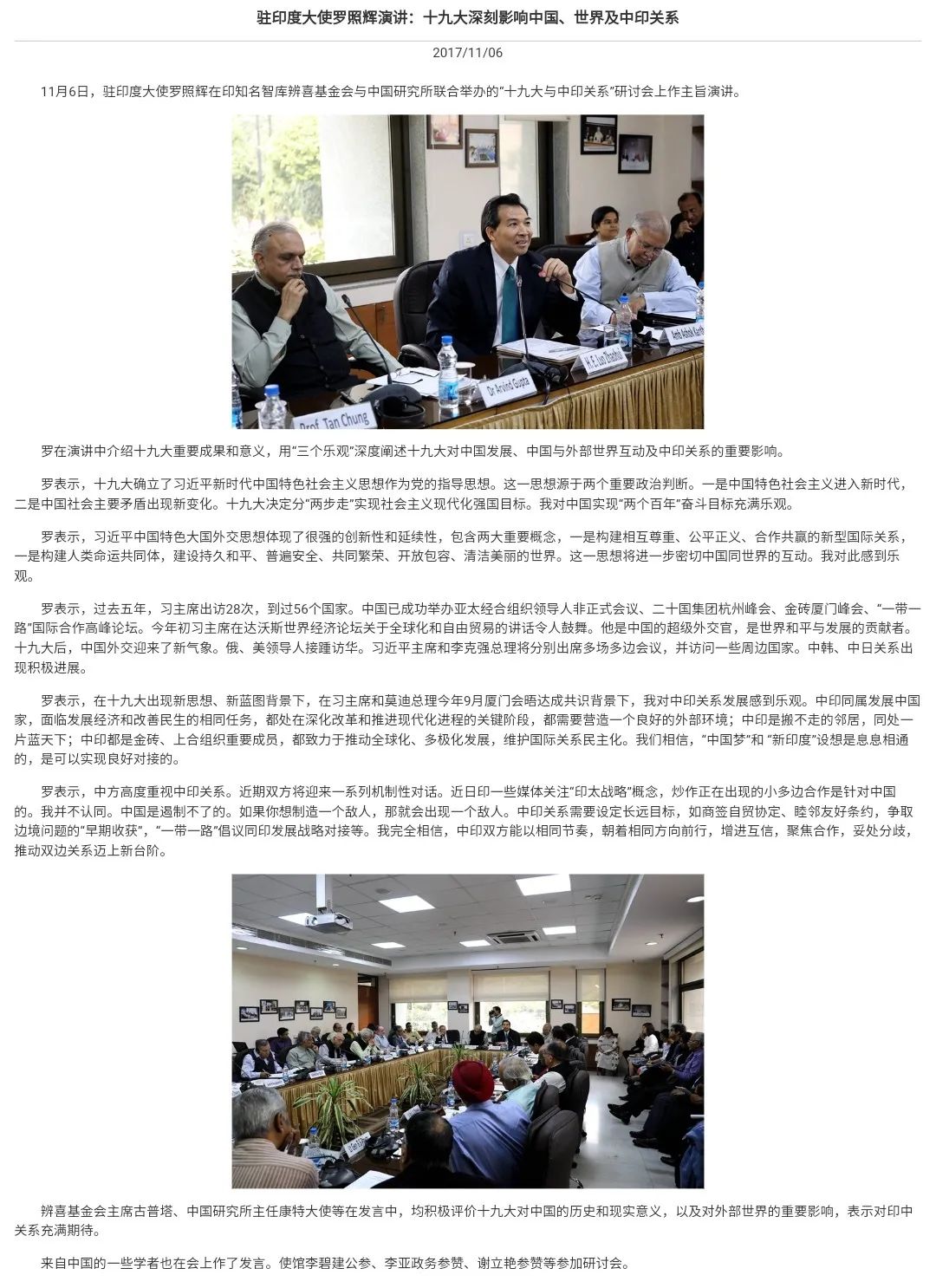
原驻印度大使罗照辉在会上发言 http://in.chineseembassy.org/chn/sgxw/t1507972.htm