
听力部分
| Section | 版本号 | 场景 | 题型 |
| One | 50112 | 邮寄包裹 | 填空 10 |
1. No late than Friday
2. Type of delivery: International Express
3. Name: Anna Hillman
4. Sender’s address: 14 Mountain Road
5. North Building
6. Address: Park Avenue
7. Packages include: (6) books and8 (a)photograph
9. How much is the post fee? $98
10. What should bring if the package lost? ID code
| Section | 版本号 | 场景 | 题型 |
| Two | 20125 | 小镇介绍 | 单选5, 填空5 |
11. When was the town built? A. 16th century
12. Why did the festival held in the winter? C there are not enough job for workers in winter
13. Council 还是谁要承担的费用?£15,000
14. What is the town most famous for? A agriculture fair
15. Where does the painting come from? C the town
16. 在sound of music 中,人们要wear fancy dress
17. 去theater看表演,如果有小孩最好买family ticket
18. 芭蕾舞演出地点:concert rooms(有s)
19. 去看芭蕾演出 需要book in advance
20. 如果想获得更多信息can check the website
| Section | 版本号 | 场景 | 题型 |
| Three | 40144 | 媒体实习反馈 | 配对6,选择4 |
21-26 Matching
A.Julie
B Mike
B.C both Julia& Mike
21. Company expected too much. A
22. Didn’t find difficult to get along with journalist. B
23. Learned from interview C
24. Publication feel excited C
25. Consult journalist B
26. Practical knowledge B (答案不确定)
27. -30 Multiple Choices
27. What Julia learned from interview ? To interrupt with polite
28. What Mike learned from writing business journalism? B the informality terms that used A the need to define technical words
29. 问女生在website上做得怎么样 A easy to log on
30. Mick 怎么看待julie的网页工作 A It’s ideal job for Julie
| Section | 版本号 | 场景 | 题型 |
| Four | 20115 | drama | 填空 10 |
31. Raise children’s’confidence
32. Participant/experience
33. Importance of listening
34. Therapy
35. Safe environment
36. Morality
37. Responsible
38. Remember
39. Participation
40. problems
阅读部分
| Passage | 题材 | 题目 | 题型 |
| One | 购物方式的变化 | Shopping by Design | 段落信息匹配 5,单选题3 ,句子填空5 |
文章大意:
文章介绍了shopping形式的发展,从最开始的人们到前台给售货员list让去找东西,到后来一个叫做saunder的人,开发了新的形式的自助shopping ,发展到连锁商店piggy wiggy。
参考文章:
Shopping by Design
A At the beginning of the 20th century, grocery stores in the United States were full-service. A customer would ask a clerk behind the counter for specific items and the clerk would package the items, which were limited to dry goods. If they want to save some time, they have to ask a delivery boy or by themselves to send the note of what they want to buy the grocery story first and then go to pay the goods later. These grocery stores usually carried only one brand of each good. There were early chain stores, such as the A&P Stores, but these were all entirely full-service and very time-consuming.
B In 1885, a Virginia boy named Clarence Saunders began working part-time as a clerk in a grocery store when he was 14 years old, and quit school when the shopkeeper offered him Ml time work with room and board. Later he worked in an Alabama coke plant and in a Tennessee sawmill before he returned to the grocery business. By 1900, when he was nineteen years old, he was earning $30 a month as a salesman for a wholesale grocer. During his years working in the grocery stores, he found that it was very inconvenient and inefficient for people to buy things because more than a century ago, long before there were computers, shopping was done quite differently than it is today. Entering a store, the customer would approach the counter (or wait for a clerk to become available) and place an order, either verbally or, as was often the case for boys running errands, in the form of a note or list. While the customer waited, the clerk would move behind the counter and throughout the store, select the items on the list—some form shelves so high that long-handled grasping device had to be used—and bring them back to the counter to be tallied and bagged or boxed. The process might be expedited by the customer calling or sending in the order beforehand, or by the order being handled by a delivery boy on a bike, but otherwise it did not vary greatly. Saunders, a flamboyant and innovative man, noticed that this method resulted in wasted time and expense, so he came up with an unheard-of solution that would revolutionize the entire grocery industry: he developed a way for shoppers to serve themselves.
C So in 1902 he moved to Memphis where he developed his concept to form a grocery wholesale cooperative and a full-service grocery store. For his new “cafeteria grocery”, Saunders divided his grocery into three distinct areas:
1) A front “lobby” forming an entrance and exit and checkouts at the front.
2) A sales department, which was specially designed to allow customers to roam the aisles and select their own groceries. Removing unnecessary clerks, creating elaborate aisle displays, and rearranging the store to force customers to view all of the merchandise and over the shelving and cabinets units of sales department were “galleries” where supervisors were allowed to keep an eye on the customers while not disturbing them. 3) And another section of his store is the room only allowed for the clerks which was called the “stockroom” or “storage room” where large refrigerators were situated to keep fresh products from being perishable. The new format allowed multiple customers to shop at the same time, and led to the previously unknown phenomenon of impulse shopping. Though this format of grocery market was drastically different from its competitors, the style became the standard for the modern grocery store and later supermarket.
D On September 6, 1916, Saunders launched the self-service revolution in the USA by opening the first self-service Piggly Wiggly store, at 79 Jefferson Street in Memphis, Tennessee, with its characteristic turnstile at the entrance. Customers paid cash and selected their own goods from the shelves. It was unlike any other grocery store of that time. Inside a Piggly Wiggly, shoppers were not at the mercy of shop clerks. They were free to roam the store, check out the merchandise and get what they needed with their own two hands and feet. Prices on items at Piggly Wiggly were clearly marked. No one pressured customers to buy milk or pickles. And the biggest benefit at the Piggly Wiggly was that shoppers saved money. Self-service was a positive all around. “It’s good for both the consumer and retailer because it cuts costs,” noted George T. Haley, a professor at the University of New Haven and director of the Center for International Industry Competitiveness. “If you looked at the way grocery stores were run previous to Piggly Wiggly and Alpha Beta, what you find is that there was a tremendous amount of labor involved, and labor is a major expense.” Piggly Wiggly cut the fat.
E Piggly Wiggly and the self-service concept took off. Saunders opened nine stores in the Memphis area within the first year of business. Consumers embraced the efficiency, the simplicity and most of all the lower food prices. Saunders soon patented his self-service concept, and began franchising Piggly Wiggly stores. Thanks to the benefits of self-service and franchising, Piggly Wiggly ballooned to nearly 1,300 stores by 1923. Piggly Wiggly sold $100 million—worth $1.3 billion today—in groceries, making it the third-biggest grocery retailer in the nation. The company’s stock was even listed on the New York Stock Exchange, doubling from late 1922 to March 1923. Saunders had his hands all over Piggly Wiggly. He was instrumental in the design and layout of his stores. He even invented the turnstile.
F However Saunders was forced into bankruptcy in 1923 after a dramatic spat with the New York Stock Exchange and he went on to create the “Clarence Saunders sole-owner-of-my-name” chain, which went into bankruptcy.
G Until the time of his death in October 1953, Saunders was developing plans for another automatic store system called the Food electric. But the store, which was to be located two blocks from the first Piggly Wiggly store, never opened. But his name was well-remembered along with the name Piggly Wiggly.
Questions & Answers
Questions 1-5
Which paragraph contains the following information?
Write the correct letter A-E in boxes 1-5 on your answer sheet.
(NB You may use any letter more than once.)
1.How Clarence Saunders’ idea had been carried out.
2.Introducing the modes and patterns of groceries before his age.
3.Clarence Saunders declared bankruptcy a few years later.
4.Descriptions of Clarence Saunders’ new conception.
5.The booming development of his business.
Questions 6-10
Complete the following sentences.
Choose ONLY ONE WORD AND/OR A NUMBER from the passage for each answer.
Write your answers in boxes 6-10 on your answer sheet.
6.When Clarence Saunders was an adolescent, he took a job as a ______ in a grocery store.
7.In the new innovation of grocery store, most of the clerks’ work before was done by _______.
8.In Saunders’ new grocery store, the section where customers finish the payment was called ______.
9.Another area in his store which behind the public area was called the ______, where only internal staff could access.
10.At ________ customers were under surveillance.
Questions 11-13
11.Why did Clarence Saunders want to propel the innovation of grocery stores at his age?
A.Because he was an enthusiastic and creative man.
B.Because his boss wanted to reform the grocery industry.
C.Because he wanted to develop its efficiency and make great profits as well.
D.Because he worried about the future competition from the industry.
12.What happened to Clarence Saunders’ first store of Piggly Wiggly?
A.Customers complained about its impracticality and inconvenience.
B.It enjoyed a great business and was updated in the first twelve months.
C.It expanded to more than a thousand franchised stores during the first year.
D.Saunders was required to have his new idea patented and open more stores.
13.What left to Clarence Saunders after his death in 1953?
A.A fully automatic store system opened soon near his first store.
B.The name of his store the Piggly Wiggly was very popular at that time.
C.His name was actually connected with his famous shop the Piggly Wiggly in the following several years.
D.His name was painted together with the name of his famous store.
参考答案:
1. D
2. A
3. A
4. C
5. E
6. clerk
7. customers /shoppers
8. lobby
9. stock room
10. galleries
11. C
12. B
13. C
| Passage | 题材 | 题目 | 题型 |
| Two | 环境 | Iceberg as a water source | 判断题7,填空题5,单选题1 |
文章大意:
本文主要讲解Iceberg作为一个水资源如何被利用,从有限的利用到具体如何操作用plastic装iceberg运输,节省资金,最后展望要利用iceberg也注意限制。
类似参考文章:
Global Warming Scare Hits Ski Country
"The Greatest Snow on Earth" is emblazoned across Utah license plates. Park City, Utah, was the alpine venue during the Winter Olympic Games in 2002. A World Cup freestyle skiing competition was held this week in neighboring Deer Valley. The arctic scenes in the movie, "National Treasure" were filmed here. As they are fond of saying in this old mining town, "when the silver mines closed, we discovered white gold."
So this week, when the results of a $60,000 climatology study were released, more than 1,000 residents of this town of 8,500 crowded into an auditorium to hear the news.
"Temperatures are projected to rise 6 to 15 degrees Fahrenheit by the end of the century," announced Mark Williams, a University of Colorado scientist who specializes in temperature and precipitation modeling.
"For the high emission scenario, there’s just no snow on Park City’s mountains," said fellow scientist Brian Lazar, who explained that "high emission" meant that the world would continue to accelerate its use of carbon based fuels that create greenhouse emissions.
Armed with graphics and statistical models, the scientists delivered the sobering message to the nervous crowd.
"I’ve been very scared for some time," said one resident, addressing the experts. "I’m scared primarily for my grandchildren, great-grandchildren," he said.
Global Warming Could Cut the Green in the Ski Industry
His concern may be well-founded. Williams and Lazar, who relied on seven different projections formulated by a United Nations team of experts, predicted dire consequences for the winter sports industry unless energy consumption is curbed.
Even under the best scenario the so-called "green" scenario, which anticipates dramatic cuts in greenhouse emissions, the ski season at the turn of the century could extend only from Christmas to President’s Day, eliminating the profitable shoulder season in the ski and snowboard industry.
Williams said carbon dioxide and other greenhouse gases thicken the atmosphere and make the planet’s surface hotter.
"The mountains of the American West are the first to heat up," he said. "You are the canary in the coal mine" he added, referring to the old mining practice of placing a bird in a cage in a mine shaft to alert miners to poisonous gases."
"One thing to keep in mind is, when we emit carbon dioxide, it stays in the atmosphere for 50 years. Regardless of what we do today, there’s a 50-year lag time," Williams added. "That has a huge effect on the ski conditions. We’d be going from Park City champagne powder -- light, dry snow -- to Sierra cement -- heavy, wet snow.
Leading the Fight Against Global Warming
The study was underwritten by POWDR Corporation, which operates Park City Mountain Resort. When asked why he funded research that predicts the end of his business, CEO John Cumming told ABC News if he believed it was hopeless, he would sell his resorts in Utah, Nevada, Oregon and California. However, he is not selling, and has become a leader in the fight against global warming.
"We have visitors from around the world that come here and hopefully see that we’ve opted for doing something different that will have a different outcome and maybe they will choose to do the same thing," he says.
参考答案:
13. TRUE
14. FALSE
15. FALSE
16. FASLE
17. TRUE
18. NOT GIVEN
19. FALSE
20. Rolls
21. Floating barge plastic
22. Xx
23. Reduce Friction
24. Current
25. C
| Passage | 题材 | 题目 | 题型 |
| Three | 社会科学 | Human cooperation | 配对5,选择5,判断5 |
文章大意:
文章主要讲解了不同形式的合作如何产生。人类无时无刻不需要合作,对于快速激烈的行动,比如跳舞,verbal communication就没有用了,如果双方能看到对反个,合作的效率更高。有时候尽管会make the process harder,但还是会合作。举例子是一个实验,让实验对象看不同颜色分别击打左右边的东西。一个人的判断会受到影响,如果the process is shared.
类似参考文章 :
A The Lumière Brothers opened their Cinematographe, at 14 Boulevard des Capucines in Paris, to 100 paying customers over 100 years ago, on December 8, 1895. Before the eyes of the stunned, thrilled audience, photographs came to life and moved across a flat screen.
B So ordinary and routine has this become to us that it takes a determined leap of the imagination to grasp the impact of those first moving images. But it is worth trying, for to understand the initial shock of those images is to understand the extraordinary power and magic of cinema, the unique, hypnotic quality that has made film the most dynamic, effective art form of the 20th century.
C One of the Lumière Brothers" earliest films was a 30-second piece which showed a section of a railway platform flooded with sunshine. A train appears and heads straight for the camera. And that is all that happens. Yet the Russian director Andrei Tarkovsky, one of the greatest of all film artists, described the film as a ‘work of genius’. ‘As the train approached,’ wrote Tarkovsky, ‘panic started in the theatre: people jumped and ran away. That was the moment when cinema was born. The frightened audience could not accept that they were watching a mere picture. Pictures were still, only reality moved; this must, therefore, be reality. In their confusion, they feared that a real train was about to crush them.’
D Early cinema audiences often experienced the same contusion. In time, the idea of film became familiar, the magic was accepted -but it never stopped being magic. Film has never lost its unique power to embrace its audiences and transport them to a different world. For Tarkovsky, the key to that magic was the way in which cinema created a dynamic image of the real flow of events. A still picture could only imply the existence of time, while time in a novel passed at the whim of the reader. But in cinema, the real, objective flow of time was captured.
E One effect of this realism was to educate the world about itself. For cinema makes the world smaller. Long before people travelled to America or anywhere else, they knew what other places looked like; they knew how other people worked and lived.
Overwhelmingly, the lives recorded - at least in film fiction - have been American. From the earliest days of the industry, Hollywood has dominated the world film market.
American imagery - the cars, the cities, the cowboys - became the primary imagery of film. Film carried American life and values around the globe.
F And, thanks to film, future generations will know the 20th century more intimately than any other period. We can only imagine what life was like in the 14th century or in classical Greece. But the life of the modern world has been recorded on film in massive, encyclopaedic detail. We shall be known better than any preceding generations.
G The ‘star’ was another natural consequence of cinema. The cinema star was effectively born in 1910. Film personalities have such an immediate presence that, inevitably, they become super-real. Because we watch them so closely and because everybody in the world seems to know who they are, they appear more real to us than we do ourselves. The star as magnified human self is one of cinema’s most strange and enduring legacies.
H Cinema has also given a new lease of life to the idea of the story. When the Lumière Brothers and other pioneers began showing off this new invention, it was by no means obvious how it would be used. All that mattered at first was the wonder of movement. Indeed, some said that, once this novelty had worn off, cinema would fade away. It was no more than a passing gimmick, a fairground attraction.
I Cinema might, for example, have become primarily a documentary form. Or it might have developed like television - as a strange, noisy transfer of music, information and narrative. But what happened was that it became, overwhelmingly, a medium for telling stories. Originally these were conceived as short stories - early producers doubted the ability of audiences to concentrate for more than the length of a reel. Then, in 1912, an Italian 2-hour film was hugely successful, and Hollywood settled upon the novel-length narrative that remains the dominant cinematic convention of today.
J And it has all happened so quickly. Almost unbelievably, it is a mere 100 years since that train arrived and the audience screamed and fled, convinced by the dangerous reality of what they saw, and, perhaps, suddenly aware that the world could never be the same again - that, maybe, it could be better, brighter, more astonishing, more real than reality.
参考答案待补充
写作部分
| Task | 图表类型 | 题目 |
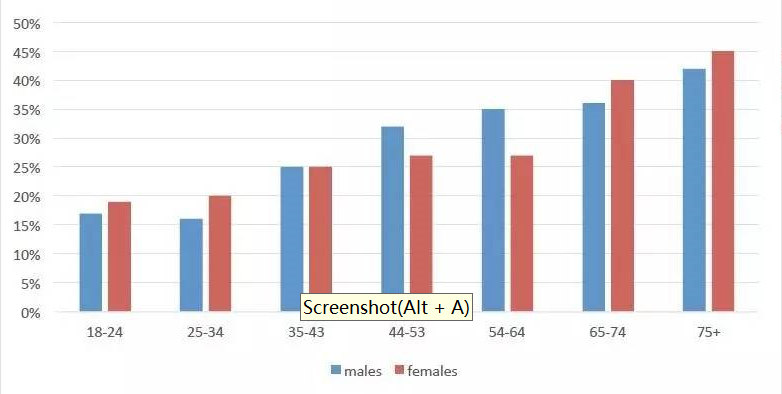
| One | 柱状图 | The chart below shows the percentage of adults not doing physical exercise in Australia in 2005.Summarize the information by selecting and reporting the main features, and make comparisons where relevant. |
| Task | 题型类别 | 作文话题 | 题目 | |
| Two | 观点类 | 社会类 | In modern society, ambition is more and more important.How important is ambition for being successful in life?Is it a positive or negative development? |
百度搜索“启德都能帮”,专家帮你规划出国留学方案!
如果大家想了解更多的留学教育、考试培训、海外学游的资讯,欢迎关注启德官网和“启德留学微服务”微信号(qidelx),我们的专业顾问团队为您解答各类问题。