
分享兴趣,传播快乐,增长见闻,留下美好。
亲爱的您,
这里是LearingYard学苑!
今天小编为大家带来的是最新钱报(七十一),
具体为文献推文(期刊论文)的精读
《Consumer Rebates from E-Commerce Platforms and Multi-Channel Management of Third-Party Sellers》
欢迎您的用心访问!
本期推文阅读时长大约6分钟,请您耐心阅读。
Share interest, spread happiness, increase knowledge, leave beautiful.
Dear you,
This is LearingYard Academy!
Today Xiaobian brings you the latest money report (71),
Specifically for the intensive reading of literature tweets (journal papers)
A dual supply chain revenue sharing contract considering online reviews and Rebates
Welcome your heart visit!
This tweet will take about 6minutes to read, please be patient.
今天小编分享一篇期刊论文《Consumer Rebates from E-Commerce Platforms and Multi-Channel Management of Third-Party Sellers》的模型描述部分,小编将从思维导图、精读内容、知识补充三个板块来介绍这一部分内容,请读者跟小编一起学习一下吧!
Today Xiaobao shares the model description of a journal paper "Consumer Rebates from E-Commerce Platforms and Multi-Channel Management of Third-Party Sellers". Xiaobian will introduce this part of the content from the mind map, intensive reading content, knowledge supplement three sections, please learn with Xiaobian!
1.思维导图
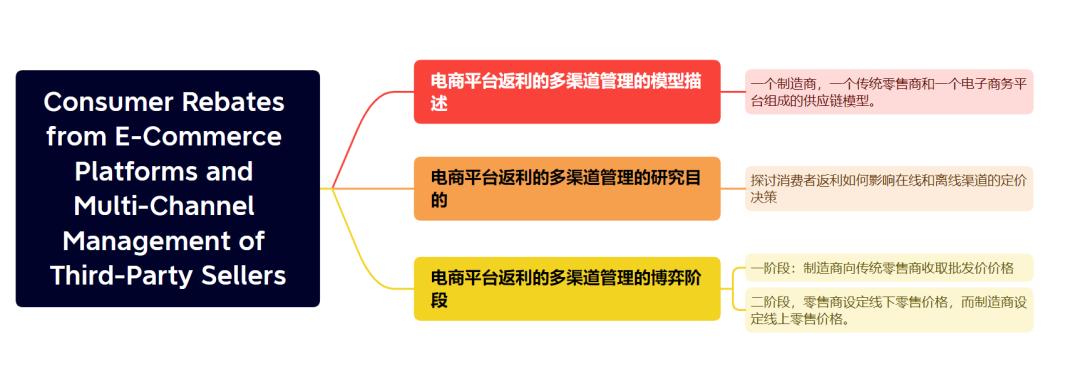
该篇文献的模型构建部分的思维导图部分如下图所示:
The mind map of the model building part of this paper is shown in the figure below:
2.精读内容
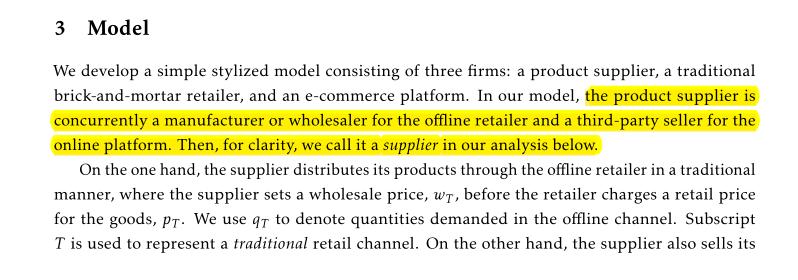
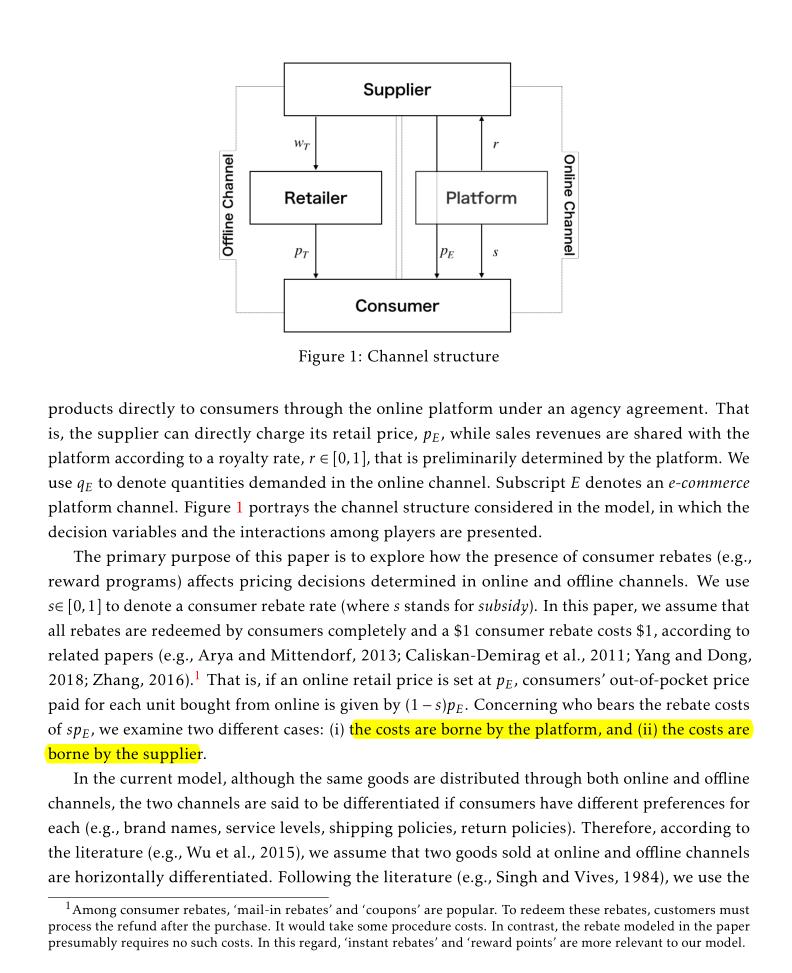
根据学者模型描述部分了解到,学者研究的是由一个制造商,一个传统零售商和一个电子商务平台组成的供应链模型。制造商一方面批发产品给传统零售商以及在第三方平台上进行销售。一方面,制造商以传统方式通过线下零售商分销其产品,制造商设定批发价格。另一方面,制造商同时也通过平台销售产品,制造商可以直接制定零售价格,而销售收入则根据平台初步确定的佣金率与平台分享。
According to the description of the scholar model, the scholar studies a supply chain model composed of a manufacturer, a traditional retailer and an e-commerce platform. Manufacturers sell their products wholesale to traditional retailers and on third-party platforms. On the one hand, manufacturers distribute their products in the traditional way through offline retailers, and manufacturers set wholesale prices. On the other hand, manufacturers also sell products through the platform. The manufacturer can directly set the retail price, and the sales revenue is shared with the platform according to the commission rate preliminarily determined by the platform.
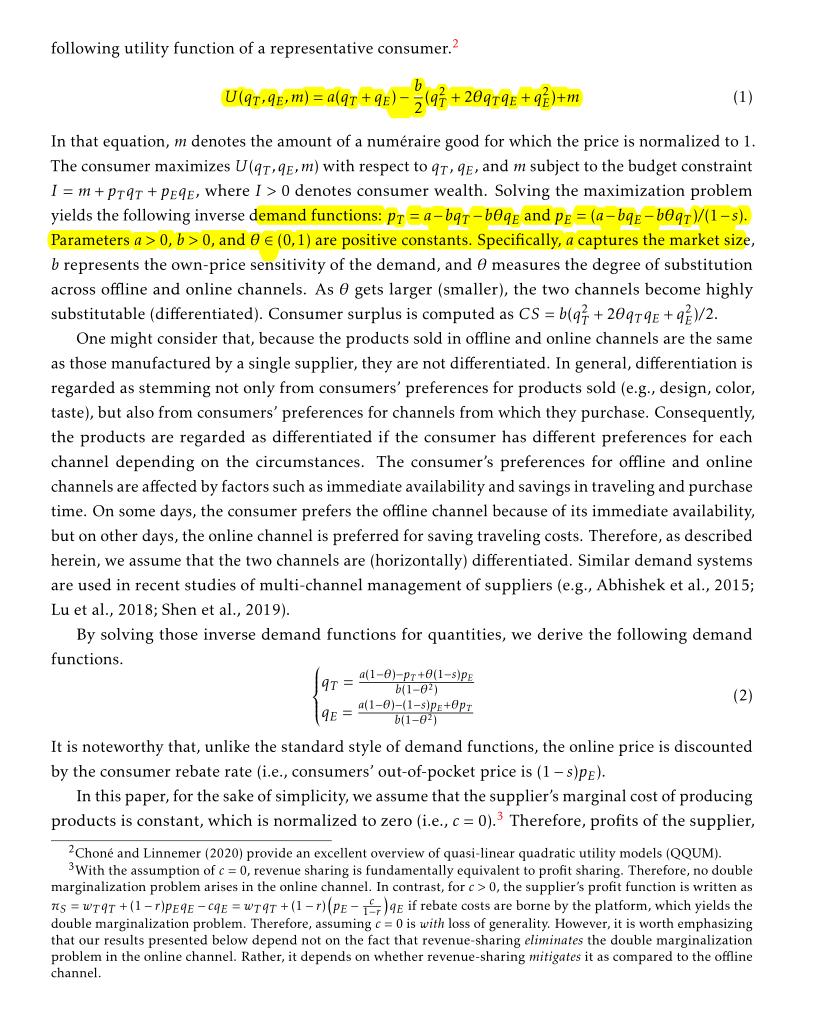
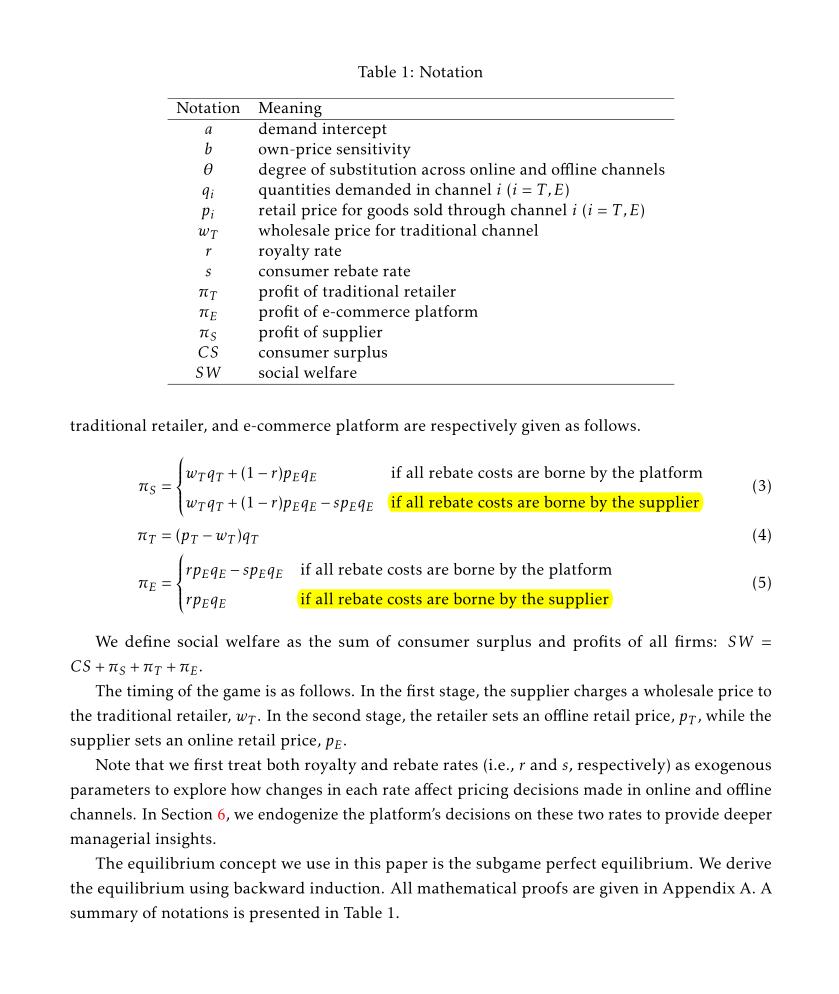
本文的主要目的是探讨消费者返利如何影响在线和离线渠道的定价决策。我们使用s来表示平台给消费者的返利。假设所有的返利都由消费者完全兑现,并参考学者(Arya和Mittendorf、Caliskan-Demirag、Yang和Dong、张等的文献)。设定如果线上零售价格设定为p,消费者从线上购买的每件商品的现金支付价格为(1-s)p。关于谁消费者返利的成本,我们考察了两种不同的情况:(一)成本由平台承担,(二)成本由供应商承担。学者还假设线上线下销售的产品具有同质性,但消费者存在消费者偏好,有的消费者更喜欢线下渠道,因为它可以立即获得,但有的换线上渠道。学者参考供应商多渠道管理的研究(,Abhishek、陆、沈),根据效用函数设置需求函数。学者将模型中的参数描述进行了参数,然后对所有返利由平台承担,还有所有返利由制造商承担情况下的利润函数进行表述,学者将社会福利定义为所有厂商的消费者剩余和利润之和。
The main objective of this paper is to explore how consumer rebates affect pricing decisions in both online and offline channels. We use s to represent the platform rebates to consumers. Assume that all rebates are fully cashing by consumers, and refer to the literature of scholars (Arya and Mittendorf, Caliskan-Demirag, Yang and Dong, Zhang, et al.). Suppose that if the online retail price is set to p, the cash price paid by the consumer for each item purchased online is (1-s)p. As for the cost of rebates for consumers, we examined two different scenarios :(1) the cost is borne by the platform, and (2) the cost is borne by the supplier. Scholars also assume that products sold online and offline are homogeneous, but consumers have consumer preferences. Some consumers prefer offline channels because they can be obtained immediately, while others switch to online channels. Scholars refer to the research on supplier multi-channel management (Abhishek, Lu, Shen) and set the demand function according to the utility function. The scholar parameterized the parameter description in the model, and then expressed the profit function under the condition that all rebates are borne by the platform and all rebates are borne by the manufacturer. The scholar defined social welfare as the sum of the consumer surplus and profits of all manufacturers.
博弈的第一阶段,制造商向传统零售商收取批发价价格。在第二阶段,零售商设定线下零售价格,而制造商设定线上零售价格。学者先将返利设为外生参数,以探究返利的变化如何影响在线和离线渠道的定价决策。
In the first stage of the game, manufacturers charge wholesale prices to traditional retailers. In the second stage, retailers set offline retail prices, while manufacturers set online retail prices. Scholars first set rebates as exogenous parameters to explore how changes in rebates affect pricing decisions of online and offline channels.
3.知识补充
1.模型描述写作注意事项
1.Notes for writing model description
博弈论(Game Theory )(亦称对策论或赛局理论,是研究理性决策者之间战略互动的数学模型。
Game Theory (also known as game theory or Game Theory) is a mathematical model of strategic interactions between rational decision makers.
2.什么是子博奕完美均衡
2. What is perfect equilibrium of sub-game
定义:展开型博弈的一个策略组合称为子博弈完美均衡,如果对于该展开型博弈的每一个子博弈,该策略组合都是Nash均衡。
Definition: A strategy combination of an expansion game is called a subgame perfect equilibrium, if for every subgame of the expansion game, the strategy combination is a Nash equilibrium.
3.论文模型构建注意事项
3. Notes for paper model construction
(1)信息结构判断,经济行为主体之间各自掌握的信息是对称还是非对称的。
(1) Judging the information structure, whether the information held by the subjects of economic behavior is symmetric or asymmetric.
(2)博弈关系,在不同主体之间的博弈结构以及各自策略集合需要描述清楚。
(2) Game relations: the game structure between different players and their respective strategy sets need to be described clearly.
(3)模型构建需要有依据,一方面是需要有现实依据,另一方面是需要有经典文献支撑,因此模型构建需要有逻辑性。
(3) Model construction needs to be based on reality on the one hand, and classical literature on the other hand, so model construction needs to be logical.
(4)模型构建需要清晰简洁,需要用最精炼的语言把模型要输呈现出来,以便于审稿人或者同领域的学者能够一眼看到论文就知道你在分析什么问题。
(4) Model construction needs to be clear and concise, and the model needs to be presented in the most concise language, so that reviewers or scholars in the same field can know what problem you are analyzing at a glance.
今天的分享就到这里了。
如果您对今天的文章有独特的想法,
欢迎给我们留言,
让我们相约明天,
祝您今天过得开心快乐!
That's it for today's sharing.
If you have a unique idea about today’s article,
Welcome to leave us a message,
Let us meet tomorrow,
I wish you a happy day today!
参考资料:有道翻译
参考文献:[1] Monden A, Zennyo Y. Consumer Rebates from E-Commerce Platforms and Multi-Channel Management of Third-Party Sellers [J]. Available at SSRN 3639717, 2021, 1(1): 1-14.
本文由LearningYard学苑整理并发出,如有侵权请在后台留言!
LearningYard学苑
文案 | Qian
排版 | Qian
审核 | Tian