
分享兴趣,传播快乐,增长见闻,留下美好。
亲爱的您,
这里是LearingYard学苑!
今天小编为大家带来《随机需求下生鲜电商供应链物流合作与运营决策》
模式比较。
欢迎您的用心访问!
本期推文阅读时长大约5分钟,请您耐心阅读。
Share interest, spread happiness,
increase knowledge, and leave beautiful.
Dear you,
this is the LearningYard Academy!
Today I bring you "Fresh produce e-commerce supply chain logistics cooperation and operational decisions under random demand "
Model Comparison .
Welcome your visit!
The reading time of this tweet is about 5 minutes, please read it with patience.
本期推文将通过思维导图,复刻论文内容,知识补充三个板块,复刻来自于中国管理科学期刊的期刊论文《随机需求下生鲜电商供应链物流合作与运营决策》模式比较。
This tweet will replicate the journal paper from the Chinese Journal of Management Science, "Fresh produce e-commerce supply chain logistics cooperation and operational decisions under stochastic demand" model comparison through three panels: mind map, replication of paper content, and knowledge supplement.
关于模式比较分析的思维导图如下:
A mind map on comparative model analysis is as follows:
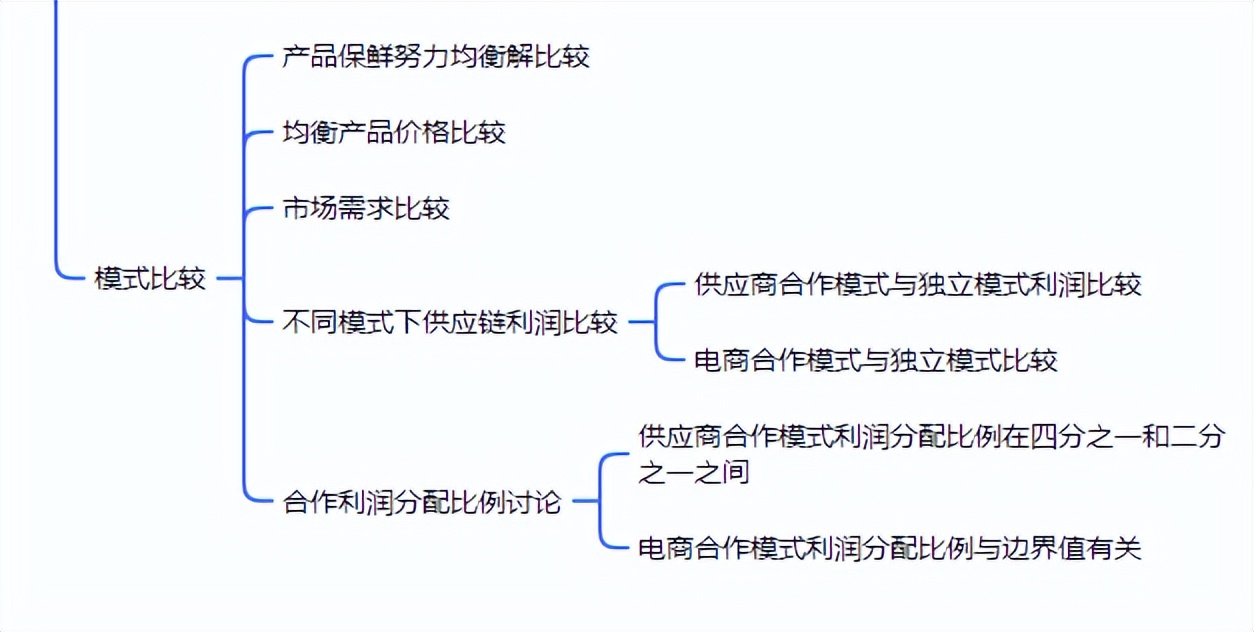
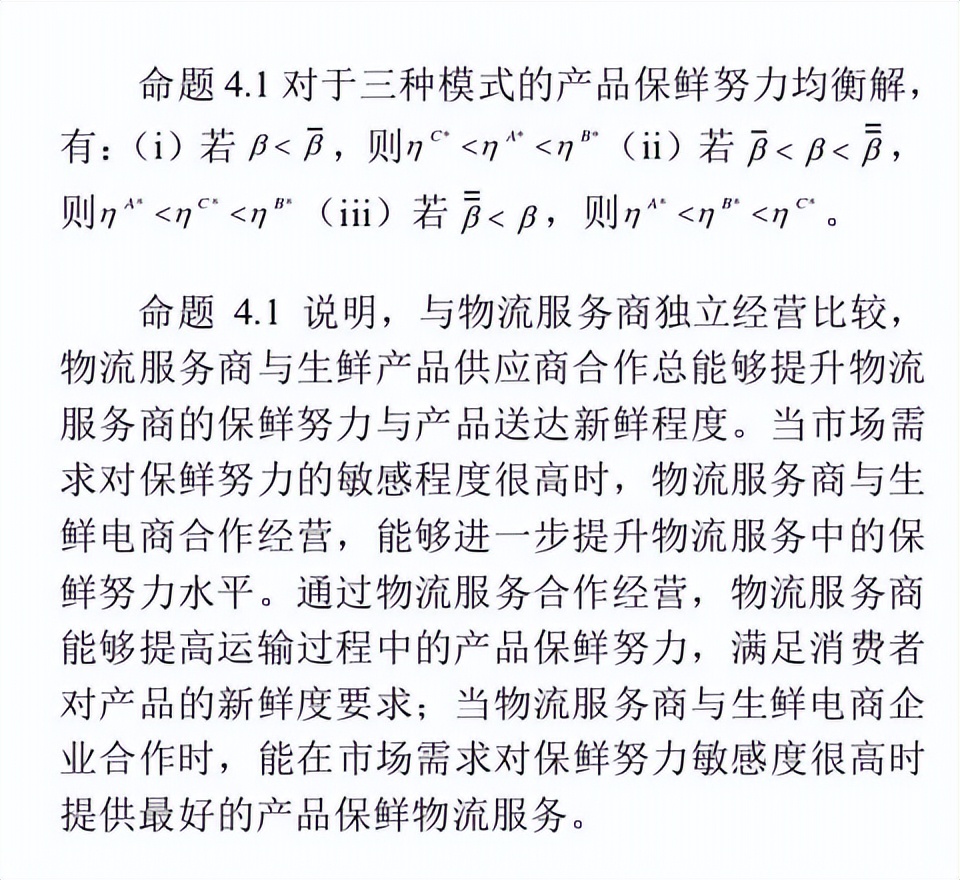
本次推文将介绍模式比较章节,作者首先比较三种模式的产品保鲜努力大小,根据临界值分类讨论,发现物流服务商和生鲜供应商合作总是大于独立经营模式的收益。另外随着保鲜努力的敏感度变高,电商合作模式的保鲜努力变的相对越来越高。
In this tweet, the chapter on model comparison is presented. The authors first compare the freshness effort of the products of the three models and discuss them according to the critical value categories, finding that the benefits of collaboration between logistics providers and fresh produce suppliers are always greater than those of the independent business model. In addition, as the freshness effort sensitivity becomes higher, the freshness effort of the e-commerce partnership model becomes relatively higher and higher.
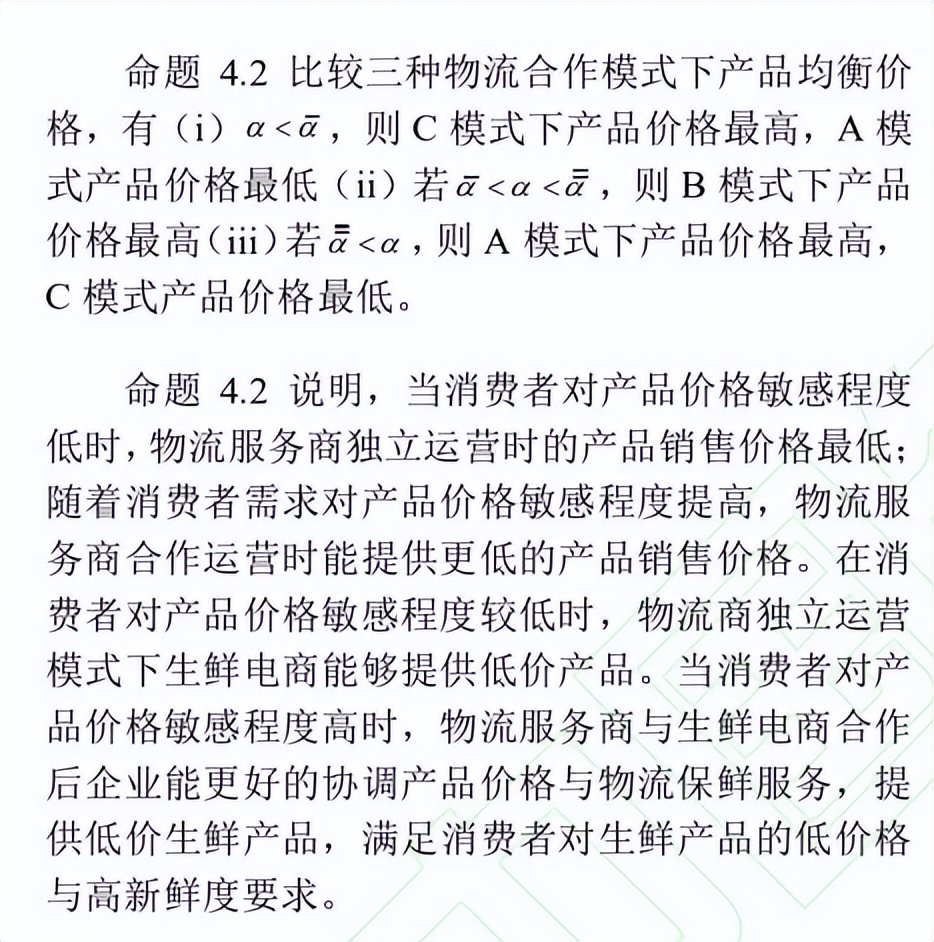
随后作者比较了均衡产品价格,发现随着消费者对产品价格敏感度的升高,产品价格最高由电商合作模式变化到供应商合作模式,最后变成独立模式最高,说明随着价格敏感程度变高,物流商选择合作可以提供更低的产品销售价格。
The authors then compared equilibrium product prices and found that as consumers became more price sensitive, the highest product prices changed from the e-commerce cooperative model to the supplier cooperative model and finally to the highest independent model, suggesting that as price sensitivity became higher, logistics providers could offer lower product sales prices by choosing to cooperate.
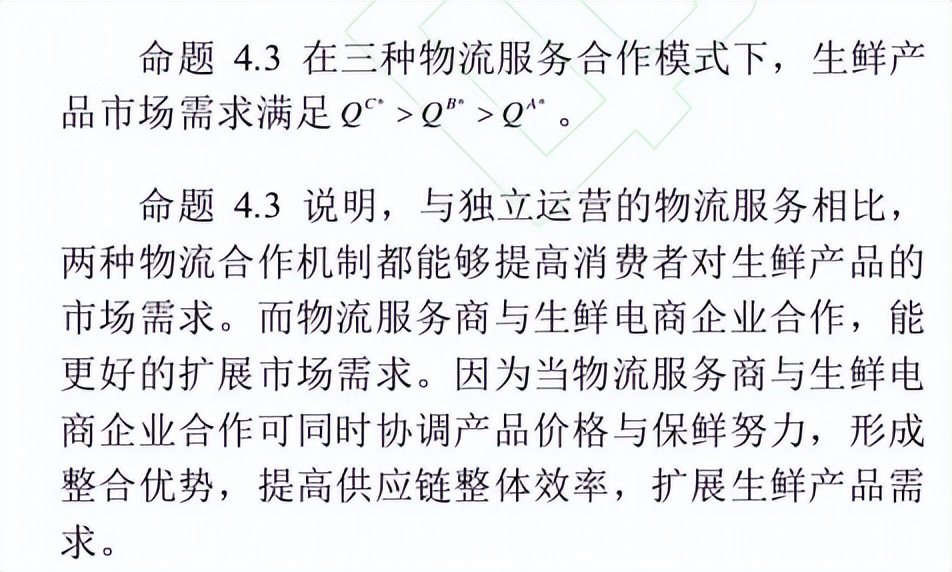
紧接着分析市场需求比较,发现电商合作模式市场需求大于供应商合作模式市场需求大于独立模式市场需求,说明合作可以提高市场需求。
Immediately following the analysis of the comparison of market demand, it was found that the market demand for the e-commerce cooperative model was greater than the market demand for the supplier cooperative model than the market demand for the independent model, indicating that cooperation can increase market demand.
接下来作者对不同模式下供应链利润比较,发现供应商合作模式的利润大于独立模式的利润,电商合作模式的利润大于独立模式的利润。可以看到选择哪种合作模式都可以获得更高的利润。
Next the authors compare the supply chain profits in different models and find that the profits of the supplier cooperation model are greater than those of the stand-alone model, and the profits of the e-commerce cooperation model are greater than those of the stand-alone model. It can be seen that higher profits can be achieved by choosing either cooperation model.
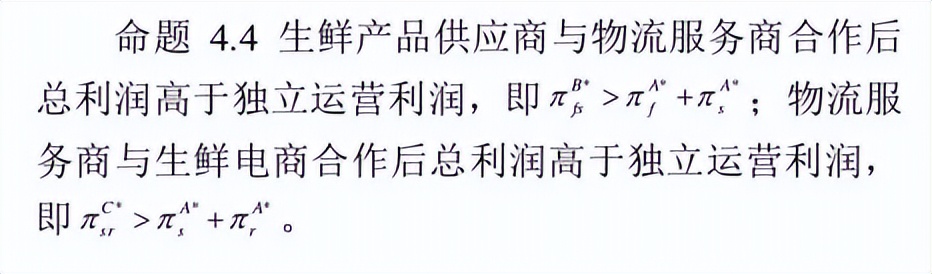
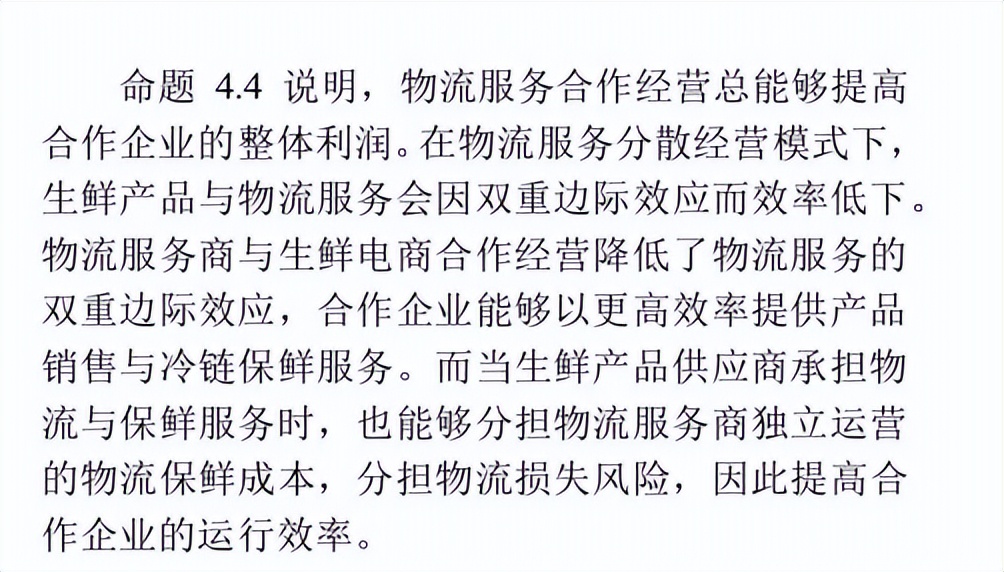
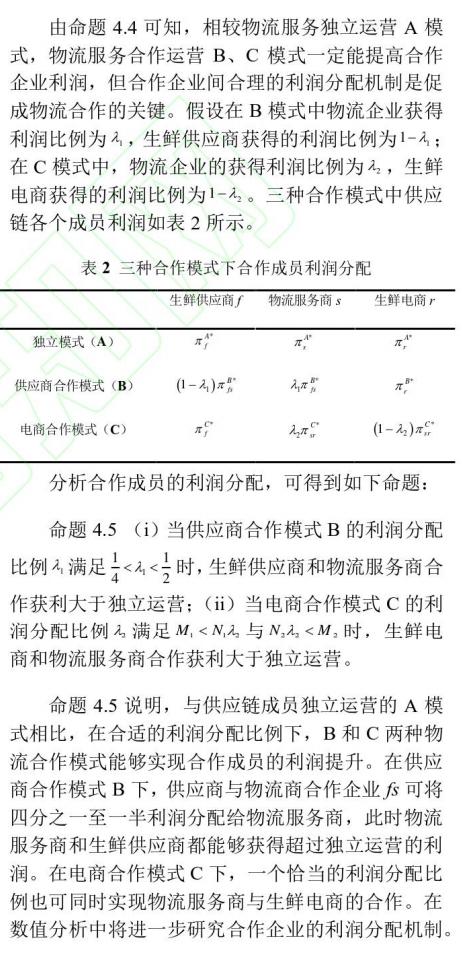
基于命题4.4的结论—选择哪种合作模式都可以获得更高的利润,作者设置了供应商合作和电商合作模式下的利润分配比例,通过计算得到供应商合作模式的利润分配比例在二分之一到四分之一之间时,可以促成合作,而电商合作模式的分配比例同时需要满足两个临界值,合作便能促成。
Based on the conclusion of Proposition 4.4 - that higher profits can be achieved by choosing either cooperation model - the authors set the profit distribution ratio between the supplier cooperation model and the e-commerce cooperation model, and calculated that a profit distribution ratio between one-half and one-fourth for the supplier cooperation model can lead to cooperation, while the distribution ratio for the e-commerce cooperation model needs to meet both The supplier cooperation model can be facilitated if the profit sharing ratio is between one-half and one-fourth, while the e-commerce cooperation model needs to meet both threshold values.
文章中市场需求考虑的是随机需求,那么市场需求的影响因素有哪些呢?
1、商品的自身价格
商品的自身价格。一般说来,一种商品的价格越高,该商品的需求量就会越小。相反,价格越低,需求量就会越大。经常会问到影响的需求最主要的因素,也就是商品的自身价格。
2、消费者的收入水平
对于多数商品也就是正常商品而言,当消费者的收入水平提高时,就会增加对商品的需求量。与此相对的是,当消费者的收入水平下降时,就会减少对商品的需求量。
3、相关商品的价格
当一种商品本身的价格保持不变,而和它相关的其他商品的价格发生变化时,这种商品本身的需求量也会发生变化。相关商品一般指该商品的替代品和互补品。替代品是指两种商品之间能够相互替代以满足消费者的某一种欲望,替代品的价格提高,则对该商品的需求增加。
4、消费者的偏好
当消费者对某种商品的偏好程度增强时,该商品的需求量就会增加。偏好程度减弱,需求量就会减少。
5、消费者价格预期
当消费者预期某种商品的价格在将来某一时期会上升时,就会增加该商品的现期需求量,也意味着,当消费者预期某商品的价格在将来某一时期会下降时,就会减少对该商品的现期需求量。
The market demand considered in the article is random demand, so what are the factors influencing market demand?
1. The price of the commodity itself
The commodity's own price. Generally speaking, the higher the price of a commodity, the smaller the demand for that commodity will be. Conversely, the lower the price, the greater the demand will be. The main factor that often affects demand is the price of the commodity itself.
2. The income level of the consumer
For most goods, which are also normal goods, when the income level of the consumer increases, it increases the demand for the goods. In contrast, when the income level of consumers falls, the demand for goods decreases.
3. Prices of related goods
When the price of a commodity itself remains constant and the price of other commodities related to it changes, the demand for the commodity itself will also change. Related goods generally refer to substitutes and complementary goods of that commodity. A substitute is a good that can be substituted between two goods to satisfy a consumer's desire. If the price of the substitute increases, the demand for the good increases.
4. Consumer Preference
When the consumer's preference for a good increases, the demand for that good increases. When the degree of preference is weakened, the demand decreases.
5、Consumer price expectations
When consumers expect the price of a commodity to rise in a certain period in the future, the current demand for that commodity increases, which also means that when consumers expect the price of a commodity to fall in a certain period in the future, the current demand for that commodity decreases.
今天的分享就到这里了。
如果您对今天的文章有独特的想法,
欢迎给我们留言,
让我们相约明天。
祝您今天过得开心快乐!
That's it for today's sharing.
If you have a unique idea about today’s article,
welcome to leave us a message,
let us meet tomorrow.
I wish you a nice day !!
参考资料:DeepL翻译,知乎,百度
参考文献:崔鑫,李春发,周驰,米新新,沈瑶.随机需求下生鲜电商供应链物流合作与运营决策[J/OL].中国管理科学:1-15[2023-02-05].
本文由LearningYard学苑整理发出,如有侵权请在后台留言!