
新概念英语全套核心单词中英双解词义用法例句拓展全集(第1册第5课)
新概念英语第一册
Lesson 5 New words & expressions
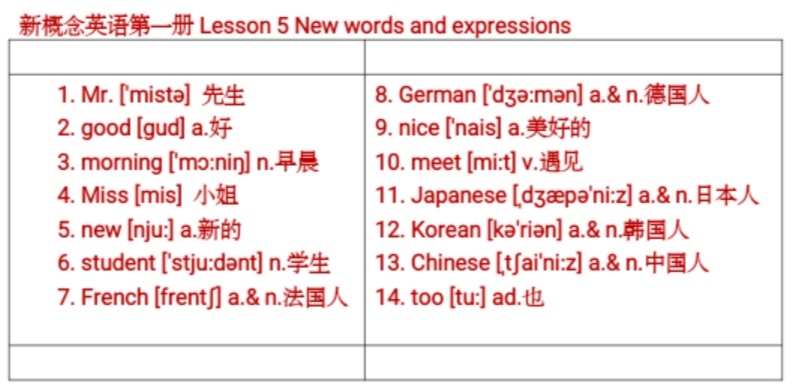
1. Mr. ['mistə] 先生
2. good [gud] a.好
3. morning ['mɔ:niŋ] n.早晨
4. Miss [mis] 小姐
5. new [nju:] a.新的
6. student ['stju:dənt] n.学生
7. French [frentʃ] a.& n.法国人
8. German ['dʒə:mən] a.& n.德国人
9. nice ['nais] a.美好的
10. meet [mi:t] v.遇见
11. Japanese [ˌdʒæpə'ni:z] a.& n.日本人
12. Korean [kə'riən] a.& n.韩国人
13. Chinese [ˌtʃai'ni:z] a.& n.中国人
14. too [tu:] ad.也
1. Mr. ['mistə] 先生 Mr,a title used before the family name or full name of a man who has no other title, or when talking to a man who holds a particularofficial position(用在男子的姓、姓名或职务之前)先生
Mr Jones/Mr Wang/Mr David Jones 琼斯先生/王先生/戴维琼斯先生
Good afternoon, Mr Dawson.下午好,道森先生。
We're looking for a Mr (= a man called) George Smith.我们在找一位名叫乔治史密斯的先生。
It's an honour to have you here today, Mr President.很荣幸您今天能来,总统先生。
2 used when expressing the idea that a man is typical of or represents a quality, activity or place (用以表示某男子是某一品质、活动或地方的典型代表)
She's still hoping to meet Mr Right (= the perfect man).: 她仍在期待遇到如意郎君。
He thinks he's Mr Big (= that he is very important). 他自认是个大人物。

2. good [gud] a.好 adjective 不规则形容词 better, best, 令人愉快的
A. very satisfactory, enjoyable, pleasant or interesting 令人满意的;令人愉快的;合意的;有趣的
1. a good book一本有趣的书
2. Did you have a good time at the party?你在聚会上玩得开心吗?
3. The weather has been really good for the time of year. 就这个季节而言,这段时间的天气真是难得的好。
4. I've just had some very good news. 我刚得知一些特别令人开心的消息。
5. It's so good to see you after all this time! 分开这么长时间,见到你真是高兴!
_______________
B . used in greetings(用于打招呼)好
1. good morning /afternoon /evening早上/下午/晚上好
___________
C. 典型错误
❌COMMON LEARNER ERROR:
good or well?
Remember: good is not used as an adverb.切記:‘good’不用作副詞。
當表示做某事做得很優秀,或者水準很高時,不用‘good’,而用‘well’:To talk about something being done in a good way or to a high standard, don't say 'good', say well:
_________
1. She did her work very good, but she was often late.(典型中文思维逻辑的❌錯誤的用法)
2. She did her work very well, but she was often late.她工作得很出色,但總是遲到。
Warning: Some US English speakers use 'good' as an adverb, but many people consider this incorrect and it should not be used in exams. 注意:一些講美式英語的人會把‘good’用作副詞,但許多人認為這一用法並不正確,並且不應在考試中使用。
_________________
C. good , better , best
HIGH QUALITY 高质量
of a high quality or level好的;出色的;优质的
1. She speaks very good French.她法语说得很好。
2. I've heard it's a very good school.我听说这是所很好的学校。
3 The apple pie was as good as the one my grandmother used to make. 这苹果馅饼就像我奶奶以前做的一样好吃。
4. This restaurant has a good reputation.这家饭店声誉良好。
3. morning ['mɔ:niŋ] n.早晨morning , mornings
A. the part of the day from the time when the sun rises or you wake up until the middle of the day or lunch time早晨;上午
1. a beautiful/sunny/wet morning美丽的/阳光明媚的/多雨的上午
2. I work three mornings a week at the bookshop. 我每周在书店工作3个上午。
3. She only works in the mornings. 她只在上午工作。
4. What's our schedule for this morning? 我们今天上午有什么安排?
5. I'd like an appointment for tomorrow morning, please.请把时间约定在明天上午。
6. I'll see you on Saturday morning. 我星期六上午见你。
7. I had too much to drink at the party, and I felt terrible the morning after. 我在聚会上喝得太多,第二天上午觉得很难受。

4. Miss [mis] 小姐
用法同 Mr
5. new [nju:] a.新的 adjective. new , newer , newest 最近创造的
A. recently created or having started to exist recently 新出现的;新兴的
1. He bought a new car. 新车
2. She's very creative and always coming up with new ideas. 她极富创造力,总会想出新点子。
3. What have they decided to call their new baby?: 他们决定给刚出生的宝宝起什么名字?
4. What's new in the fashion world?时尚界有什么新潮流?
5. We have to invest in new technology if we are to remain competitive.如果我们要保持竞争力,就必须投资开发新技术。
________________
B. 新的;有别于从前的 [before noun] different to one that existed earlier
1. Have you met the new secretary?你见过新秘书了吗?
She's looking for a new job.她在找新工作。
2. Have you seen Ann's new house (= the house that Ann has just started living in)?你去过安的新居吗?
C. 新发现的;新近知道的 discovered or made known
1. This new cancer treatment offers hope to many sufferers.这种新型疗法给许多癌症患者带来希望。
2. Out with the old and in with the new.除旧迎新
6. student ['stju:dənt] n.学生
A. [C]student , students 大学生;中学生
a person who is learning at a college or university, or sometimes at a school
1. He is a law student (= someone learning about law) 他是一个学法律的学生。
2. a postgraduate student研究生
3. a student teacher (= a person training to become a teacher)师范生
4. He was a student at the University of 5. Beijing/California/Washington)Chicago.他是北京/加利福尼亚/华盛顿/芝加哥大学的学生。
________________
B. If someone is a student of a stated subject, they know about it and are interested in it, but need not have studied it formally (特定学科的)学习者(指了解并有兴趣,但不一定是正式的研究者)
1. When you're a nurse, you get to be a bit of a student of (= to know about) human nature.当护士的,一定得对人性有一点儿认识。

7. French [frentʃ] a.& n.法国人
1. French [不可数名词U]
the language that people speak in France, Belgium, parts of Canada and other countries法语
__________
2 the French[plural] the people of France法国人
__________
3. adjective 法国的;与法国有关的 from, belonging to or relating to France
French food/culture/music法国食品/文化/音乐
__________
4. relating to France or to the French language法国的,法语的
We spent our holidays in a small French town. 我们在一个法国小镇里度假。
8. German ['dʒə:mən] a.& n.德国人
1.German [C] a person from Germany 德国人,复数形式是Germans
We have a group of Germans staying at the hotel. 我们宾馆住了一群德国人。
2. German [不可数名词U]
the language of Germany, Austria and parts of Switzerland德语(德国、奥地利和瑞士部分地区的语言)
3. German adj. 德国的;德国式的;德语文的
of or relating to Germany

9. nice ['nais] a.美好的 nice adjective, nice , nicer , nicest 近义词PLEASANT令人愉快的
1 pleasant, enjoyable or satisfactory愉快的;美好的;满意的
Did you have a nice holiday? 你假期过得愉快吗?
Have a nice day/time! 祝你度过愉快的一天/过得愉快!
This orange juice doesn't smell very nice. 这种橘汁闻起来味道不太好。
Thanks for your visit - it's been nice talking to you. 谢谢你来访——跟你聊天很开心。
It''s nice of them to invite us. 他们真不错,想到了邀请我们,不是吗?
______________
2 nice and... pleasantly 令人愉快地,很好地
This orange is nice and juicy. 这橙子真是味美多汁。
__________
3. 近义词kind, friendly or polite 好心的;友善的;有礼貌的
Her new boyfriend is a really nice guy. 她的新男友是个很不错的小伙子。
I wish you'd be nice to your brother. 我希望你会好好对待你弟弟。
It was very nice of him to drive you home. 它开车送你回家真是好心。
It's not nice to talk with your mouth full. 嘴里塞满食物时说话是不礼貌的。
10. meet [mi:t] v.遇见meet/mi:t/verb met, met 与…相识
1. 用作及物动词或不及物动词 [I or T] to see and speak to someone for the first time (和…)初次见面;(与…)相识
They met at work.他们是在工作时认识的。
I met her in Hawaii.我在夏威夷认识了她。
Would you like to meet my sister?你愿意认识一下我姐姐吗?Come and meet (= be introduced to) my friend Lily.来,认识一下我的朋友莉莉。
_____________
2. 用作及物动词或不及物动词 [I or T] to come together with someone intentionally(与…)会面,会合
Lory and I meet for lunch once a month.洛瑞和洛兰每月见一次面吃午饭。
We agreed to meet on Tuesday to discuss the project.我们同意星期二见面讨论这一项目。
The women's club meets every Thursday afternoon. 妇女俱乐部每星期四下午集合。
They're meeting with their advisers to work out a new plan. 他们正与顾问会面来制订一项新计划。
________________
3. 用作及物动词或不及物动词 [I or T] to come together with someone without intending to 遇见,遇到
It's always awkward when you meet someone you know, but you can't remember their name.遇到你认识的人但却记不起他们的名字总会让人很尴尬。
Guess who I met in town today. 猜猜今天我在城里遇到了谁。
We met our old neighbours at the airport last Saturday. 我们上周六在机场遇到了老邻居。
_______________
4. 用作及物动词 [T] 满足;达到,完成to fulfil, satisfy, or achieve
The workers' demands for higher pay were not met by the management.管理层没有满足工人们增加工资的要求。
We haven't yet been able to find a house that meets our needs/requirements.: 我们还没能找到符合我们需要/要求的房子。
They will only agree to sign the contract if certain conditions are met. 只有某些条件得到了满足,他们才会同意签合同。
Do you think we will be able to meet our deadline/target? 你认为我们能如期完成/达到目标吗?
__________________
5 . 用作及物动词 [T] to pay支付,偿付
The company has agreed to meet all our expenses. 公司已同意支付我们所有的费用。
________________
6 用作及物动词 [T] 迎接,等候 to wait at a place for someone or something to arrive
Will you meet me at the airport (= be there when the aircraft arrives)?你到机场接我好吗?

11. Japanese [ˌdʒæpə'ni:z] a.& n.日本人
Japanese作日本人时,单数形式与复数形式相同都是Japanese。
12. Korean [kə'riən] a.& n.韩国人
13. Chinese [ˌtʃai'ni:z] a.& n.中国人
Chinese作中国人时,单数形式与复数形式相同都是Chinese
14. too [tu:] adv.也 副词adverb
1. (especially at the end of a sentence) in addition, also
(尤用于句末)也,还;或用于主语之后,用逗号与前后词分开。
I'd like to come too.我也想来。
I,too, want to comt.
I want to comt,too.
非正式用法informal
"I love chocolate." "Me too.我也喜欢。
________________
2. 更多,太,过于 more than is needed or wanted; more than is suitable or enough 太;过于
She'd too fat.她太胖了。
I can't reach the shelf - it's (a bit) too high.我够不着书架——它(有点儿)太高了。
There were (far) too many people for such a small room.这么小的房间人太多了。
It's too difficult (for me) to explain.这太难了,(我)无法解释。
formal
It was too expensive a desk for a child's room.作为孩子房间的书桌,这个太贵了。
It's (all) too much (= more than I can deal with) - I can't bear it.这太过分了,我受不了。
________________
3. all too used before an adjective or adverb to emphasize a negative meaning太,过于(用于形容词或副词前,强调不好的意味)
The holidays flew by all too quickly. 假期过得太快了。
________________
4. only too used before an adjective to emphasize a positive meaning太,非常(用于形容词前,强调积极的意味)
"Would you like to make a donation?" "I'd be only too pleased."“你想捐助吗?”“我非常乐意。”
________________
5 . 很very, or completely 很,非常;完全
He wasn't too pleased/happy when I told him about the mistake.我告诉他这个错误时,他不太高兴。
My mother hasn't been too well recently.我妈妈最近身体不太好。