
分享兴趣,传播快乐,
增长见闻,留下美好。
亲爱的您,
这里是LearingYard学苑!
今天小编为大家带来知识打卡(一百五十二)
欢迎您的用心访问!
本期推文阅读时长大约8分钟,请您耐心阅读。
Share interest, spread happiness,
increase knowledge, and leave beautiful.
Dear you,
this is the LearingYard Academy!
Today, the editor brings you knowledge punch cards (152)
Welcome your visit!
This tweet usually takes about 8minutes to read. Please be patient and read.
1.内容提要
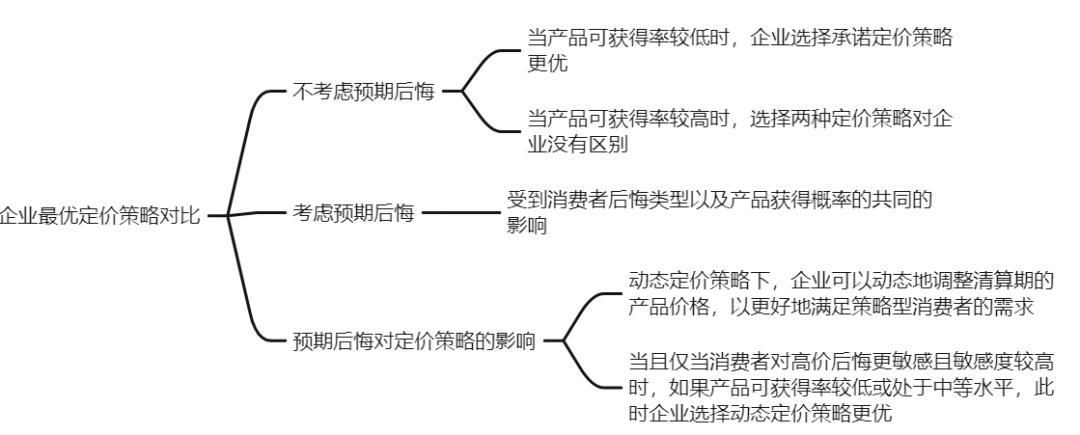
本期我们将继续学习《考虑消费者预期后悔行为的产品定价模型》,在前面几期中,我们学习了动态定价策略和承诺定价策略下考虑预期后悔的定价决策情况。本期我们将对两种定价决策进行对比分析。
In this issue, we will continue to study " A Product Pricing Model Considering Consumers' Expected Regret Behavior" . In the previous issues, we have studied the case of pricing decisions considering expected regret under dynamic pricing strategy and commitment pricing strategy. In this issue, we will provide a comparative analysis of the two pricing decisions.
本期内容将从思维导图、精读内容和知识补充三部分展开。
In this issue, we will start from three parts: mind map, intensive reading content and knowledge supplement.
2.思维导图
3.精读内容
【不考虑预期后悔】
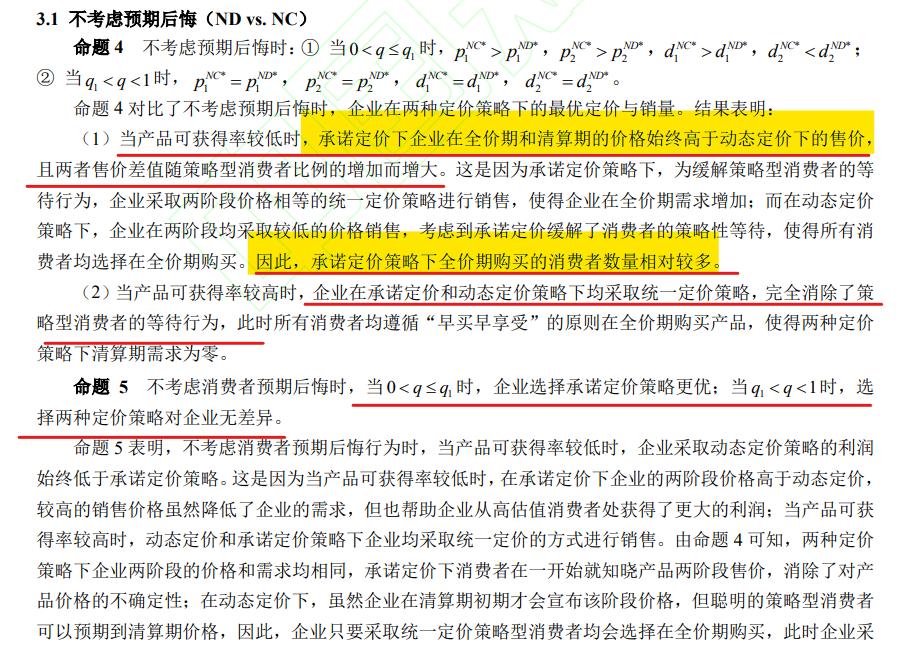
不考虑预期后悔下,文章得出了命题5与命题5。
命题4将不考虑预期后悔时,企业在两种定价策略下的最优定价与销量进行对比,发现:
①当产品可获得率较低时,承诺定价策略下企业在全价期和清算期的价格始终高于动态定价策略下的售价。
②当产品可获得率较高时,企业在承诺定价和动态定价策略下均采取统一定价策略,需求和价格均相等。
基于命题4,文章得到命题5。命题5指出当产品可获得率较低时,企业选择承诺定价策略更优;当产品可获得率较高时,选择两种定价策略对企业没有区别。
[Without considering expected regret]
Without considering expected regret, the article derives Proposition 5 vs.
Proposition 4 compares the firm's optimal pricing and sales volume under the two pricing strategies when expected regret is not considered and finds that:
① When product availability is low, firms' prices in the full-price and liquidation periods under the commitment pricing strategy are consistently higher than their selling prices under the dynamic pricing strategy.
②When product availability is high, firms adopt a uniform pricing strategy with equal demand and price under both commitment pricing and dynamic pricing strategies.
Based on Proposition 4, the article obtains Proposition 5. Proposition 5 states that when the product availability rate is low, it is better for the firm to choose the commitment pricing strategy; when the product availability rate is high, it makes no difference to the firm to choose the two pricing strategies.
【考虑预期后悔】
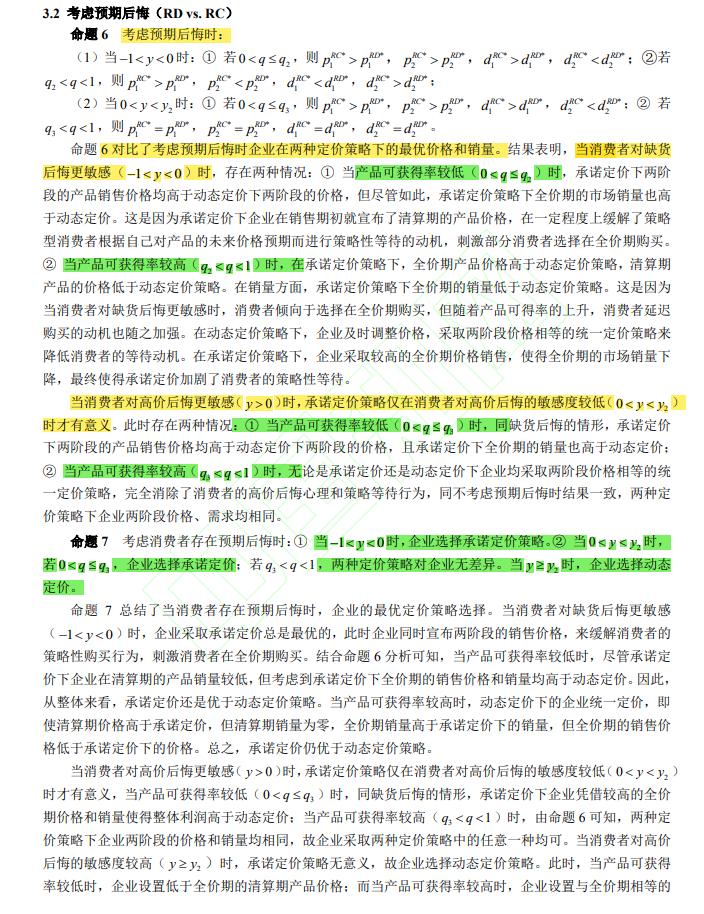
相较于不考虑预期后悔,考虑预期后悔的分析就比较复杂,受到消费者后悔类型以及产品获得概率的共同的影响。
在命题6中,文章对比了考虑预期后悔时企业在两种定价策略下的最优价格和销量,发现:
若当消费者对缺货后悔更敏感时:①当产品可获得率较低,承诺定价下两阶段的产品销售价格均高于动态定价下两阶段的价格,承诺定价策略下全价期的市场销量也高于动态定价;②当产品可获得率较高时,在承诺定价策略下,全价期产品价格高于动态定价策略,清算期产品的价格低于动态定价策略。在销量方面,承诺定价策略下全价期的销量低于动态定价策略。
当消费者对高价后悔更敏感时:①承诺定价策略仅在消费者对高价后悔的敏感度较低时才有意义;②当产品可获得率较低时,承诺定价下两阶段的产品销售价格均高于动态定价下两阶段的价格,且承诺定价下全价期的销量也高于动态定价;③当产品可获得率较高时,企业均采取两阶段价格相等的统一定价策略,即两种定价策略下企业两阶段价格、需求均相同。
命题7则是基于命题六的分析下,总结考虑消费者预期后悔时,企业的最优定价策略选择。①当消费者对缺货后悔更敏感时,企业采取承诺定价策略。②当消费者对高价后悔更敏感时,承诺定价策略仅在消费者对高价后悔的敏感度较低时才有意义,当产品可获得率较低时,企业选择承诺定价策略;当产品可获得率较高时,企业采取两种定价策略中的任意一种均可。③当消费者对高价后悔的敏感度较高时,承诺定价策略无意义,故企业选择动态定价策略。
[Considering Expected Regret]
Compared to not considering expected regret, the analysis of considering expected regret is more complex and is influenced by a combination of the type of consumer regret as well as the probability of product acquisition.
In Proposition 6, the article compares the optimal price and sales volume of firms under two pricing strategies when anticipatory regret is considered and finds that:
If when consumers are more sensitive to out-of-stock regret: ①when product availability is low, product sales prices are higher in both phases under commitment pricing than in both phases under dynamic pricing, and market sales are also higher in the full-price period under the commitment pricing strategy than under dynamic pricing; ② when product availability is high, product prices are higher in the full-price period under the commitment pricing strategy than under the dynamic pricing strategy, and lower in the liquidation period than under the dynamic strategy. In terms of sales volume, the sales volume of the full-price period under the commitment pricing strategy is lower than that under the dynamic pricing strategy.
When consumers are more sensitive to high price regret: ① the commitment pricing strategy makes sense only when consumers are less sensitive to high price regret; ②when the product availability rate is low, the product sales price in both phases under commitment pricing is higher than the price in both phases under dynamic pricing, and the sales volume in the full-price period under commitment pricing is also higher than dynamic pricing; ③ when the product availability rate is high, the firms both adopt the two phases with equal price.③ When the product availability is high, the firm adopts a uniform pricing strategy, i.e., the firm's price and demand are the same in both phases under both pricing strategies.
Proposition 7 is based on the analysis of Proposition 6, which summarizes the optimal pricing strategy choice of the firm when considering consumers' expected regret. ① When consumers are more sensitive to out-of-stock regret, the firm adopts a commitment pricing strategy. ②When consumers are more sensitive to high price regret, the commitment pricing strategy only makes sense when consumers are less sensitive to high price regret. When the product availability is low, the firm chooses the commitment pricing strategy; when the product availability is high, the firm adopts either one of the two pricing strategies. ③ When consumers' sensitivity to high price regret is high, the commitment pricing strategy is meaningless, so the firm chooses the dynamic pricing strategy.
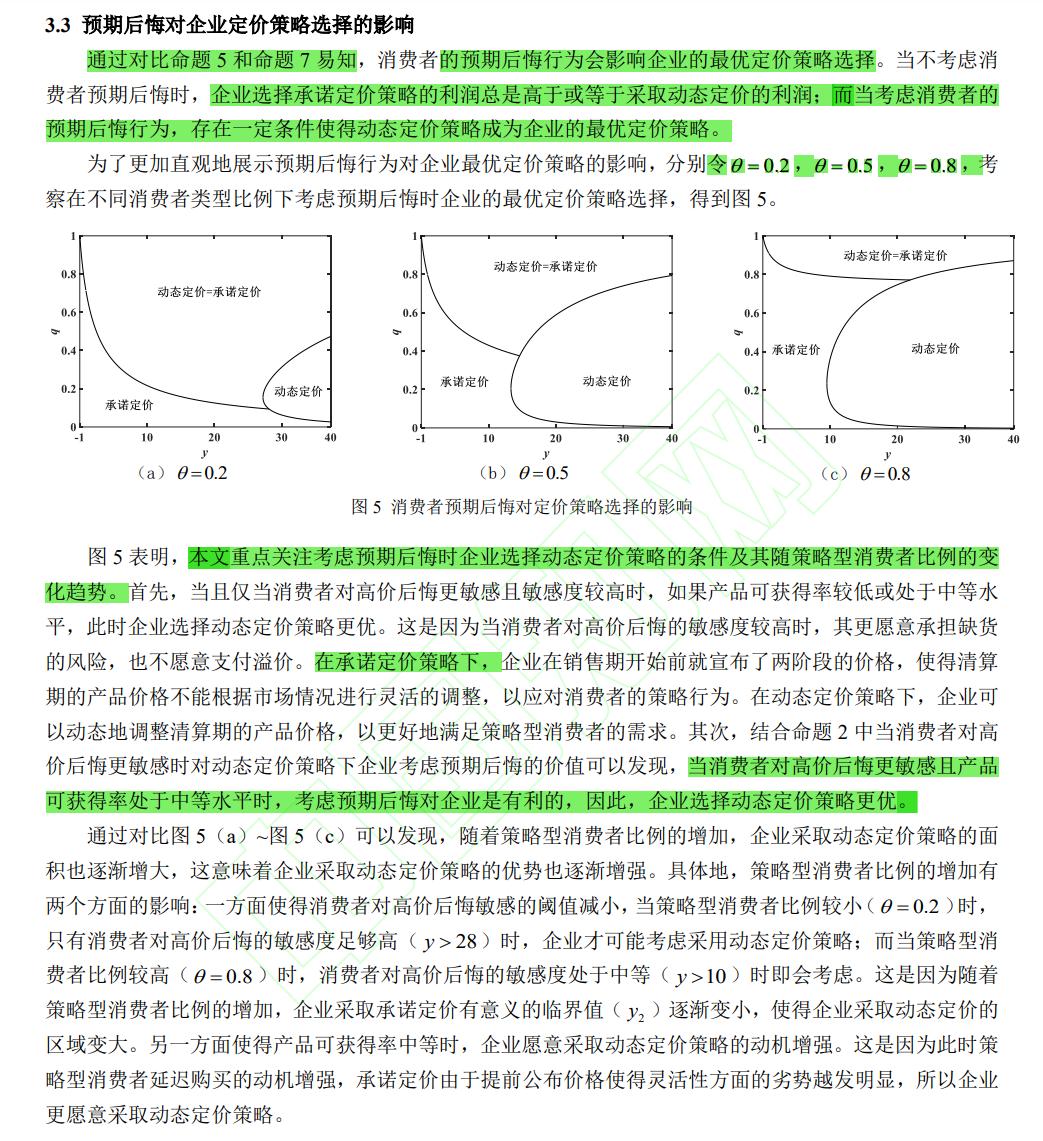
对比命题5和命题7可以发现消费者的预期后悔行为会影响到企业的最优定价策略选择。当不考虑消费者预期后悔时,企业选择承诺定价策略最佳;但是当考虑消费者的预期后悔行为时,在一定条件,企业可选择动态定价策略。
在图5中,重点关注考虑预期后悔时企业选择动态定价策略的条件及其随策略型消费者比例的变化趋势。
一是,当且仅当消费者对高价后悔更敏感且敏感度较高时,如果产品可获得率较低或处于中等水平,此时企业选择动态定价策略更优。这是因为当消费者对高价后悔的敏感度较高时,其更愿意承担缺货的风险,也不愿意支付溢价。
二是在动态定价策略下,企业可以动态地调整清算期的产品价格,以更好地满足策略型消费者的需求。其次,可以发现,当消费者对高价后悔更敏感且产品可获得率处于中等水平时,考虑预期后悔对企业是有利的,因此,企业选择动态定价策略更优。
通过对比图5中的(a)~(c)可以发现,随着策略型消费者比例的增加,企业采取动态定价策略的面积也逐渐增大,这意味着企业采取动态定价策略的优势也逐渐增强。略。
Comparing Proposition 5 and Proposition 7, we can find that consumers' expected regret behavior affects the firm's optimal pricing strategy choice. When consumers' expected regret is not considered, the firm chooses the best commitment pricing strategy; however, when consumers' expected regret behavior is considered, under certain conditions, the firm can choose the dynamic pricing strategy.
In Figure 5, the focus is on the conditions under which firms choose dynamic pricing strategy when considering expected regret and its trend with the proportion of strategy-based consumers.
First, when and only when consumers are more sensitive and sensitive to high price regret, if the product availability is low or at a moderate level, it is better for firms to choose dynamic pricing strategy at this time. This is because when consumers are more sensitive to high price regret, they are more willing to take the risk of out-of-stock and are not willing to pay a premium.
Second, under the dynamic pricing strategy, firms can dynamically adjust the product price in the liquidation period to better meet the demand of strategic consumers. Second, it can be found that when consumers are more sensitive to high price regret and product availability is at a moderate level, it is advantageous for firms to consider expected regret, and therefore, it is better for firms to choose the dynamic pricing strategy.
By comparing (a) to (c) in Figure 5, it can be found that as the proportion of strategic consumers increases, the area for firms to adopt dynamic pricing strategy also gradually increases, which means that the advantage of firms to adopt dynamic pricing strategy also gradually increases. Slightly.
4.知识补充
溢价是一种市场行为,当购买者在购买某种商品或某种服务时,出于某种特定的原因,消费者为产品或服务支付比正常市场价格高的价格。简而言之,溢价是将商品或服务的价格提高到高于市场平均水平的价格。在文章中,支付溢价意味着消费者实际支付的金额超过了产品的名义价值或票面价值。
这种情况我们在生活种也比较常见,比如景区中售卖的产品,矿泉水、零食等。若正常的矿泉水售价在1-2元,在景区内售价可能是3元及以上,此时消费者就多支付一元,也就是支付溢价。
A premium is a market behavior in which a consumer pays more than the normal market price for a product or service for a specific reason when the purchaser is buying a good or a certain service. In short, a premium is a price that raises the price of a good or service above the market average. In the article, paying a premium means that the actual amount paid by the consumer exceeds the nominal value or face value of the product.
This situation we are also more common in life kind, such as products sold in scenic spots, mineral water, snacks, etc.. If the normal mineral water selling price in 1-2 yuan, in the scenic spot selling price may be 3 yuan and above, at this time the consumer will pay an extra yuan, that is, pay a premium.
今天的分享就到这里了。
如果您对今天的文章有独特的想法,
欢迎给我们留言,
让我们相约明天,
祝您今天过得开心快乐!
That's it for today's sharing.
If you have a unique idea about today’s article,
welcome to leave us a message,
Let us meet tomorrow.
I wish you a nice day!
参考资料:谷歌翻译、百度百科;
参考文献:
[1] 叶新兰,李金凤,官振中.考虑消费者预期后悔行为的产品定价模型 [J/OL].系统管理学报.
本文由LearningYard学苑整理并发出,如有侵权请在后台留言!