Unit 1 Can you play the guitar?
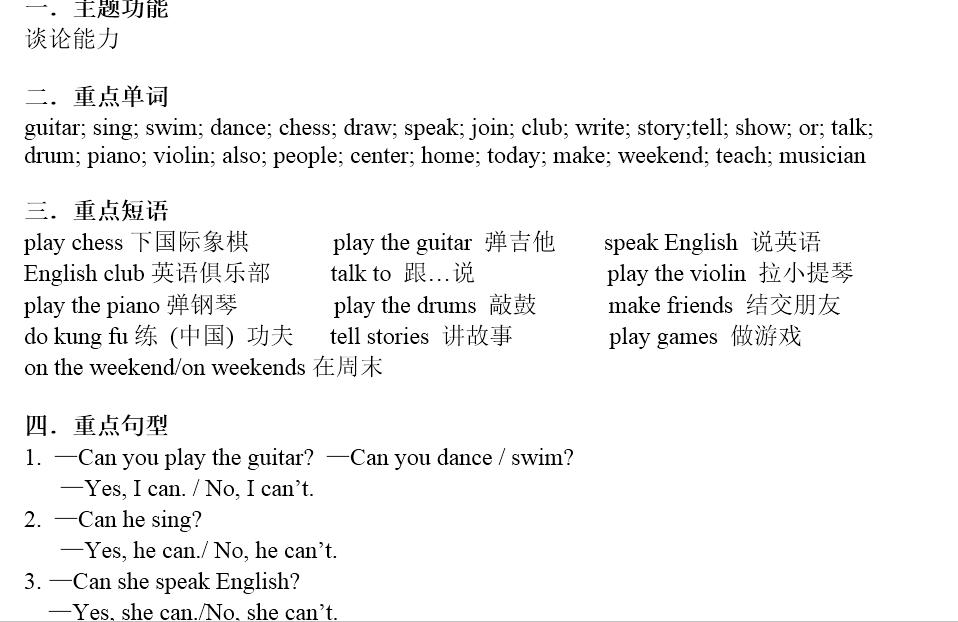
一. 主题功能
谈论能力
二.重点单词
guitar; sing; swim; dance; chess; draw; speak; join; club; write; story;tell; show; or; talk; drum; piano; violin; also; people; center; home; today; make; weekend; teach; musician
三.重点短语
play chess下国际象棋 play the guitar 弹吉他 speak English 说英语 English club英语俱乐部 talk to 跟…说 play the violin 拉小提琴 play the piano弹钢琴 play the drums 敲鼓 make friends 结交朋友
do kung fu练 (中国) 功夫 tell stories 讲故事 play games 做游戏
on the weekend/on weekends在周末
四.重点 句型
1. —Can you play the guitar? —Can you dance / swim?
—Yes, I can. / No, I can’t.
2. —Can he sing?
—Yes, he can./ No, he can’t.
3. —Can she speak English?
—Yes, she can./No, she can’t.
4. What club do you want to join?
5. I want to join the art / music club.
6. Can you play the piano well?
7. Are you good with old people?(be good with sb. 善于和某人相处)
8. May I know your name? = What’s your name?
9. —What can you do?
—I can play chess.
10. Can you help me with my English?
11. Come and join us!
12. You are very good at telling stories.
五.语法结构
情态动词can的用法
六. 教材知识全解
1. — Can you play the guitar? —Yes, I can. —No, I can’t.
解析: ①情态动词can的用法:情态动词无人称和数目的变化,不能独立使用作谓语,后面必须接动词原形,情态动词和动词原形一起构成谓语。
常用的情态动词有:can, may, must, need。
含情态动词的句子一般疑问句是把情态动词提到句首,否定句是在情态动词后加not。
② play the guitar“弹吉他”,play后加乐器名词时,乐器名词前要加the,“play + the+ 乐器”表示“弹奏某种乐器”。
play后加球类名词时,球类名词前不加the,“play +球类名词”表示“踢、打某种球”。
2. Can you speak English?
解析:speak English“说英语”,“speak + 语言”表示“说某种语言”。 say it in English “用英语说它”
例:Can you say it in English?
3. I want to join the art club.
解析:(1).join是动词,意为“参加,加入”,后面接表示团体、俱乐部或组织的词作宾语,意为“加入某种团体、俱乐部或组织,并成为其中的一员”。
①若想表示加入某项活动、聚会、比赛等时,要加介词in。
②join还可以用于“join sb ( in doing sth)”结构中,意为“加入到某人中(一起做某事)”。
(2).对俱乐部的名称进行提问时,疑问词用What club。
例:I want to join the art club.
对划线部分进行提问时,答案是:What club do you want to join?
4. What can you do?
解析:What can you do? 是对主语会干的动作进行提问。
例:He can play the piano.
(对划线部分进行提问)答案是:What can he do?
5. Are you good with kids?
解析:be good with sb 意为“和某人相处的好”,
be good for··· 意为“对······有益处”,
be good at···意为“擅长······”
6. Come and join us !
解析:Come and join us!是祈使句,以动词原形开头。
come 和 join 是并列关系,用连词 and 相连。
7. Can you help kids with swimming?
解析:help sb with sth / doing sth 意为“帮助某人干某事”
8. Musicians Wanted for School Music Festival
解析:职业名词 + wanted表示“招聘···”
9. Can you play the piano, the trumpet, the drums or the guitar?
解析:这是一个选择疑问句,并列的选项用or连起来,选择疑问句不能用Yes或No回答,只能答其中的一个选项。
例:—Are you in Class 1 or Class 2?
—I’m in Class 1. / I’m in Class 2.
10. We want two good musicians for our rock band.
解析:for our rock band意为“为我们的摇滚乐队“
11. I can do Chinese kung fu.
解析:do Chinese kung fu意为“表演中国功夫”,其中的do是实意动词。
12. You can be in our school music festival.
解析:be in意为“参加,加入”
13.Please call Zhang Heng at 622-6033.
解析:call sb at + 电话号码 意为“给某人打电话拨打···号
14. What’s your address?
解析:问“你的地址在哪里?”疑问词是what而不是where.
例:What’s your e-mail address?
15. Can you play the guitar well?
解析:play the guitar well “弹吉他弹得好”,well是good 的副词,用来修饰实义动词play,修饰实义动词要用副词。
16. Come and show us.
解析:show sth to sb = show sb sth “把某物给某人看”
例:Show your photo to me.= Show me your photo.
Unit 2 What time do you go to school?
一. 主题功能
1.学会不同时间段的表达法;
2.学会用频度副词谈论自己的日常生活和作息习惯
二.重点单词
up; dressed; brush; tooth; shower; usually; forty; fifty; wow; never; early; job; work; station; o’clock; funny; exercise; best; group; half ; past; quarter; homework; run; walk; clean; quickly; either; lot; taste; life
三. 重点短语
what time 几点 go to school 去上学 get up 起床
take a shower洗淋浴 brush teeth 刷牙 get to 到达
do homework 做家庭作业 go to work去上班 go home回家
eat breakfast 吃早饭 get dressed穿上衣服 get home到家
either…or… 要么…要么… go to bed 上床睡觉. take a walk 散步
in the morning/ afternoon/ evening 在上午/下午/晚上 lots of=a lot of 许多,大量 radio station 广播电台 be late for=arrive late for 迟到at night 在晚上
四.核心句型
1. What time do you usually get up?
I usually get up at six thirty.
2. That’s a funny time for breakfast.
3. When do students usually eat dinner?
They usually eat dinner at a quarter to seven in the evening.
4. In the evening, I either watch TV or play computer games.
5. At twelve, she eats lots of fruit and vegetables for lunch..
6. She knows it’s not good for her, but it tastes good.
7. Here are your clothes.
五.语法结构
1.时间的表达法
2.时间介词的用法
六.教材知识全解
1.What time do you get up?
解析:这是一个由疑问词what time(几点)引导的特殊问句。
其结构:What time +助动词do/does +主语+动词原形,询问某人做某事的具体时间。
例:what time do you begin class in the morning?你们早晨几点开课?
注意:What’s the time=What time is it?也是用来询问时间,意为“几点了”。用it作答。
例:What’s the time? It’s 7:30.几点了?七点半了。
2 . I usually get up at five o’clock.我通常在五点钟起床。
解析:(1)句中usually与often 一样都是频度副词,常用于动词be 之后,行为动词之前。
always意思是“总是”、“永远”,表示动作重复,状态继续,中间没有间断,通常用来修饰动词的一般时态。
例:We always get up before six o’clock.我们总是六点前起床。
若修饰动词进行时,则有“老是”,“再三地”的意思,带有厌烦、不满、赞美等感情色彩。
例:You are always coming late.你老是迟到。(含有责备的意思)
He is always thinking of others.他总是想着别人。
usually(75%)意为“通常”,着重表示已习惯的动作。反义词为:unusually。
例:They usually have four classes in the morning.他们上午通常上四节课。
They usually do some shopping on Sunday.他们通常星期天买东西。
often(50%)意为“时常”、“经常”,表示常常这样,但不总是这样,反义词为: seldom。
例:She often helps her mother with her housework after school.放学后她常常帮助母亲做家务。
We often go to see our teacher.我们常去看望我们的老师。
sometimes(20%)表示“有时”、“不时”的意思,说明的是偶尔发生的事情或情况。它的位置比较灵活,可置于句首、句中、句末。
例:Sometimes I come on foot.有时我步行来。
It is sometimes hot and sometimes cold here.这里有时,热有时冷。
下面的排列更直观地说明了这几个词的频率的 " 大小 "。
always>usually>often>sometimes>seldom>never
(2)介词 at 常用于具体时刻之前,意义为 在…… ,如:at 5:00 在5:00钟。
o’clock=of the clock 表示 ……点钟 ,其前通常是整点,
如:six/seven/eight o’clock 六/七/八点钟。
注意:介词at 除了指时间以外,还可指
1)人物的所在之处,
例:at my uncle’s home 在我姑姑家, at the station 在火车站.
2)朝向,如:look at me!看我!
3)指速度或价格.
例:she buys the book at a good price 她以优惠的价格买了这本书。
3. What a funny time to eat breakfast ! 在这个时间做早饭是多么有趣的啊!
解析:这是一个感叹句,what 意为“多么的,何等的”,用于感叹句中,修饰后面的单数或复数名词,其句式结构为:
(1)What a/an +形容词+单数名词+主语+谓语!
例:what a good girl she is!她是多么好的女孩啊!
(2)What+形容词+可数名词复数+主语+谓语!
例:What good girls they are!她们是多么好的女子啊!
(3)What +形容词+不可为名词+主语+谓语!
例:What terrible weather it is! 多么恶劣的天气啊!
注意:how也可以引导感叹句,how 为副词,在感叹句中修饰动词,形容词或副词:
(1)How+形容词/副词+陈述句(主语+谓语)
例:How cold it is! 多冷啊! How hard he works! 他工作多么努力啊!
(2)How+陈述句(主语+谓语)
例:How he loves his son! 他多么爱他的儿子啊!
(3)How+形容词+a/an+单数可数名词+陈述句(主语+谓语)
例:How tall a tree it is! 多么高的一棵树啊!
4 . After breakfast he plays his guitar , then he goes to work.
早餐以后,他练习吉它,然后他去上班了。
解析:go to work的意思是“去上班”,work是不可数名词,其前面不加冠词,该短语同go to school“去上学”。
例:They go to work in their cars = by car. 他们开车去上班。
We go to school by bus.我们乘公共汽车上学。
5.To get to work,he takes the number17 bus to the Sai Te Hotel.为了工作,他乘坐17路公交车到赛特宾馆。
解析:动词take在此时“乘坐”的意思;而by也有“乘坐”的意思,但它是介词。
比较:He often takes the bus to work.他经常乘公交车上班。
He often go to work by bus.
注意:动词词组作谓语,介词短语作状语。
6.He works all night.他工作一整夜。
解析:all修饰一个表示时间的单数可数名词,表示整个这一段时间。
例:Don’t read all day.不要整天看书。
He stays at home all morning.他整个上午呆在家。
7.People love to listen to him.人们喜欢听他的!
解析: love to do sth.=like to do sth.very much.喜欢做某事,强调具体活动。而love doing sth.=like doing sth. very much则强调习惯。
例:Do you come out to play with me?你喜欢出来和我玩吗?
I like watching TV.我喜欢看电视。
8. hear 与 listen to
解析: hear 意为“听见”,表示听的结果,而listen to则表示“听”,强调的是“听”的动作。
例:Let’s listen to the music. 咱们听音乐吧!
We listen but don’t hear.我们听了,但什么也没听见。
9. He gets home at 7 : 00 , and he watches morning TV.他七点钟回家,然后看早见新闻。
解析:(1)句中get 意为 “到达 ”,后接地点名词时,要加介词to,后接副词
时,不能加to。
例如:She gets to school at six o’clock.她六点钟到校。
注意:home 是一个副词,所以其前不能加介词to,但home也可作名词,这时其前
有物主代词时,可以加to。
例:She gets to her home at eight o’clock.她8点钟到家。
Can you get there at eight tomorrow morning? 明天上午八点你能到那儿吗?
(2)句中 morning news 表示早间新闻,其中news 是一个不可数名词。
例:a piece of news 一条新闻 ,two pieces of news 两条新闻 。
Watch……On TV 表示 通过电视看……节目 。
例:We often watch football game on TV. 我们经常通过电视看是球赛。
10.Can you think what his job is ?你能想到他的工作是什么吗?
解析:这里what his job is表示“他的工作是什么 ”,其中,what his job I 作think
的宾语。英语中类似的表达很多,它们在句中可充当主语、宾语、表语等。
例:What she says is very good.她说得很好。(作主语。注意,谓语动词要用单数。)
The book is just what you want.这本书正是你想要的。(作表语)
I don’t know what you say.我不懂你说的话。(作宾语)
11.What time is it ?-几点了?-It’s eight thirty. 八点三十分。
解析: 本句是就具体时刻进行提问的,what time 意为“几点”,这是特殊问句,它
的同义句为:What’s the time? /What time is it by your watch? 在回答这个句子时,要
用It’s +钟点。
注意:英语时刻的表达法:顺读法和逆读法。
顺读法:钟点数+分钟数。
例:4:25→four twenty-five,6:58→six fifty-eight,7:00→seven o’clock
说明:这种表达不论分钟数是多少,均可使用。
逆读法:分钟为+介词to/past+钟点数,可分两种情况:
1)分钟为不超过半小时,用分钟数+past(/pa:st/过)+钟点数。
例:4:23→twenty-three past four,5:19→nineteen past five.
2)分钟数超过了半小时,用(所差的)分钟的+to+(下一个)钟点为。
例:7:31→twenty-nine to eight,10:58→two to eleven
说明:在逆读法中分钟数逢 “五”逢 “十”可省略minute(s)。否则应加上。当然,英语习惯上把十五分钟(fifteen)称作一刻a quarter,三十分钟(thirty)称为half/half,因此10:30,可以用两种表达方式,half past ten,ten thirty。
12.Thanks for your letter. 感谢你的来信。
解析: thanks for… 表示“因…而感谢某人”。for是介词,后跟名词,代词宾格或者动名词。
例:Thanks for your help. 感谢你帮助我。
Thanks for telling me the good news.谢谢你告诉我这好消息。
13. Do you want to know about my morning ?你想知道关于我的早晨吗?
解析:(1)该句中 want to do…句型。表示“想要做某事”,该短语中want为及物动
词,后面的to do是不定式(英语中把to+动词称为不定式)作want的宾语,不定式符号
不可以省略。
例:I want to play the drum. 我想打鼓。
I want to see my old teacher next week.下周我想去看我以前的老师。
(2)want也可以带名词或代词作宾语。
例:I want a bottle of orange.我想要一瓶桔汁。
He wants you in the classroom. 他想要你进教室去。
(3)know about 知道有关…,了解有关…,句中about 意为“关于,有关”的意思。
14 .about 与 on
解析:about作介词,意为“关于、大约、对于”。作“关于”解,可用on代替。
例:a song about him有关他的一首歌。
on作介词,意为“关于”。侧重于书籍、文章、演讲的严肃性或学术性,指可供专门研究某一问题的人阅读的书籍。
例:a book on the history 有关历史的书。
注意:在动词learn、read、quarrel、hear和名词story后一般用about而非on。
15.I do my homework at 6:30.六点半我做家庭作业。
解析: do homework意为做家庭作业,其中homework为不可数名词,这个短语=do one’s lessons.
16.School starts at nine o’clock.学校九点开始上课。
解析: start=begin,意为“开始”。
常见句型有start/begin to do sth.和start/begin doing sth.
例:She starts/begins to learn English.她开始学习英语、
They start/begin learning English.他们开始学习英语了。
17.Please write and tell me about your morning.请写信告诉我你的早晨。
解析:(1)tell sb. about sth.告诉某人有关某事的情况。
例:My father often tells me about China.我爸爸经常告诉我有关中国的情况。
(2)write sb. a letter=write a letter to sb.给某人写信。
例:She often writes me a letter=She often writes a letter to me.她经常给我写信。
18 . 一般现在时
(1)句型语序:主语——谓语(行为动词)——宾语——状语
(2)主谓一致:主语三单,谓语三单;主语非三单,谓语用原形。
(3)句型转换:变疑问句首加do/does,谓语动词用原形;变否定谓语动词原形前
加don’t/doesn’t.
注意:一般现在时的第三人称单数动词的变化规则:
(1).一般在动词词尾加“s”。如:like→likes,play→plays。
(2).以ch,sh,s,x,o结尾的动词,在词尾加es,如:do→does,teach→teaches,go→goes
(3).以“辅音字母+y”结尾的词,变y为i,再加es。如:fly→flies, apply→applies study→studies
Unit 3 How do you get to school?
一.主题功能
1.能够谈论如何到达目的地
2.能够谈论自己的日常生活
二.重点单词
subway; train; minute; kilometer; quick; half; past; stop; transportation; north; depend; must; bicycle; ill; worry
三.重点短语
get to school 到达学校 take the subway乘地铁 ride a bike骑自行车
how far多远 from home to school从家到学校 every day 每天
take the bus 乘共汽车 by bike 骑自行车 bus stop 公共汽车站
think of 认为 between and … 在…和…之间 have to 不得不 play with … 和 come true 实现
one 11-year-old boy 一个11岁的男孩.
四.核心 句型
1. How do you get to school?
I ride my bike.
2. How far is it from your home to school?
3. How long does it take you to get to school?
4. For many students, it is easy to get to school.
5. There is a very big river between their school and the village.
五.语法结构
How引导的特殊疑问句
六. 教材知识全解
1 、 How do you get to school ?
讲解:(1) how是疑问副词,意为“如何,怎样,用什么手段”。
本句为how引导的特殊疑问句, 用以询问交通工具。
① take + a/the + 表示交通工具的名词,是动词短语,在句中作谓语。
② by + 表示交通工具的单数名词或on/in + a/the +表示交通工具的单数名词,是介词短 语,作方式状语。
例: I walk./ I get to school on foot. I ride my bike./ I get to school by bike./ I get to school on my bike. I take the bus./ I get to school by bus./ I get to school on the bus.
注意:by + 表示交通工具的单数名词时,名词前不能加任何冠词或者其他修饰词。
(2)get 在句中为不及物动词,意为“到达”,常与to连用,但是表示目的地的词是副词here、 there、home等时,则不需要用介词to。
例:They’ll get to Beijing at six tonight.
I’ll get there on time.
2、 It takes about 25 minutes to walk.
讲解:It takes sb. sometime to do sth. 做某事花费某人多长时间
词语辨析:
spend, cost, pay 与 take
(1)spend 的主语必须是人。常用于 spend„on sth或 spend„(in) doing sth.意为“某人花时 间/金钱做某事”。
例:I spent 5 dollars on the book.
(2)cost的主语只能是事情。常用于sth cost sb some money意为“某物花费某人多少钱”。
例:The skirt costs her 200 yuan.
(3)pay的主语必须是人。长用于sb pay some money for sth.意为“某人为某物付款”。 例:He paid 1000 yuan for the TV set.
(4)take用于 It takes sb some time( money) to do sth. 句型中。
例:It took him seven days to make the big cake.
3、 Then the early bus takes him to school.
讲解:take...to,意为“把......带到......”
词语辨析:
take,bring与fetch
| 词语 | 意义 |
| take | 意为“带走,拿走”,强调从说话地将人和物带走别的地方去。 |
| bring | 意为“带走” ,强调将某人或某物从别的地方带到说话地来。 |
| fetch | 意为“去拿,去取” ,即离开说话地去取某物后再回来,强调动作的往返 |
4、 How do students around the world get to school ?
讲解:(1)意为“环绕;围绕;绕过”
例:The earth moves around the sun.
(2)表示“在......四周”
例:There are many trees around the playground.
(3)表示“在......的附件”
例:Is there a park around here ?
(4)表示“大约”,常与数字连用
例:He goes to school at around 8 o’clock.
5、 In North America, not all student take the bus to school.
讲解:not all„这个结构所表达的意思通常是“部分否定”,意为“并不是所有的„都„”。当not用于代词all, many, much, every, both前时,均属于部分否定。
例:Not all that glitters is gold. 发光的并不都是金子。
6、 I have a map but it’s in Chinese, and I only speak English.
讲解:in Chinese “用汉语”,in 表示“用„”,主要用“用某种语言,用某种材料,用某种方式”。
例:I paid the bill in cash.
词语辨析:
say, speak, talk与tell
say意为“说,讲”,它针对的是说话的内容
speak 意为 “说,讲”,不强调说话的内容,但有时指讲某种语言,(在会上)发言要用speak
talk意为“谈话;交谈”,有不及物动词和名词两种词性,常与with,about或to搭配 tell意为“说;告诉”,侧重于“告诉”的含义多一些,常用tell sb about sth “告诉某人关于某事“和tell sb (not )to do sth “告诉某人(不要)做某事”
7、 Let me look at your map.
讲解:
词语辨析:
look, read, see与watch
| 词语 | 意义 |
| look | 意为“看”的动作,强调“看”的动作,多以词组形式出现,如look at, look like,.look after等 |
| read | 意为“读”,多指看书、看报、看杂志、看图等 |
| see | 意为“看见,看到”,侧重于“看”的结果,常用句式:see sb do/doing sth |
| watch | 意为“观看,注视”,指非常仔细地、有目的地、特定地看,多接比赛、电视 |
8. 语法讲解 ——how 引导的特殊疑问句
讲解:(1)how引导的特殊疑问句提问交通方式。其答语分三种情况:
① take a/the + 交通工具(单数)
② by + 交通工具(单数)
③ on/in + 限定词 + 交通工具
例:—— How do you go to work every day?
—— I drive to work./I go to work by car./ I go to work in my car.
(2)how far 用来提问距离,意为“多远”。其答语分为两种情况:
①用长度单位表示
例:—— How far is it from your home to the bus stop ?
—— It’s five kilometers.
②用时间表示
例:—— How far is the park from the shop ?
—— It’s ten minutes’ walk.
(3)how long 用来提问时间,意为“多久”。
例:—— How long have you been in America?
—— For two years.
Unit 4 Don’t eat in class.
一.主题功能
1.学会用英语表达一些标志的含义。
2.熟练使用目标语言谈论对某些规章制度(校规、家规等)的看法
二.重点单词
rule, arrive, hallway, hall, listen, fight, sorry, outside, wear, important, bring, uniform, quiet, dirty, kitchen, more, noisy, relax, read, terrible, feel, strict, remember, follow, luck
三.重点短语
on time 准时,按时 listen to …听…… in class 在课上
be late for做……迟到 have to 不得不 be quiet 安静
go out外出 do the dishes 清洗餐具 make breakfast 做早饭
make (one’s) bed铺床 be noisy 吵闹 keep one’s hair short 留短发 play with sb. 和某人一起玩 play the piano 弹钢琴 have fun 玩得高
make rules 制订规则
四.核心 句型
1. Don’t arrive late for class.
2. Can we bring music players to school?
3. And we always have to wear the school uniform.
4. There are too many rules!
5. Don’t leave the dirty dishes in the kitchen!
6. I have to keep my hair short.
五.语法结构
1.祈使句的否定形式
2.情态动词can和have to的用法
六.教材知识全解
1.Don’t fight. 不要打架。
讲解:fight作动词,意为“打架、打仗”。其过去式为fought.
(1)fight for“为…而斗争”,后面常接抽象名词,表示为事业、自由等而斗争。 例:They are fighting for freedom.他们正为自由而战。
(2)fight against“为反对…而战斗”,后接事物名词、人和国家名词。
例:They fought against the enemy.他们和敌人作战。
(3)fight with“和…打架”,“同…(并肩)战斗”,后只接表示人或国家的名词。 例:Don’t fight with him.不要和他打架
They fought ________the Italians in the last war,but________them in this war.
A. with; with B. with;for C. against against D.with; against
2. .Ms./Mrs./Miss.
讲解:Ms.:“女士”,用于婚姻状况不明或不想区分婚否的女子的姓前。 Mrs.:“夫人”,用于已婚女子姓前。
Madam:也用于已婚女子,意为“夫人、女士”,一般单独使用,不与姓连用。 Miss.:“小姐”用于未婚女子姓前,还常用于年轻的女教师的姓前,可译为“老师”。
3. get to/reach/arrive 辨析
讲解:相同点:都是“到达“的意思
不同点:get to+地点;reach+地点;arrive at+小地点(车站等);arrive in+大地点(国家等)
注意:get to与地点副词(here/there/home…)不用介词to
例:I want to go to Beijing. I got home at 15:00.我下午三点到的家。
arrive是不及物动词,后面若接地点名词则要和in/at连用,接地点副词时则不用介词。
例: I arrived home at 15:00. =I got home at 15:00.
He arrived in Shanghai yesterday.他昨天到的上海。
He arrived yesterday.他昨天到的。
reach是及物动词,后面直接接地点名词或副词。
例:When will they reach here?
---What time did the team________the top of the mountain?
---At about 4:30 p.m.
A.come B.go C.arrive D.arrive at
4. on time , in time 辨析
讲解:on time“准时,按时”,指按规定的时刻不早不晚。
例: He always go to school on time.他总是按时上学。
in time“及时”,指没有迟到,时间还充裕。
例: Fireman reached the house on fire in time.消防员及时赶到那幢失火的房子。
5. hear 、 listen 和 sound 辨析
讲解:都有"听"的意思,但三者是有区别的:
hear"听说"侧重于"听"的内容。
例:I’m sorry to hear that you are ill. 听说你生病了,我很难过。
I never heard such an interesting story. 我从来没听过这么有趣的一个故事。 listen"听"侧重于"听"这一动作。
例:Listen to me carefully. 认真听我说。
The children like to listen to music. 孩子们喜欢听音乐。
sound"听起来"它是系动词,后面接形容词等。
例:That sounds great. 那听起来真不错。
It sounds like fun. 听起来挺有趣。
________carefully,or you are not able to________anything.
A.Hear;listen B.Listen;hear C.Hear;listen D.Listen;listen
6. take,bring 辨析
讲解:take“带走,拿走”指把东西从说话地带到别的地方。
例:Can you help me to take the books to the classroom?你能帮我把这些书带到教室里去吗?
bring“带来”指把东西从别处带到说话地。
例:Bring your homework here tomorrow,please.请你明天把作业带到这儿来。
________away this dirty shirt and ________me a clean one.
A.Take;bring B.Take;take C.Bring;take D.Bring;bring
7. Strict
讲解:是形容词,意为 “严格的”; “严厉的”,通常与be动词连用。
be strict with sb “对某人严厉”
例:Mr. White is very strict with us. 怀特先生对我们要求很严格。
We should be strict with ourselves. 我们应该对自己要求严格。
be strict in (doing) sth “对某事要求严格”
例:Our boss is strict in our work. 我们的老板对我们的工作要求严格。
8. remember
讲解:“记得,记住”,是及物动词,可以直接加名词。
remember doing sth记得已做某事(已做)
例:I remember seeing him once.我记得见过他一次。
remember to do sth 记得要做某事(还没做)
例:Remember to post the letter for me.记得给我寄这封信。
forget“忘记,忘了”,作remember反义词时,用法和remember相同。
9. help
讲解:作动词意为“帮助”常用的结构有:
help sb (to) do sth帮助某人做某事
help sb with sth(n.)帮助某人做某事
例:I often help him with his lessons.我常帮他学功课。
help oneself(myself/yourself/herself…) to+n.请随便用…
例:Please help yourselves to some fruit.请随便吃些水果。
help还可作名词,表示“帮助”,是不可数。
10. too many, too much 与 much too 辨析
讲解:
| 易混词组 | 意义及用法 | 例句 |
| too many | 形容词,“太,太多”,接可数名词 | There are too mang people in the park. |
| too much | 形容词,“太多”,接不可数名词 | I have too much homework today. |
| much too | 副词,“太,非常”,接形容词或副词 | My mother is much too busy. |
例:I have ________skirts and this one is ________large for me,so you can take it if you like.
A. too mang; too much B. too much; much too C. too mang; much too
11. either, too 与 also 辨析
讲解:
| 易混词 | 意义及用法 | 例句 |
| either | “也”,用于否定句中,置于句末时用“,”隔开 | I won’t go there,either. |
| too | “也”,用于肯定句句末,用“,”隔开 | I like dancing,too. |
| also | “也”,用于肯定句句中 | I also like English. |
例:I don’t like her, ________.
A.also B.too C.either D.to
12. be in bed
讲解:"在床上、卧床",in 和bed之间不能用冠词,bed也不用复数。
例:He is in bed for 10 years. 他卧床10年了。
Dave has to be in bed early every night.大卫每晚必须很早睡觉。 .
13. No talking !
讲解:"禁止交谈。" no后面加上名词或动名词doing也表示不要做某事。与don’t +do的用法相似。
例:No wet umbrellas! / Don’t put wet umbrellas here! 禁止放湿雨伞
No food! Don’t eat food here! 禁止吃食物
No smoking! Don’t smoke here! 禁止吸烟
Unit 5 Why do you like pandas?
一. 主题功能
1.谈论自己的喜好;
2.询问他人的喜好;
二.重点单词
tiger, elephant, koala , dolphin, panda, lion, penguin, giraffe, smart, cute, ugly, friendly, beautiful, scary, kind of, very, South Africa, Australia,pet,leg,cat,sleep
三.重点短语
kind of 有几分,有点儿 be from / come from 来自于 South Africa 南非
all day 整天 for a long time 很长时间 get lost 迷路
places with food and water 有食物和水的地方 cut down 砍倒
in (great) danger 处于(极大)危险之中 twelve years old 十二岁
things made of ivory 由象牙制成的东西
四.核心 句型
1. —Why do you like pandas?
—Because they’re kind of interesting.
2. —Why does John like koalas?
—Because they’re very cute.
3. —Why don’t you like tigers?
—Because they’re really scary.
4. —Where are lions from?
—They’re from South Africa.
5. Elephants can walk for a long time and never get lost.
6. They can also remember places with food and water.
7. But elephants are in great danger.
8. People cut down many trees so elephants are losing their homes.
9. Today there are only about 3,000 elephants (over 100,000 before)
10.Isn’t she beautiful?
五.语法结构
1.why引导的特殊疑问句
2.because引导的特殊疑问句
六.教材知识全解
1 、语法点:祈使句是表示请求、命令、劝告、祝愿或建议的句子。
讲解:(1)特点:
1)祈使句的主语一般为第二人称,但往往省去不用。
2)一般没有疑问句,只有肯定和否定两种形式。

(2)结构:
1)be+形容词/名词:Be quiet! Be a good student!
肯定形式 2)以实义动词开头:Come in,please!
3)Let型: Let me help you.
1)be型: Don’t be careless!
Never be late again next time!
2)do型: Don’t believe him!
否定形式 Never do it again!
3)let型: Let+宾语+not+动词原形+其他:Let’s not think about it.
Don’t+let+宾语+动词原形+其他:Don’t let Jim do that.
在公共场所中的提示语,否定祈使句常用“No+名词/V-ing形式”,表示“禁止做某事”。
No photos!禁止拍照
No parking!禁止停车
2.Why don’t you+ 动词原形:为什么不…
讲解:交际语中常见的结构,常用来提建议和请求,或征询对方的看法和意见。相当于Why not+动词原形。
例:Why don’t we meet earlier?=Why not meet earlier?
肯定回答:OK!All right./Good idea./Yes,I think so.
否定回答:Sorry,I…/I’m afraid not.
表示建议的句型:How/What about… 怎么样
You should do…你应…
Let’s do… 让我们…
Shall we do…?我们…好吗?
Will you please do…?可以请你…吗?
Would you like to do…?你愿意…吗?
3. one of+ 名词的复数形式
讲解:作主语时谓语用单
例:one of my friends is going to travel to New York.
Two of…:…中的两个;Some of…:…中的一些;Many of…:…中的许多
All of…:…中的全部
4. Symbol
讲解:是一个名词,意为“象征,标记”。常用短语a/the symbol of......表示象征。
例:The dove is /the symbol of the peace. 白鸽是和平的象征。
5. danger
讲解:是一个名词,意为危险。
常用短语:
be in danger意为遇险. danger前可用great修饰,表示“巨大的”.
be in great danger 意为面临巨大的危险
例:The boy can be in great danger. 那个男孩会面临巨大的危险。
6.with.
讲解:是一个介词 prep.意为“.与...一起,偕同,和...”
例:She watches TV with her sister. 她和她姐妹一起看电视。
With做介词还有“带有...;有...的”之意,其后面接一个名词构成介词短语修饰前面的名词。
例:The girl with long hair is my classmate. 那个长头发的女孩是我同学。
7. forget(v.)意为忘记
讲解:常用短语:
forget to do sth 忘记去做某事 (言下之意,事情还没做);
forget doing sth 忘记做过某事 (事情已做,但是忘了。)
8. 固定短语, get lost 迷路 =lose one’s way
9. over
讲解:
prep: 在…上方 There is a bird over the sea.
遍及 We have friends all over the world.
Adv: 结束 The film is over.
经过 The plane flew over about an hour.
10.must 用法
讲解:用在一般疑问句中,否定回答用needn’t。
表示推测时,用在肯定中,否定句中用can’t.
例:Her room is light on. She must be at home. She can’t be out.
11. Let’s see the pandas first.
讲解:(1)这是一个let’s开头的祈使句,表示邀请,建议;意为“让我们…吧”。
let’s是let us缩写,后面接动词原形。即let sb do sth.,
肯定回答用That sounds interesting/ OK./All right./Yes, let’s … /All right或OK。
否定回答用Sorry, I……
例:— Let’s play volleyball.
—All right.
(2)see 在句中是及物动词,意为看见,强调看的结果。
例:Can you see the bird?你能看见那只鸟儿吗?
(3)“first”副词。意为“首先、最初”,
例:I want to go home first.我想先回家.
“First” 也可做序数词,表示“第一”
例:National Day is on October 1st.国庆节*十月在**一日。
12. why do you want to see them?
讲解:(1)Why 是特殊疑问词,意为“为什么”,用来引导询问原因的特殊疑问句。常用because引导的句子来回答,表示直接的原因或理由。
Why do you like music? Because it’s interesting.你为什么喜欢音乐?因为它有趣.
(2)在英语中用because不用so,或用so不用because。
例:Because English is very interesting, I like it.
Because English is very interesting, so I like it. ( × )
(3)want sth.想要某物
例:I want a blue sweater.我想要一件蓝色毛衣。
want to do sth .想要做某事
例:She want to look the elephants first.她想先看大象。
want sb to do sth.想要某做某事
例:My parents want me to them.我父母想要要我帮助他们。
13. well, because she’s kind of boring.
讲解:kind of 是固定用法,常见口语中,意为“有点儿”,常用来修饰形容词。
例:Koalas are kind of shy.考拉有点害羞。
“kind”可做名词,意为“种类”。
短语what kind of....“哪种”
例: What kind of food do you like? 你喜欢哪种食品?
“kind”还可做形容词,意为“善良的、友好的”。
Her mother is a kind woman.他的妈妈是一个善良的女人。
形近短语:all kinds of 各种各样different kinds of 不同种类的a kind of 一种…
14.S he sleeps all day, her name is Lazy.
讲解:(1)sleep做动词,意为“睡觉”后面可跟副词或介词。
例:I can’t sleep well because of noise(噪声)。因为噪声我不能睡好。
(2)all形容词,意为全部的,整个的,与单数名词连用时,表示某事在某段时间内持续发生。
例:He plays all day and night.他整日整夜的玩。
all做形容词时,还可与可数名词复数或不可数名词连用,表示“全部、所有;一切”。此时名词前可用the,this,that, my ,her 等修饰;可数名词复数前还可用数词修饰。
例:All her friends are here.她所有的朋友都在这儿。
All the students go home after school.所有的同学放学后都回家了。
15. But I like tigers a lot.
讲解: “a lot ”是固定搭配,意为“非常”,在句中做副词,相当于very much.
短语 “like......a lot ”意为非常喜欢(=like......very much.)
例:Mary likes hamburgers a lot/very much.玛丽非常喜欢汉堡包。
16. I like dogs because they’re friendly and smart.
讲解:“friendly” 是一个形容词,它是由名词“friend”加上“ly”构成的,意为“友好的”.
常用短语:
be friendly to sb ,意为对某人友好/友善;
be friendly with sb意为和某人友好相处.
Unit 6 I’m watching TV.
一.主题功能
1.继续练习运用现在进行时态来谈论人们正在做的事情。
2.掌握打电话用语。
二.重点单词
mall, pool, TV show, cleaning ,reading, shopping, swimming, playing, watching TV, doing homework, eating dinner, talking on the phone
三.重点短语
watch TV 看电视 read a newspaper 看报纸 talk on the phone 通过电话交谈 listen to music 听音乐 use the computer 使用电脑 make soup做汤
wash the dishes 洗餐具 kind of 有点儿 go to the movies 看电影
eat out 出去吃饭 host family 寄住家庭 any other 任何一个
四.核心 句型
1. —Why are you doing?
—I’m watching TV.
2. —What’s she doing?
—She’s washing her clothes.
3. —What are they doing?
—They’re listening to a CD.
4. —Are you doing your homework?
—Yes, I am. / No, I’m not. I’m cleaning my room.
5. Zhu Hui misses his family and wishes to have his mom’s delicious zongzi.
五.语法结构
现在进行时
六.教材知识全解
1. 现在进行时:
讲解:表示现在(说话瞬间)正在进行或发生的动作。
标志词:now, Look!Listen! It’s…o’clock . at the moment, right now…
肯定句:主语+be+现在分词(主语在前be在后,现在分词跟着走。)
否定句主语+be+not+现在分词
一般疑问句:be+主语+现在分词
特殊疑问句:特殊疑问词+be+主语+现在分词+其他?
2. 一般现在时:
讲解:表示通常性、规律性、习惯性的状态或者动作。
标志词:always, usually, often, sometimes, never, every day/night,in the morning,on weekends…
| 句型 | 主语是第三人称单数 | 主语不是第三人称单数 |
| 肯定句 | 主语+动词s+其他 | 主语+动词原形+其他 |
| 否定句 | 主语+doesn’t+动词原形+其他 | 主语+don’t+动词原形+其他 |
| 一般疑问句 | Does+主语+动词原形+其他 | Do+主语+动词原形+其他 |
3.a lot, a lot of, lots of 的区别
讲解:a lot 意为“非常”,可以修饰形容词、副词或动词。
例:We use the computer a lot.
Thanks a lot.
a lot of 意为“大量的,许多的”,既可修饰可数名词,也可以修饰不可数名词。
lots of是a lot of 的复数形式。
例:There are a lot of/lots of rules.
4 . live
讲解:live with sb. 和某人住在一起
live in +地名 住在某地
5. clean
讲解:v. 使清洁;使干净
例:Please clean the windows.请你把窗户擦一擦。
adj. 干净的
例:That shirt is dirty, here is a clean one. 那件衬衣脏了,这里有件干的。
6. wait v. 等候;等待
讲解:
例:Please wait a minute. 请等一会儿。
wait for … v. 等候…
wait for a bus 等公共汽车
例:I’m waiting for James to arrive. 我正等着詹姆斯的到来。
7.talk to v. 与 … 谈话
讲解:
例:The teacher is talking to the students.老师正和学生们谈话。
talk about v. 谈论 -
-What are you talking about?.--你们在谈什么呢?
--We are talking about the final exam--我们在谈论期末考试的事。 .
talk on the phone. 在电话上交谈。注意用介词on.
8.watch TV 看电视
讲解:watch, see, look, read这四个词的区别:
(1)watch 意为“观看、注视”。指长时间看某一活动的场面,如:看电视、比赛、表演、赏月等。
例:He likes watching TV. 他喜欢看电视。
(2)look 强调发出看的动作,不注重结果。是一个不及物动词,带宾语时加at。
例:Look. There is a boy under the tree.
看,树下有一个男孩。
Please look at the blackboard. 请看黑板。
(3)see 强调“看”的结果。指看见还是没看见。也指看电影(see a comedy)、看病(see a doctor)
例:I can see some birds in the tree. 我能看见树上有一些鸟。
(4)read 意为“看、读”。其宾语常是有文字的“书、报、杂志”等。
例:He is reading a book. 他正在看书。
体会下边的话:
Look. David is looking at the blackboard. He can see a girl. She is reading books. She isn’t watching TV.看,大卫正在看黑板。他能看见一位女孩在看书,她没有看电视。
9. family 家;家庭。
讲解:强调“整体”,是单数;强调“成员”时,是复数。
例:His family has a shower. 他们家有一个淋浴。
His family are watching TV. 他全家在看电视。
10. write a letter 写信。
讲解:Write a letter to sb. = write to sb. 给某人写信。
例:I often write a letter to my friend.
= I often write to my friend. 我经常给朋友写信。
11. all 全部;全都。
讲解:指三者及三者以上。通常放助动词后,实义动词前。
例:We are all students. 我们全都是学生。
They all work hard. 他们全都努力学习。
12. thanks for 因 … 而感谢。
讲解:
例:Thanks for your pen.
Thank sb for + 名词/代词/V-ing. 因…而感谢某人。
例:Thank you for your help. 谢谢你的帮助。
=Thank you for helping me.
Thank him for his pen. 谢谢他的笔。
13. photo 照片。
讲解:复数加-s。以o结尾的名词只有tomato 和potato的复数加-es。其余的加-s。
14. some of… , …… 中的一些。
讲解:后接可数复数或不可数。
例:Some of meat is bad. 有些肉坏了。
Some of us are teachers. 我们中有一些是老师。
I like some of these books. 我喜欢其中的一些书。
One / two of ……中的一/两个。Many of ……中许多。 All of ……中全部。
15. Study 学习
讲解:study + 学科 表学习什么
例:study English 学习英语
study for sth. 表为了什么而学习
例:study for the English test 为了英语考试而学习
learn to do sth. 学习做某事
例:learn to speak English.
七年级英语下册期中测试卷
Ⅰ. 词汇(10分)
A)根据句意及所给首字母,完成单词。(每题1分,共5分)
1. Are you learning to d pictures?
2. There is a big tree in f of Tom’s house.
3. Most of the students in our class think math is d .
4. My room is on the s floor.
5. The bus will take you there. You can’t m it.
B)根据句意及所给汉语意思,完成句子。(每题1分,共5分)
1. Guo Tao is playing football on the (操场).
2. Physics is my (最喜爱的) subject.
3. Listen! Someone is (敲) at the door.
4. Wang wei likes living in the (乡村).
5. A soccer game (在两者之间) Class One and Class Five is on the playground at 4:00 in the afternoon.
Ⅱ. 选择填空(15分)
( )1. —What’s on the floor?
—
A. That’s my key. B. There’s a book. C. It’s red.
( )2. I have two pens here. is blue, is black.
A. One, the one B. One, other C. One, the other
( )3. The park is 200 meters here.
A. far B. (away) from C. far away
( )4. Why not home and watch TV?
A. to go B. go C. going
( )5. —What’s the matter?
—There is with my bike.
A. wrong something B. something wrong C. anything wrong
( )6. —Can I borrow your English book, please?
—Sure. Please soon.
A. give back B. give back it C. give it back
( )7. — music lessons do you have every week?
—Two.
A. How much B. How C. How many
( )8. He’s his purse, but he can’t it.
A. look, find B. looking for, find C. finding, look for
( )9. What do you think our lab?
A. with B. of C. to
( )10. turn right!
A. Not B. Don’t C. Isn’t
( )11. Someone you at the school gate.
A. is waiting to B. waits to C. is waiting for
( )12. —I’m really sorry, I’m late.
—
A. Don’t say so. B. You’re welcome. C. It doesn’t matter.
( )13. There are many young children in the park.
A. playing B. are playing C. play
( )14. I hear you play the piano .
A. wonderful B. Beautiful C. beautifully
( )15. — ?
—I can’t find my bag.
A. What’s matter B. What’s the wrong C. What’s the matter
Ⅲ. 句型转换:按要求完成下列句子(5分)
1. There is a tree in the garden. (就划线部分提问)
in the garden?
2. That is her photo. (就划线部分提问)
photo is that?
3. Art is my favorite subject. (改为同义句)
I art of all subjects.
4. There is an old tea house near here. (改为复数形式)
There old tea houses near here.
5. Mr. Green lives next to me. (改为否定句)
Mr. Green next tome.
Ⅳ. 综合填空(10分)
用所给词的正确形式填空。
1. September 1 is the (one)day of our new term.
2. The boy often goes to the library to read (story).
3. She usually (watch)TV on Saturday evening.
4. He doesn’t (do)his homework every day.
5. Ms. Lin (be)never late for class.
6. Look, he is (put)on his shoes, he wants to play sports.
7.Kangkang usually (have)breakfast at home, but sometimes in a restaurant.
8. Listen, they are (read)in the classroom.
9. Today is Sunday. Some boys are (fly)in the park.
10. We often take exercise after school, but today we are (play)the piano.
Ⅴ. 补全对话(5分)
根据情景,从方框中选出正确的选项,其中一项多余。
A. Go along this street, then turn left at the second turning.
B. Which bus do I need?
C. Can I take a bus?
D. You’re welcome.
E. But where’s the bus stop?
F. But where’s the park?
A:Excuse me. Where’s the Linghu Park?
B: 1
A: How far is it from here?
B: It’s about thirty minutes on foot.
A: 2
B: Yes.
A: 3
B: The No.8 bus.
A: 4
B: It’s on the other side of the street.
A: Thank you very much.
B: 5
1. 2. 3. 4. 5.
Ⅵ. 完形填空(10分)
Jane 1 her bedroom because she likes sleeping(睡觉). Michael likes the 2 room best for he often watches TV and does many things there. Kangkang likes the dining room because she likes 3 . They are all my good friends. 4 Sundays they often come to my home. I 5 a dining room. 6 a round table and four 7 in it. We eat meals and drink 8 and talk 9 English. 10 there any dining rooms in your house?
( ) 1. A. like B. liking C. loves D. love
( ) 2. A. live B. living C. dining D. bedroom
( ) 3. A. eat B. sleep C. eating D. dancing
( ) 4. A. On B. In C. At D. For
( ) 5. A. have B. has C. am D. is
( ) 6. A. There are B. There be C. There is D. Having
( ) 7. A. chair B. desk C. chairs D. desks
( ) 8. A. meat B. apple C. rice D. tea
( ) 9. A. on B. about C. at D. to
( ) 10. A. Is B. Are C. Be D. Am
Ⅶ. 阅读理解(30分) (A)
English Students’ Education
English schools begin in September after a long summer holiday. There are two terms in a school year. The first term is from September to January, and the second term is from February to June. Most English children begin to go to school when they are five years old. When they finish high school, they are seventeen or eighteen years old.
High school students take only five or six subjects each term. They usually go the the same class every day, and they have homework for every class. After class, they do a lot of interesting things. After high school, many students go to college①. They usually have to pay② a lot of money. So they have to work after class to get money for their studies.
Notes:
1. go to college 上大学 2. pay v. 付款
Read the passage and choose the best answers.(阅读短文,选择最佳答案。)
( )1. In England, summer holidays begin in .
A. September B. January C. June D. July
( )2. Most English children go to school at the age of .
A. five B. seven C. seventeen D. eighteen
( )3. High school students after class.
A. do housework B. go to work
C. play sports D. do interesting things
( )4. Many English college students work after class for .
A. helping their parents B. getting money for their studies
C. helping others D. learning some useful things
( )5. After high school, many students go to .
A. cities B. work C. college D. towns
(B)
I’m Sorry to Trouble You
Bill lives on the second floor of a building. One Sunday morning while he and his friends were playing games at home, Uncle Wang came up and knocked at① the door. He lives downstairs②. He said, “I’m sorry to trouble③ you, but I work at night, so I have to sleep in the daytime. If you make a lot of noise, I can’t sleep at all, would you please keep quiet?”Bill said sorry to Uncle Wang. After that, when they want to play, they go out④. He doesn’t trouble Uncle Wang any more⑤. Bill is getting on well with⑥ his neighbors.
Notes:
1. knock at... 敲击…… 2. downstairs adv. 在楼下
3. trouble v. 打扰 4. go out 出去
5. not... any more 不再 6. get on well with... 与……相处融洽
Read the passage and mark (T)for True or (F) for False to each statement.(阅读短文,判断正误)。
( )1. Bill lives on the first floor.
( )2. One Saturday morning Uncle Wang came up and knocked at Bill’s door.
( )3. Uncle Wang works at night and sleeps in the daytime.
( )4. Uncle Wang came up and said sorry to Bill first.
( )5. After that Bill and Uncle Wang are getting on well with each other.
(C)
It’s Sunday. Children don’t go to school on Sundays. But Kate gets up early in the morning.“It’s my birthday. I’m eight years old today.” she thinks,“Where are Dad and Mum? I want to know what they can give me for my birthday.”
Her father and mother are not at home. They are going shopping. And now they are talking about what to buy for Kate.
Dad: How about the doll? It looks nice. I think Kate would like the doll.
Mom: I don’t think so. She is not a little girl. I think she likes a new dress. Girls often like new dresses very much.
Dad: But she has a few new dresses and some new blouses. Oh, I think she must be very happy to have a box of colorful pencils and some picture books. Do you think so ?
Mom: Yes. Let’s go over there and buy them.
Read the passage and choose the best answers. (阅读短文,选择最佳答案。)
( )1. often like new dresses.
A. Girl B. The girl C. Girls D. The girl’s
( )2. Kate has new dresses.
A. few B. a lot of C. some D. a little
( )3. doesn’t want to buy the doll.
A. Kate B. Kate’s father C. Kate’s mother D. the shopkeeper
( )4. From the passage, we can know Kate is .
A. in the school B. a school girl C. going to school D.going shopping
( )5. From the passage, we can know Kate .
A. doesn’t like a doll
B. doesn’t like a dress
C. doesn’t know what her parents buy for her
D. wants to buy something for her parents
Ⅷ.写作
| 姓名 | Tom White | 性别 | 男 | 年龄 | 12 | 籍贯 | 美国纽约 |
| 科目 | 英语 | ﹢﹢ | 数学 | ﹣ | |||
| 食品 | 冰淇淋 | ﹢﹢ | 汉堡包 | ﹣ | |||
| 颜色 | 红色 | ﹢ | 黄色 | ﹣﹣ |
注意:“++”表示非常喜欢,“+”表示喜欢,“- -”表示一点都不喜欢,“-”表示不喜欢。
要求:⒈ 请根据表格内容介绍你的笔友,以“My Pen pal”为题用英语写一篇小短文。
⒉ 短文必须包括表格提示的所有内容。
⒊ 要做到文理通顺,标点符号正确,不得少于10句话
参考答案
Ⅰ. A)1. draw 2. front 3. difficult 4. second 5. miss
B)1. playground 2. favorite 3. knocking 4. countryside 5. between
Ⅱ. 1~5 A C B B B 6~10 C C B B B 11~15 C C A C C
Ⅲ. 1. What’s 2. Whose 3. like, best 4. are, many 5. doesn’t, live
Ⅳ. 1. first 2. stories 3. watches 4. do 5. is 6. putting 7. has 8. reading 9. flying 10. playing
Ⅴ. 1~5 A C B E D
Ⅵ. 1~5 C B C A A 6~10 C C D B B
Ⅶ.(A)1-~5 D A D B C (B)1~5 F F T T T (C)1~5 C C C B C
Ⅷ.
My Pen pal
I have a pen pal. His name is Tom White. He is from New York. He is twelve years old. He likes English very much, but he doesn’t like math. He likes ice cream very much, but he doesn’t like hamburgers. His favorite color is red, but he doesn’t like yellow.
Unit 7 It’s raining!
一.主题功能
1.能用所学的知识描述天气情况。
2.描述正在发生的动作。
二.重点单词
rain, windy, cloudy, sunny, snow, weather, cook, study, bad, terrible, pretty, hot, cold,
cool, warm, vacation, lie, beach, group, surprised, heat, relaxed, winter, scarf, everyone, man
三.重点短语
not bad不错 at the park在公园 right for… 适合……
call sb. back给某人回电话 no problem没问题 right now 现在 talk on the phone通过电话交谈 some of ………当中的一些 by the pool在游泳池边
drink orange juice 喝橙汁 study hard 努力学习 on a vacation 在度假 in the mountains 在山里 call sb. 给某人打电话 write to sb. 给某人写信take a message for …为……捎个口信
have a good time / have a great time / have fun / enjoy oneself过得很愉快
四.核心 句型
1. How’s the weather?
2. It’s cloudy. / It’s sunny. / It’s raining.
3. How’s it going?
4. Great! / Not bad. / Terrible!
5. Can I take a message for him?
6. I’m having a great time visiting my aunt in Canada.
7. My family and I are on a vacation in the mountains.
8. It’s hot in your country now, isn’t it?
五.语法结构
1.现在进行时
2.How’s the weather询问天气
六.教材知识全解
1 、 rain
讲解:① I like walking in the rain. 我喜欢在雨中散步。 ②It is going to rain. 要下雨了
rain可用作名词,意为“雨水”,通常用作不可数名词,如例①;也可用作动词,意为“下雨”,通常用it作主语,如例②。
rainy是rain的形容词形式,意为“阴雨的;多雨的”。例: What do you usually do in the rainy weather? 你通常在阴雨的天气里做什么?
补充:大部分表示自然现象的词都可以通过在词尾加y变为形容词。
例:snow雪一snowy下雪的,wind风一windy多风的,cloud云一cloudy多云的,sun太阳—sunny晴朗的,storm暴风雨—stormy有暴风雨的等。
2、 How’s the weather?
讲解:①一How’s the weather today? 今天天气怎么样? 一It’s cloudy.多云的。
②一How is the weather in Beijing? 北京的天气怎么样? 一lt’s raining. 在下雨。
该句型常用来询问天气状况,意为“天气怎么样?”,其后还可接表示时间或地点的短语,如例句所示。
其答语通常为“It’s + 表示天气状况的形容词或动名词”。
表示天气状况的形容 词或动名词有:
dry,cold,hot,warm,windy,cloudy,raining,snowing等。
“What’s the weather like?”是“How’s the weather?”的同义句型,二者可互换使用。例② 可以表述成:
What’s the weather like in Beijing?
2 、 Is Lisa talking on the phone again? 莉萨又在讲电话吗?
讲解:again用作副词意为“再一次;又一次”,常用来修饰动词,表示动作再一次发生,一般用于句尾。
again的常用短语有:
again and again“一再地”和once again“再一次”。
例:She tells her son again and again not to do that. 她一再地告诉她儿子别那样做。
3 、 visit
讲解:①I’m also visiting some of my old friends. 我也拜访了我的一些老朋友。
②She wants to visit Tian’anmen Square this weekend. 她想在这周末参观*安门天**广场。
visit用作及物动词时,意为“拜访;参观”其后可以接表示人的名词或代词作宾语,如例①;也可以接表示地点的名词,如例②。
visit也可用作名词,意为“参观;看望”,其后常接介词to, 其常用短语为:have/pay a visit to ...,意为“参观某地/拜访某人”。例: It’s my first visit to the history museum. 这是我第一次参观历史博物馆。
This afternoon, we pay a visit to Mr.White. 今天下午,我们去拜访了怀特先生。
4 、 Are you studying hard, or are you having fun? 你正在努力学习,还是在开心地玩
讲解:hard可用作副词,意为“努力地”,常用来修饰动词,如例句所示。
其常用短语有:
work hard “努力工作”和study hard“努力学习”。
hard还可以用作形容词,意为“困难的”,常用在名词前作定语或be动词后作表语。
例: This is a hard question. 这是一个难题。 It’s hard to find a good job. 要找到一个好工作是困难的。
5 、询问天气的句型及其答语 .
讲解:
例句:--How’s the weather ? 天气怎么样?
-- It’s cloudy./It’s sunny./It’s raining.多云./晴天./在下雨.
(1)常见的询问天气的句型有:
How’s the weather? What’s the weather like ?
两个句型后面都可以加“in+ 地点”,用以询问“某地天气如何”
(2)回答天气状况
回答询问天气的问句时,通常用:“It’s +表示天气的形容词”。
常见的该类形容词有:fine(晴朗的) dry(干燥的) warm(温暖的) cold( 寒冷的) cool(凉爽的) hot(炎热的) rainy(下雨的) snowy(下雪的) sunny(晴朗的) cloudy(多云的)等。
同时也可以用现在进行时进行回答:It’s raining/snowing 正在下雨/ 下雪。
例句: —How’s the weather in your city?—It’s warm.
—What’s the weather like in Shanghai?—It’s raining now.
例1:How’s the weather in Shanghai?( 同义句转换 )
例2.--- ___________________---It’s sunny today.
A.How was the weather yesterday? B.How are you doing?
C.What fine weather! D.What’s the weather like today?
例3.—How’s the weather there?
---Great. It’s ______.I can make a snowman tomorrow.
A.rainy B.sunny C.cloudy D.snowy
6 、常见的打电话用语
讲解: It’s Steve.“我是史蒂夫。”是打电话的常用语。
在打电话时一般用it或this表示“我”,that表示“你”,而不用I和you来表示。
例:---Hi, is that Laura? 嗨,你是劳拉吗?
---No ,it’s / this is her mother. 不,我是她的妈妈。
总结电话语:
(1)打招呼:
Hello!/Hi!
(2)找某人接电话:
May/ Could/ Can I speak to...? 我可以和......通电话吗?
I’d like to speak to ...我想和......通电话。
(3)询问对方是谁及其答语:
---Who’s that (speaking)? 你是谁?/谁在讲话?
---This is ...(speaking). 我是......
---Is that ...(speaking)? 你是......吗?/是......在讲话吗?
---Yes, this is ... (speaking) 是的,我是....../是的,......在讲话。
(4)请求某人稍等:
Hold on for a moment.等一会儿。
Hold on please.请稍等。
(5)为某人稍口信:
Could I take a message?我可以捎个口信吗?
例---Hello! Who’s speaking?
--- Hi,Rose.______Linda.
A. This B. Its C. This is D. That is
7 、 ---How’s it going? 最近怎么样?
---Not bad,thanks. 还不错,谢谢。
讲解:用法:How’s it going?“最近怎么样”是询问“对方处境或事情进展如何”的习惯用语,相当于How is everything?
即:How’s it going ?=How is everything?
常用答语有:
Great! 好极了! Not bad!还不错! Terrible! 糟糕透了! Pretty good! 相当好!
Just so-so! 一般般
例:( )---_____ it going?---Pretty good!
A. How’s B. What does C. What’s D. Where’s
例: How’s it going? (同义句转换) ________________________
8. 反意疑问句。
讲解:反意疑问句即附加疑问句,用来询问对方的看法或对某事没有把握需要对方证实。反意疑问句由两部分组成:“陈述句+简短的疑问句”,两部分的人称及时态应保持一致。反意疑问句遵循以下原则:
(1) 陈述部分肯定+疑问部分否定
(2) 陈述部分否定+疑问部分肯定。
例: It’s rainy today, isn’t it? 今天下雨,不是吗?
Tom didn’t like vegetables ,did he? 汤姆不喜欢蔬菜,是吗?
---They work hard, don’t they? 他们工作努力,不是吗?
---Yes, they do / No, they don’t. 是的,他们工作努力。/ 不,他们工作不努力。
例:---Your brother often disagrees with you, ______ he?
---_______.We often have different opinions.
A. does; Yes B. doesn’t; Yes C. does; No D. doesn’t; No
Unit 8 Is there a post office near here?
一.主题功能
1. 学习常见的地点词汇;
2. 学会在街上问路和指路的表达
二.重点单词
post, office, post office, police, police station, hotel, restaurant, bank, hospital, street, pay, near, across, across from, front, in front of, behind, town, around
三.重点短语
post office邮局 police station警察局 pay phone付费电话 Bridge Street桥街 Center street中心大街 Long Street长街
near here附近 across from 在……对面 next to挨着,靠近 in front of在……前面 excuse me 劳驾 far from 离……远
go along…沿着……走 be free 免费(有空) look like看起来像
in life一生中 turn right / left 向右 / 左转in my neighborhood在我的街区
on the(或one’s) right / left在(某人的)右边 / 左边
between… and…在……和……之间
四.核心 句型
1. —Is there a hospital near here?
—Yes, there is. It’s on Bridge Street.
2. —Oh… where’s Center Street?
—It’s not too far from here.
3. Go along long Street and it’s on the right.
4. Turn right at the first crossing.
五.语法结构
1.There be句型的一般现在时
2.方位介词
六.教材知识全解
1. Is there a hotel in the neighborhood ?
解析:这是问路时常用的交际用语。
例: Excuse me. Is there a police station near here ? 请问,附近有警察局吗? 链接 在英语中,“问路”的说法有很多种:
例:Excuse me. Where is the pay phone ? 请问,公用电话在哪里?
Excuse me. How can I get to the library ? 请问,我怎样才能到达图书馆?
Excuse me. Can you tell me how to get to the library ? 请问,你能告诉我怎样才能到达图书馆吗?
Excuse me. Can you tell me the way to the library ? 请问,你能告诉我去图书馆的路吗?
2. You’re welcome.
解析:它是当对方道谢时的回答语。You’re 是You are 的缩略形式。
例: — Thank you very much.
— You are welcome.
回答thank you的用语还有:
(1) That’s all right. 不用谢。
(2) That’s OK. 不用谢。
(3) Not at all. 没关系,不用谢。
例:—Thank you very much !
—____ .
A. That’s right. B. You’re welcome. C. That’s OK.
3. Welcome to the garden district.
解析:welcome 可以和某些表示说话人场所的副词或介词to短语连用,表示欢迎对方来到某地。
例: Welcome back to school !欢迎回校来!
Welcome home! 欢迎回家!
Welcome to China! 欢迎到中国来!
例题:改错
Welcome you to come to Hangzhou.
分析:欢迎对方来到某地,直接用welcome to +地点。
答案为Welcome to Hangzhou.
4. Take a walk through the park on Center Avenue.
解析:walk 在短语中的词性是名词,talk a walk 意为“散步”。through是介词,意思是“穿过,从......中通过”。
(1) walk在英语中有两种词性
作名词,例:take a walk / go for a walk 散步 ;
还可以作动词,例:walk to school 走路上学。
(2) 在本单元里我们学习了两个单词across 和through, 都有“穿过,通过”的意思,但 across它着重从某物的表面“横过,穿过,从一边到另一边”;而through 强调从空间 内的一头纵穿到另一头,意思是“穿过,从......中通过” 。
例: 用across 和through填空
Go ____ the bridge.
Light comes in ____ the window.
分析 “穿过桥”是从桥的表面横跨;“光线透过窗户照进来”强调光从窗户中通过。 答案 across through
5. Across from the park is an old hotel.
解析:这是一个倒装句型。地点介词位于句首时,起强调作用,这时主谓要求倒装。 链接 倒装句的用法较广,如 副词here/ there, 当主语是名词时必须倒装,
例: Here’s the money. 钱在这里。
There goes the bell. 铃响了。
当主语是代词时,主谓不要倒装。
例: Here you are. 给你。
There he comes. 他来了。
Here John comes. Here is it. (改错题)
分析: John 是人名,是名词,here位于句首时,主语是名词必须倒装; it 是代词,不要倒装。 答案 Here comes John. Here it is.
6. Next to the hotel is a small house with an interesting garden.
解析:with an interesting garden在这里是作状语,修饰house。 with 表示具有,意为“带有,具有”。
例: China is a country with a long history. 中国是一个具有悠久历史的国家。
with 还有许多其他的用法:
(1) 表示手段或方法,意为“以......”,“用......”。
例:We see with our eyes. 我们用眼睛看。
(2) 表示伴随,意为“与......一道”,“跟......一起”。
例:She is playing with some children. 她正在和孩子们一起玩。
This is a coat ____ two pockets. A. with B. on C. in
分析: 这是件有两个口袋的大衣, 表示具有,带有。 答案 A
7. This is the beginning of the garden tour.
解析:the beginning of 意为“......的起点,”“......的开始”。begin 是动词,beginning 是其动名词形式。
the end of 是它的反义词,意为“在......末端”,“在......结尾”。
例:改错
I know the book from beginning to end.
分析: 这句话的意思是“这本书从头到尾我都熟悉。”begin 这个单词是一个元音加一个辅音重读闭音结尾的的单词,因此要双写辅音字母n, 再加ing。 答案: 将beginning 改成beginning 。
8. Bridge Street is a good place to have fun.
解析: have fun 意为“玩得高兴”,“过得愉快”。
to have fun 在这里是个不定式短语作后置定语,修饰前面的名词place。
例: I have lots of homework to do. 我有许多家庭作业要做。
have fun 的同义词: enjoy yourself / have a good time。
have fun (in) doing sth. 意为“做某事很有乐趣”,in 可以省略。例: We have fun learning and speaking English. 我们学说英语很有趣。
We have lots of ____ eating a new kind of fruit.
A. funs B. fun C. funny
9. You can enjoy your meal on a bench in the park.
解析:enjoy 在这里的意思相当于eat,意为“享受”。
enjoy 还有“喜欢”的意思.
例: Do you enjoy this book ? 你喜欢这本书吗?
I enjoy learning English. 我喜欢学英语。
enjoy 与反身代词连用,表示“过得愉快,玩得痛快”的意思。例: enjoy oneself = have a good time
Do you enjoy yourself today ? 你今天玩得开心吗?
例:用所给词的正确形式填空。
(1) They enjoy ____ (play) football.
(2) Do you enjoy ____ (yourself), Lucy and Lily ?
10. I know you are arriving next Sunday.
解析:you are arriving next Sunday 是一个宾语从句,作动词know 的宾语。are arriving 用的是现在进行时,但表示的是将来发生的动作,next Sunday 是表将来的时间状语。
在英语中,go, come, return, start, arrive, leave 等表示移动的动词,可以用现在进行时表示即将发生的动作。
例: She is leaving for London tomorrow. 明天她动身去伦敦。
例:改错 I’m going to go to Beijing tomorrow.
分析: tomorrow 是表示将来的时间状语,需用将来时。而go 是表示移动的动词,可以直接用它的进行时表将来,而不需要用“be going to + 动词原形”的形式表将来。 答案:I’m going to Beijing tomorrow.
11. Let me tell you the way to my house.
解析: let sb. do sth. 意为“让某人干某事”,let 称为使让动词,其特点是后跟省略to 的不定式,即动词的原形作宾语补足语。
例:Let me see. 让我看看。
tell sb. sth. 意为“告诉某人某事”,接双宾语。
例:Tell me the time, please. 请告诉我时间。
tell 和say,speak,talk都含有“说”的意思,但tell多指以口头方式将某事告诉某人或指连续地述说,有时含有嘱咐或命令之意。
例:He told us a story yesterday. 他昨天给我们讲了个故事。
say 着重讲话的内容,指以口头或书面语言表达思想。
例: What did he say ? 他说了什么?
speak 着重开口发言、说话的动作,不着重说话的内容。作及物动词时,一般接语言作宾语。
例: Do you speak English ? 你讲英语吗?
talk 指跟少数人“随意地说”、“快活地说”,不着重所说的内容。一般只用作不及物动词,常与介词to, with 和about 连用。
例: She is talking with her friends. 她在和她的朋友谈话。
例:选择填空
Can you ____ the sentence (子) in English ? Of course. I can ____ English very well.
A. speak, say B. speak, talk C. say, speak
12. Then go down Bridge Street and turn left at New Park.
解析:go down 意为“往前走”。turn left / right 意为“向左 /右拐”。
在英语中表示“往前走”的短语还有go / walk up, go / walk down, go / walk along 等。例: Turn right and go straight along this road. 向右转,然后沿着这条路一直走下去。
翻译句子:
沿着这条街往前走直到交通灯处。
Go ____ this street until you ____ the traffic lights.
分析: 这个题有多种答案,go along / up / down 都有“往前走”的意思;reach / get to / arrive 也都有“到达”的意思。
答案: along / up / down; reach / get to / arrive at.
13. I hope you have a good trip.
解析:have a good trip 意为“有一个愉快的旅途”。hope 在这里是用来表达愿望的。例: I hope you are strong. 我希望你强壮。
have + a + (形容词)+ 名词 的结构有很多,如:
have a good time 玩得高兴 have a good rest 好好休息一会儿
have a look 看一看 have a walk 散步
have a meeting 开会 have a bath 洗澡
have a cold 患感冒 have a headache 患头痛
have a try 试一试 have a drink 喝点饮料
例:Do you ____ today ?
A. have good time B. enjoy yourself C. have a nice time
Unit 9 What does he look like?
一.主题功能
友好、客观地描述人的形象。
二.重点单词
curly, straight, tall, medium, thin, heavy, build, tonight, little, cinema, glasses, later
三.重点短语
short hair 短发 long hair 长发 curly hair 卷发 straight hair 直发 go to the movies去看电影 (be) of medium build中等身材
(be) of medium height中等个子a little有点儿 look like看起来像 a big nose 大鼻子 a small mouth小嘴巴 a round face 圆脸
black hair 黑发 big eyes 大眼睛 a long face 长脸
the same way 同样的方式 in the end 最后 blonde hair 金黄色的头发
四. 核心 句型
1. —What does he look like?
—He’s really tall.
2. —Do they have straight or curly hair?
—They have curly hair.
3. —Is he tall or short?
—He isn’t tall or short. He’s of medium height.
4. The man with a pair of glasses is my English teacher.
5.Some people see crimes and then talk to Joe.
6.They tell him what the criminal look like.
7.Then Joe draws a picture of the criminal,and the police put it in newspapers and on television to find him.
8.I like him because he is really cool and fun, and he is good at soccer.
五.语法结构
1.what引导的特殊疑问句
2.询问并描述人的外貌
六.教材知识全解
1. What does he look like?
解析:(1)look like 看起来像 (常用来询问某人的外貌)
用来询问某人的身材或长相,即外貌,其结构为“What + do/does +主语+
look like?”
He looks like her mother.
(2)be like 像…..一样 ,指品德、相貌等像(指人的个性特征)
如果询问人的性格、人品时,多用What be(am/is/are)...like?
例:—What’s he like? 他是个什么样的人呢?
—He’s friendly and kind. 他友好善良。
—What is John like?
— He is shy.
补充:回答相貌的提问: — What do/does sb. look like?
a)—sb. +be+形容词/
b) —be of +名词 (指描述某人的体形、身材等)
c) — have/has +形容词+名词 (指强调某人的体貌特征)
例:— What does she look like?
— She is tall /She is of medium build/She has long hair
①I ____ my mother and I ______ her.
A. am like; like B. am like; am like C. like; like D. like; am likes
②-How do you _______ China?
-Very much.
A. like B. likes C. liked D. look like
2.She is of medium build, and she has long straight hair.
解析:medium height 中等身材
表示某人中等身材或中等个头时,
其构成为“sb + be + of + medium build/height”。
表示“某人长着或留着发”时,则只能用has/have,
其构成为“主语 + have/has + „hair”。
(“be +形容词”强调某人是......样子的外形”,常用于描述大概的体形、身高等。 “have/has +名词”结构强调某人具有的相貌特征,常用于描述五官、相貌等。)
例:( ) Our captain _______ tall and he _______ a medium build.
A. has; has B. has; is C. is; has D. is; is
3. medium height/build
解析:build作名词意为“体格,体型”。
有两种表达方法: He is of medium build=He has a medium build.
例:My father is of medium height.= my father has a medium height.
某人中等个儿:sb is of medium build.
某人中等身材:sb is of medium height.
a man of strong build 一个体格健壮的人
build 作动词意为“建造,建设,建立”
例:We are building a house. 我们正在建造一个房子。
My sister ____ curly hair and she ____ of medium height.
A. is, is B. has; has C. has; is D.is; has
4. We’re meeting at seven, right?
解析:现在进行时表将来表示按计划、安排将要发生的动作,常跟tomorrow,soon等表示将来的时间状语。能用这种结构表示将来的动词往往是表示位置移动的动词,如go, come, leave, arrive, start, begin, move, fly等 。
例:They are going to the village tomorrow.
My brother are coming to my home soon.
5.Yes , but I may be a little late.
解析:a little, a bit, a little bit, a bit of
(1)a little = a bit = a little bit 表示“有点”,后接adj/adv。
例:It’s a little hot today.
(2)a little = a bit of 表示肯定,意为“有一点”,后接不可数名词。
例:There is a little rain tomorrow. 明天有小雨。
(3)拓展: little:几乎没有,表示否定。
例:There is little rain here in spring, so it’s very dry.
6.Well, he has brown hair and wears glasses.
解析:(1) glass n 玻璃→ glasses 眼镜
wear, put on, have on 辨析
wear是“穿着”“戴着”的意思,强调状态。常用一般现在时表示经常状态,用进行时态表示暂时状态。wear还可用来表示佩戴手表、首饰、徽章、花儿的“佩”或“戴”以及留头发,胡须的“留”。
put on是“穿上”“戴上”,强调动作,是终止性动词短语,不能跟表示一段时间的状语连用。
have on意为“穿着”“戴着”,与wear同义,指穿的状态,其后可以接表示衣服、帽子、鞋子的名词。have on不用于进行时态。
①He always ______ black trousers and he always ______ his son in black. A. dress; dress B. wears; puts on C. wears; dresses D. puts on; wears
②He likes _______ the red coat.
A. wearing B. wears C. putting on D. dressing
(2)glass的用法
glass作“玻璃”讲时,为不可数名词。
例:Glass breaks easily. 玻璃易碎。
glass作“玻璃杯”讲时,为可数名词。
例:Please have a glass of water. 请喝杯水。
He handed the glasses of beer to his father. 他把那几杯啤酒递给了父亲。
glass作“眼镜”讲时,只用复数形式。 a pair of glasses 一副眼镜
例:He’s wearing a pair of glasses. 他戴着一副眼镜。
I like wearing _______ in hot summer.
A. a glass B. glass C. some glasses D. Glasses
7.He has long straight brown hair .
解析:curly /short/straight/long hair 卷/短/直/长 发
几个形容词修饰一个名词时的顺序:大小长短→形状→颜色。
形容词的顺序一般与被修饰形容词关系密切的形容词靠近名词; 如果几个形容词的重要性差不多, 音节少的形容词在前, 音节多的方在后, 在不能确定时, 可参照下面:
限定词+数量词(序数词在前, 基数词在后)+性状形容词+大小、长短、高低等形体+名词
例: those + three + beautiful + large + square
新旧+颜色+国籍+材料+名词
例: old + brown + wood + table
She has short curly blonde hair.
8.He wants to draw a good picture of each criminal.
解析:(1)each做adv,意为“每一个”。
例:For boys,you can buy shirts for only ¥30 each.
(2) each做adj,修饰名词时,名词要用可数名词单数形式。
例:Each boy has a pair of socks.
(3)each做代词,可与of连用;做主语时,谓动词用单数。
例:Each of the boys has a pair of socks.
Unit 10 I’d like some noodles.
一.主题功能
1.学会用英语点面食,描述面食的大小和种类以及点自己喜欢的饮料和食物
2.掌握电话点餐中的日常用语,学会为比萨饼写宣传广告。
二.重点单词
noodles,beef, cabbage, potatoes, special, size, bowl, mutton, chicken, dumplings, soup, green tea, would like, large
三.重点短语
would like 想要 take one’s order 点菜 beef soup 牛肉汤 one bowl of… 一碗…… what size 什么尺寸 what kind 什么种类 small / medium / large bowl 小/ 中/大碗 green tea 绿茶 orange juice 橘汁 around the world 世界各地 birthday cake 生日蛋糕
the number of… 的数量 make a wish 许个愿望 blow out 吹灭 in one go 一口气 come true 实现 cut up 切碎
四.核心 句型
1. What kind of noodles would you like?
2. I’d like beef noodles, please.
3. What size would you like?
4. I’d like a medium bowl, please.
5. Would you like a large bowl?
6. Yes, please.
7. If he or she blows out all the candles in one go, the wish will come true.
五.语法结构
1.学习可数名词与不可数名词的用法
2.掌握would like和like的用法
六. 教材知识全解
1. fish n. 鱼
解析:(1)表示条数或数量时,单复数同形。
例:There are three fish in the bowl. 鱼缸里有三条鱼。
(2)表示不同种类的鱼时,加es
例:There are three fishes in the bowl. 鱼缸里有三种鱼
(3)表示鱼肉时,是不可数名词 I like fish. 我喜欢鱼肉。
V. 钓鱼
Would you like go fishing with me? 你想和我去钓鱼吗?
例:(1)池塘里有许多种鱼。There are many ______ in the pool.
(2)池塘里有许多鱼。 There are many ______ in the pool.
(3)我喜欢吃鱼肉。 I like eating _____.
2. order n 订单
解析:May I take your order now? 你们可以点菜了吗?
v . 命令
order sb. to do sth
例:The doctor ordered you to be quiet. 医生嘱咐你要保持平静。
order sb. sth. = order sth. for sb.
例:My father ordered a new desk for me. 父亲为我订做了一个新写字台。
take an order 接受…… 的订购
3. large adj. 大的,宽大的,
解析:侧重面积体积之大 large=big → small
例:China is a large country. 中国是个大国。(强调面积)
big 侧重体积之大 还表示人的高大和长大
例:little China is a big country. 中国是个大国。(强调实力)
great 伟大的, 可指抽象的程度。
例:China is a great country. 中国是个大国。(抽象意义上的伟大)
4.would like 的用法
解析:would like 意为想要,愿意,相当于want,用于提出要求或建议;但语气比want委婉,一般有一下三种形式:
①would like sth. 想要某物
例:I would like some ice cream. 我想要些冰淇淋。
②would like to do sth. 想要干某事
例:I would like to go with you. 我想要和你一起去。
③ would like sb. to do sth. 想要某人做某事
例:I would like her to meet you. 我想要她去接你。
注意:would like 中的would 在句中经常和前面的主语缩写成’d
例: I’d = I would, You’d = You would, He’d = He would.
句式一:陈述句变一般疑问句,把情态动词移到句首, I 变为you。
例: I would like some milk..
Would you like some milk?
注意:其中的some 没有变成 any 是因为句子表达的是“要求,请求,提供需要”的意思,在这种情况下,句中的some 不需要变成any
句式二:陈述句变成否定句
例: I would like some milk.
变为否定句时,在情态动词后面加not,将some变any.
例: I would not like any milk.
句式三:特殊疑问句(对划线部分提问)
—你想要什么?
— What would you like? = What do you want?
—我想要一些面条:
—I’d like some noodles. = I want some noodles.
句型:
想要某东西:would like sth = want sth (后跟名词,不加to)
想要做某事:would like to do sth = want to do sth (后跟动词,加to)
例:(1) Do you want ________?
A. speak English B. to the new pants C. ho home D. to go to school
(2) Would you like ________ (drink) some green tea?
5. Would you like a large bowl?
解析:Would you like ...? 用于向对方有礼貌的提出建议和请求。
肯定回答:Yes, I’d like to. Yes , I’d love to.
否定回答:No, thanks . or : Sorry ,+ 拒绝的理由。
6. What size would you like ?
解析:What size...? 用来询问大小,尺寸,尺码,意思是“多大尺寸...?”
常用 large, medium, small来回答。
例:—What size shirt do you want?
—I want size 36.
7.They bring good luck to the birthday person.
解析:bring: 带来,拿来。是从某处把某人或某物带来,带到说话者的地方来。
take : 带走,拿走。是把某人或某物从说话者的地方拿走。
例:Don’t forget to bring your homework to school.
Please take him to the hospital now.
8. I don’t like onions, green tea or porridge.
解析:or是并列连词,用于否定句,表示“...和...都不”。在进行句型转换时,要把肯定句中的and 改为or 。
例: Mr Smith smokes and drinks.
Mr Smith doesn’t smoke or drink.
9. Can I have two bowls of beef soup then?
解析:a bowl of ...“一碗......”。后跟可数名词的复数或不可数名词。
例:a bowl of dumplings, a bowl of rice,
即:表示数量的多少,用:数词+ 量词 + of + 不可数名词 / 复数名词。 当数词大于1时,量词应变为复数。
例:a cup of tea, two cups of tea a glass of water , three glasses of water a box of pens, some boxes of pens
Unit 11 How was your school trip?
一.主题功能
学会客观地表达对事物的看法
二.重点单词
milk, cow, horse, feed, farmer, quite, anything, grow, farm, pick, excellent, countryside,
yesterday, flower, worry, luckily, sun, museum, fire, painting, exciting, lovely, expensive,cheap, slow, fast, robot, guide, gift, everything, interested, dark, hear
三.重点短语
go for a walk去散步 milk a cow 挤牛奶 ride a horse 骑马 feed chickens喂小鸡 talk with 与……谈话 take photos 拍照
quite a lot相当多 show… around带领……参观 learn about 了解 from… to…从……到…… grow strawberries 种植草莓 pick strawberries 采草莓
in the countryside 在乡下 go fishing 去钓鱼 at night 在夜晚 a lot of 许多;大量 come out 出来 go on a school trip去学校郊游
along the way 沿线 after that 之后 buy sth. for sb.为某人买某物 all in all 总的来说 take a / the train乘火车 be interested in对……感兴趣
not… at all 根本不……
四.核心 句型
1. —How was your school trip?
—It was great!
2. —Did you go to the zoo?
—No, I didn’t. I went to a farm.
3. —Did you see any cows?
—Yes, I did. I saw quite a lot.
4. —Were the strawberries good?
— Yes, they were. / No, they weren’t.
5. Everything was about robots and I’m not interested in that.
五.语法结构
一般过去时的用法
六.教材知识全解
1. — Did you see any cows?
— Yes, I did. I saw quite a lot.
解析:quiet a lot (相当多)+of+可数或不可数, 也可以单独使用。
quite a little 相当多+不可数名词 quite a few 相当多+可数名词
例:We drank quite a lot of milk.
I saw quite a lot of cows.
I play tennis quite a lot in the summer.
There is quite a little water in the bottle.
Quite a few students were late.
2. I didn’t know they could play chess with us.
解析:play 后面接球类、棋类、牌类等体育运动名称时,前面不加冠词
例:play basketball, play chess, play cards。
play 后接乐器时,前面则加定冠词
例: play the violin, play the piano。
3. Then the guide taught us how to make a model robot.
解析:teach sb. to do sth. 教某人做某事
例:Our English teacher teaches us to learn English. teach sb. sth. 教某人某事
例:Our English teacher teaches us English.
4. All in all, it was an exciting day.
解析:(1) all in all 总的来说,总而言之
例:All in all, I think you did a good job.
(2) an exciting day 让人兴奋的一天
exciting是形容词, 后接名词,意思是“让人兴奋的,使人兴奋的”,多形容物。 excited也是形容词, 多用来形容人感到。
5. I think today’s school trip was terrible.
解析:表示有生命的东西的名词及某些表示时间、距离、星球、世界、国家等无生命的东西的名词后加 ’s来表示所有关系,叫做名词所有格。
例: men’s room 男厕所
a mile’s distance 一英里的距离
但如果该名词是以-s或-es接尾,则只在该名词后加“’”来构成所有格。
例: 3 hours’ walk 三小时的路程
five minutes’ walk 五分钟路程
two miles’ distance 两英里的距离
6. I’m not interested in that.
解析:(1)interesting和 interested的区别
①interesting 形容词 ,主语通常是物。
例:The book is very interesting.
The story sounds interesting.
②interested 是形容词 ,意为“感兴趣的”;“对......感兴趣”,主语通常是人。
be interested in ( doing ) sth. 对(做)某事感兴趣
例:He is interested in the movie。
I am interested in English.
He is interested in playing football.
7. The rooms were really dark and it was difficult to take photos.
解析: (1) It is + adj. (for sb.) to do sth. (对某人来说)做 ......怎么样
例: It is easy for me to go to school by bike.
It is necessary for us to study English hard.
(2) take与photo,picture等词搭配时,表示拍摄、摄影。表示拍摄某人或物时,要在短语后面接介词of引入所拍摄的对象。
例:Let me take a picture of that house.
The girl likes to take photos of herself with her cell phone.
8. 一般过去时
解析:(1) 定义:
表示在过去某个时间或某一段时间内发生的动作或存在的状态。
(2) 常用的时间状语,即标志词:yesterday, last night, last week, last year, last Monday, two days/years ago , just now, in
1999, at the age of 5, one day …
(3) 句式构成
含有be动词的:
肯定句:主语+ was / were + 其它。
肯定回答:Yes, 主语+ was/ were.
否定句:主语+ was/ were + not +其它。
否定回答:No, 主语+ wasn’t/ weren’t.
一般疑问句:Was/ Were +主语+ 其他?
特殊疑问句:疑问词+一般疑问句?
例:
肯定句:My school trip was excellent.
否定句:My school trip was not excellent.
一般疑问句:Was your school trip excellent?
肯定回答:Yes, it was.
否定回答:No, it wasn’t.
特殊疑问句:How was your school trip?
含有实意动词的:
肯定句:主语+ did + 其它。(did代表动词的过去式)
否定句:主语+ didn’t do +其它。(do代表动词的原形)
一般疑问句:Did + 主语+ do+ 其他?
肯定回答:Yes, 主语+ did.
否定回答:No, 主语+ didn’t.
特殊疑问句:疑问词+一般疑问句?
例:肯定句:We went to Green Park.
否定句:We didn’t go to Green Park.
一般疑问句:Did you go to Green Park?
肯定回答:Yes, I did.
否定回答:No, I didn’t.
特殊疑问句:Where did you go last week?
(4) 动词变过去式的规则
a. 规则变化
1) 一般情况下,在动词原形后面加-ed。
look →looked play→ played start→ started visit→ visited
2)以不发音e结尾的动词,在词尾直接加-d。
live→ lived use→ used taste→ tasted
3)以“辅音字母+ y”结尾的动词,先将 y 改为i ,再加 –ed。
study→ studied try→ tried fly→ flied
4)以重读闭音节(即辅音+元音+辅音),末尾只有一个辅音字母的动词,要先双写这个辅音字母后,再加 –ed。
stop→ stopped plan→ planned prefer→ preferred
b. 不规则变化
动词 过去式 动词 过去式
am/is was are were do/does did have/has had go went come came eat ate get got keep kept sleep slept let let put put read read see saw take took tell told lose lost fly flew
Unit 12 What did you do last weekend?
一.主题功能
1.帮助学生树立合作学习观点。
2.讲述美好的周末,树立学生享受生活,热爱美好的大自然情感。
二.重点单词
camp, lake, beach, badminton, sheep, as, natural, butterfly, visitor, tired, stay, stay up late
三.重点短语
do my homework做我的家庭作业 go to cinema去看电影
go boating / camping去划船 / 去野营 play badminton 打羽毛球
on Saturday morning 在星期六早上 work as 以……身份而工作
have a good weekend 周末过得愉快 kind of 有点儿
stay up late 熬夜 run away 跑开
shout at 对……大声叫嚷 fly a kite 放风筝
high school 中学 put up 搭起,举起
in the countryside 在乡下 get a surprise 吃惊
make a fire 生火 each other 互相
so… that… 如此……以至于…… go to sleep 入睡
the next morning 第二天早上 look out of…向……外看
shout to 冲……呼喊 up and down 上上下下
wake…up 把……弄醒 move into… 移进……
a swimming pool 一个游泳池
四.核心 句型
1. —What did you do last weekend?
—I did my homework. / We went boating.
2. —Who visited her grandma?
— Becky did.
3. My sister finished high school two weeks ago.
4. But I was so tired that I went to sleep early.
五.语法结构
一般过去时的特殊疑问句
六.教材知识全解
1 . What did you do last weekend, Lucy ?
解析:这个句子是谓语动词是实义动词的一般过去时的特殊疑问句用法。
特殊疑问词+did+主语+动词原形+其它?
例:What did you do last night? 昨天晚上你做了什么?
Where did he go last Sunday? 上个星期天他去哪儿了?
Who did she go with? 她和谁一起去的?
注意:(1)当特殊疑问词是充当主语时,则不需要使用助动词did,直接用特殊疑问词加动词的过去式来表达就可以了。
例:Who visited her grandma?谁拜访了她的奶奶?
(2)当句子的谓语动词是be动词was/were时,特殊疑问句的结构为“特殊疑问词 + was/were +其它?”
例:How was your weekend? 你周末过得如何?
How was the weather in Beijing? 那时候北京天气如何?
2 . How interesting!
解析:这是个感叹句。在英语中,感叹句有两种,what引导的感叹句和how引导的感叹句。
这里我们先学习最简单的“How + 形容词或副词 + 感叹号(!)”的感叹句,表示“多么……!”
例:Look at that bird. How beautiful! 看那只鸟,多么漂亮啊!
Some two hours ago we left Wuhan, but now we’re in Taiyuan. How fast! 差不多两个小时前我们才离开武汉,可现在我们在太原了!多快啊!
3.Yeah, it was good, but I’m kind of tired now. I stayed up late to watch the soccer game.
解析:(1)kind of为固定搭配,表示“稍微,有点儿,有几分”。
例:I’m kind of interested. 我有点儿感兴趣。
It seems kind of ridiculous. 看上去有点怪怪的。
(2)stay up late 深夜不睡,熬夜
例:Don’t stay up late every day. It’s bad for your health. 不要每天熬夜,对你的身体不好。
4. Father Mouse shouted at the cat, “Woof, woof!”
解析:(1)woof是一个象声词,表示狗的叫声。再比如cluck, oink, quack, moo等。
(2)shout at sb.和shout to sb.的区别。
shout to sb.意为“向某人喊话,向某人大声叫喊”,目的是让别人听见。
例:The policeman shouted to the driver,“Stop”. 警察向司机大声喊“停车”。
shout at sb.意为“冲某人大声吼叫,嚷嚷(有叫骂的含义)”。
例:The woman shouted at the man angrily. 那位妇女生气地向那位男士喊着。
5.Well, son, that’ why it’s important to learn a second language.
解析:…it was important not to go near a snake, … 重要的是不要靠近蛇。
It is + 形容词+ to do sth.是英语中一个重要的形容词句型,十分常见。能够这样用的形容词除important外,我们学过的还有easy, difficult等,表示“做某事是重要、容易、困难的”等等。
例:It’s easy to run, but it’s not so easy to be the first. 跑步很容易的,但要当第一名却不那么容易。
It’s difficult for me to study math. 对我来说,学习数学好难啊。
6.As a special gift, our parents took us to India.
解析:(1)此处介词as表示“作为……;当作……”,其后可以接职业、用途、特点等。用在句首时,这种短语的后面往往有逗号与语句的主体隔开。
例:As a student, I must work hard. 作为一名学生,我必须努力学习。
(2)本句中动词take表示“带领”,take…to…则表示“带领某人去某处”。
例:On Sundays, the father would take his son to the park. 一到星期天,爸爸便会带他儿子去公园。
7. But I was so tired that I went to sleep early.
解析:英语中“so+形容词+that句子”,表示“太……以至于……”。
例:I was so scared that I couldn’t move. 我是那么害怕,一动都不敢动。
The game is so interesting that I don’t want to stop playing it.这个游戏是如此有意思,以至于我都不想停下来。
The soup was so delicious that he drank it up. 汤是那么好喝,于是他喝了个精光。
8.When we looked out of our tent, we saw a big snake sleeping near the fire.
解析:英语中表示感官的动词,比如see, hear, feel等动词后可以接动词的ing形式,表示“看见、听到、觉得某人或某物正在做某事”。
例:I can hear the children singing in the classroom. 我能听见孩子们在教室里唱歌。
I looked out the window and saw some boys playing soccer on the playground. 我往窗外望去,看见一些男孩子在操场上踢球。
My dad told me later that snakes don’t have ears but can feel things moving. 我爸爸后来告诉我说,蛇是没有耳朵的,但是它们能赶到东西的震动。
9. spend ----spent 度过,花费
解析:sb. spend some time (in ) doing sth 某人花一段时间做某事
sb. spend some time on sth 某人花一段时间在某事上
例:I spent 2 hours in doing my homework.我花了2 个小时做我的家庭作业。
I spent 2 hours on my homework.我花了2 小时在我的家庭作业上。
sb. spend some money (on )doing sth某人花钱买某物
sb. spend some money on sth.某人花钱在某物上
例:I spent 10yuan on buying this dictionary. 我花了10元钱买这本词典。
I spent 10yuan on this dictionary . 我花了10元钱在这本词典上。
10. How about = What about …….. 怎么样?
What about + v-ing ? 做某事怎么样?
解析: What about +sth ? 某物怎么样?
例:What about the watch?这块手表怎么样?
What about +sb? 某人怎么样? / 某人的观点意见怎么样?
例:What about your mother?你妈妈怎么样?
My mother likes the scarf , what about your mother?
我妈妈喜欢喜欢这个围巾,你妈妈呢?
七年级英语下册期末试卷
一 单项选择。(每题1分,共15分)
1.most kids, the weekend is .
A. With, fun B. For, interested C. Of, funny D. For, fun
2.---Does he glasses? ---Yes, he is a tall manglasses.
A.has;with B.wears;wears C.with;wears D.wear;with
3. ---? ---Yes,I’d like some tea.
A.Where are you? B.Do you like me? C.What do you do? D.Can I help you
4.Whereshe often go when she was young?
A.does B.was C.did D.is
5.She looks very young.She is forty years old.
A.But B.And C.Then D.So
6.---Why do you look so happy?
---I helped my momdinner,and that made my momhappy.
A.made;feeling B.make;to feel C.make;feeling D.make;feel
7.Come and workusa waiter.
A.for;for B.as;for C.for;is D.for;as
8.---How is the weather? ---It’s sunny today,but yesterday was a day.
A.sunny B.rainy C.cloud D.raining
9.I know Mrs. Smith,woman.
A.is 80-years-old B.is 80 year old C.an 80-year-old D.a 80 years old
10.---What does your father think of me? ---.
A.He isn’t like you B.He doesn’t think of me C.You are a boy D.He doesn’t mind you
11.On her way home,Ms.Lia little boyin the corner.
A.found;lying B.found lied C.looked;lie D.watch;lying
12.---Whathe look like? ---Heshort hair.
A.does;was B.is;has C.does;is D.does;has
13.---Is it time for mehome,mom? --Yes,it’s timehome,baby.
A. going; for B. go; to C. to go; for D. to go; at
14.---What kind of noodles would you like? ---?
A.I’d like a large bowl B.Ok C.Sure,beef D.Beef noodles
15.---in 1984? ---I was a doctor.
A.How are you B.What are you C.What was he D.What did you do
二. 完形填空。(每题1分,共10分)
Charlie Leng spent a few months saving up(积蓄)seven dollars. He wanted to1a model plane and went to the shop with the money.
On the way, Charlie saw a little boy2on a corner of the street.“3are you crying?”Charlie asked.
“ Three big boys 4 my four dollars just now.” the boy said.“ I was 5 to buy some exercise-books, but now I can’t.”
Charlie thought of the 6 dollars in the pocket. He thought of the model plane and the poor 7. Charlie wanted to walk away, 8he did not. 9 he gave four dollars to the boy and went home.
Charlie10 happy.Do you know the reason?He was happy because the little boy was happy.
1. A.sell B.buy C.hold D.bring
2. A.crying B.talking C.stand D.sit
3. A.What B.How C.The reason D.Why
4. A.gave B.sent C.took away D.bought
5. A.on my way B.go C.come D.walked
6. A.three B.seven C.four D.little
7.A.some exercise-books B.seven dollars C.three big boys D.boy
8. A.and B.or C.but D.so
9. A.At first B.At last C.At night D.In fact
10. A.becomes B.fall C.were D.fell
三 阅读理解。(每题1分,共15分)
A
Every year students in many countries learn English. Some of the students are children. Others are young people. Some learn at school. Others teach themselves. Why do all these people learn English?
In China many boys and girls learn English at school because it is one of their school subjects. Many people learn English because it is very useful in their work or they have to read books in English. They want to learn a lot from foreign countries.
1.Every yearlearn English.
A. all the young people B. many old people
C. students in many countries D. all people in foreign countries
2.How do these people learn English?.
A. They learn at school B. They teach themselves
C. They learn from foreign people D .Both A and B
3.What is the Chinese meaning of “useful”?.
A.简单的 B.无所谓的 C.有用的 D.无用的
4.Why do many boys and girls learn English?It’s because.
A. it is one of their lessons B. other people learn it ,too
C .it is very easy D. they like English
5.Many boys and girls want to learn a lot from.
A.their teachers B.young people C.some of the students D.foreign countries
B
An artist went to a beautiful part of the country for a vacation, and stayed with a farmer .Every day he painted from morning to evening, and then when it got dark, he went back to the farm(农场)and had a good dinner before he went to bed.
At the end of his vacation he wanted to pay the farmer, but the farmer said, “No, I don’t want money---but give me one of your pictures. What is money? In a week it will be all over, but your painting will still be here with me?
The artist was very happy and thanked the farmer for saying such kind things about his painting. The farmer smiled and answered, “It’s not like that. I have a son in London. He wants to be an artist. When he comes here next month, I will show him your picture, and then he won’t want to be an artist any more, I think.”
6. The artist went to the beautiful part of the country.
A. to see a friend B. to visit the farmer
C. to go on vacation D. for nothing
7. What did the artist do there every day?.
A. He had a talk with the farmer B. He took a walk in the country
C. He did nothing but eat a good dinner D. He made pictures
8. The farmer wanted.
A. to get more money from the artist B. the artist to teach his son
C. to get a picture from the artist D. the artist to stay longer with him
9. The farmer.
A. enjoyed the artist’s pictures very much. B. didn’t think the artist’s pictures were good
C. had too much money D. liked the artist’s picture
10. The best title of this article is .
A. A Happy Vacation B. A Terrible Painting C. A Great Painting D. How To Be A Farmer
C
One day Tom met a rich man. The rich man said, “I heard you are very clever and nothing is difficult for you. Can you tell me why you are so clever?” Tom answered with a smile, “Oh, I am not clever. Instead(然而) you are foolish.”The rich man was very unhappy.
Tom said, “Mister, please don’t be angry. If you don’t believe me, now let me ask you a very easy question. If you have a group of sheep, I give you another group. Then you say, how many groups of sheep do you have?”
“Why! That’s the easiest(最容易的)question in the world! One and one is two. Anybody knows that. I have two groups of sheep, of course.”
Tom laughed and laughed, and said, “You are quite wrong. Mister. Two groups of sheep put together is still one group. That’s the easiest question in the world, right?”
根据短文内容判断正误。(正确的涂A,错误的涂B)
11. The rich man wanted to be clever like Tom.
12. Tom thought the rich man was not clever.
13. Tom’s words made the rich man cry.
14. The rich man thought Tom’s question was very easy.
15. When Tom asked the question, he was not sure about the rich man’s answer to the question.
第II卷
四 口语应用。根据对话内容,从方框中选出五个合适的句子补全对话。(每题0.5分,共2.5分。)
A: Hello, Lucy. 1
B. It was great!
A: Where did you go?
B: I went to China with my family.
A: Really?Wow!What did you do there?
B: Well, 2 .
A: Oh,how were the museums?
B: They were really interesting. But 3
A: Did you go shopping there?
B: Yeah,I did.
A: How were the stores?
B: Oh, they were very cheap. 4
A: Did you meet any Chinese people?
B: Yeah, the people were really friendly. My parents have some Chinese friends, and
5
A:How was the food?
B: It was delicious. I love Chinese food!
VIII.用所给单词的适当形式填空。(每空0.5分,共5.5分)
1. Nobody(be)in the room just now.
2. I don’t like them because they are(friend).
3. Listen!Some of them(cry).
4. I’d like some(tomato)noodles.
5. Last night we(eat)a big cake.
6. They did some(shop)that day.
7. They had great fun(play) football.
8. I didn’t agree with(they).
9. Henry,(not, talk)in class.
10. We often watch the boys(play)football after school.
11. Don’t talk so (loud)in the classroom.
IX.句型转换。根据要求完成下列句子。每空一词。(每空0.5分,共10分。)
1. I think he’s so great.(改成否定句 I he so great.
2. I’d like a small bowl of noodles.(划线提问)What bowl of noodles you like?
3. Helen wrote a letter yesterday.(划线提问) Helenyesterday?
4. Open the door, please.(改成否定句) Please open the door.
5. Do you know how to get to the post office?(改成同义句)
Do you know the post office?
6. How do you like your vacations?(同义句) do you your vacations?
7. They went to the Palace Museum.(划线提问) they ?
8. He doesn’t want to do anything.(改为句) He to do .
X.汉译英。(每空0.5分,共7分)
1.汤姆中等体. Tom is of .
2.他喜欢牛肉,但是他不喜欢土豆和鱼。
He likes beef, but he doesn’t like fish.
3.那天你是走路回到学校的吗? you walk to school that day?
4.去看场电影怎样? to a movie?
5.上周末我不得不打扫我的房间。 weekend, I clean my room.
6.不要上课迟到。 arrive late class.