本文主要介绍如何使用Pytorch进行神经网络的搭建,从而完成分类的任务。
原始待分类的数据如下
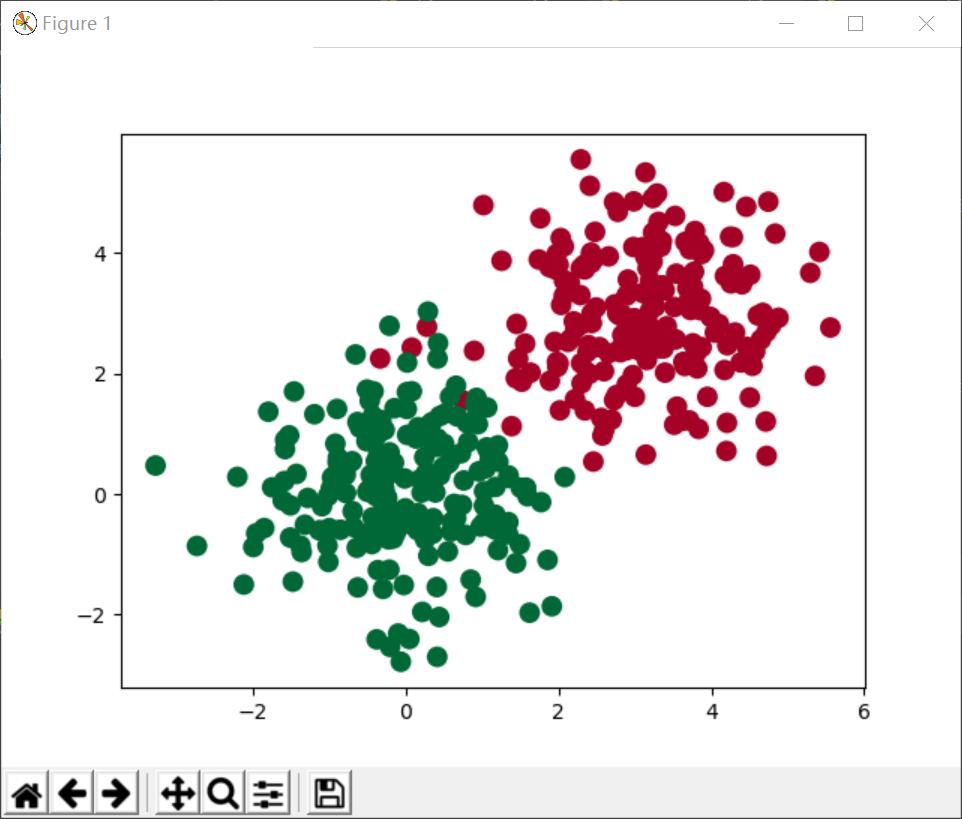
原始分类数据
我们采用批训练的方式,共训练10代,每一批次为30个数据。这次我们没有采用继承的方式来搭建网络,而直接使用torch.nn.Sequential来搭建网络。
代码如下:
import torch
import torch.nn.functional as F
import torch.utils.data as Data
import matplotlib.pyplot as plt

# 假数据
n_data = torch.ones(200, 2)         # 数据的基本形态
x0 = torch.normal(3*n_data, 1)      # 类型0 x data (tensor), shape=(100, 2)
y0 = torch.zeros(200)               # 类型0 y data (tensor), shape=(100, )
x1 = torch.normal(1*n_data, 1)     # 类型1 x data (tensor), shape=(100, 1)
y1 = torch.ones(200)                # 类型1 y data (tensor), shape=(100, )
# 注意 x, y 数据的数据形式是一定要像下面一样 (torch.cat 是在合并数据)
x = torch.cat((x0, x1), 0).type(torch.FloatTensor)  # FloatTensor = 32-bit floating
y = torch.cat((y0, y1), ).type(torch.LongTensor)    # LongTensor = 64-bit integer
net=torch.nn.Sequential(
        torch.nn.Linear(2, 10),
  			torch.nn.ReLU(),
  			torch.nn.Linear(10, 2)
    )

BATCH_SIZE=30
torch_dataset = Data.TensorDataset(x, y)
loader = Data.DataLoader(
    dataset=torch_dataset,      # torch TensorDataset format
  batch_size=BATCH_SIZE,      # mini batch size
  shuffle=True,               # random shuffle for training
)


optimizer = torch.optim.SGD(net.parameters(), lr=0.02)
loss_func = torch.nn.CrossEntropyLoss()  # the target label is NOT an one-hotted
plt.ion()   # something about plotting
for epoch in range(10):   # train entire dataset 3 times
				for step, (batch_x, batch_y) in enumerate(loader):  # for each training step
    						out = net(batch_x)  # input x and predict based on x
                loss = loss_func(out, batch_y)  # must be (1. nn output, 2. target), the target label is NOT one-hotted
                optimizer.zero_grad()  # clear gradients for next train
                loss.backward()  # backpropagation, compute gradients
                optimizer.step()  # apply gradient
        # plot and show learning process
        plt.cla()
        out=net(x)
        prediction = torch.max(out, 1)[1]
        pred_y = prediction.data.numpy()
        target_y = y.data.numpy()
        plt.scatter(x.data.numpy()[:, 0], x.data.numpy()[:, 1], c=pred_y, s=100, lw=0, cmap='RdYlGn')
        accuracy = float((pred_y == target_y).astype(int).sum()) / float(target_y.size)
        plt.text(1.5, 3, 'Accuracy=%.2f' % accuracy, fontdict={'size': 20, 'color': 'red'})
        plt.pause(0.1)

plt.ioff()
plt.show()
使用单层网络的训练结果:
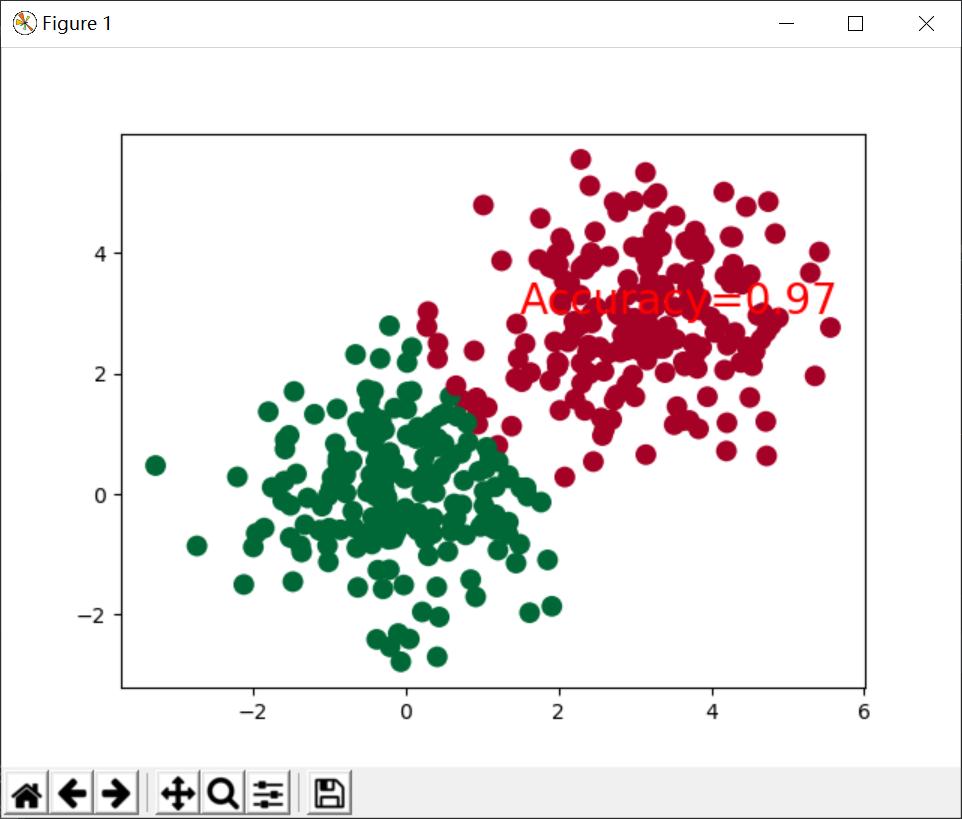
单层神经网络
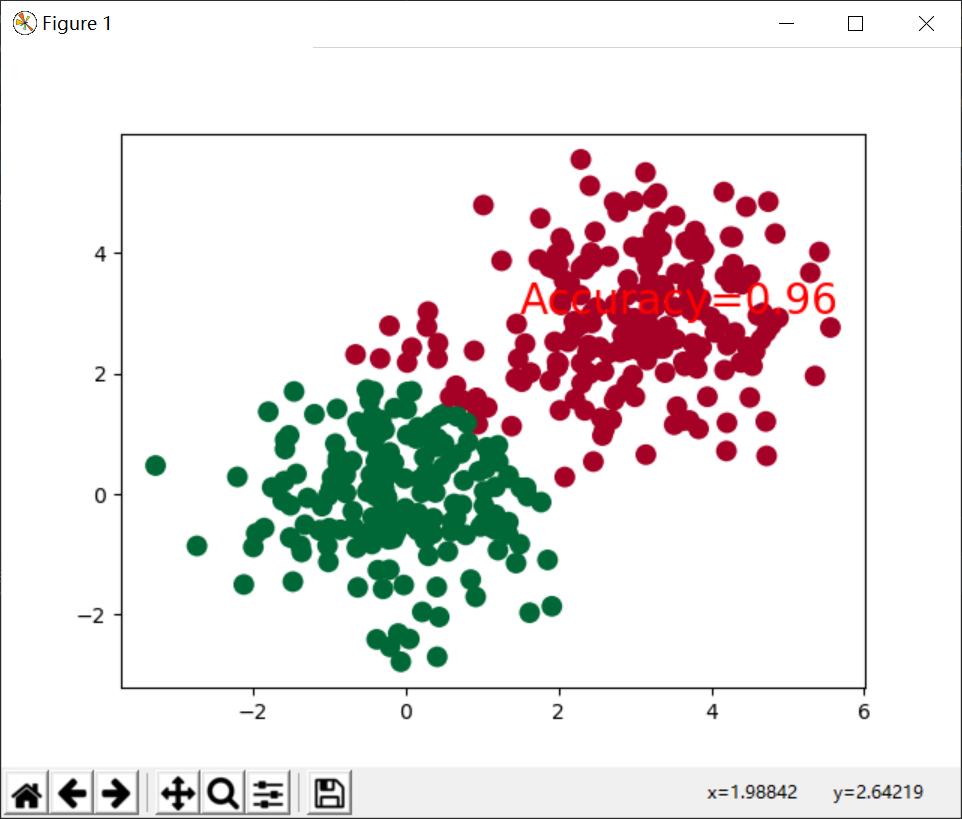
双层神经网络
可以看到拟合这样简单的分类任务,网络层数对预测的结果影响不大。但是当我们进行多特征分类任务时,就需要增加网络层数。