when, where 引导的从句 东联中学 张利平
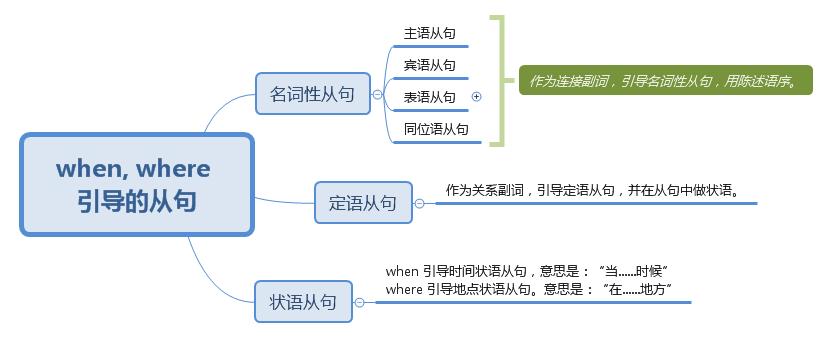
从上图我们可以看出when 和 where 是最活跃的两个引导词,它们可以引导英语中所有类型的从句。所以在文章中出现由这两个词引导的从句能否快速准确判断出是什么从句对于理解文章至关重要。下面让我们通过一些例句来分析一下:
-
(W hen and w here we will hold the sports meet) has not been decided yet.
-
The school has’t decided (w hen and w here we will hold the sports meet).
-
The skin is (where you feel cold, heat or pain and it gives you your sense of touch).
What we don’t know is (when he will come to help us).
4. The question (w hen and w here we will hold the sports meet) has been put forward at the meeting.
1--4例中 when 和 where 引导的为名词性从句。其中例1中,从句放在谓语动词 has not been decided 前,为主语从句。例2中,从句放在谓语动词 hasn’t decided 后,为宾语从句。例3中, 从句放在系动词 is 后,为表语从句。例4中,从句放在名词 question 后,且 question 在从句中无成份,故为同位语从句。
5. Please show me a place where there’s some wildlife protection.
Have you ever had a case where someone accused your journalists of getting the wrong end of the stick?
He lived in England and the USA but spent his last years in Switzerland, where he was buried in 1977.
例5中,where 引导的从句放在名词 a place, a case, Switzerland 后,且这些名词在从句中做地点状语,故为定语从句。
注意这三句中先行词的特点:a place 是一个明显的表示地点的名词,当这类名词为先行词时,我们很容易想到用where来引导定语从句,但必须要注意这些名词一定要在从句中做地点状语。如果它们在从句中做主语或宾语时,还是要用that/which; a case(情况)虽不是明显表示地点的名词,但它们在从句中是做状语,不可用that/which,而是用where。类似的名词还有:ocassion, position, point, stage等等,如果这类名词含有时间概念,也可用 when 来引导;Switzerland是表示地点的专有名词,表示特定意义,所以只能用非限制性定语从句。
6. This was a time when the two countries were at war.
China and Japan have mid-autumn festivals, when people admire the moon and in China, enjoy mooncakes.
例6中,when 引导的从句放在名词 a time, festivals 后,且这些名词在从句中做时间状语,故为定语从句。
注意这两句中先行词的特点:a time 是一个明显的表示时间的名词,当这类名词为先行词时,我们很容易想到用 when 来引导定语从句,但必须要注意这些名词一定要在从句中做时间状语。如果它们在从句中做主语或宾语时,还是要用that/which; festivals 前有mid-autumn来修饰是“中秋节” ,是这两国唯一的节日,所以只能用非限制性定语从句。
7. When I find a millipede insect, I rub it over my body. 当我找到千足虫时,我就把它擦在我身上。
The next morning I’d just about given myself up for lost (when I was spotted by a ship). 第二天早晨,我正要因迷路而放弃,正当这时我被一艘大船发现了。
How can he help when they won’t let him? 既然他们不让他帮,他怎么能去干呢?
例7中 when 引导的从句放在句首,句未,说明谓语动作发生的时间,故为时状语从句。三句中when的意思分别为:“当......时候” “正当这时......” "既然......"
8. Where there is a will, there is a way. 有志者,事竟成。(在有意志的地方,就会有办法。)
With all these attractions, no wonder tourism is increasing wherever there is a Disneyland. 有所有这些吸引人的景点,难怪只要在有迪士尼乐园的地方,旅游业就会增涨。注意:wherever 比where 语气更强。
例8中,where(ever)引导的从句放在句首,句未,说明谓语动作发生的地点,故为地点状语从句。
你学会了吗?现在分析一下下面的几个例子,它们是什么从句?请你参与:
Please make a mark (where you have a qustion)? ( )
Can you tell me when you will come back? ( )
You can ask him a question when you meet him. ( )