山东济宁郭晓辉英语教学教研团队
从2023高考英语写作思新课程标准教材的教与新高考评价体系的考(系列教学分享)

2023年全国甲卷书面表达
你们学校正举办主题为“用英文讲中国故事”征文活动。请你以一位中国历史人物为题写一篇短文投稿,内容包括:1. 人物事迹;2. 意义;3. 启示 析 (1)Text Type: contribution (2)题材: famous Chinese historical figures (3)要点(谋篇布局):
① 人物事迹:background, values, achievements
② 意义:the influence of his or her values or works on Chinese history and culture
③ 启示:reflect his or her spirits, attitudes towards life and values

相关语料
新教材中无处不在的语篇载体,还在等什么?读起来,积累起来:
01必修一 U3 Sports and fitness
Reading and Thinking——Lang Ping(alive)
02必修二 U4 History and traditions
Listening and Speaking ——Confucius
03必修三 U2 Morals and virtues
Reading and Thinking——Lin Qiaozhi 林巧稚;
Video time——Confucius and Ren 孔子和“仁”
04选必一 U1 People of achievement
Reading and Thinking——Tu Youyou 屠呦呦(alive)
Using Language——Introduce someone you admire (维词教学系统—教材课件—读写)
Reading and Writing ——Heroes in your eyes 黄大年
05选必一 U5 Working the land
Reading and Thinking——Yuan Longping 袁隆平
06选必二U1 Science and Scientists
Using Language——Qian Xuesen 钱学森
07选必三U4 Adversity and Courage
Reading and Writing—— Fan Zhongyan 范仲淹
Project—— Si Maqian 司马迁
08选必三 U5 Poems
Video time——The poet Sushi 苏轼
以上这些语篇内容都是famous figures in China, 包括运动领域、医学领域、科学领域、农业领域、文学领域等,分布在新教材相应话题的各个板块中,有阅读部分Reading and Thinking,Reading for Writing,也有听力部分Listening and Speaking,Video time, 写作部分Using Language, 课题设计Project部分。
虽然这些语篇写作目的不尽相同,但其题材都是写或听或看famous figures in China,完全可以作为此类语篇写作的素材。

具体课例展示
一次推门听课 (Poem——听说看)
在这节课中“看”环节,内容是Video Time——The poet Sushi
教学设计 PART.1
课前任务
学生自主看完视频一遍,并预习完成阅读听说看这部分音视频材料。
PART.2
课中步骤
(由读到写)
① 领着学生把 Video Time——The poet Sushi 语篇读了一遍,引导学生根据 context猜词,paraphrase 解决词汇障碍,如Cipai, prominent, pass the civil service examination等;或用词根拆分结合语境猜词,如opposition, demoted, exile, running, script, calligraphy 等。
目的:这一环节保证学生在阅读或看的过程中不存在生词障碍。
② 分析语篇结构(采用 detect questions 的方法一步步引导学生猜测下一部分内容):
Part I General introduction
Part II Introduce in detail (life experience and achievements one by one)
Part III Summary
“看”的语篇结构完美呈现此类语篇要点,包括整体介绍人物及贡献、生平、代表作及作品中体现的他个人不屈不饶的乐观品性等。
③ 引导学生找此类语篇要点的描述语言:词、块、句等。
The Poet Su Shi
Many of the best known classical Chinese poems are from Song Dynasty poets, such as Su Shi, Ouyang Xiu, Lu You, and Li Qingzhao. At that time, the Ci form of poetry became quite popular. Ci poetry is written using different structures called cipai (词牌), which control the poem’s tones, rhythm, syllables per line, and number of lines.
Among the prominent (= famous/important ) Song Dynasty poets, Su Shi (1037-1101) was, without doubt, one of the most popular. He made strong contributions to the fields of poetry, literature, painting, calligraphy, and more.
Su Shi came from a literary family: his father and brother were both great poets in their own rights. At the young age of 19, Su Shi passed the civil service examination (译: 通过科举考试 ), which was a gateway (= access ) to a political career. Then he took various governmental positions, including serving as the magistrate (地方法官) of Mizhou and the governor of Xuzhou. However, because of his opposition to radical reform measures (激进式改革), he was repeatedly demoted (降职).
Sushi’s first remote trip of exile (流放) was to Huangzhou, Hui Provine. During this period, he grew fond of the area he lived in and he often wandered along the rivers and in the mountains. It was here that he wrote many of his best poems, such as Reflections on the Ancient Red Cliff—To the Tune of Nian Nu Jiao (《念奴娇·赤壁怀古》). In this poem, he expressed his admiration for some heroic figures (表达了对英雄人物的钦佩), and described his aspirations (= ambition ) and sorrows. The poem remains so popular that nearly every Chinese student can recite it:
The Great River flows, eastward waves sweeping away, for thousands of years, gallant heroes ...Su Shi’s most famous piece of calligraphy, The Cold Food Festival (Han Shi Tie《寒食帖》),expressing his loneliness and disappointment (表达了他的孤独和失望), was also written in Huangzhou. Han Shi Tie is traditionally ranked third overall in the category of Chinese running script calligraphy (“天下第三行书”).
Despite his hard life, Su Sh’s works show a spirit of confidence and optimism (自信积极乐观). His poems make people feel encouraged, reminding them that even during the hardest of times, there is always room for hope. A classic example is his poem Shui Diao Ge Tou:
People have sorrow or joy, be near or far apart,The moon may be dim or bright, round or crescent shaped,This imperfection has been going on since the beginning of time.May we all be blessed with longevity,Though thousand miles apart,We are still able to share the beauty of the moon together.Even today, Su Shi’s poems still have a great influence on Chinese people. They can be heard in classrooms all over China, and seen quoted in the works of many Chinese scholars (为中国学者在作品中引用).
* 下划线词、块、句为要点表达,让学生当堂背诵。
④ Summary (下笔成文)
让学生架构并完成语篇写作:讲中国故事——你喜欢的诗人苏轼(不限语篇类型)
PART.3
课中及课后作业
——整理 polish上交写作
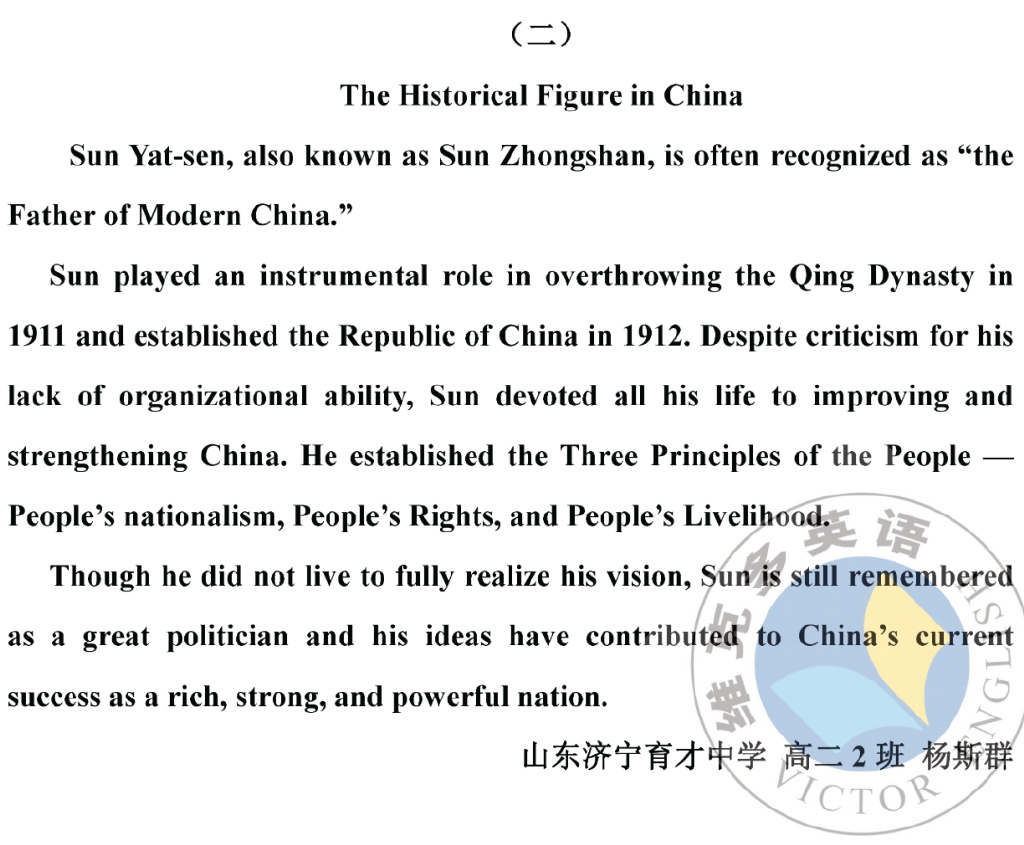
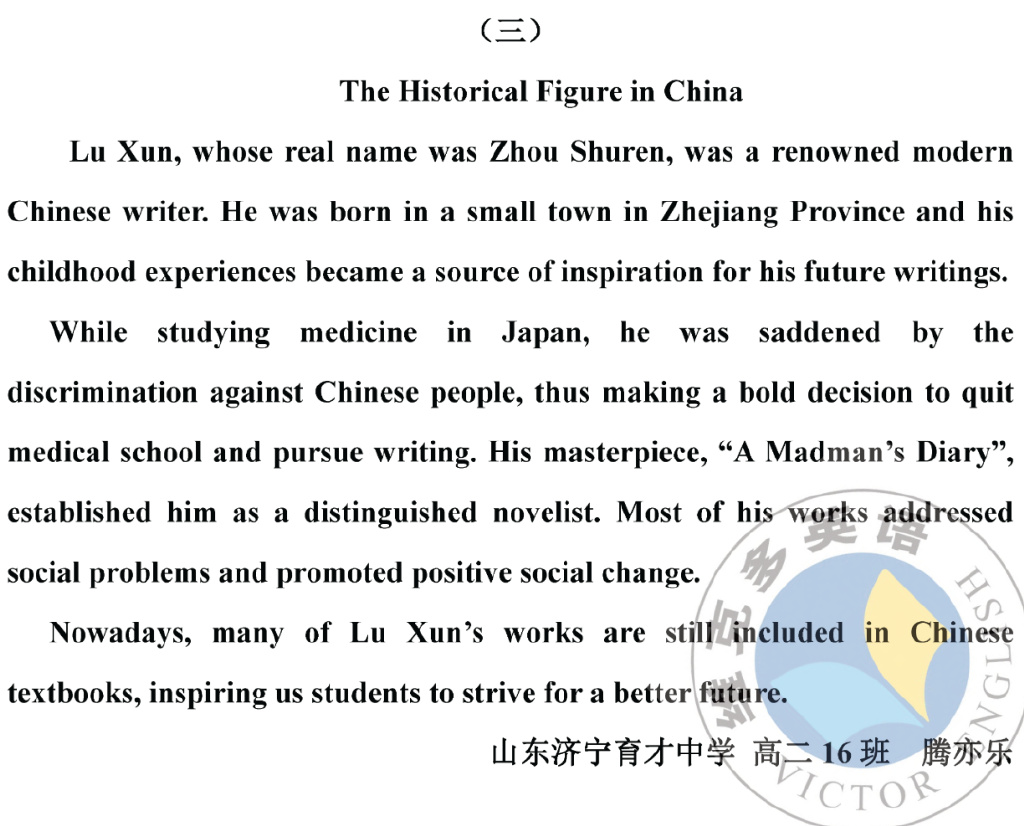
高二2班普通班的孩子,在老师的引领下,课下每人交给了我他们“以读促写”的这篇作文,孩子们非常有成就感。
此类做法还有选必二 U1 Using Language,“读”部分给了两篇,钱学森和霍金。“读写”的第一节课就是让学生对钱学森那个语篇进行了“summary”(很好的以读促写的办法哦),当堂让一位成绩稍好的孩子硬生生将一大篇课文浓缩成了一篇作文——a scientist I admire。还有 Reading and Thinking 部分介绍屠呦呦、林巧稚、袁隆平、黄大年等,Reading for Writing 部分也是如此,学生很喜欢这种方式。

“教”与“学”感悟
无论哪个话题,无论话题哪个板块,所有的语篇包括“听”“课题Project”及“看”都是很好的话题读写素材。新课标改革培养英语学科素养之语用能力,将这一学科学习回归到语言学习本质——以读促写,以大量文本阅读来输出写作,而非背诵“范文”“模版”,真正培养学生的语篇阅读及读写迁移能力。
应此要求,郭晓辉老师团队老师们集体协作,充分利用新教材,听说读写看各类语篇都不放过,集体创作相关题页,力求在 “教”与“学”中以新教材话题语篇为依托,培养学生读、思、写的能力,达到新课标标准。

输出范文
Possible Version
Many of the best known classical Chinese poems are from Song Dynasty prominent poets, such as Su Shi, Ouyang Xiu, Lu You, and Li Qingzhao, among whom Su Shi (1037-1101) was, undoubtedly, one of the most popular. He made strong contributions to the fields of poetry, literature, painting, calligraphy, and more.
Su Shi came from a literary family. At the young age of 19, he passed the civil service examination, which was a gateway to a political career. Then he took various governmental positions. However, because of his opposition to radical reform measures (激进式改革), he was repeatedly demoted (降职).
In spite of ups and downs, Su Shi created many poems like minced and roasted meat loved by people, such as Reflections on the Ancient Red Cliff—To the Tune of Nian Nu Jiao, in which he expressed his admiration for some heroic figures, anddescribed his ambitions and sorrows. Additionally, his famous piece of calligraphy, The Cold Food Festival (Han Shi Tie《寒食帖》), expressing his loneliness and disappointment, is traditionally ranked third overall in the category of Chinese running script calligraphy (“天下第三行书”).
Despite hard life, Su Shi’s works show a spirit of confidence and optimism, which make people feel encouraged, reminding them that even during the hardest of times, there is always room for hope. Even today, Su Shi’s poems still have a great influence on Chinese people. They can be heard in classrooms all over China, and seen quoted in the works of many Chinese scholars.
学生习作:
本文由山东济宁育才中学李冉冉老师原创,本平台仅供展示分享。如涉及原创争议,可联系维克多英语平台协助解决。禁止转载。