第三套人民币共有十三种版别,七种面额,由于当时的环境人文文化,国家发展方向,相关政策等造就了独特历史含义的一套人民。
第三套人民币是中国人民银行于1962年4月20日开始发行的。与第二套人民币比价相等,并在市场上与之混合流通。这套人民币与第二套人民币相比,取消了3元纸币,增加了1角、2角、5角和1元四种金属币,保留了1分、2分、5分纸币。
纸币中“中国人民银行”六字是由马文蔚先生所书写。票面上两方印章分别为“行长之章”和“副行长章”。纸币背面印有用汉语拼音、蒙古文、维吾尔文、藏文、壮文书写的“中国人民银行”字样。第三套人民币1962年4月20日发行枣红色1角纸币起,到2000年7月1日停止流通,前后历时38年。
第三套人民币
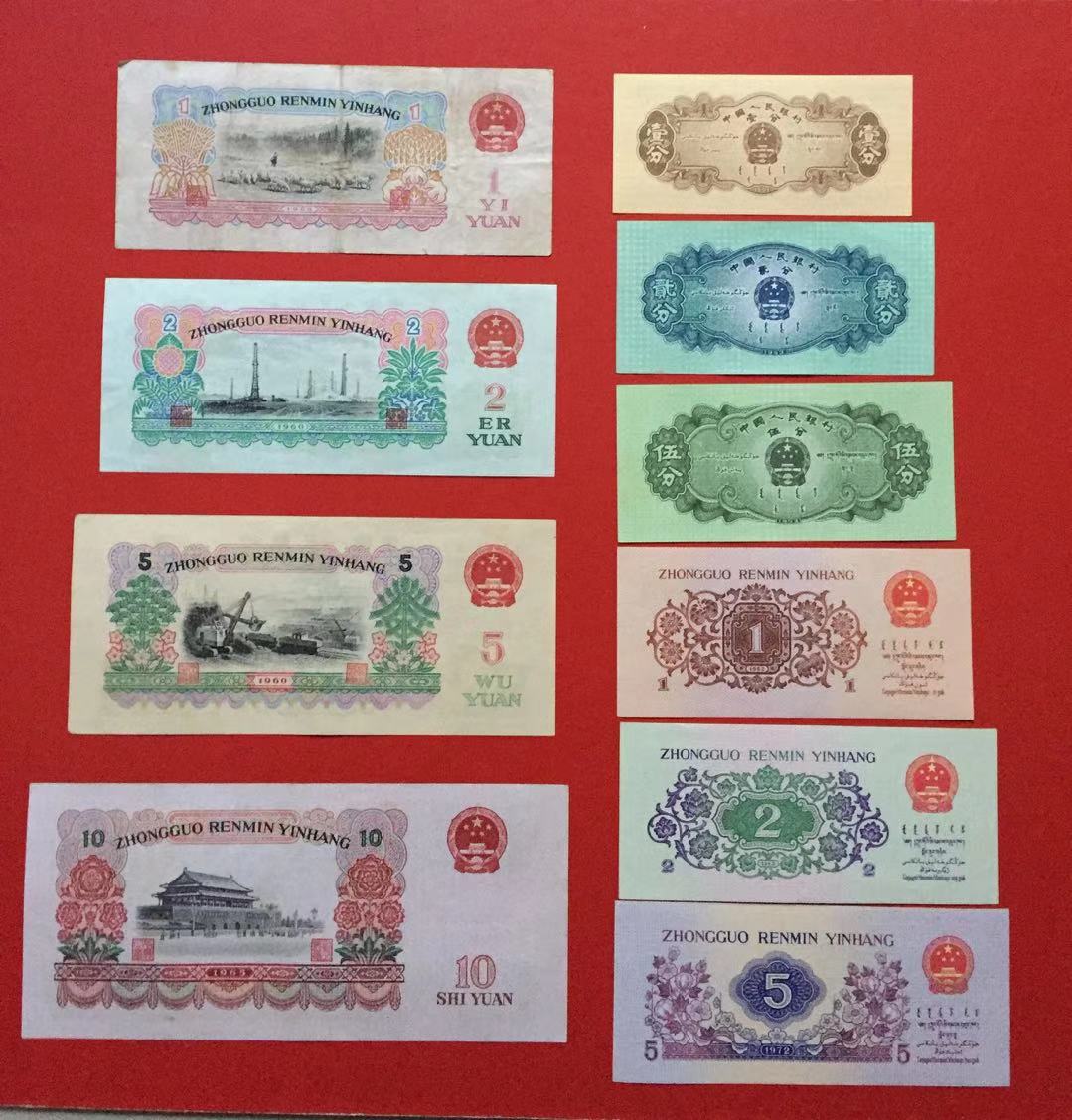
十元大团结:1965年10元纸币是大家都十分熟悉的收藏品之一,在它发行的年代里,人们都亲切的称呼它为大团结,在那个正处在发展的时代里,手里如果有这么一张大团结,就已经是有钱的大户人家,所以一直到现在人们对它还依然特别有感情,不过这种纸币在当时的发行量比较少,而且距离现在的时间又太特别长,所以收藏市场上看到了已经是越来越少。
女拖拉机手红一圆长三罗马:一元纸币上印着的是一位女拖拉机手,这位中国女性名叫梁军,谈起那张照片,梁军说,在1959年11月13日,我国产第一批13台“东方红-54”拖拉机到达了黑龙江,梁军心情十分激动,她跳上一台“东方红”驾驶了一圈,在场有记者拍下了那个令人振奋的画面。有趣的是,最有趣的是,梁军本人并不知道那张照片后来被印在了第三套人民币一元纸币,也就是我们说的女拖拉机手的票面上。
长江大桥长二罗马二角:长江大桥就好比现在的珠港澳大桥,是中国造桥工程的骄傲,回望过去中国依然是造桥大国,我为中国自豪。长江大桥长二罗马二角,也是为了纪念中国伟大工程,将永久留存在这张长江大桥长二罗马二角人民币上。
左倾一角:这张一角纸币最大的特征是所有人都在向左走,虽然有人目向右方但是整个画面都在向左行走,被当时认定左倾思想,发行不久就被停止了。确实有一个坎坷的故事,60年代,阶级斗争还是非常激烈的,“左倾”思想...也就是因为这个原因,1960年1角一跃成为了第三套人民币中的币王,身价飞涨。
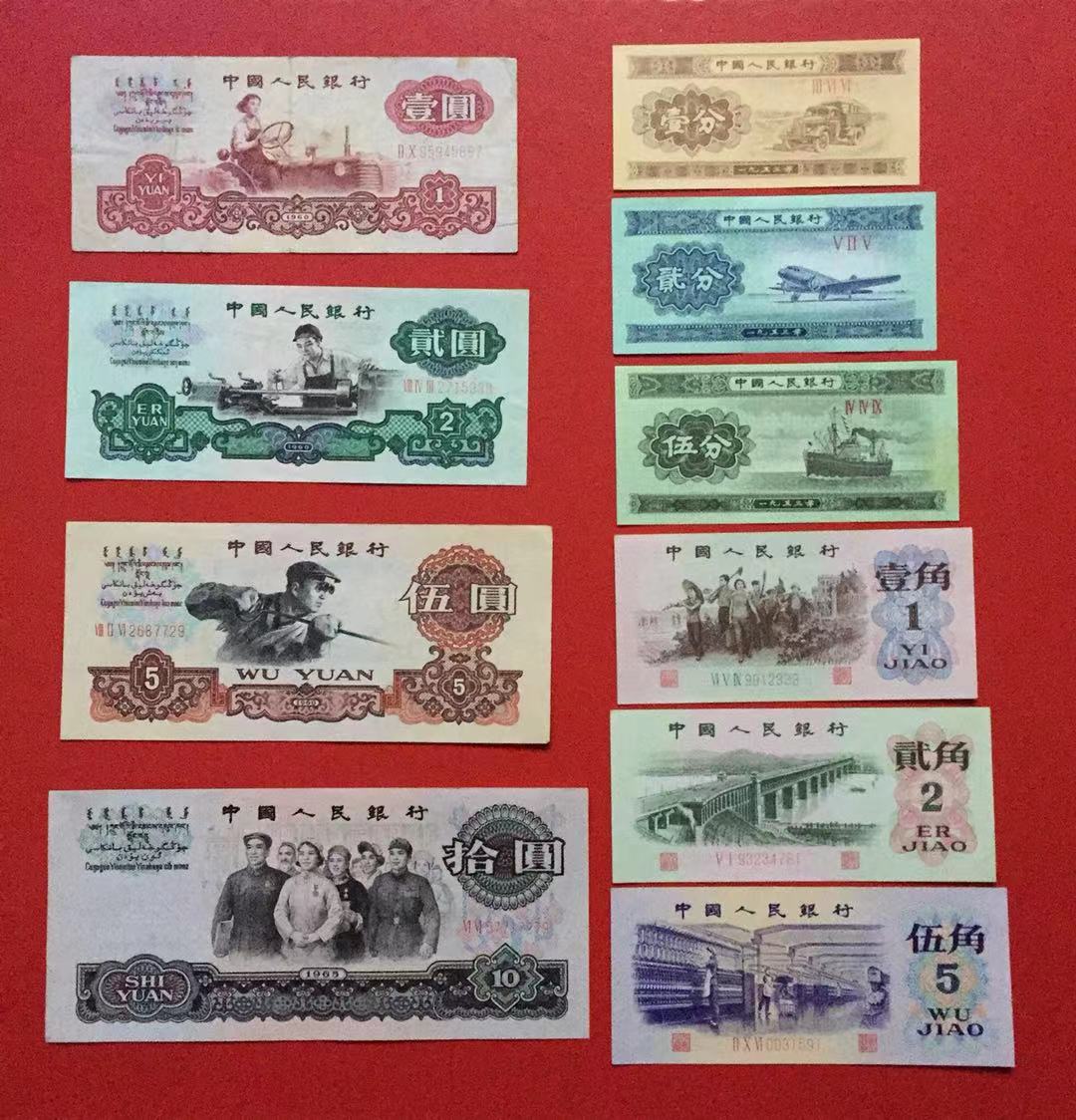
第二套人民币辅币:第二套人民币又称为“53版”人民币,于1955年发行流通,共印有一分至十元十一种面额。其中一分纸币为米黄色,主图是汽车;二分纸币为浅蓝色,主图是飞机;五分纸币为浅绿色,主图是轮船。三款面额纸币正图还冠有大写罗马字母和7位阿拉伯数字,用来记录发行序列和编号。上世纪80年代我国再版发行了纸分币,图案和形制完全采用53版,为了区分不同,在票面正图右上方仅仅冠有大写罗马字母而删去了阿拉伯数字,同属第二套人民币。
第三人民币,不仅拥有第三套,还有辅币,而辅币更是第二套人民币就开始发行的,时代感很强,目前第一套价值以及超过五百万,可见第这三套人民币,十分抢手,目前市场已不见其踪影,都被藏友所收藏,只藏不出,导致市场稀缺,具有极高的收藏价值。
英文翻译:The third set of RMB has 13 editions and seven denominations. Due to the environment, cultural culture, national development direction and relevant policies at that time, a set of people with unique historical meaning was created.
The third set of RMB was issued by the People's Bank of China on April 20, 1962. It is equivalent to the second set of RMB and mixed with it in the market. Compared with the second set of RMB, this set of RMB has cancelled the 3 yuan note, and increased the 10 jiao, 20 jiao, 50 jiao and 1 yuan four metal coins, and retained the 1 fen, 2 fen and 5 fen notes.
The six characters "People's Bank of China" on the banknote were written by Mr. Ma Wenwei. The two seals on the face of the bill are respectively "governor's seal" and "Vice Governor's seal". On the back of the notes are printed the words "People's Bank of China" in Chinese pinyin, Mongolian, Uygur, Tibetan and Zhuang languages. The third set of RMB lasted 38 years from April 20, 1962, when the jujube red one-cent banknotes were issued to July 1, 2000.
Third set of RMB
Ten yuan unity: 10 1965 yuan notes is one of the collection of everyone is familiar with, and at times, it was released people affectionately call it as an unity, lying in the development of times, if there is such a great unity in his hand, has been a large family of rich, so until now, people still have special feelings about it, However, the circulation of this kind of banknotes was relatively small at that time, and the time is too long now, so the collection market has been less and less.
Female tractor driver red one round long three Rome: Talking about the picture, Liang jun said that on November 13, 1959, the first batch of 13 "Dongfanghong 54" tractors made in China arrived in Heilongjiang province. Liang Jun was very excited. She jumped on one of the "Dongfanghong" and drove around. A reporter was present to capture the uplifting scene. Interestingly, and most interestingly, Liang himself had no idea that the photo was later printed on the face of the third set of RMB one yuan notes, the female tractor driver.
The Yangtze River Bridge is just like the Zhuhai-Hong Kong-Macao Bridge today, which is the pride of China's bridge construction project. Looking back to the past, China was still a big bridge builder. I am proud of China. The two Roman horns of the Yangtze River Bridge, also to commemorate the great Project of China, will be permanently preserved on the two Roman horns of the Yangtze River Bridge.
Left-leaning corner: The biggest feature of this one-corner note is that everyone is walking to the left. Although some people are looking to the right, the whole picture is walking to the left. It was identified as left-leaning ideology at that time, and was stopped soon after it was issued. There is indeed a rough story. In the 1960s, the class struggle was still very fierce, and the "left" ideology... Because of this reason, in 1960,1 Jiao became the king of the third set of RMB and its value soared.
The second set of RMB subsidiary notes: The second set of RMB, also known as the "53 Edition" of RMB, was issued and circulated in 1955, with 11 denominations ranging from one minute to 10 yuan. One of the notes is beige and the main picture is a car. The banknote is light blue, and the main picture is an airplane. The nickel is light green and the ship is the main picture. The three denomination notes are also depicted with capital Roman letters and seven Arabic numerals to record the issue sequence and serial number. In the 1980s, China reissued the paper coin, with the pattern and shape of 53 edition completely adopted. In order to distinguish differences, the upper right part of the picture on the face of the paper only bears the capital Roman letters and Arabic numerals are deleted, which belong to the second set of RMB.
Not only has 3 yuan, third, and COINS, and a bit more has issued a second set of RMB, times feeling is very strong, and more than five million, the first set of value can be seen in the first three sets of renminbi, in high demand, at present, the market has not see the trace, collection by Tibetan friend, only to hide out, lead to market scarce, has a very high collection value.