学科网小编提示
很多同学在学习英语语法时都觉得很绕,还经常会混淆。下面是对中考英语语法分类详解,同学们可以好好看一看,然后记得收藏哦!更多中考英语相关干货,可以登录学科网手机版搜索中考英语,随时随地想看就看!

学科网手机版搜索中考英语
名词
专题一 名词
1. 名词的数
概述: 名词按其表示的事物的性质分为可数名词和不可数名词。
可数名词及其单复数:可数名词有单复数变化,其前通常用不定冠词和数词来修饰,还可用many, few, a few, some, any, plenty of, lots of, a number of 等修饰。构成名词复数形式的方法分为规则法和不规则法两种。
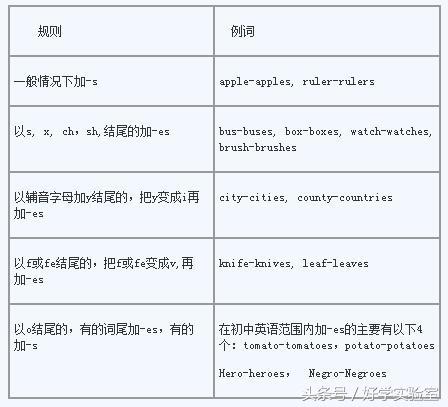
复数的规则构成法:绝大多数英语中的名词复数都是在单数名词后加上词尾-s或-es构成的。具体规则如下图:
2) 复数的不规则构成法:
a.单复同形的:Chinese-Chinese, Japanese-Japanese, deer-deer, sheep-sheep, fish-fish(表示鱼的数量)
b. 熟记下列词的复数变化:man-men, woman-women, policeman-policemen, foot-feet, tooth-teeth, mouse-mice, child-children
c. 以man, woman做定语构成的复合名词,变复数时要全变:a man teacher-two men teachers; 其他情况一般只变主体名词而作定语的名词不变:a girl student-two girl students
3. 不可数名词:不可数名词没有单复数。如:water, meat, air等。在表示数量时,通常用以下方法。
1)用some, much, a little, little, a lot of, lots of, plenty of 等表示多少。
There is little milk at home.
The old man has lots of money.
2) 若要表示不可数名词的数量,应用“数词+量词+of+名词”这种形式,若数字超过一,量词应用复数形式。如:a glass of water-two glasses of water, a piece of bread-two pieces of bread
2. 专有名词:专有名词是表示特定的人,事物, 地点等,如:Tom, China, the United Kingdom. 专有名词的第一个字母一般大写,大部分专有名词前一般不用冠词。
3. 名词的所有格:
1. 概述:名词的所有格在句中是表示所有关系,作定语。
2. 名词所有格的构成:名词所有格包括 –s所有格和of所有格两种形式。无生命的名词的所有格通常用of短语来表示所有关系。如:the name of the school, the window of the house等。–s所有格主要用于有生命的东西和表示时间,距离,国家等的名词后。构成方法如下:
一般直接在名词后加’s. 如:Jim’s book
复数名词的所有格,若以s/es结尾只加撇号,不以s/es结尾仍加’s。如:
Children’s Day, the teachers’ office.
3)“ and”连接的并列名词的所有格,表示两人“共有”只在后一个名词尾加’s; 表示“各自拥有”,两个名词尾都要加’s. 如:Jim and Lucy’s book(共有); Jane’s and Tom’s books(不共有)
4)表示店铺或某人的家等处所时,常在名词的所有格后省去shop, house, home等。如:the barber’s, at my uncle’s
5) 表示时间,距离,国家,城市的无生命名词,可以在词尾加’s或’表示所有格,如:today’s newspaper, five minutes’ walk.
3. 双重所有格
1)名词双重所有格的含义:of+名词所有格称为双重所有格,这种结构中,of前面是一部分,of后面是一个整体。
例如:Mr Wang is a friend of my father’s. (=Mr Wang is one of my father’s friends.) 王先生 是我父亲的一个朋友.
2)名词双重所有格的构成方法:
a. of前面的名词前面通常有一个含泛指意义的限定词,如a, any, some, no, few, several以及two, three等。例如:
Have you read any stories of Lei Feng’s? 你看过雷锋的故事吗?
They gave me some books of theirs. 他们把他们的一些书给了我。
Three classmates of my sister’s have found good jobs. 我姐姐的三个同学已经找到了好工作。
b. 有时of前面的名词前面可以用指示代词this, that表示某种感情色彩。例如:
That answer of Jim’s was right. 吉姆的那个回答是对的。
Something is wrong with this eye of mine. 我的这只眼睛出了毛病。
c. of后面带有’s的名词或名词性物主代词通常是特指的人。例如:
That’s a book of Lu Xun’s. 这是鲁迅的一本书。
This is a child of theirs. 那是他们的一个孩子。
3)名词的双重所有格与“of + 名词”结构之间的区别:
a.. 句子所表达的侧重点不同。试比较:
He is a friend of my father’s. (着重说明“父亲”的朋友不止一个)
He is a friend of my father. (着重说明“他”是父亲的一个朋友)
b. of前面是picture等词时,含义不同。试比较:
This is a picture of my teacher’s. 这是我老师收藏的一张照片。
This is a picture of my teacher. 这是我老师的一张照片。
数词、冠词
一.数词
1.数词概述:表示数目多少或顺序先后的词叫做数词。其用法相当于名词或者形容词。
2.数词的种类:可以分为两种: 基数词:表示数目多少的数词。序数词:表示先后顺序的数词。
3.基数词的写法和用法
1)1—12的基数词是独立的单词,即: one,two,three,four,five,six,seven,eight, nine,ten,eleven,twelve。
2)13—19的基数词以-teen结尾。如:14—fourteen,但13,15,18较特殊,13—thirteen 15—fifteen 18—eighteen。
3)20—90的整十位均以-ty结尾。如:60—sixty,但20,30,40,50,80较特殊, 20—twenty 30—thirty 40—forty 50—fifty 80—eighty。
4) 十位数与个位数之间要加连字符号“-”,如:28—twenty-eight,96—ninety-six。
5) 百位和十位(若无十位则和个位)之间加“and”,如:148—one hundred and forty-eight , 406—four hundred and six。
6) hundred(百),thousand(千),million(百万),billion(十亿)等前面即使有具体的数词,也不能在它们的后面加s。
7) .百(hundred),千(thousand),百万(million)等词与介词of连用的时侯,用复数形式,表不确定数目,其前面不可与数字连用
8).表示“几十”的数词,复数形式可用来表示人的岁数或年代。
如: He is in his forties. 他四十多岁。
This took place in the 1930s. 这事发生在二十世纪三十年代。
9).基数词可与其他词构成形容词。
如: Can you say something about your two-month holiday? ?(two和month之间有连字符时,month用单数)
4. 序数词的写法和用法
1).基数词变序数词可利用口诀巧记:“一、二、三,特殊记,八去“t ”,九去“e”,“ve”要用“f”替,见“y”变成“i”和“e”,词尾加上“th”,若是遇到几十几,只变个位就可以。”
变法如下:first,second,third,eight—eighth nine—ninth,five—fifth,twelve—twelfth,twenty—twentieth,forty—fortieth,twenty-five—twenty-fifth。
其余情况均在基数词后加th。如: six—sixth, nineteen—nineteenth , hundred— hundredth, thousand—thousandth等。
2). 序数词前常用定冠词the, 表“顺序”。但如果序数词不表示顺序,而表示“又一个,另一个”时,则不能用the, 要用a. 如:Try it a second time. 再试一下。
5. 序数词表示“名次”时,不用定冠词。
He was first. 他得了第一名。
Who was first? Who was second?谁是第一名?谁是第二名?
注意:
1.分数的读法:分子必须用基数词,分母用序数词。分子如果大于1,分母须用复数形式。先读分子,再读分母。分子为one时可换用a. 如:
In our class, about a third can speak English well.
Two thirds 三分之二。
2.1/2读作“a(或one)half(而不是a second “一秒钟”),1/4既可读作“a(或one)quarter”又可读作 “a(或one)fourth”.
3/4:Three quarters
3.小数的读法:小数点的前的基数词与前面所讲的基数词读法完全相同;小数点读作point,小数点后只须将数字一一读出。
15.67 读作: fifteen point six seven
4. 百分数的读法:先读基数词,再读百分号 “%”(读作percent).
5% 读作: five percent.
5.年代的读法为“两位,两位”地读。整百的后读hundred,整千的后读thousand, 前常加 the year. 如:
1937读作nineteen thirty-seven 或:nineteen hundred and thirty-seven
2000 年 读作 the year two thousand
December the first, nineteen ninety-four 一九九四年十二月一日
二.冠词
1. 冠词概述:冠词是虚词,本身不能单独使用,也没有词义,它用在名词的前面,帮助指明名词的含义。
2. 冠词的种类:英语中的冠词有三种,一种是定冠词,另一种是不定冠词,还有一种是零冠词。
3. 不定冠词的用法
不定冠词a (an)与数词one 同源,是"一个"的意思。a用于辅音音素前,一般读作[e],而an则用于元音音素前,一般读做[en]。
1) 表示"一个",意为one;
2) 代表一类人或物。
A knife is a tool for cutting with.
Mr. Smith is a doctor.
3) 词组或成语。
a little / a few / a lot / a type of / a great many / many a / in a hurry / in a minute / in a word / in a short while / after a while / have a cold / have a try / keep an eye on /
4. 定冠词的用法
定冠词the与指示代词this,that同源,有"那(这)个"的意思,但较弱,可以和一个名词连用,来表示某个或某些特定的人或东西。它有以下意义:
1)特指双方都明白的人或物:定冠词the与指示代词this,that同源,有"那(这)个"的意思,但较弱,可以和一个名词连用,来表示某个或某些特定的人或东西。
1)特指双方都明白的人或物: Take the umbrella. 带上伞。
2)上文提到过的人或事: He bought a book. I’ve read the book.
他买了一本书。我看过那本书。
3)指世上独一物二的事物: the sun, the sky, the moon, the earth
4)单数名词连用表示一类事物,如:the dollar 美元; the fox 狐狸;或与形容词或分词连用,表示一类人:the rich 富人; the living 活着的人。
5)用在序数词和形容词最高级,及形容词only,very,same等前面:
Where do you live? I live on the second floor. 你住在哪?我住在二层。
That’s the very thing I’ve been looking for. 那正是我要找的东西。
6)用在表示身体部位的名词前: She caught me by the hand. 她抓住了我手。
7)用在某些由普通名词构成的国家名称、机关团体、阶级、等专有名词前:
the People’s Republic of China 中华人民共和国 the United States 美国
8)用在表示乐器的名词之前: She plays the piano. 她会弹钢琴。
9) 用在姓氏的复数名词之前,表示一家人: the Greens 格林一家人 (或格林夫妇)
10) 用在惯用语中:
in the day, in the morning (afternoon,evening), the day after tomorrow
the day before yesterday, the next morning, in the sky (water,field,country) in the dark, in the rain, in the distance, in the middle (of), in the end, by the way, go to the theatre
5.零冠词的用法
1) 国名,人名前通常不用冠词:England,Mary;
2)泛指的复数名词,表示一类人或事物时,可不用定冠词; They are teachers.
3)抽象名词表示一般概念时,通常不加冠词; Failure is the mother of success. 失败乃成功之母。
2)在季节、月份、节日、 假日、日期、星期等表示时间的名词之前,不加冠词;
We go to school from Monday to Friday.
3)在三餐、球类运动和娱乐运动的名称前,不加冠词
4) 当by 与火车等交通工具连用中间无冠词;by bus,by train;
5)有些个体名词不用冠词;如: school,college,prison,market,hospital,bed,table,class, town,church,court 等个体名词,直接置于介词后,表示该名词的深层含义,
如:go to hospital 去医院看病
go to the hospital 去医院 (并不是去看病,而是有其他目的)
6)不用冠词的序数词;
a. 序数词前有物主代词
b. 序数词作副词 He came first in the race.
c. 在固定词组中 at (the) first, first of all, from first to last
介词、连词
一. 介词
1. 介词概述:介词表示它与后面的名词或代词与其他句子成分的关系。介词是虚词,不能单独做句子成分。介词在英语中用法很活,也无一定规律可循。在初中范围内还应学一个记住一个,特别是那些和动词的特殊搭配。
2. 常用介词的意义和用法。
⑴ 时间或地点介词in、on、at的用法区别:
表示时间时, in表示在一段时间里(在将来时句子中则表示在一段时间之后), on表示在具体的某一天或者某天的上下午等, at表示在某个时刻或者瞬间;
表示地点时, in表示在某个范围之内, on表示在某个平面上或与一个面相接触,at则表示在某个具体的场所或地点。如:
He was born on the night of May 10th.
I usually get up at 7:00 in the morning.
His glasses are on the desk.
My brother is at the bus stop.
⑵ after与in表示时间的用法区别:“after+(具体时刻/从句)”表示“在…时刻之后”常用于一般过去时态;“in+(一段时间)”表示“在(多久)之后”,常用于将来时态。如:
He said that he would come back after 6:00.
My father is coming back from Astralia in about a month.
⑶ since与for表示时间的用法区别:“since+(具体时刻/that-从句)”表示“自从…起一直到现在”,“for +(一段时间)”表示“持续一段时间”,都常用于完成时态;如:
My father has worked in this factory since 1970.
My father has worked in this factory for over 30 years.
⑷ by、in与with表示方式的用法区别:都可以表示“工具、手段”,但是by主要表示“乘坐”某个交通工具或“以……方式”,在被动句中可以表示动作的执行者;in表示“使用”某种语言/文字,with表示“使用”某个具体的工具、手段。如:
We write with our hands and walk with our feet.
Please speak in English.
Let’s go to the zoo by bus.
It was invented by Adison.
⑸ about与on的用法区别:都可以表示“有关…”,但是about的意义比较广,而on主要表示“有关…(专题/课程)”。如:
Tom is going to give a speech on the history of China.
They are talking about the English test.
⑹ through与across、over的用法区别: through指“穿过…(门洞/人群/树林)”; across和over可以指“跨越…(街道/河流)”,可互换,但是表示“翻过…”时只能用over. 如:
Just then a kangaroo (鼠)ran across the road.(就在那时一只袋鼠跑过路面)
There is a bridge across/over the river.(河上有座桥)
They climbed over the mountain and arrived there (他们翻过大山到达了那里)/
The visitors went through a big gate into another park.(参观者们穿过一个大门来到另一个公园)
(7)as与like的区别:两个词都表示“像……”,但是as译为“作为……”,表示的是职业、职务、作用等事实,而like译为“像……一样”,表示外表,不是事实。如:
Let me speak to you as a teacher.(我以老师的身份和你讲话。)
Let me speak to you like a teacher.(让我像一位老师一样和你讲话)
(8)in front of 与in the front of:in front of“在…的前面”, 与in the front of“在…的前部”。如:
A group of people was standing in front of the hall.
In the front of the hall stood a group of people.
(12)except与besides的区别:except“除了”,表示排除掉某人物,即不包含;而besides“除了”则表示包含,即“不仅……又……”。如:
Everyone went to the park except Tom.(除了Tom,大家都去了公园)(Tom没有去公园)/
Besides maths he also studied many other subjects.(除了数学之外,他还学其他许多功课)(“数学”也是他学的功课之一)
连词
1.连词概述:连词是一种虚词,用于连接单词,短语或句子,但不单独做句子成分。按照连词的性质,可将连词分为并列连词和从属连词。并列连词如:and,but,or,for等,它们即可连接单词,短语,又可连接句子。从属连词如:when,before ,because等,它们主要引导名词性从句。
2.常见连词的用法:
1)并列连词 的用法: 并列连词有:and, but, or, nor, so, for yet, however, as well as, both...and, not only...but also, either...or, neither...nor, still,
And: 连接单词短语句子 。如:Tom and I study in the same school.
But, or :I have a pen but no pencil. / Would you like coffee or tea?
Nothing but除了,只有: I did nothing but watch it.
Or表示否则:如: Hurry up or you will miss the train.
for 表示后面的句子是原因。如: He is good at piano for he practices harder than others.
Not only…but also 不仅…而且。可并列主、谓、宾、表及句子。主语并列时,谓语要就近一致。如: Not only he but also I am a nurse.
As well as 以及,同样。并列单词、短语、句子。并列主语时,动词要随前面的主语变化 .如:He works as well as he can
Either…or 既…又…,或…或…,并列主、谓、宾、表及状语 ,如:Either come in or go out.
Neither…nor 既不…也不, 并列主、谓、宾、表、状语,并列主语时,谓语就近一致。如:Neither you nor he is lazy.
Both…and 和,既…也,并列主、谓、宾及表语。I can speak both English and French.
nor 也不,引导句子要倒装 。如:He can not play the piano, nor can I.
so 因此,所以,不和because连用。如:You like swimming, so do I.
1) 从属连词的用法: 从属连词有:after, when, before, as, while, since, until, till, if, unless, because, than, that, whether, so that
after 表示“时间”,在…之后。如:After I finished the school, I became a worker in the factory.
Although/though 表示让步, “尽管”。如: Although she is young, she knows a lot.
as 表示时间,“当…时”,方式“象…”,原因,“由于、因为”让步,“尽管、虽然” 。如: As it was rainy, we couldn’t go out now.
As if/as though 表方式,“似乎、好像” 。如: He told us such a story as though he had been there before.
As long as/so long as 表条件,“只要” 。如: As long as I am here, I’ll go to help you.
As soon as 表时间,“一…就…”。如: I will call you as soon as I come back.
because 表原因,“因为”。如: I have to practice more because I am not good at English.
before 表时间,“在…之前’’ 。如: You should think more before you do it.
Even if/ even though 表让步,“即使”。如: You should try again even if you failed.
Hardly…when 表时间,“(刚)一…就”。如: Hardly I entered the gate when the bell rang.
if “假如”,引导条件状语从句。如: We will stay at home if the rain doesn’t stop.
“是否”,引导宾语从句。如; I don’t know if he goes shopping.
In order that 表目的,“为了,以便”。如: We study hard in order that we can pass the exam.
No matter +疑问词 表让步,“无论,不管”。如: No matter what you do, you should try your best.
No sooner…than 表时间,“刚一…就…”。如: No sooner had I come home than it began to rain.
once 表时间,“一旦…”。如: Once you read this book, you’ll never forget it.
since 表时间,“自从…以来”.如: He has been in this city since he left school.
表原因,“既然,由于” 。如: Since the job is dangerous, let’s do it more carefully.
so far as/as far as 表条件,“就…而言,就…而论”.如:As far as I know, it is easy for you to speak in English.
So that 表目的,“以便” 。如: Speak loud so that everybody can hear clearly.
So…that 表结果“如此,以致”。如: He got up so early that he caught the early bus.
than 表示比较,“比” 。如: Things were worse than we thought.
unless 表条件,“除非,如果不” 。如: You will fail in the test unless you study hard.
Until/till 表时间,“直到…为止” 。如: I’ll wait till my mother comes back.
when 表时间,“当…时’’。如: When they got there, the train has left.
whether “是否”引导名词性从句 。如: Whether he can come to see us is unknown.
表让步,“不管/无论、是否”。如:Whether she is rich or poor, she is always happy.
while 表时间,“当…时” 。如: While he was in Beijing, he visited the Great Wall.
whenever 表时间,“无论什么时候”。如: Whenever you meet any trouble, tell me at once.
代词
一、 代词概述
代词是代替名词的一种词类。大多数代词具有名词和形容词的功能。
二、代词分类
英语中的代词,按其意义、特征及在句中的作用主要分为:人称代词、物主
代词、反身代词、指示代词、不定代词、疑问代词。
1、 人称代词及其用法
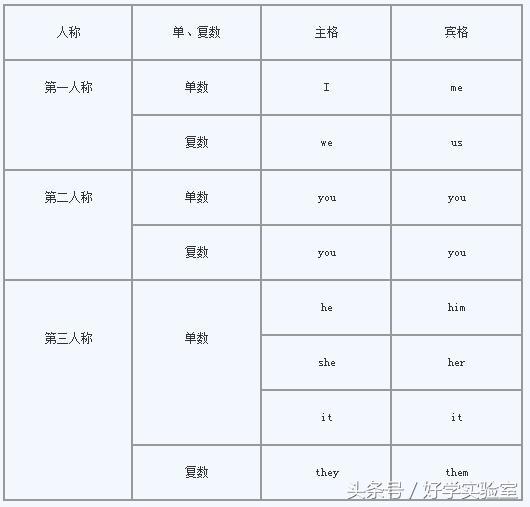
1)人称代词主格和宾格
2) 人称代词的用法
① 人称代词主格在句子中担任主语。
例如:She likes watching movies.她喜欢看电影。
They have been to America twice..他们到过美国两次。
② 人称代词宾格在句子中担任动词宾语、介词宾语或表语。
例如: We listen to them and they help us.我们听他们,他们帮我们。
---Who is knocking at the door? --It’s me.—谁在敲门?—是我。
2、 物主代词及其用法
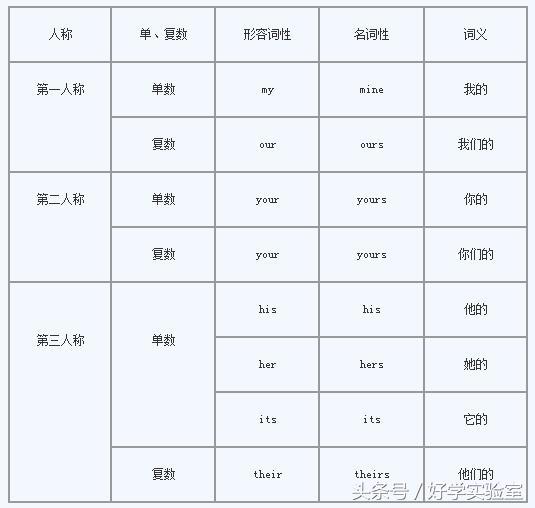
1)形容词性和名词性物主代词
2)物主代词的用法
① 形容词性物主代词相当于形容词,在句子中担任定语修饰名词,一般不单独使用。
例如:This is my book. Your book is over there.这是我的书。你的书在那里。
They are our new friends.他们是我们的新朋友。
②名词性物主代词语法上相当于名词,意义上相当于“形容词性物主代词+名词”,经常用其来避免和前面提到的名词重复。
例如:This is my dictionary. Where is yours (=your dictionary)?这是我的词典。你的(词典)在哪里?
My idea is just the same as his(=his idea).我的想法正如他的(想法)。
3、反身代词及其用法
1)反身代词的构成

[NextPage]
2)反身代词的用法
① 反身代词在句子中担任动词宾语或介词宾语。
例如:The boy is too young to look after himself.这男孩太小了无法照顾自己。
They did the job all by themselves.这件工作他们完全是自己做的。
② 反身代词常用词组
例如:teach oneself自学 learn by oneself自学 enjoy oneself玩得愉快
hurt oneself伤了自己 help oneself to自便 come to oneself苏醒
by oneself单独;亲自
4、 指示代词及其用法
1) 指示代词:单数this(这)、 that(那);复数these(这些), those(那些)
2) 指示代词的用法
① this/these用于指代近距离的人或事物。
例如:This is my friend and these are his new books.这是我的朋友。这些是
他的新书。
② that/those用于指代远距离的人或事物。
例如:Look!That girl in red is Kate.瞧!那个穿红衣服的女孩是凯特。
③ 打电话时用this介绍自己,用that询问对方。
例如:This is Mar speaking. Is that Mrs Jones?我是玛丽,您是琼斯夫人吗?
5、 不定代词及其用法
不定代词是比较复杂的一类代词,在词形上有简单的不定代词和复合不定代词两种形式,分别列表如下。
1) 表一:初中阶段常见的简单的不定代词
2) 不定代词的用法
在实际使用中,普通不定代词多数时候用作形容词修饰名词。
① some和any。两者均可修饰可数和不可数名词。一般情况下,some用于肯定句,any用于否定句、疑问句和条件句中。但在说话人想要得到肯定回答或表达请求、建议的疑问句中用some。
例如:There are some students in the classroom, but there aren’t any teachers.
教室里有一些学生,但没有老师。
---Would you like to have some tea or coffee? ---Neither, thanks.
--想要喝茶还是咖啡?--谢谢,两个都不要。
② many 和much。many修饰可数名词的复数形式,much修饰不可数名词。
两者均可以和表示程度的副词so,too,as,how连用构成too many/much, so many/much, as many/much as, how many/much.
例如:I have too much work to do.我有太多的工作要做。
How did you make so many mistakes?你怎么会犯这么多错误?
Please speak English as much as possible.请尽量说英语。
③ few, a few 和little, a little. few和a few修饰可数名词,little和a little修饰不可数名词。few,little表示否定,a few,a little表示肯定。
例如:He is a new student in the school, so he has few friends.他是本校的新生,所以几乎没有朋友(表示否定)。
I have so little money that I can’t afford the new magazine. Can you lend me some?我几乎没钱了,买不起这本杂志(表示否定)。你能借我一些吗?
---Can I have a few words with you, Mrs Brown? –Sure, I have a little time. –布朗夫人,我可以和你说几句话吗(表示肯定)?--当然可以,我有一点点时间(表示肯定)。
④ both和all。both只能用于指代两者,all指代三者或以上的人或物。
例如:My parents are both teachers. Both my brother and I are students. We all live in Changsha.我父母亲都是老师。我哥和我是学生。我们都生活在长沙。
⑤ either, neither和none。either只能是“两者中取其一”,neither是“两者都不”,是both的反义词,none“都不”是all的反义词。
例如:Either you or your sister has to help your dad in the garden.你或者你姐姐得帮助你爸爸在花园里干活。(只要一个人帮助爸爸干活即可)
---Would you like some milk or coffee? –Neither. Just water, please.—你想要牛奶还是咖啡?--都不要,水就可以。
They are all teenagers. None of them should be allowed to smoke.他们都是青少年,谁都不应该获许抽烟。
⑥ other, others, the other, the others.概括地说,不带the的为泛指,带the的为特指,带s的指代复数的人或物,不带s的指代单数的人或物。
例如:Beijing is larger than the other cities in China.北京比中国其他城市大。
Lei Feng was always ready to help others(=other people)。雷锋乐于助人。
I have only two good friends. One is Jack, the other is David.我只有两个好朋友,一个是杰克,另一个是大卫。
I bought six new books yesterday. One is English, the others(=the other books) are Chinese.我昨天买了六本书。一本是英语,其余的(书)都是中文。
⑦ one, another, one指代上文提到过的单数可数名词,避免重复。another指的是三者以
上中的任意一者,还可以表达“额外添加”的意思。
例如:This building is taller than that one.这个建筑比那栋高。
I have already spent half an hour on the job, but I need another ten minutes to finish it.
我已经花了半个小时做这件工作,但是我还要十分钟才能够完成。
⑧ 复合不定代词的句*功法**能可以参考some、any、no、every的用法。但下列几点必须。
[NextPage]
注意:
a)复合不定代词在句子中担任主语时,谓语动词要用单数形式。
例如:Is there anything wrong with the computer?电脑出问题了吗?
Everybody is here. Let’s begin the meeting.大家到齐了,我们开会吧。
b)修饰复合不定代词的形容词要放在他们的后面,做后置定语。
例如:Be quiet, please. I have something important to tell you.请安静,我有重要
的事情要告诉你们。
6、 疑问代词及其用法
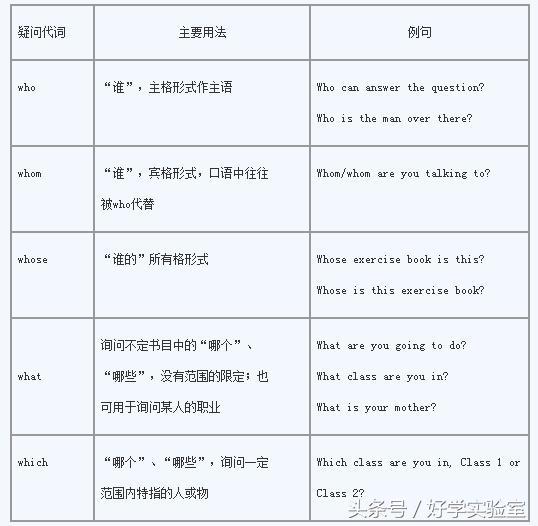
疑问代词在句中起名词词组的作用,用来构成疑问句。
形容词、副 词
一、形容词
1、 形容词概述
形容词修饰名词,说明事物或人的性质或特征。大部分形容词直接说明事物的性质或特征,有级的变化,可以用程度副词修饰,在句中可作定语、表语和补语。例如:hot 热的,beautiful美丽的。有的形容词只能作表语,没有级的变化,也不可用程度副词修饰。例如:afraid害怕的,asleep睡着的。
2、 形容词的用法
1)作定语修饰名词时,要放在名词的前面。但是如果形容词修饰以-thing为词尾的词语即复合不定代词时,要放在这些词之后。
例如:What an interesting movie it is! 多有趣的一部电影啊!
There is nothing interesting in today’s newspaper.今天的报纸没有什么有趣的内容。
2)作表语放在系动词后面。
例如:The food smells delicious. 食物闻起来很香。
3)位于宾语后做宾语补足语。
例如:You must keep your classroom clean and tidy.你们必须保持教室干净整洁。
4)少数形容词只能作表语,如:afraid, asleep, awake, alone, alive, well(健康的),ill,sorry,glad,sure,pleased等。
例如:He is alone in the classroom.他独自在教室。
She has been asleep for three hours.她睡了三个小时了。
5)某些形容词之前加上冠词the表示一类人,如 the rich, the poor, the young, the old, the deaf, the blind, the living, the dead, the hungry等。
例如:The rich should help the poor. 富人应该帮助穷人。
The young should be polite to the old.年轻人对老年人应该有礼貌。
二、副词
1、 副词概述
副词主要用来修饰动词,形容词,其他副词或句子。
2、 副词的分类和用法
1) 时间副词:如now,today,yesterday,soon等,在句子中担任时间状语,是决定动词时态的主要依据之一。
例如:There is going to be a class meeting tomorrow.明天将有一个班会。
They visited the aquarium yesterday. 他们昨天参观了水族馆。
2) 频度副词:如sometimes,often, always, usually等,在句子中担任时间状语,是决定动词时态的主要依据之一。
例如:They have never seen each other before.他们以前从未见过面。
What do you usually do on weekends?你们周末通常做什么?
3) 地点副词:如here, there, home, somewhere, anywhere,outside等,在句子中担任地点状语。
例如:I have looked for my pen everywhere, but I can’t find it anywhere.我到处找了我的钢笔,但哪儿都没看见。
4) 方式副词:如slowly, quickly, fast, luckily, easily等,在句子中担任方式状语。这类副词大都由“形容词+ly”构成。
例如:Please speak more slowly so that we can hear you clearly.请慢点说以便我们能够听清楚你说的内容。
5) 程度副词:如very, quite, rather, too, much, so等,在句子中修饰形容词或其他副词,作状语。
例如:It’s much too hot in Changsha these days.这些天长沙太热了。
The little boy can play the guitar very well.这小男孩吉他弹得非常好。
6) 疑问副词:如when, where, why, how, how long, how soon, how often, how far,how old等,放在句首构成特殊疑问句。
例如:How soon will your father be back home? 你爸过多久回到家?
How often do you go to the movie? 你们隔多久看一次电影?
7) 关系副词:如when, where, why, how等,用来引导相关从句。
例如:What were you doing when the UFO landed? UFO着陆时你在干什么?
I ‘d like to go somewhere where people are friendly. 我想去人们友好的地方。
3、副词的位置
总的来说,很多副词的位置比较灵活,在句子开头、中间、结尾都可以。但是请注意下面几点:
1)频度副词作状语时放在be动词、助动词、情态动词之后,行为动词之前。
例如:He is never late for school.他上学从不迟到。
He usually goes to see his grandparents on Saturday. 他通常周六去看望爷爷奶奶。
2)enough修饰形容词或副词时要放在被修饰词的后面。
例如:The little boy isn’t old enough to go to school. 小男孩没到上学的年龄。
He ran fast enough to catch the thief. 他跑得够快,抓住了小偷。
[NextPage]
三、形容词和副词的比较等级
1、 形容词和副词比较等级的构成
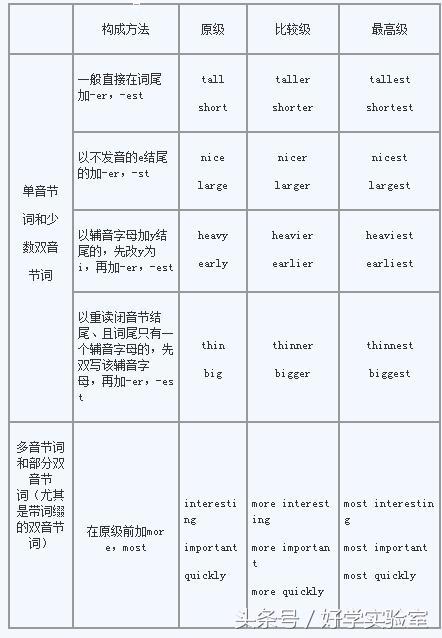
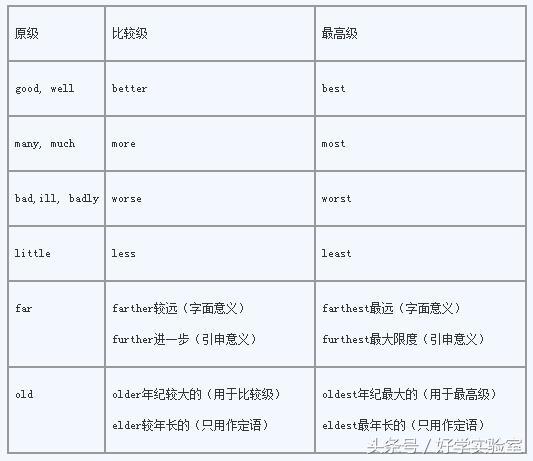
绝大多数形容词和副词有三个等级:原级(原形)、比较级和最高级,他们的构成规则大致相同。列表如下:
表一:规则变化
2、形容词、副词比较级和最高级的用法
1)两者之间进行比较用比较级。其常见句子结构为:A +谓语动词+比较级+than+B。
例如:This tree is taller than that one.这棵树比那棵树高。
Lily has more friends than I. 莉莉比我朋友多。
Tom runs faster than Jim. 汤姆比吉姆跑得快。
注:可以用程度副词a little, a lot, a bit, much, even, still, far等修饰比较级,表示比较的程度差异。
例如:It is much hotter in Changsha than that in Beijing in summer.长沙的夏天比北京的夏天热得多。
He studies English a lot harder than the other students in his class.他学英语比班上其他同学努力得多。
[NextPage]
2)在三者或三者以上的人或物之间进行比较时用最高级,形容词最高级前必须加定冠词the,副词最高级前the可加可不加,句子中常有in或of短语来表示比较的范围。其常见句子结构为:A+谓语动词+the+最高级+比较范围。
例如:Changjiang is the longest river in China.长江是中国最长的河流。
Rruce runs fastest of the three. 布鲁斯是三个人中跑得最快的。
3)表示A和B在某一方面相同或不及时用同级比较。其常见句型为:A+谓语动词+as+原级+as+B。其否定结构为:A+谓语动词(not)+as/so+原级+as+B。
例如:English is as important as Chinese.英语和语文一样重要。
Math is not as interesting as History. 数学不如历史有趣味。
He speaks English as well as Chinese. 他英语和汉语说得一样好。
She doesn’t do her homework as carefully as her brother.她做作业不如她哥哥细心。
4)选择疑问句比较级和最高级的句型分别为:“疑问词+谓语动词+比较级,A or B?”和“疑问词+谓语动词+最高级,A,B or C?”
例如:Which is bigger, the sun or the earth?太阳或地球,哪个更大?
Which is the biggest, the sun, the earth or the moon? 太阳、地球或月亮,哪个最大?
Who plays soccer better, David or Martin?戴维或马丁,谁足球踢得更好?
Who plays soccer best, David, Martin or Bill?戴维、马丁或比尔,谁足球踢得最好?
5)表示“越……就越……”时,其句型为“the +比较级,the+比较级”。
例如:The more trees, the better. 树木越多越好。
The harder you study, the better grades you will get. 学习越努力,成绩就越好。
6)表示“越来越……”时,用比较级的叠加形式,即:比较级+ and+比较级。
例如:It’s getting hotter and hotter. 天气越来越热了。
The city is becoming more and more beautiful. 城市越来越漂亮了。
动词
二、实义动词及用法
实义动词也叫行为动词,是四类动词中唯一能独立作谓语的一类动词。根据其句*功法**能可以分为及物动词和不及物动词两类。
1、及物动词
及物动词本身意义不够完整,需要后接宾语才能使其意思完整。
1)动词+宾语,构成主谓宾句型。
例如:Could you please clean the blackboard? 请你擦黑板好吗?
We learn English every day. 我们每天学习英语。
2)动词+直接宾语+to/for+间接宾语 / 动词+间接宾语+直接宾语,构成主谓双宾句型。有的动词必须在后面带表示人的间接宾语和表示物的直接宾语,即两个宾语才能表达完整的意思。
例如:Who teaches you English? 谁教你们英语?
Please pass me the book.= Please pass the book to me.请把那本书递给我。
My mother bought me a snow globe on my birthday.
= My mother bought a snow globe for me on my birthday.
我过生日时我妈买给我一个雪球。
常见的带双宾语的动词有:pass, give, bring, buy, get, leave, lend, make, cook, teach, tell, write, read, return, ask, show等。
3)动词+宾语+宾语补足语,构成主谓复宾句型。有的动词必须在宾语后再加上形容词、副词、名词、不定式、-ing形式、介词短语等做宾语补足语,构成复合宾语,句子意思才能够表达完整。
例如:Please keep the door open. 请让门开着。(形容词open做宾补)
I often see the children play in the park。我经常看见孩子们在公园里玩。(不带to的不定式play做宾补).
You can call me Mrs Jones.你们可以称呼我琼斯夫人。(名词Mrs Jones做宾补)
动词see, hear, watch, make, let, have, notice, find等经常以动词不定式或-ing形式做宾补。
2、不及物动词
1)不及物动词自身意思完整,无需再接宾语。
例如:Horses run fast。马儿跑得快。
He sings well. 他唱得好。
2)很多不及物动词也可以用作及物动词,还有的不及物动词后带上某个介词就成了带宾语的及物动词。
例如:They are reading. 他们在朗读。(read为不及物动词)
They are reading English. 他们在朗读英语。(read为及物动词)
He is waiting at the bus stop.他在公交车站等。(wait为不及物动词)
He is waiting for me at the bus stop.他在公交车站等我。(wait for为及物动词,带me做宾语)
三、连系动词
连系动词本身有词义,但不能单独作谓语,必须和其后面的表语一起构成合成谓语,说明主语的性质、特征、状态或身份。
常见的连系动词有be, become(变得、成为), get(变得), look(看起来),seem(似乎、好像),turn(变得),sound(听起来),smell(闻起来),taste(尝起来),feel(摸起来)等。除be以外的连系动词大多数时候是实义动词,他们用作连系动词时多数没有进行时态,也没有被动语态。
例如:He is angry.他生气了。
He got angry at the news.听到这个消息他生气了。
That sounds good.那听起来不错。
Trees turn green when spring comes.春天来临,树叶转绿。
China is getting stronger and stronger.中国正变得越来越强大。
四、助动词
助动词本身没有词义或意思不完整,不能单独作谓语。它们的主要作用是帮助构成时态、语态、疑问句或否定句等。
1、助动词be(am, is, are, was, were)
1) be+doing(现在分词), 构成进行时
例如:They are listening to music.他们在听音乐。(be的现在时形式帮助构成现在进行时)
They were walking down the street when the UFO landed.(be的过去时形式帮助构成过去进行时)
2)be+done(及物动词的过去分词), 构成被动语态
例如:The light bulb was invented by Thomas Edison.电灯泡是由托马斯.爱迪生发明的。(be的过去时形式帮助构成过去时的被动语态)
The classroom is cleaned every day.教室每天打扫。(be的现在时形式帮助构成现在时的被动语态)
The problem will be solved next week.这个问题将在下周得到解决。(be的将来时形式帮助构成将来时的被动语态)
2、have (has, had)
1)have/has/had+done(动词的过去分词),构成完成时态。
例如:They have already done their homework.他们已经完成作业。(have+过去分词构成现在完成时)
He hasn’t come yet.他还没有回来。(has+过去分词构成现在完成时)
The bus had gone when I got to the bus stop.我到达车站时公交车已经离开。(had+过去分词构成过去完成时)
2)have/has/had+been+doing(动词的现在分词),构成完成进行时态。
例如:How long have you been collecting shells?你收集贝壳有多长时间了?
He has been studying English since five years ago.他从5年前开始就一直在学习英语。
[NextPage]
3、助动词do/ does/ did
助动词do/ does/ did主要帮助构成疑问句,也可用于倒装句、强调句或代替上文提到过的行为等。他们的否定式don’t/ doesn’t/ didn’t帮助构成否定句。
例如:Does he often play sports after school?他经常放学后做运动吗?
We don’t speak Japanese.我们不说日语。
Did they visit the Palace Museum on their last day off?他们上个休息日参观故宫了吗?
She didn’t watch TV yesterday evening.她昨晚上没看电视。
4、助动词will, shall, would, should
助动词will, shall主要用于构成一般将来时,其中will可用于各人称,而shall一般只用于第一人称。would,should是will,shall的过去式,可以用于构成过去将来时,但很多时候被用作情态动词。
例如:There will be more trees and less pollution in the future.将来会有更多的树木,更少的污染。(帮助构成一般将来时)
Shall we go to the park on the weekend?我们周末去公园好吗?(一般将来时,用于提出建议)
They said they would come the next day.他们说他们第二天来。(帮助构成过去将来时)
Would you mind my turning down the radio?你介意我关小收音机吗?(用于礼貌地提出建议)
You should lie down and rest. 你应该躺下休息。(用于提供建议)
5、情态动词can, may, must, might, could等
情态动词具有一定的词义,用以表达说话人的态度或情感,必须和后面的实义动词一起构成合成谓语。(请详见专题七 情态动词)
情态动词、系动词
在英语中,表示主语动作或状态的词就叫做动词。根据动词的意义及在句子中的作用,可将动词分为实义动词(v)、系动词(link-v)、情态动词(modal verb)和助动词(v. aux)四种类型。
下面我们就来看看情态动词和系动词的具体用法。
一、情态动词
情态动词本身有一定的意义,但不能独立作谓语,要和动词原形一起构成谓语,表说话人的语气和态度。它没有人称和数的变化。常见的情态动词有:
1. can表示能力,有“能”“会”的意思;表示可能性,多用在否定或疑问句中;表示请求和许可。
如:The parrot can speak three languages. 这只鹦鹉能讲三种语言。
Can I borrow the book from the library?我可以从图书棺借这本书吗?
Shanghai can be very cold in March. 上海三月份可能会很冷。
拓展延伸can还有过去式could 可表“能,会”,又可以和be able to替换,而be able to有 更多时态。 如:
He could swim when he was four. =He was able to swim when he was four. 他四岁时就会游泳。 在一般疑问句中,can/could 常用来表示请求或征求对方意见,用could 比用can语气更加委婉和客气。类似用法的还有Will /Would you (please)…等句型。
如:Could you tell me how I can get to the post office? 你能告诉我怎样到邮局吗? Would you please turn up the radio?请你把收音机开大点,好吗?
2.may表示“许可”时,相当于can,其否定回答用can’t/mustn’t;表推测时,常用在肯定句中,表“可能”。
如:-May I borrow your ruler?我可以借用您的直尺吗?
-No, you can’t /mustn’t. 不行。
She may be a teacher. 她可能是一名教师。
拓展延伸may可表示祝愿。如: May you succeed! 祝你成功!
3.must表示“必须;必要”,以“must”开头的一般疑问句其肯定回答用“must”,否定回答用“needn’t”或“don’t have to”。 must表推测时,常用在肯定句中,是“一定”的意思,其否定形式mustn ’ t表“禁止”的意思。
如:-Must I leave now?现在我必须离开吗?
-No,you needn’t /you don’t have to. 没有必要。
This book must be Lucy’s . Look! Her name is on the book cover. 这本书是露西的。看!封面上还有她的名字。
You mustn’t draw on the wall. 你不准在墙上画画。
拓展延伸must表示说话人的主观看法,只有一般现在时;have to强调客观要求,有时态、人称和数的变化。如: My mother is ill. I have to look after her now. 妈妈病了,我得去照看她。
4.need作情态动词时,常用在否定和疑问句中,表示“需要;要”的意思。
如:Need we finish the work now?现在我们需要完成这项工作吗?
They needn ’ t look after him. 他们不需要照顾他了。
拓展延伸need还可以用作行为动词,可以用于各种句型。如:
Does he need any help? 他需要帮助吗?
The desk needs repairing. 这张桌子需要修理。
5.shall 用于第一人称,表示说话人征求对方意见,过去式为should;will 用手第二人称的疑问句中,表示说话人向对方提出请求和建议,过去式为would。
如:Shall I go shopping with you?’我可以同你去购物吗?
I don’t know what I should do next. 我不知道下一步该干什么。
Would you please come a little earlier?请你来早一点好吗?
6.情态动词had better的用法
(1)had better 后接动词原形,表劝告、建议,意为“最好”。“You’d better… ”含有强制命令的语气,对长辈不宜使用。
如:You’d better ask that policeman over there. 你最好问一下那边的那个警察。
(2)慎用had better! 注意以下四条:
①had better表达的是说话者强硬性的建议,告诫别人(包括自己)如何做。 如:Granny, the hospital is not very near. We’d better catch a bus. 奶奶,医院不是很近。我们最好坐公共汽车。
②had better不用于礼貌的请求或征询,它隐含一种警告或威胁。 如:You ’ d better finish the work today and bring it tomorrow. 你最好今天就把作业完成,明天带来。
③had better意思接近should,但它除了表示语气强硬以外,还表示马上要去做的事情,比should更紧迫。 如:You’d better see a doctor at once. 你最好马上去看医生。
④had better不含比较的意思,该结构表示“It would be good to… ”,而不是“It would be better to…”。
二、系动词
系动词有实际意义,但不能单独做谓语,必须与表语一起构成句子的谓语,说明主语的性质、状态或身份等。 它分为完全系动词和不完全系动词。
1.完全系动词(be)可接名词、代词、形容词、副词、介词短语、非谓语动词短语、句子做表语。如: I’m a student. 我是个学生。(名词) He is fine. 他很好。(形容词) It is me. 是我。(代词) Are you there?你在那儿吗?(副词) She is at school. 她在学校读书。(介词短语) He is to come soon. 他过会儿该来了。(不定式) My job is teaching English. 我的工作是教英语。(动词的ing形式) My idea is that we will start now. 我的想法是我们现在就开始。(句子)
2.不完全系动词 (get,turn,feel,smell,look,sound,taste)一般只接形容词做表语。如:When spring comes, it gets warmer and warmer.
春天来了,天气变得越来越暖和了。 Food may go bad soon if it is not put into a fridge.
食物如果不放进冰箱里就会很快变坏。 My brother became / turned a teacher after his graduation.
我哥哥毕业后就当上了老师。(注意become和turn的用法区别)
被动语态
动词语态分为两大类:主动语态和被动语态。 主动语态:主语是动作的执行者。 被动语态:主语是动作的承受者。动作的执行者由by连接的短语表示,常译为“被、由”。
对于英语的被动语态,我们可以以下五个方面来掌握。
一、主语与谓语动词的逻辑关系 被动语态表示句子的主语是谓语动词动作的承受者或对象。 如:Computers are widely used in our work and daily life. 电脑在我们的工作和日常生活中广泛应用。(computers就是use的对象或承受者)
二、表示被动语态的形式 (1)基本形式:主语 + be + vt.的过去分词 + (by + sb.) This song is often sung by children at school. 这首歌经常在学校被孩子们唱。
常见被动语态的时态:
①一般现在时:am/is/are+ vt.的过去分词;
②一般过去时:was / were + vt.的过去分词;
③一般将来时:will / shall / be going to + be + vt.的过去分词;
④现在完成时:have / has + been + vt.的过去分词;
⑤过去完成时:had + been + vt.的过去分词;
⑥现在进行时:am/is/are + being + vt.的过去分词;
⑦过去进行时:was / were + being + vt.的过去分词
⑧过去将来时:would + be + vt.的过去分词
注意:被动语态不用于将来进行时及完成进行时。
(2)其他形式: (选学)
①主语 + be + vt. 的过去分词 + (by +. sb.)+宾语/ 介词 + 宾语
A. 主语 + be + vt. 的过去分词 + (by + sb.)+ 宾语/to +宾语 I was shown his gold medal there. 在那里他给我看了他的金牌。 His gold medal was shown to me. 他的金牌给我看了。 能用于这一句型的常见动词有bring,give,hand,lend,offer,pass,post,send,show,teach,tell,throw,write等。
B. 主语 + be + vt. 的过去分词 + (by + sb.)+ 宾语 /for +宾语 I was bought a new dictionary (by my father). 我父亲给我买了一本新字典。 A new dictionary was bought for me (by my father). 我父亲给我买了一本新字典。 能用于这一句型的常见动词有buy,call,cook,do,get,make,save等。
②主语 + be + vt. 的过去分词 + (by + sb.)+ 主语的补足语 Jim was made chairman at the meeting. Jim在会上被推选为主席。 Li Lei was seen to break the glass this moming. 李雷今天上午被人看到打碎了那块玻璃。 能用于这一句型的常见动词有feel,hear,make,observe,see,watch等。特别注意的是,在主动语态中,不定式做宾语的补足语,不定式前面的小品词to必须省略,而在被动语态中,不定式做主语的补足语,不定式的小品词to必须补上。
③主语 +情态动词(can/could/may/might/must/should/ought to)+ be + 动词的过去分词 + (by + sb.) Water can be turned into ice. 水能转变成冰。 Your essay should be rewritten again. 你的论文应该还重新修改一遍。
④主语 +be + 短语动词的过去分词 + (by + sb.) His words should be paid much attention to. 应该多注意他的话。 The children in China are taken good care of now. 现在中国的孩子被照料得很好。 注意:动词后面的介词或副词不能省略。
⑤形式主语(It) +be + vt.的过去分词 +主语从句 It is reported that our team has won the game again. 据报道,我们队又赢了比赛。 能用于这一句型的常见动词有believe,expect,know,report,say,suppose,think等。这一句型也可变为: 主语 + be + vt. 的过去分词+不定式短语 The Mars is believed to have no life on it. 火星被确认无生命迹象。 Our team is reported to have won the game again. 据报道,我们队又赢了比赛。
三、被动语态的用法
被动语态往往表示一种客观的事实,有时语气比较生硬,没有商量的余地,从而令人难以接受,因此,切不可随便使用。在能用主动语态表示时,尽量使用主动语态,只有在下面的情况中才使用被动语态。
①说不出动作的执行者或没有必要说出动作的执行者; 如:The classroom had been cleaned when I got there.
当我到达教室的时候,教室已经被人打扫过了。
(教室究竟是谁打扫的,说话者并不知道)
②为了突出或强调动作的承受者或对象;如:Homework must be finished before school is over.
作业必须在放学之前做完。(强调 Homework)
③为了修辞的需要,使句子间的联系更紧密。如: I have a new motorbike. It was given to me by my father yesterday as my birthday present. 我有一台新摩托车。它是昨天我父亲买给我作为生日礼物的。(显然,It指代 the new bike就与上文的a new motorbike紧密相连)
四、不能使用被动语态的情况
(1)不及物动词没有被动形式。特别要注意汉语中带名词或代词做宾语的动词,如belong,die,happen,occur,take place等不及物动词。 如:A terrible traffic accident happened on the road yesterday. (昨天在公路上发生了一起可怕的交通事故。)就不能改写为:A terrible traffic accident is happened on the road yesterday.
(2)一些静态的及物动词也不能用于被动语态。如agree with,fit,have,hold,own,suit等。 如:I don’t agree with Jack. (我不同意Jack的观点。)就不能改写为:Jack isn ’ t agreed with.
五、主动形式表被动意义如:The pen writes well. 这支笔很好写。 The food tastes good. 这些食物尝起来味道很好。
His house is comfortable to live in. 他的房子住起来很舒服。
(m.zxxk.com转载并发布)