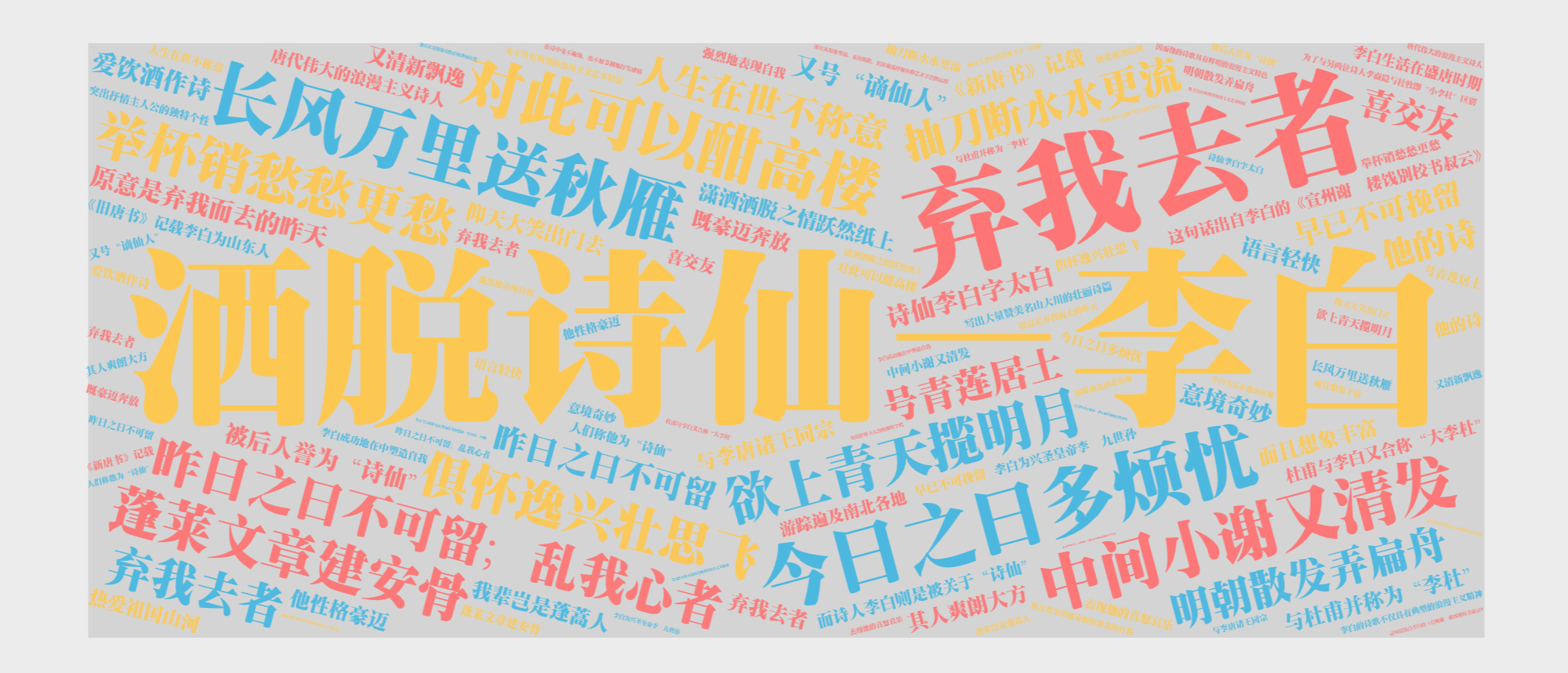
洒脱诗仙
—李白
Free and easy poetry fairy
—Li Bai
弃我去者,昨日之日不可留;乱我心者,今日之日多烦忧。长风万里送秋雁,对此可以酣高楼。蓬莱文章建安骨,中间小谢又清发。俱怀逸兴壮思飞,欲上青天揽明月。抽刀断水水更流,举杯销愁愁更愁。人生在世不称意,明朝散发弄扁舟。
Whoever abandons me shall not stay on the day of yesterday;
Those who disturb my heart, today are so troubled.
The long wind sends Qiuyan for thousands of miles, and you can enjoy high-rise buildings.
Penglai's article builds the bones, and Xiao Xie clears his hair in the middle.
All of them are eager to fly, and want to go up to the blue sky to embrace the bright moon.
Draw a knife and cut off the water, the water will flow more, and the toasting will be more worrying.
Life is unsatisfactory in this world, and the Ming Dynasty distributed a flat boat.
宣州谢朓楼饯别校书叔云
洒脱
弃我去者,昨日之日不可留
Those who abandon me shall not stay in the day of yesterday
这句话出自李白的《宣州谢朓楼饯别校书叔云》,原意是弃我而去的昨天,早已不可挽留。潇洒洒脱之情跃然纸上,而诗人李白则是被关于“诗仙”,诗仙李白字太白,号青莲居士,又号“谪仙人”,唐代伟大的浪漫主义诗人,被后人誉为“诗仙”,与杜甫并称为“李杜”,为了与另两位诗人李商隐与杜牧即“小李杜”区别,杜甫与李白又合称“大李杜”。《旧唐书》记载李白为山东人,《新唐书》记载,李白为兴圣皇帝李暠九世孙,与李唐诸王同宗。其人爽朗大方,爱饮酒作诗,喜交友。
This sentence comes from Li Bai's "Xie Tulou, Xuanzhou, Farewell to the School Book Shuyun", the original intention was to abandon me yesterday, and it has long been irresistible. The unrestrained and unrestrained feelings are vivid on the paper, and the poet Li Bai is referred to as the "Poetry Fairy", the poet Li Bai's character is Taibai, the name is Qinglian layman, also known as the "exiled fairy", a great romantic poet in the Tang Dynasty, and was praised by later generations. It is called "Poem Immortal", and Du Fu is also called "Li Du". In order to distinguish it from the other two poets Li Shangyin and Du Mu, namely "Little Li Du", Du Fu and Li Bai are also collectively called "Big Li Du". The "Old Tang Book" records that Li Bai is from Shandong, and the "New Tang Book" records that Li Bai is the ninth descendant of the Xingsheng Emperor Li Hao, who shares the same clan with the Li and Tang kings. He is cheerful and generous, loves to drink and write poetry, and likes to make friends.

豪迈
仰天大笑出门去,我辈岂是蓬蒿人。
Looking up to the sky, laughing and going out, how can I be a Penghao people?
李白生活在盛唐时期,他性格豪迈,热爱祖国山河,游踪遍及南北各地,写出大量赞美名山大川的壮丽诗篇。他的诗,既豪迈奔放,又清新飘逸,而且想象丰富,意境奇妙,语言轻快,人们称他为“诗仙”。李白的诗歌不仅具有典型的浪漫主义精神,而且从形象塑造、素材摄取、到体裁选择和各种艺术手法的运用,无不具有典型的浪漫主义艺术特征。李白成功地在中塑造自我,强烈地表现自我,突出抒情主人公的独特个性,因而他的诗歌具有鲜明的浪漫主义特色。他喜欢采用雄奇的形象表现自我,在诗中毫不掩饰、也不加节制地抒发感情,表现他的喜怒哀乐。
Li Bai lived in the prosperous Tang Dynasty. He had a heroic personality and loved the mountains and rivers of the motherland. He traveled all over the north and south, and wrote a lot of magnificent poems praising famous mountains and rivers. His poems are bold and unrestrained, fresh and elegant, and rich in imagination, wonderful in artistic conception, and brisk in language. People call him "Poem Immortal". Li Bai's poems not only have the typical romantic spirit, but also have typical romantic artistic features from image shaping, material acquisition, genre selection and application of various artistic techniques. Li Bai succeeds in shaping himself, expressing himself strongly, and highlighting the unique personality of the lyrical protagonist, so his poems have distinct romantic characteristics. He likes to express himself in a majestic image, expressing his emotions without concealment or restraint in his poems, expressing his emotions.
参考资料:文字:百度;图片:百度;翻译:谷歌翻译
本文由LearningYard新学苑原创,部分图片文字来自网络,如有侵权请联系。