
吉林大学食品科学与工程学院张铁华教授团队在食品国际Top期刊Food Chemistry上发表姜黄素包埋研究论文“Formation, stability and in vitro digestion of curcumin loaded whey protein/ hyaluronic acid nanoparticles: Ethanol desolvation vs. pH-shifting method”。
摘要:
采用乙醇脱溶法(DNP)或pH转换法(PSNP)将姜黄素(CUR)封装在pH值为5.4、4.4、3.4和2.4的乳清蛋白分离物/透明质酸(WPI/HA)静电纳米粒子中。对所制备的纳米颗粒的理化性质、结构、稳定性和体外消化进行了描述和比较。与DNPs相比,PSNPs的颗粒尺寸更小,分布更均匀,封装效率更高。制造纳米颗粒的主要驱动力是静电力、疏水力和氢键。PSNP对盐、热处理和长期储存表现出更好的抗性,而DNPs对CUR的热降解和光降解表现出更强的保护。纳米颗粒的稳定性随着pH值的降低而增加。体外模拟消化显示,DNPs在SGF中的CUR释放率更低,其消化产物的抗氧化活性更高。在构建基于蛋白质/多糖静电复合物的纳米颗粒时,数据结果可以为选择装载方法提供全面的参考。
研究结果:
1. 颗粒大小、Zeta电位、封装效率(EE)和表面疏水性
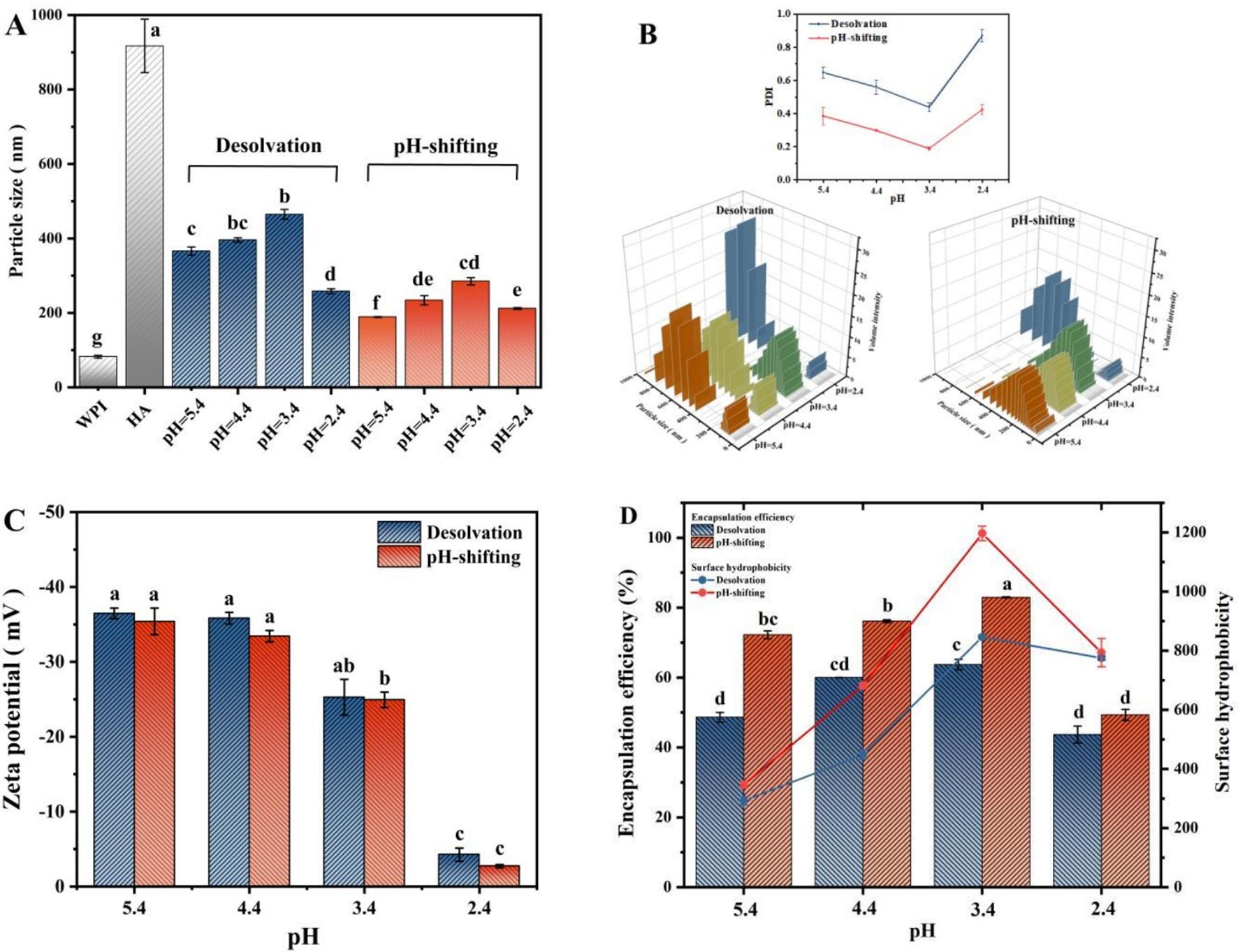
Fig. 1. Particle size (A), particle size distribution by volume and particle distribution index (PDI) (B), zeta potential (C) of CUR-loaded WPI/HA nanoparticles formed with different methods and pH values. Encapsulation efficiency of CUR-loaded WPI/HA nanoparticles and the maximum ANS fluorescence intensity of WPI/HA nanoparticles shell formed with different methods and pH values (D). Note: Columns marked with different letters denote significant difference at P < 0.05.
2. 形态学观察
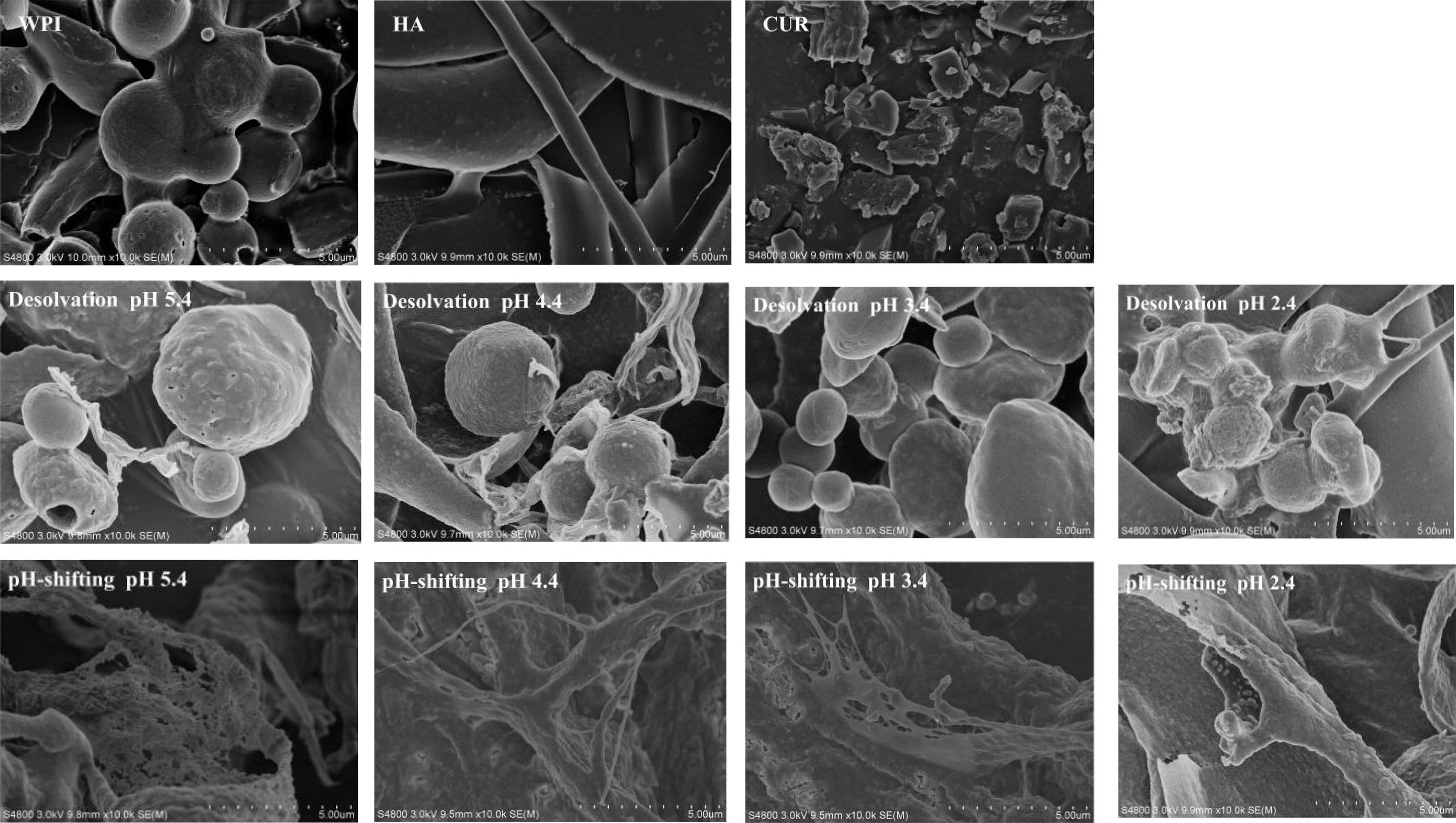
Fig. 2. SEM micrographs of freeze-dried powdered WPI, HA, CUR, and CUR-loaded WPI/HA nanoparticles formed with different methods and pH values.
3. 荧光光谱、远紫外圆二色(CD)光谱、红外光谱和XRD分析

Fig. 3. Fluorescence spectra of pure CUR, HA, WPI and CUR-loaded WPI/HA nanoparticles formed with different methods and pH values (A), CD spectra of WPI/HA nanoparticles shell formed with different methods and pH values (B), FTIR (C) and XRD (D) spectra of pure CUR, HA, WPI and CUR-loaded WPI/HA nanoparticles formed with different methods and pH values.
4. 稳定性评价:离子稳定性、储藏稳定性、热稳定性、光稳定性
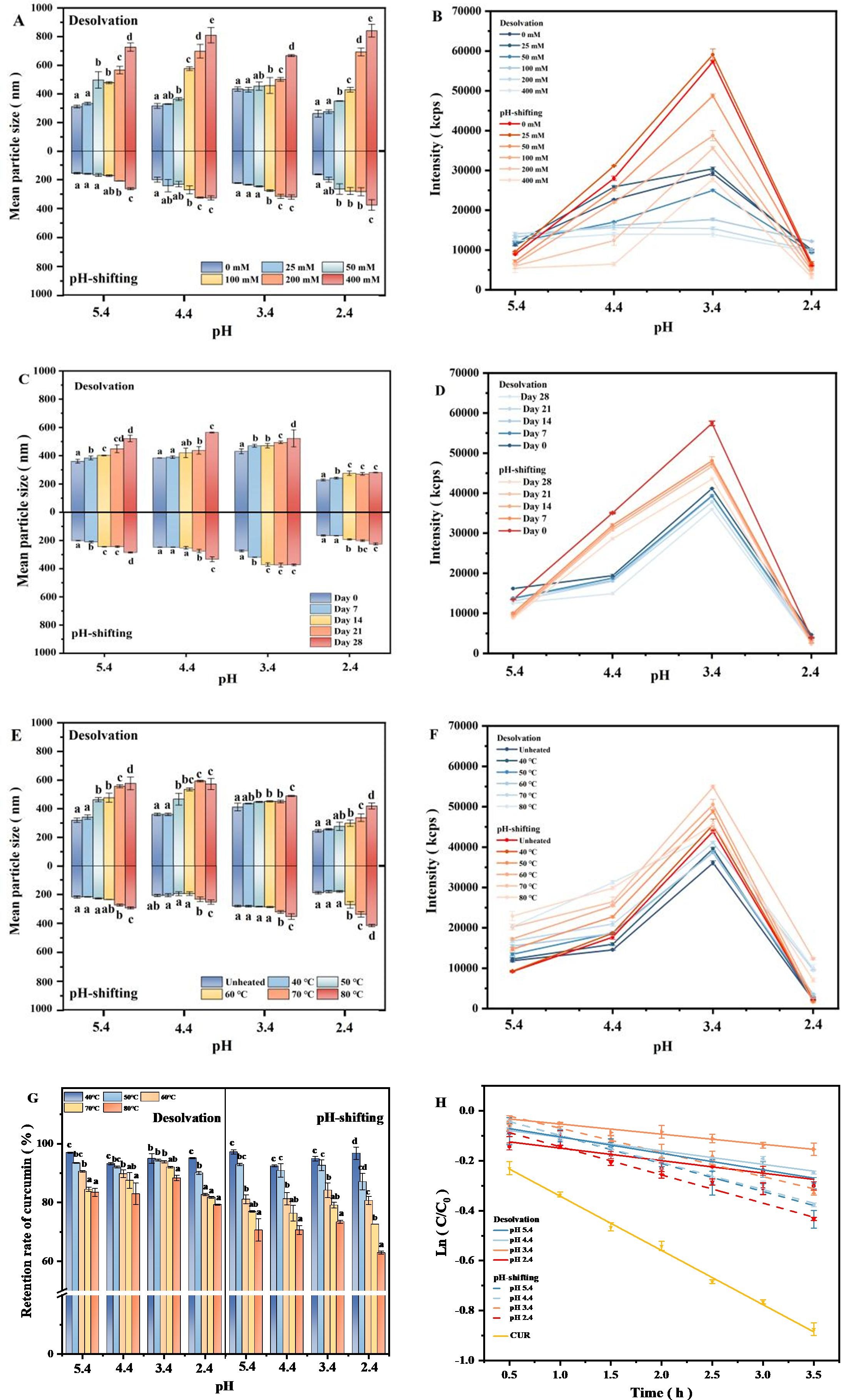
Fig. 4. Stability of nanoparticles formed at different methods and pH values. Salt stability (A and B); changes in particle size and scattered light intensity over 4 weeks at 4 °C (C and D). Changes in particle size, scattered light intensity and CUR’s retention rate of WPI/HA nanoparticles after heating at 40–80 °C for 30 min (E, F and G). Degradation curve of CUR under UV light irradiation (H). Note: Columns marked with different letters denote significant difference at P < 0.05.
5. 纳米颗粒的释放行为:释放CUR、消化产物的抗氧化能力
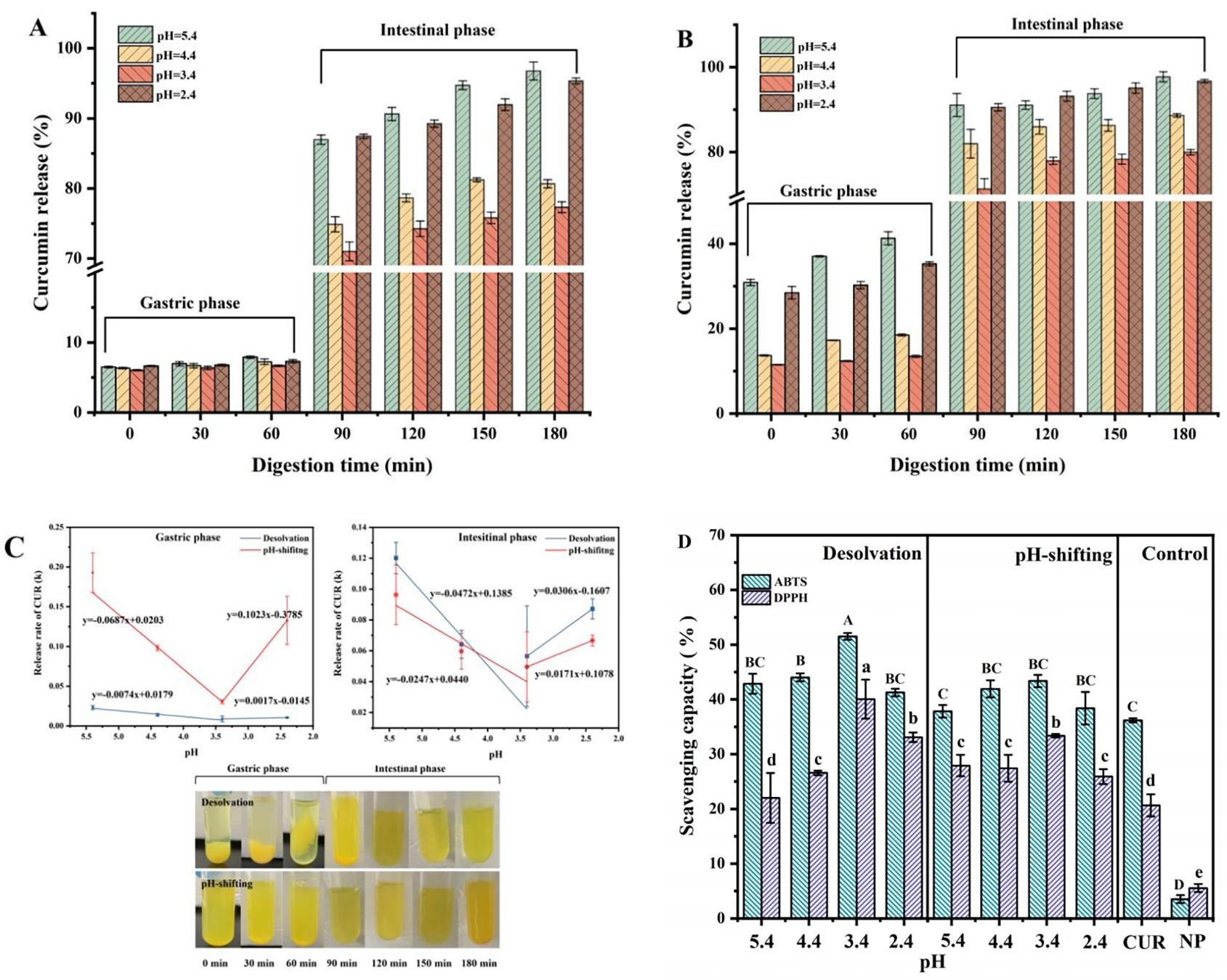
Fig. 5. Released profiles of CUR from WPI/HA nanoparticles during in vitro simulated gastrointestinal conditions (A for DNP and B for PSNP). pH-dependent curves of CUR release rate and appearance of nanoparticles at pH 3.4 using both methods in different digestion phases (C). DPPH and ABTS scavenging capacity of gastrointestinal digestive products of CUR-loaded WPI/HA nanoparticles, free CUR and WPI/HA shell was used as control (D). Note: Columns marked with different letters denote significant difference at P < 0.05.
结论:
在不同的pH值下,通过乙醇脱溶法或pH值转换法制造了含有CUR的WPI/HA纳米粒子。数据表明,纳米颗粒的理化性质、稳定性和体外消化行为都取决于制造方法和纳米颗粒悬浮液的最终pH值。一般来说,PSNPs的颗粒小,封装了更多的CUR,物理稳定性更好,而DNPs对CUR的热降解和光降解有更好的保护。DNPs控制CUR的释放更慢。WPI和HA之间的强静电相互作用导致了纳米颗粒更高的稳定性和控制释放性能。这项研究可以为选择具有有效封装、保护和输送疏水性物质的装载方法提供全面的参考,在不同的应用场合。然而,随后的研究应着重于比较两种纳米颗粒在体内条件下的释放特性和代谢方面的差异,以评估其商业应用的潜力。
原文链接:
https://doi.org/10.1016/j.foodchem.2023.135684