分享兴趣,传播快乐,
增长见闻,留下美好。
亲爱的您,
这里是LearingYard学苑!
今天小编为大家带来知识打卡(一百二十四)
欢迎您的用心访问!
本期推文阅读时长大约8分钟,请您耐心阅读。
Share interest, spread happiness,
increase knowledge, and leave beautiful.
Dear you,
this is the LearingYard Academy!
Today, the editor brings you knowledge punch cards (124)
Welcome your visit!
This tweet usually takes about 8minutes to read. Please be patient and read.
内容提要
前面几期的硕博论文学习,我们对博士论文《多渠道供应链定价及协调策略研究》进行了学习,对各章节进行了阅读,本期我们对这篇文章进行整体的梳理,进行一下学习总结。
In the previous several master's and doctoral papers, we have studied the master's thesis "Research on Pricing and Coordination Strategy of Multi-Channel Supply Chain" and read each chapter. In this period, we will sort out the whole article and make a summary of the study.
本期内容将从思维导图、精读内容和知识补充三部分展开。
In this issue, we will start with three parts: mind map, intensive reading content and knowledge supplement.
思维导图

精读内容
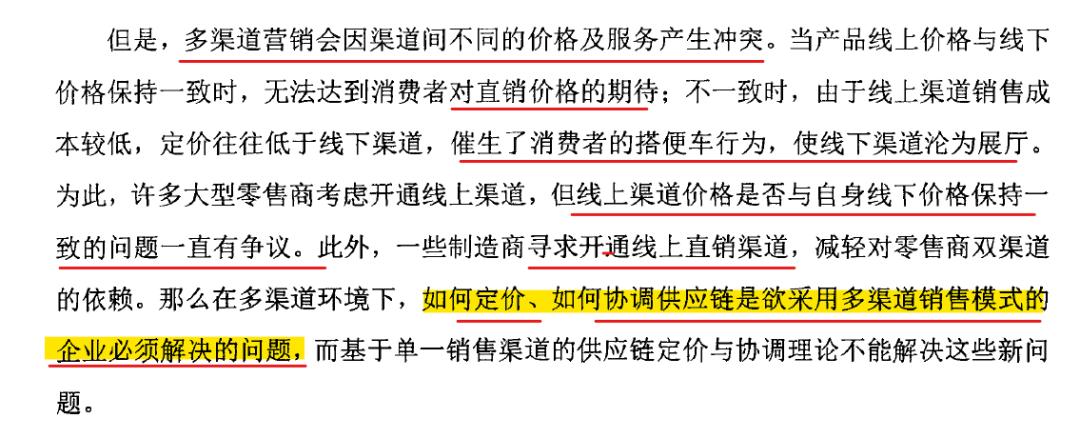
解决的问题:这篇文基于现实生活中制造商将产品卖给零售商的同时,有开通线上直销渠道,可以看作就是现在所说的厂家直销的这种形式。同时又考虑道零售商不止线下销售渠道的情况。在这样的现实背景中,研究企业该如何去确定线下线下的销售价格?是否需要保持线上线下价格一致?零售商、制造商有必要开通线上销售渠道吗?制造商和零售商改如何合作,提高供应链的效率?
Problems solved: This article is based on the fact that when manufacturers sell their products to retailers in real life, they open online direct selling channels, which can be regarded as the form of manufacturer direct selling now. At the same time, we also consider the situation that Dao retailers have more than offline sales channels. In such a realistic background, how should research enterprises determine the offline sales price? Do you need to keep online and offline prices in line? Do retailers need to open online sales channels? How can manufacturers and retailers work together to improve supply chain efficiency?
解决思路和方法:作者针对上述问题,进行了六个方面的研究。
To solve these problems, the author has carried out six researches.
一是多渠道供应链批发价格制定策略。这章节引入零售价所形成的参照价格效应和零售商议价能力,建立需求函数,构建利润目标函数,分别从制造商单独定价、以零售价格为基准,以线上直销价格为基准三种情况探讨制造商对产品批发价格的制定。
First, multi-channel supply chain wholesale price formulation strategy. This chapter introduces the reference price effect formed by the retail price and the bargaining power of retailers, establishes the demand function and the profit objective function, and discusses the manufacturer's determination of the wholesale price of products from three aspects: the manufacturer's independent pricing, the retail price as the benchmark, and the online direct selling price as the benchmark.
二是双渠道环境下基于制造商渠道选择的定价及协调策略。这一问题则是基于零售商有线上销售渠道,考,研究制造商开通线上直销渠道的问题。作者从制造商开通和制造商不开通,以及制造商主导和零售商主导角度分别进行研究,通过构建需求函数和利润目标函数,采用逆向归纳算法进行求导。
The second is the pricing and coordination strategy based on the manufacturer's channel selection in the dual-channel environment. This problem is based on the retailers' online sales channels, research manufacturers open online direct sales channels. The author studies from the perspective of manufacturer opening and manufacturer non-opening, manufacturer leading and retailer leading respectively. By constructing demand function and profit objective function, backward induction algorithm is used for derivation.
三是双渠道环境下基于零售商渠道选择的定价策略。这一章研究的内容和第二个问题是相似的,探讨了制造商有线上渠道后,零售商是否需要开设线上渠道。
The third is the pricing strategy based on retailer's channel selection under the dual-channel environment. The content of this chapter is similar to the second question, which explores whether retailers need to open online channels after manufacturers' online channels.
四是基于多渠道供应链博弈的线上价格策略。这里作者考虑了制造商开通线上直销渠道,零售商有线下销售渠道也有线上,研究线上线下价格是否需要保持一致。
The fourth is the online price strategy based on multi-channel supply chain game. Here, the author considers that manufacturers open online direct sales channels and retailers have offline sales channels as well as online sales channels to study whether online and offline prices need to be consistent.
五是制造商统一定价下多渠道供应链促销及协调策略。在这里,作者以制造商统一定价为前提,促销成本分担-滞销补贴契约,研究供应链协调,以及零售商议价能力和产品价格对契约参数的影响。
Fifth, the multi-channel supply chain promotion and coordination strategy under unified pricing by manufacturers. Here, the author studies the coordination of supply chain and the influence of retailers' bargaining power and product price on contract parameters, based on the premise of unified pricing by manufacturers, promotion cost sharing - slow selling subsidy contract.
从上述五个问题来看,作者以多渠道供应链定价及协调策略研究为题目,将题目细化,然后研究了五个方面的问题,得到各自的一个结论。这种将问题细化,聚焦在更具体的方面,可以让研究更深入。
From the above five issues, the author takes the research on pricing and coordination strategy of multi-channel supply chain as the topic, divides the topic into details, and then studies the five aspects of the problem, to get a conclusion. This kind of elaboration of the problem, focusing on more specific aspects, can make the research more in-depth.
在模型构建方面,一是要推导出各渠道的需求函数,文章中考虑了各渠道价格差异对需求的影响(需求交叉价格弹性系数),以及促销努力水平的影响。二是基于需求函数构建目标函数(各参与主体的利润函数)。最后采用逆向归纳算法求解。
In terms of model construction, the first is to deduce the demand function of each channel. In this paper, the influence of price difference of each channel on demand (cross-price elasticity coefficient of demand) and the influence of promotion effort level are considered. Second, construct the objective function (profit function of each participant) based on the demand function. Finally, backward induction algorithm is used to solve the problem.
知识补充
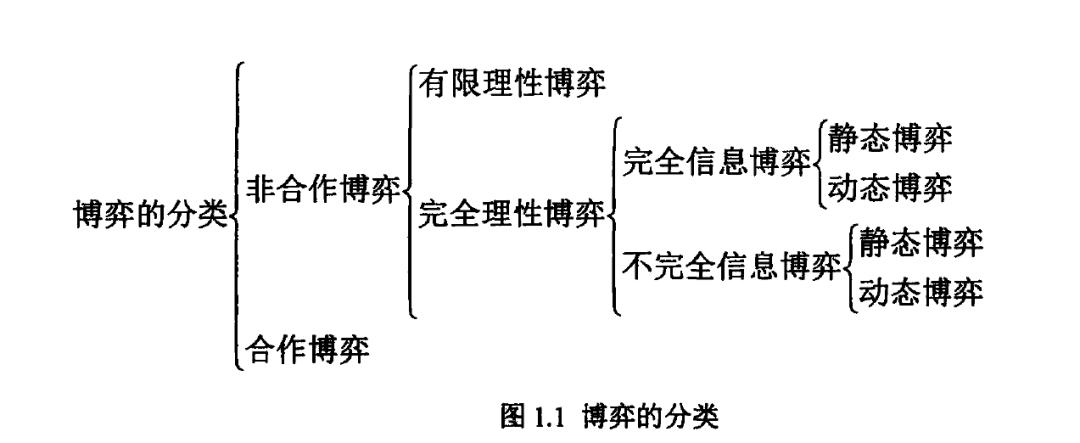
文章中采用到了博弈理论,关于博弈,我们先来看看存在哪些博弈类型。首先,博弈分为合作博弈和非合作博弈。文章中讨论的集中决策可以归于合作博弈,其余为非合作博弈。现实中,大多都为非合作博弈,各自决策,希望能获得更多的利益。
Game theory is used in this article, so let's first look at what kinds of games exist. First, the game is divided into cooperative game and non-cooperative game. The centralized decisions discussed in this paper can be attributed to cooperative games, and the rest are non-cooperative games. In reality, most of them are non-cooperative games, making their own decisions in the hope of gaining more benefits.


在非合作博弈中,又可以继续划分为完全理性博弈和有限理性博弈。目前我们一般假设为完全理性博弈,即博弈参与者的行为是完全理性的。在完全理性博弈中,可以分为完全信息博弈和不完全信息博弈。
In the non-cooperative game, it can be further divided into completely rational game and bounded rational game. At present, we generally assume a perfectly rational game, that is, the behavior of the players in the game is perfectly rational. In the completely rational game, it can be divided into complete information game and incomplete information game.

除此之外,还以分为静态博弈和动态博弈。我们常用的斯坦伯格博弈就是完美且完全信息动态博弈。
In addition, also divided into static game and dynamic game. The Steinberg game we often use is the perfect and complete information dynamic game.

今天的分享就到这里了。
如果您对今天的文章有独特的想法,
欢迎给我们留言,
让我们相约明天,
祝您今天过得开心快乐!
That's it for today's sharing.
If you have a unique idea about today’s article,
welcome to leave us a message,
Let us meet tomorrow.
Have a nice day!
参考资料:谷歌翻译、百度百科;
参考文献:
[1]刘昊. 多渠道供应链定价及协调策略研究[D].大连海事大学,2018 .
本文由LearningYard学苑整理并发出,如有侵权请在后台留言!