声明:2016年7月开始,中国新经济指数报告由万事达卡冠名,指数名称正式更名为:万事达卡财新BBD中国新经济指数。
一、指数概览
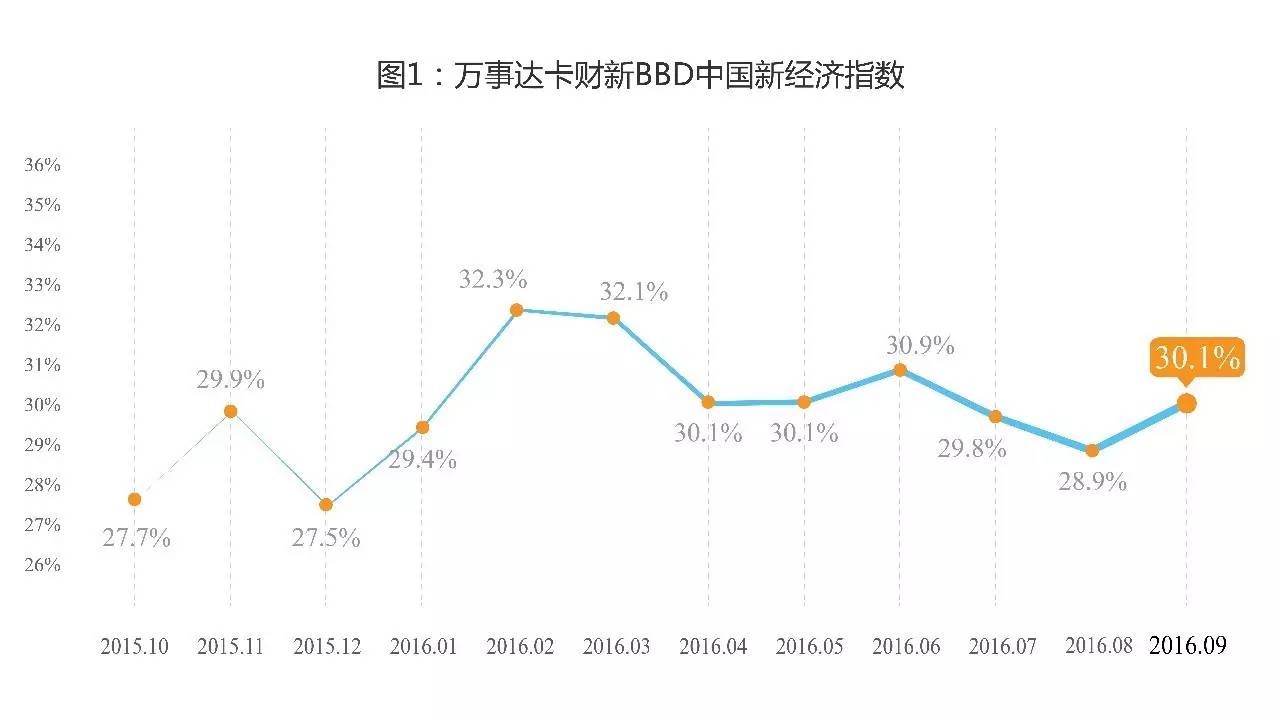
2016年9月,万事达卡财新BBD中国新经济指数(NEI)为30.1,即新经济占整个经济投入的比重为30.1%。该值较8月的28.9上升1.2个百分点,回到了2016年4至5月的水平(图1)。本月新经济指数对就业大数据进行了整理,获取了新的数据源,将不同数据源的结构影响矫正后,从2016年4月开始的新经济指数都作了微调。
二、主要分项指标
NEI包括劳动力、资本和科技三项一级指标,它们在NEI中的权重分别是40%、35%和25%。
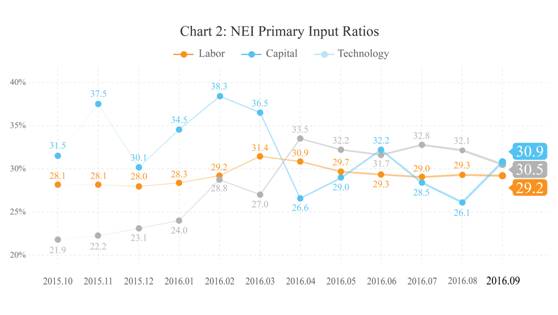
9月NEI上升主要来自资本投入的回升。资本投入指数在近半年中的波动较大,在经过连续两月的强劲反弹与连续三个月的回落后,本月重新上升至30.9(图2)。劳动力投入指数从3月开始首次突破30,达到31.4,随后四个月该指数连续下降,8月与9月从底部略有反弹,本月达到29.2,仍然高于去年的大多数月份。 科技投入指数稳中略有下降,本月为30.5。

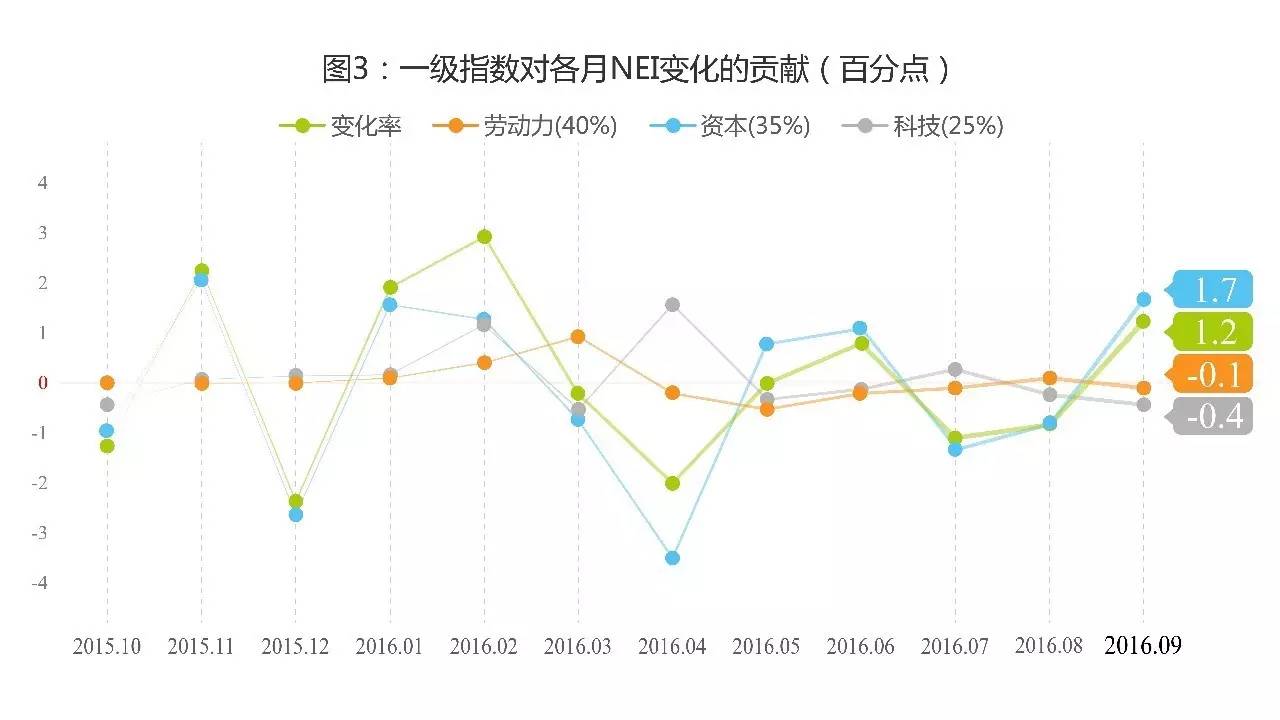
劳动力、资本和科技投入的变化绝对值分别为-0.1,1.7,和0.4个百分点,与权重相乘求和后,对9月NEI变化的绝对贡献值为1.2(图3)。
三、新经济就业
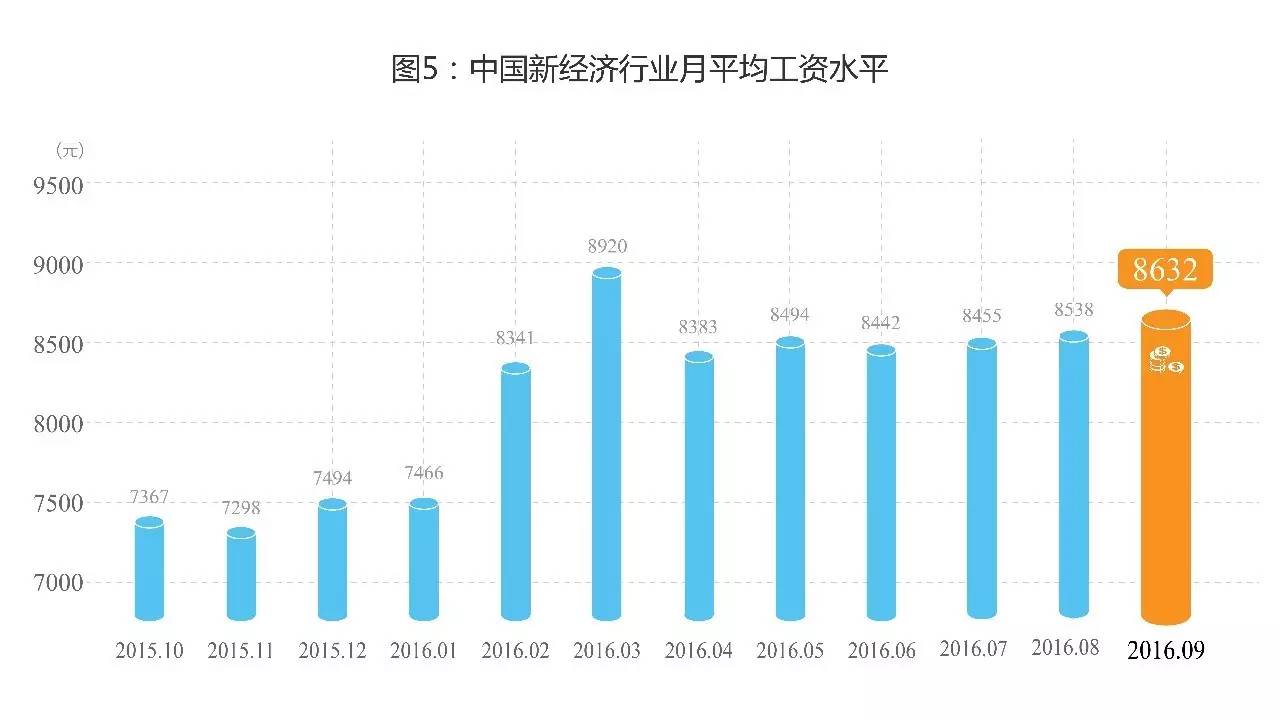
2016年9月,新经济行业入职平均工资水平回升至每月8632元(图5)。新经济工资主要来自51job、智联招聘、拉钩、赶集网等数个招聘网站的招聘信息,即对劳动力的需求工资。 本月对新经济指数中的就业大数据进行了整理,获取了新的数据源,将不同数据源的结构影响矫正后,重新计算了各项就业指标。
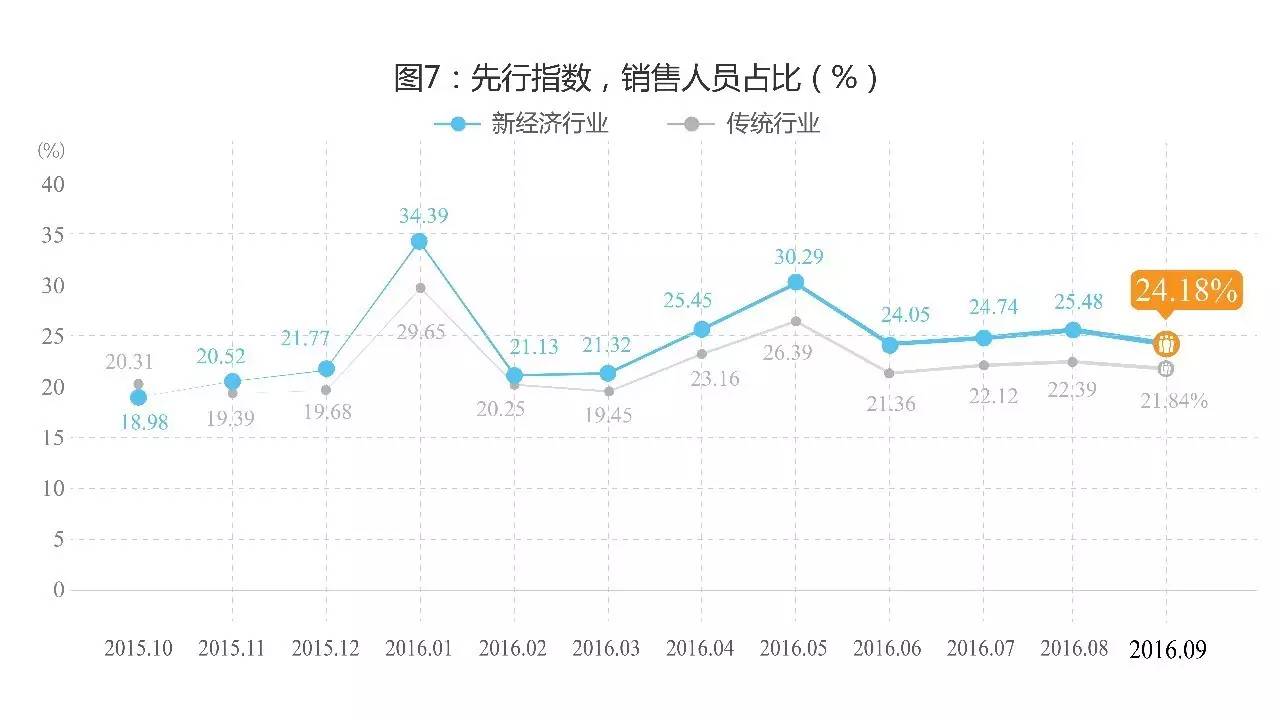
本月我们首先分析销售人员需求占比这一项领先指标。与直观的理解不同,企业对销售人员招聘需求增加,可能代表库存压力的增加,也可能是就业市场匹配效率提高的结果。从2015年9月至2016年9月,新经济行业的销售人员需求占比从19.6%上升至24.2%,增速高于传统行业,后者仅从18.6%上升至21.8%(图7)。
四、人口流动
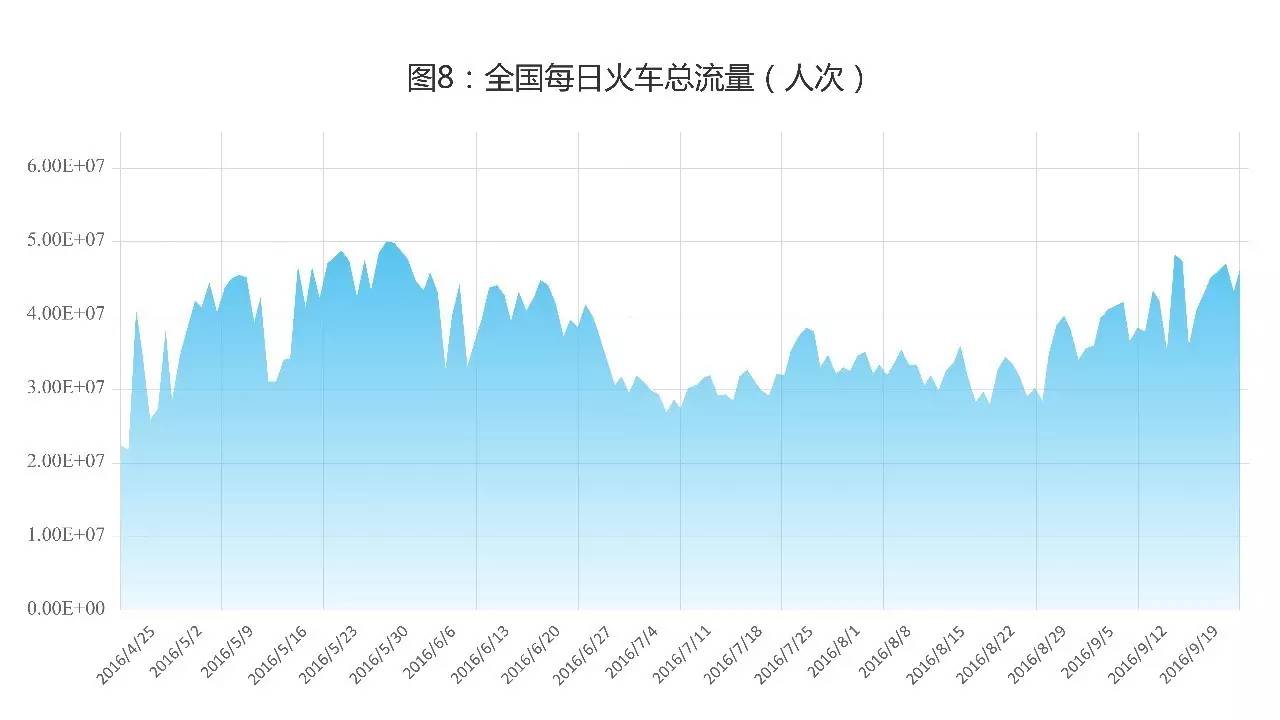
人口流动数据与经济活力息息相关。从2016年4月至今共半年,中国铁路人口流动数据经历了先下降后上升的态势。本月的平均每日人口流动比年度低谷7、8两月高28%,与5月持平(图8)。
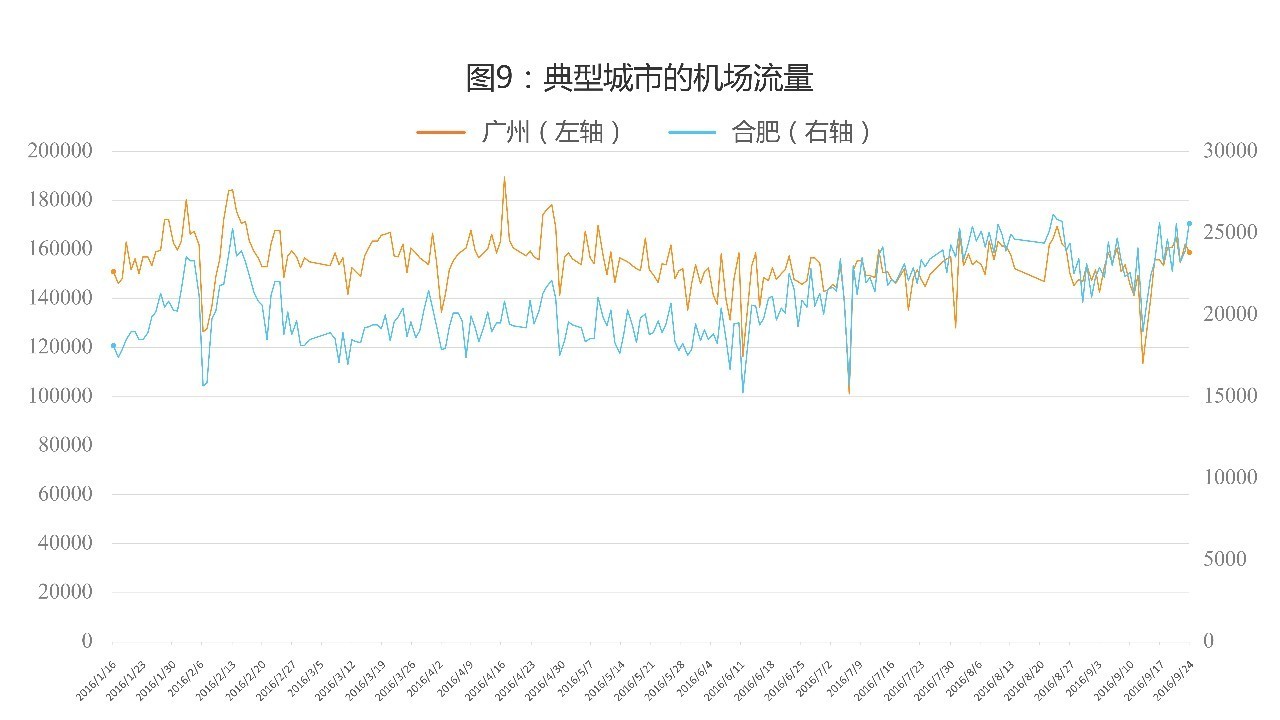
不同城市的人口流动情况也出现了分化。较为典型的是广州和合肥两个城市。在新经济指数半年多来的报告中,广州市的排名下滑,从第5名下降至第7名;合肥市的排名则从18名稳步上升至本月的第12名,在两个城市从年初至今的航班人口总流量中也能看出,广州市第三季度的平均日航班人口流量较第一季度下降4.4%,而合肥则上升了17.1%(图9)。
五、城市新经济排名
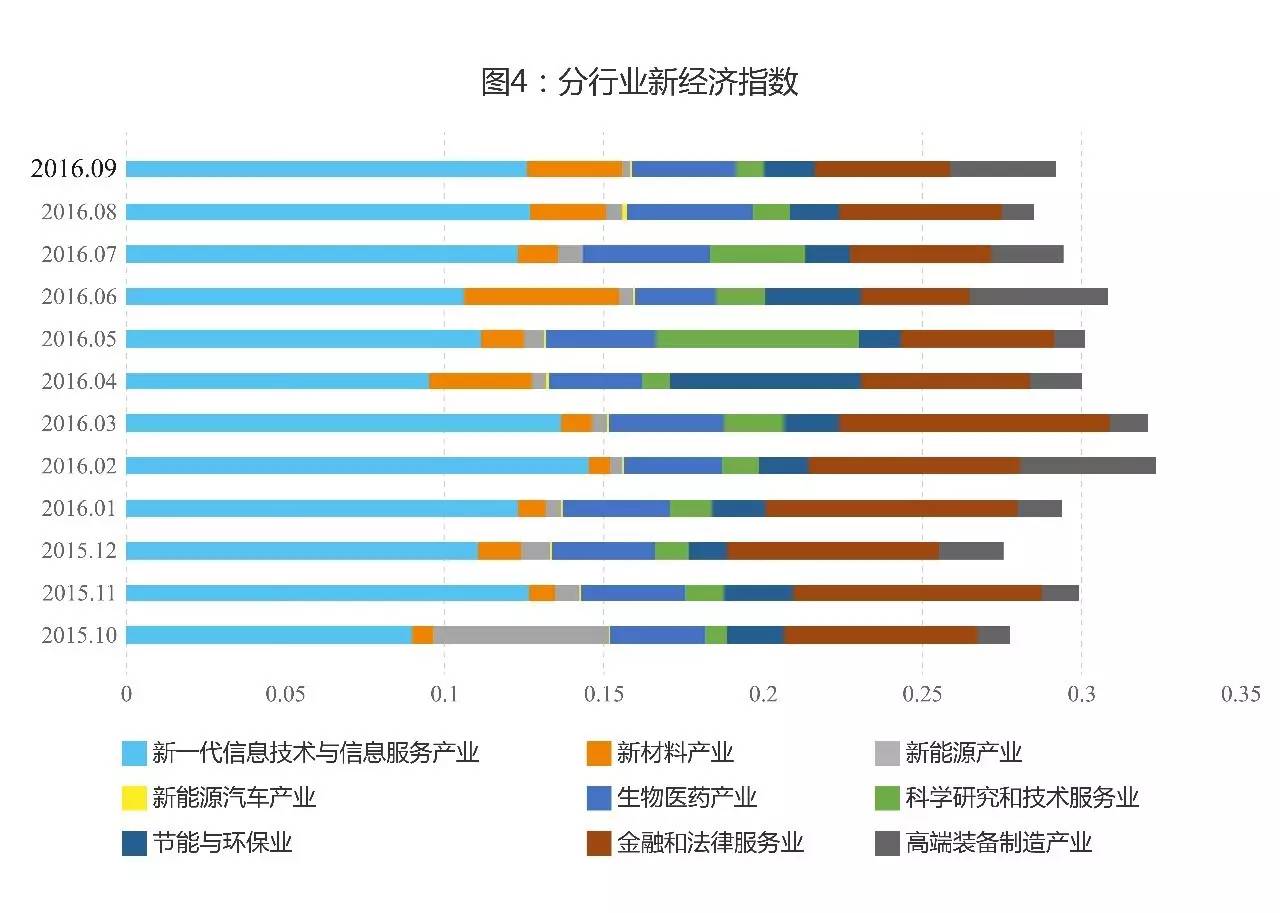
新经济总量指数城市排名前20名如图10所示,上海、北京、深圳、杭州与重庆排名前五,该排序计算每个投入指标在所有城市中的排序百分位,再将百分位加权平均,体现的是近半年城市间新经济总量排名。

图11是从2016年3月到2016年9月城市NEI平均排名,前五名为杭州、上海、北京、深圳、广州。上海重新回到全国第二名,但仍然落后于杭州。

更多咨询敬请联络 :
万事达卡
公共关系副总裁 吴焕宇
电话:+86-10-8519-9304
电邮:Huanyu_wu@mastercard.com
财新智库
财新智库莫尼塔董事长兼首席经济学家 沈明高公关总监 马玲
电话:+86-10-8518-8170 转8618电话:+86-10-8590-5204
电邮:minggaoshen@caixin.com电邮:lingma@caixin.com
BBD(数联铭品)
BBD(数联铭品)首席经济学家 陈沁
电话:+86-28-65290823
电邮:chenqin@bbdservice.com
版权声明
万事达卡财新BBD中国新经济指数,是由财新智库(深圳)投资发展有限公司和成都数联铭品科技公司共同研发,与北京大学国家发展研究院合作,经过近一年努力,于2016年3月2日在北京首发的指数产品,此后每月2日上午10:00发布上月数据。
关于万事达卡:
万事达卡(纽交所股票交易代码:MA),www.mastercard.cn,是全球性的支付与科技公司。通过运营全球最快的支付处理网络,万事达卡将超过210个国家和地区的消费者、金融机构、商户、政府和企业连接在一起。万事达卡的产品和解决方案使得每个人在购物、旅行、企业经营、财务管理等日常商业活动都变得更容易、更安全和更高效。敬请关注我们的“万事达卡”官方微信以及在新浪的官方微博@万事达人,以获悉动态并参与互动。也可访问万事达卡新闻中心或万事达卡互动中心获取更多资讯。
关于财新:
财新传媒是提供财经新闻的全媒体集团,依托专业的团队和强大的原创新闻优势,以网站、移动端、期刊、视频、图书、会议等 多层次的业务平台,为中国最具影响力的受众群,提供准确、全面、深入的财经新闻产品。财新智库是财新传媒通过孵化另行建立的高端金融资讯服务平台,旨在通过发展金融数据业务,壮大宏观经济研究队伍,服务于智库业务客户。详细信息,敬请浏览 www.caixin.com。
关于BBD:
BBD(数联铭品)是行业领先的大数据解决方案提供商,紧密围绕新经济,通过动态尽调、信用评级、风险定价和经济指数四个步骤,BBD提供从微观到宏观的大数据服务。详细信息,敬请浏览:http://www.bbdservice.com。、
报告英文版:
MasterCard Caixin BBD China New Economy Index September 2016
In an effort to increase transparency on thestructural changes underway in China’s economy, the MasterCard Caixin BBD ChinaNew Economy Index (NEI) was established. The subject of a year of research, theNEI was first publically released on March 2, 2016 and will be issued at10:00am the 2ndof every month China Standard Time.
Overview
In September 2016, the MasterCard Caixin-BBD New Economy Index (NEI) reading came in at 30.1, indicating that the NewEconomy accounted for 30.1% of overall economic input activity in September.This month’s reading saw a 120 basis points increase from August and returnedto a level seen in April and May (Chart 1). We made adjustments to labor inputsbig data by utilizing new data sources and making subsequent structuralmodifications. These changes are reflected in NEI starting from April 2016 onward.

Primary Inputs
TheNEI includes labor, capital and technology inputs that account for 40%, 35% and25% of the total weight of the index, respectively. Among the primary inputs,the rise in the September NEI reading came primarily from increasing capitalinvestment. Although capital investment fluctuated widely in 1H16, it reboundedthis month to 30.9 (Chart 2). The labor input index has seen a four-monthconsecutive decline since breaking the 30 point barrier, at 31.4, in March. Itstarted to slowly rebound in August, reaching 29.2, higher than most monthslast year. Technology input showed slight decline to 30.5.
Percentagechanges in labor, capital and technology inputs were -0.1, 1.7 and 0.4percentage points, respectively. After accounting for the sum of theirweightings, the net result for the NEI was a 1.2 percentage point increase fromthe previous month (Chart 3).

Lookingat sub-sectors, the New IT industry contributed 12.6 percentage points to NEI,the largest sector of the New Economy. This was followed by Finance & LegalServices with 4.2 percentage points, which saw a slight decline. The thirdlargest contributor was advanced equipment manufacturing with 3.3 percentagepoints (Chart 4).

New Economy Employment
InSeptember 2016, the average monthly entry level salary of the New Economy roseto RMB 8,632 per month (Chart 5). New Economy wage information is compiled fromonline websites of career platforms and recruitment services including 51joband Zhaopin, as well as other sites that list job demands.

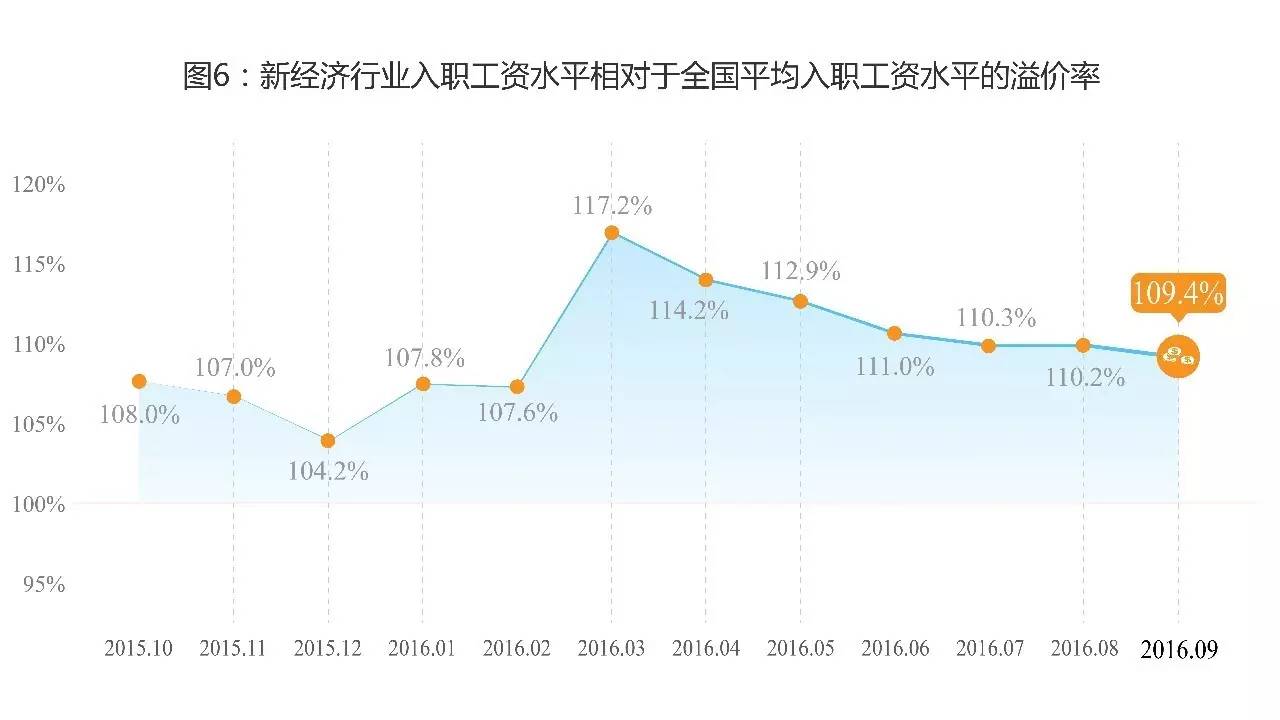
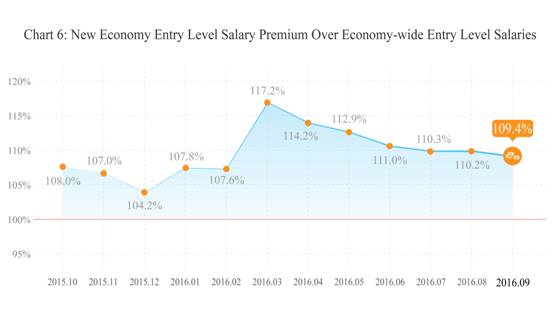
Hiringin the New Economy sectors accounted for 27.8% of total hiring in September,same as the previous month. The compensation share of New Economy sectorsdecreased slightly, from 30.7% to 30.5%. The entry level salary premiums of theNew Economy remained essentially flat in September, as new economy workersearned a 9.4% premium as compared to economy-wide counterparts (Chart 6).
Fromthis month onwards, we will use new data sources to examine several leadingindicators in labor demand, such as 1) the share of demand for workers engagedin production activities to total workforce – a leading indicator for capacity investment;2) the share of demand for sales workers to total workforce – a leadingindicator for inventory depletion; 3) job matching rate – a leading indicatorfor the expansion of existing firms; 4) the share of demand from largeenterprises to total demand – a leading indicator for economic stabilization.
Wefirst analyze the share of demand for sales workers this month. A firm’s decisionto hire more sales staff could reflect the pressure of rising inventory, orimply higher efficiency in job matching. From September 2015 to September 2016,the demand for sales workers in the New Economy sectors increased from 19.6% to24.2%. The demand growth rate was lower among economy-wide counterparts, whichincreased from 18.6% to just 21.8%.

Urban Population Flows
Wereport domestic traffic between China’s largest train stations as a proxy fornet population movement between China’s urban centers using 12306.cn, the CRC’sofficial ticket purchase website.
China’spopulation flows by railway have fluctuated since April. Average dailypopulation flows this month increased 28% compared with the troughs in July andAugust, and reached a level similar to that in May (Chart 8).

Differentairports have exhibited diverse trends, as can be seen in Guangzhou and Hefei.Guangzhou’s NEI ranking this year dropped from the fifth to the seventh;whereas Hefei improved steadily from the eighteenth to the twelfth this month.As for YTD population flows by flights, the average daily population flow inGuangzhou dropped 4.4% between 1Q and 3Q, whereas Hefei increased 17.1% (Chart9).

City Rankings of the New Economy
Basedon overall New Economy rankings, Shanghai, Beijing, Shenzhen, Hangzhou andChongqing placed in the top five (Chart 10). Rankings are based on a movingaverage of the percentile rank of indicators for the city in the past 6 months.

Whenlooking at the city NEI rankings based on average NEI from March to Septemberof 2016, Shanghai rose to second this month, but still behind Hangzhou (Chart11). Beijing, Shenzhen and Guangzhou rounded out the top five.

The MasterCard Caixin BBD China New EconomyIndex is the fruit of a research partnership between Caixin Insight Group andBBD, in collaboration with the National Development School, Peking University.The subject of a year of research, the NEI was first publically released onMarch 2, 2016 and will be issued the 2ndof every month at 10:00amChina Standard Time.
About Caixin
Caixin Media is China's leading media group dedicated to providingfinancial and business news through periodicals, online content, mobileapplications, conferences, books and TV/video programs. Caixin Media aims toblaze a trail that helps traditional media prosper in the new media age throughintegrated multimedia platforms. Caixin Insight Group is a high-end financialdata and analysis platform. For more information, please visit www.caixin.com.
About Master Card
MasterCard (NYSE: MA), www.mastercard.com, is a technology company in the globalpayments industry. We operate the world’s fastest payments processing network,connecting consumers, financial institutions, merchants, governments andbusinesses in more than 210 countries and territories. MasterCard’s productsand solutions make everyday commerce activities – such as shopping, traveling,running a business and managing finances – easier, more secure and moreefficient for everyone. Follow us on Twitter@MasterCardAPand@MasterCardNews, join the discussion on theBeyond the Transaction Blogandsubscribefor the latest news on theEngagement Bureau.