本篇文章介绍了孩子十种负面童年经历,并提到了其他负面经历,同时讲述了7种可以抵消负面经历的正面经历。在一些关于孩子因责骂而轻生的评论中,一些人会认为打骂没错,因为他们从小被打骂也没怎么样。这就忽视了其他来自于家庭内外负面经历、个体差异以及可以与之相抵消的正面经历等因素;有的父母选择为了孩子“不离婚”,虽然离婚对孩子而言的确是一个负面经历,但往往这种环境中争吵不断、对孩子继续忽视、*力暴**对待、精神操纵,或者母亲继续受到欺侮,这就相当于拣了芝麻丢了西瓜,避免了一个负面经历,换取了多项负面经历。
Adults who self-report more positive childhood experiences (PCEs) tend to have a lower likelihood of clinical depression or poor adult mental health—and a higher probability of healthy adulthood interpersonal relationships—according to a new survey-based study from Johns Hopkins University.
根据约翰斯·霍普金斯大学的一项新的调查研究,报告说自己有更多正面童年经历(PCE)的成年人,被临床诊断抑郁症或处于不佳心理健康状态的可能性更低,拥有健康成年人际关系的可能性则更高。
A total of 6,188 women and men over the age of 18 participated in this survey. Although the study has some significant limitations (e.g., cross-sectional, observational, correlational) and cannot confirm causal effects, the findings suggest that the seven interpersonal positive childhood experiences (that were the focus of this research) could have lifelong, beneficial ripple effects on mental and relationship health.
共有6188人参与了本次调查,参与者有男有女,均在18岁之上。尽管该研究有一些严重限制(如,横断式、观察式和相关法研究方式),而且也不能确定因果,但这些发现却展示了7种人际正面童年体验(该调查的核心主题)能够对心理和感情健康产生持续终生的、有益的影响。
Christina Bethell and co-authors hope their recent findings will be a call to action for parents and public health advocates to take a two-pronged approach to:
Christina Bethell和其合著作者们希望他们的研究能够让父母们和公共卫生倡导者们行动起来,采用*管双**齐下的方式:
1. Boost positive childhood experiences加强正面童年经历2. Reduce adverse childhood experiences.减少负面童年经历
"This study offers the hopeful possibility that children and adults can thrive despite an accumulation of negative childhood experiences," Bethell said in a statement. "People assume eliminating adversity automatically results in good health outcomes, but many people reporting lower adversity in childhood still had poorer mental and relational health outcomes if they did not also report having had positive childhood experiences."
“这一研究给出了这一充满希望的可能性,即,即使存在一些负面童年经历,儿童和成年人依旧可以健康成长,”Bethell表示,“人们一直假设,消除负面经历自然而然就能够带来良好的健康结果,但很多汇报说自己在童年时期负面经历较少的人,如果他们并未汇报说有正面童年经历,他们依旧表现出较差的心理和关系健康程度。”
"PCEs" and "ACEs" Are Two Sides of the Same "Childhood Experiences" CoinPCE 和 ACE:童年体验这一硬币的正反两面
If you bumped into someone on the street taking this psychological survey and they randomly asked: "Before the age of 18, did you experience more positive childhood experiences (PCEs) or more adverse childhood experiences (ACEs)?" what would be your knee-jerk response?
如果你在大街上遇到做这一心理调查的人,他们随机问到:在18岁之前,你的正面童年经历较多还是负面童年经历较多?你的第一反应会是什么?
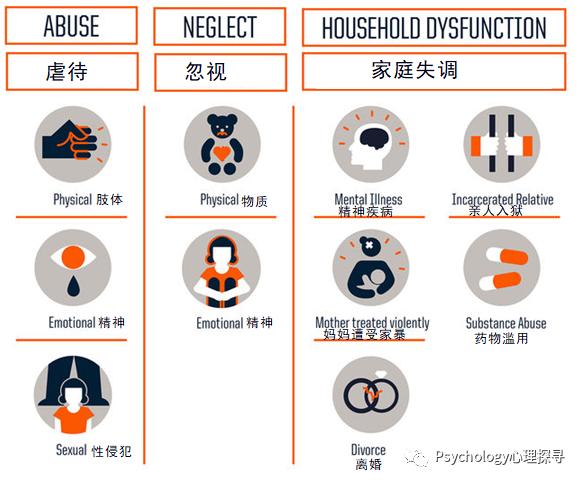
These are the 10 adverse childhood experiences (ACEs). Each of these items counts for one point as part of an individual's 1-10 ACE score.共有10种负面童年体验(ACE),在ACE评分体系中,每一项代表与一分。
Source: Centers for Disease Control and Prevention/Robert Wood Johnson Foundation
I know my ACE score; therefore, my very first response to the survey taker would be: "I've taken the ACE test but, until now, I'd never heard of PCEs. Exactly what type of early life experiences do you classify as so-called 'positive childhood experiences?'"
我知道我的ACE分数,因此,对这一调查开展人员,我的第一反应是:我是做过ACE测试的,但我从没听说过PCE。究竟你们把哪类早期生活经历归类为所谓的“正面童年经历”?
Below are the seven items on the positive childhood experience (PCE) psychometric analysis. For each item, respondents are asked to respond "yes" or "no" to a prompt, "Before the age of 18, I was..."
以下是正面童年经历心理计量分析中的7项经历。对于每项经历,被测试者需要对每个以“18岁之前,我曾经……”开始的问题回答是或否。
1. Able to talk with my family about my feelings.2. Felt that my family stood by me during difficult times.3. Enjoyed participating in community traditions.4. Felt a sense of belonging in high school.5. Felt supported by friends.6. Had at least two non-parent adults who took a genuine interest in me.7. Felt safe and protected by an adult in my home.
1.能够和我的家人谈论我的感受。
2.在我的艰难时刻,我能感受到我的家人和我站在一起。
3.喜欢参与社区传统活动。
4.在高中时有归属感。
5.感到来自朋友的支持。
6.至少有两个父母之外的成年人发自真心地对我感兴趣。
7.在家中,感到安全,并感到被一位成年人保护。
Now that you know the seven PCEs, how many times did you answer "yes" on this seven-item survey? The higher your score, the more positive childhood experiences you had based on this psychometric analysis.
现在你知道这7项PCE了,你有几项是回答“是”的呢?你的分数越高,根据这一心理计量分析,你的正面童年经历就越多。
According to the researchers, "This study designed, tested, and used a new positive childhood experiences measure that showed a dose-response relationship between how many positive experiences adults reported and their mental and relational health. This new "cumulative positive" design captures aggregate experiences in the same way adverse childhood experiences measure 'cumulative risk.'"
据研究人员所说,“该研究设计、测试并使用了一种全新的正面童年经历测试方法,这一测试方法展现了成年人所汇报正面经历数量以及他们的心理与关系健康程度之间的量效关系。”这一全新的“累积正面经历”设计捕捉累积经历,与负面童年体验对“累积风险”的测量方式相同。
ACEs Quiz负面童年经历测试
As mentioned, the latest Johns Hopkins survey also gave respondents the standard adverse childhood experiences (ACEs) quiz. (If interested, you can get your ACE score by clicking on this free NPR link and answering "yes" or "no" to 10 questions.)
如上所述,这一调查同时还让受调查对象参加了标准的负面童年经历(ACE)测试。如果感兴趣,可参见下文,用是或否回答这10个问题。
For each “yes” answer, add 1. The total number at the end is your cumulative number of ACEs.
对每个回答“是”的问题,加1分。最后总分则是你的ACE总分。
Before your 18th birthday:你18岁生日前:
1. Did a parent or other adult in the household often or very often… Swear at you, insult you, put you down, or humiliate you? or Act in a way that made you afraid that you might be physically hurt? 家中是否有一位父母或其他成年人经常或非常频繁……骂你、*辱侮**你、贬低你或羞辱你?或其行为让你害怕你可能会受到肢体伤害?2. Did a parent or other adult in the household often or very often… Push, grab, slap, or throw something at you? or Ever hit you so hard that you had marks or were injured? 家中是否有一位父母或其他成年人经常或非常频繁……推、拉、扇你或向你扔东西?或甚至将你打到留下印痕或受伤?3. Did an adult or person at least 5 years older than you ever… Touch or fondle you or have you touch their body in a sexual way? or Attempt or actually have oral, anal, or vaginal intercourse with you? 是否有一位成年人或一位至少比你大5岁的你曾经……出于性目的触摸或抚弄你或让你触摸他们的身体?或试图或的确与你发生*交口**、*交肛**或阴部*交性**关系?4. Did you often or very often feel that … No one in your family loved you or thought you were important or special? or Your family didn’t look out for each other, feel close to each other, or support each other? 你是否曾经常或非常频繁感到……你的家中没有人爱你,或者没有人觉得你重要或特别?或你的家人并不互相关心、彼此不亲密、不支持?5. Did you often or very often feel that … You didn’t have enough to eat, had to wear dirty clothes, and had no one to protect you? or Your parents were too drunk or high to take care of you or take you to the doctor if you needed it? 你是否曾经常或非常频繁感到……你没有足够的食物、不得不穿脏衣服、没有人保护你?或你的父母因为酗酒或吸毒无法照顾你,或当你需要就医时无法带你去医院?
6. Were your parents ever separated or divorced? 你的父母是否分居或离婚?
7. Was your mother or stepmother:你的母亲或继母:Often or very often pushed, grabbed, slapped, or had something thrown at her? or Sometimes, often, or very often kicked, bitten, hit with a fist, or hit with something hard? or Ever repeatedly hit over at least a few minutes or threatened with a gun or knife? 经常或频繁被推搡、拽、扇巴掌或被扔东西?或者有时、经常或非常频繁被踢、被咬、被拳头打或被硬器打?或曾经在至少短短几分钟内被反复殴打,或被用枪或刀具威胁?
8. Did you live with anyone who was a problem drinker or alcoholic, or who used street drugs? 你是否曾经与问题酗酒者或吸毒者同住?9. Was a household member depressed or mentally ill, or did a household member attempt suicide? 是否有家庭成员抑郁或患有精神疾病?或是否有家庭成员试图自杀?
10. Did a household member go to prison? 是否有家庭成员曾经入狱?
Source: NPR, ACEsTooHigh.com. This ACEs Quiz is a variation on the questions asked in the original ACEs study conducted by CDC researchers.
What’s Missing?该ACE测试未囊括事项
The quiz is a helpful tool for raising awareness about the potential impact of ACEs. But it’s important to remember all the things this quiz doesn’t take into account.
对于提高人们对负面童年经历潜在影响的意识方面,该测试是非常有用的工具。但也需要记住,这一测试并未囊括所有因素。
Stressors outside the household (e.g., violence, poverty, racism, other forms of discrimination, isolation, chaotic environment, lack of services)
家庭外压力源 (如:*力暴**、贫穷、种族歧视、其他歧视形式、隔绝、混乱环境、缺乏必需服务等)
Protective factors (e.g., supportive relationships, community services, skill-building opportunities)
保护因素 (如支持型感情关系、社区服务、技能培训机会等)
Individual differences (i.e., not all children who experience multiple ACEs will have poor outcomes and not all children who experience no ACEs will avoid poor outcomes—a high ACEs score is simply an indicator of greater risk。Every one is different, and adverse experiences in childhood affect each child differently. Just because a person has experienced several ACEs does not mean that later social, emotional, or health problems are inevitable. Some children develop resilience – the ability to overcome serious hardship – while others do not. Genetic factors also play a role, in that some children are predisposed to be more sensitive to adversity than others. And the most common factor among children who show resilience is at least one stable and responsive relationship with a supportive adult.)
个体差异(即,并非所有经历多重ACE的孩子都会有不良后果,也并非没经历过任何ACE的孩子就不会有不良后果——高ACE分数只是意味着更高风险。每个人都各不相同,童年负面体验对每个孩子会产生不同影响。一个人经历过一些负面童年经历,并不一定就意味着之后在社交、精神或健康方面一定会产生问题。一些孩子会形成坚韧品质——克服重大困难的能力,而另一些孩子则并不会。基因因素也会产生一定影响,一些孩子天生要比另一些孩子对逆境更敏感。 而在具有坚韧品质的孩子群体中,最为普遍的一个因素,是他们至少与一位支持他们的成年人之间具有稳定的、回应式关系(积极回应孩子需求)。 )
来源:https://developingchild.harvard.edu/media-coverage/take-the-ace-quiz-and-learn-what-it-does-and-doesnt-mean/
正面童年经历可能会对心理和关系健康产生终生影响。
In the paper's discussion section, Christina Bethell and co-authors "hypothesize that PCEs may have a greater influence in promoting positive health, such as getting needed social and emotional support or flourishing as an adult. In turn, these positive health attributes may reduce the burden of illness even if the illness is not eliminated."
在该论文的讨论部分,Christina Bethell 和合著作者们“假定了正面童年经历可能对促进健康正向发展有更大的影响,如,能够获得所需的社交与精神支持,或在成年后蓬勃发展。”而这些正面健康特征也可进一步减少疾病所带来的负担,即使疾病并未完全被根除。”
"Overall, study results demonstrate that PCEs show a dose-response association with adult mental and relational health, analogous to the cumulative effects of multiple ACEs," the authors concluded. "Findings suggest that PCEs may have lifelong consequences for mental and relational health despite co-occurring adversities such as ACEs."
“整体而言,研究结果展示,正面童年经历与成年人心理与关系健康之间显示出存在量效关系,类似于负面童年经历的累积效果。发现结果显示,尽管存在诸如负面童年经历之类同时发生的逆境,正面童年经历可能会对心理和关系健康产生终生影响。”
If you are a parent, guardian, or caregiver of someone under 18: In closing, I've reframed the seven positive childhood experiences (PCEs) listed above in the third person, present tense. The next time you need a reminder on how to plant the seeds of future flourishing for your kid(s), say to yourself:
如果你是一位18岁以下孩子的父母、监护人或看护人:
最后,我从第三人称、现在时态的角度重新编辑了上面的7条正面经历。下次当你需要被提醒该如何给孩子种下茁壮成长的种子的时候,告诉自己:
"Children are more likely to have better mental health, a lower risk of depression, and healthier relationships in adulthood if they are able to:
“当孩子能够有以下经历时,孩子成年后更可能有更好的心理健康水平、更低的抑郁风险以及更健康的感情关系:”
(1) Talk with family members about their feelings, (2) Feel that their families stood by them during difficult times, (3) Enjoy participating in community traditions, (4) Feel a sense of belonging in high school, (5) Feel supported by friends, (6) Have at least two non-parent adults who take genuine interest in them, and (7) Feel safe and protected by an adult in their home."
与家庭成员谈论他们的感受;在困难时刻,感受到他的家人与他站在一起;喜欢参与社区传统活动;在高中感到归属感;感到来自朋友的支持;有至少两位父母之外的成年人发自真心地对他们感兴趣;在家中感到安全,并感到被一位成年人保护。
The good news for every parent is that these PCE items are practical and, for the most part, easy to facilitate in your child's day-to-day life.
对每位父母来说,好消息是,这些正面童年经历很切实际,而且大部分时候,在孩子日常生活中,都易于实践。