The world’s stockmarkets
Who’s up, who’s down?
The decline of Britain’s stockmarket should be seen in a broader historical context
It is tempting to look at Britain’s history and conclude that the loss of its empire made the relative decline of its stockmarket inevitable. But Britain’s is hardly the only one to have ballooned and shrivelled in the centuries since the idea of raising capital by selling equity to the public gained popularity. The fortunes of the world’s big exchanges have fluctuated throughout history. In recent decades two important trends have driven those shifts: the rise of Asian equities and the growing significance of the technology sector. Britain’s market has been clobbered more forcefully than those of its peers, exacerbating its de- cline. But these are merely the latest twists in 200 years of stockmarket history.
tempting: adj. something that is attractive, and make people want to have it, do it, etc. 吸引人的,诱人的 e.g.: It was a tempting offer.
shrivel: v. to become or make sth dry and wrinkled as a result of heat, cold or being old 9使)枯萎、干枯、皱缩 e.g.: The leaves on the plant had shrivelled up from lack of water.
clobber: v. to hit sb very hard; to affect sb badly or to punish the them, especially by making them lose money 狠击,猛打,极大的打击,惩罚,使受到(严重经济损失)
exacerbate: v. to make sth worse, especially a disease or problem 使恶化;使加剧
America’s and Europe’s stockmarkets first took off in the 19th century. Successive crazes for investing in canals, Latin America and railways led to the creation of hundreds of companies that raised capital in London, explains Bryan Taylor of Global Financial Data, a provider of historical statistics. “Once most of Europe’s railroads were built by the 1850s, British investors started financing the American ones instead,” he says. Britain’s stockmarket became a conduit for investment in a range of companies in Canada, India, South Africa, Australia and South America.
take off: (飞机等)起飞;to become successful or popular very quickly or suddenly 突然大受欢迎;迅速流行
craze:n.狂热,风行一时的东西 e.g. the latest fitness craze to sweep the country 最近风靡全国的健身热
conduit: n. 管道,中转人,中转机构,中转国
It was not the only hub for raising capital for overseas ventures. By the early 20th century, the shares of hundreds of firms were being traded simultaneously in London, New York, Paris and Berlin. America’s domestic growth was striking, too. The First Bank of the United States raised $10m ($291m today) at its incorporation in 1791. The incorporation s of dozens of other banks and insurance firms followed. By 1911 the combined value of the British, American, French and German markets reached a high of $49bn—over $1.4trn today—a 175- fold expansion on a century before.
incorporation: n.编入,法人组织,合并。
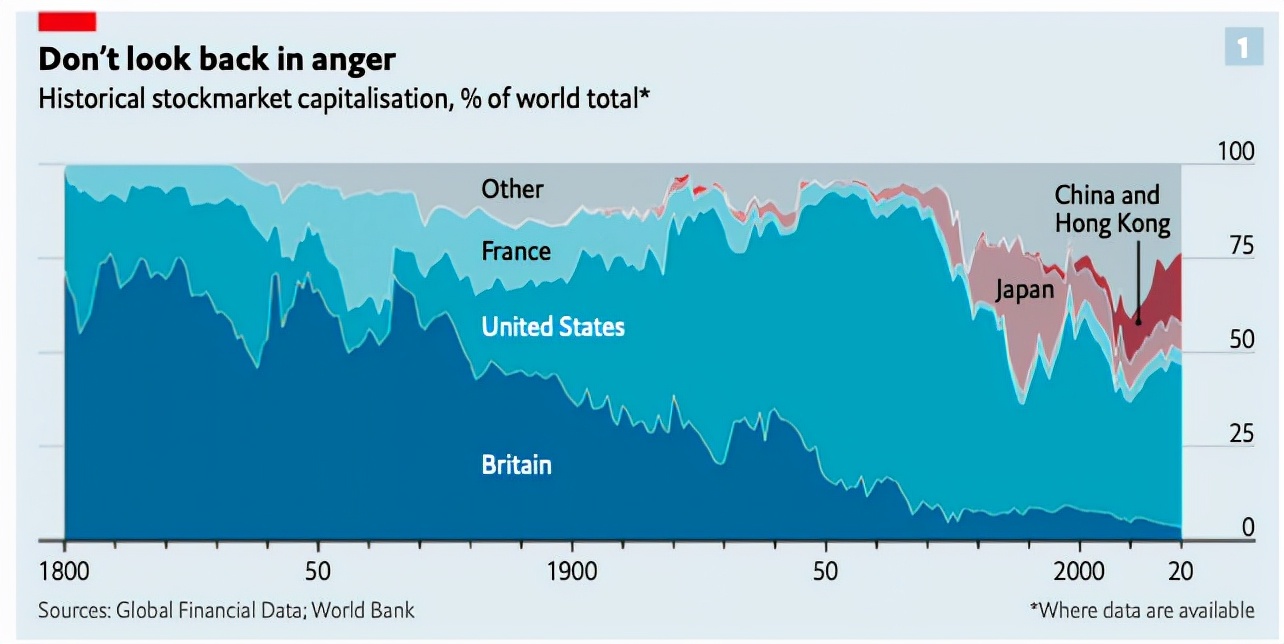
Two world wars later, a hobbled and fragmented European market offered little by way of challenge to America’s dominance (see chart 1). During the fighting bourses had largely been shuttered. When exchanges were able to open, they had frequently been subject to price restrictions that limited trading. Currencies were devalued and capital controls imposed, complicating cross-border flows. Hyperinflation in Germany and much of eastern Europe, combined with the rise of communism, had wiped out many investors. For decades after the end of the second world war, governments’ willingness to regulate and nationalise many industries kept European equities firmly in check.
hobble: v.to walk with difficulty, especially because your feet or legs hurt 蹒跚,破行;
bourse: n. a stock exchange, especially the one in Paris 证券交易所
wiped out: extremely tired 十分疲劳,筋疲力尽 e.g.: You looked wiped out.
--------------分割线------------
全文翻译(仅供参考):
应该在更广泛的历史背景下看待英国股市的下跌。
回顾英国的历史,很容易得出这样的结论:大企业集团的丧失使得其股市的相对下跌不可避免。但自从通过向公众出售股权来筹集资金的想法流行以来,英国并不是唯一几个世纪以来膨胀和萎缩的国家。世界各大交易所的命运在历史上一直波动。近几十年来,有两个重要趋势推动了这些转变:亚洲股市的崛起和科技行业日益重要的地位。英国市场比其他国家的市场受到的打击更大,加剧了其衰落。但这只是 200 年股市历史上的最新转折。
美国和欧洲的股票市场在 19 世纪首次起飞。历史统计数据提供商 Global Financial Data 的 Bryan Taylor 解释说,投资运河、拉丁美洲和铁路的连续热潮导致数百家公司在伦敦筹集资金。 “一旦欧洲的大部分铁路在 1850 年代建成,英国投资者就开始为美国的铁路提供资金,”他说。英国的股票市场成为对加拿大、印度、南非、澳大利亚和南美洲的一系列公司进行投资的渠道。
它不是为海外企业筹集资金的唯一枢纽。到 20 世纪初,数百家公司的股票在伦敦、纽约、巴黎和柏林同时交易。美国的国内增长也很惊人。美国第一银行于 1791 年成立时筹集了 1,000 万美元(相当于今天的 2.91 亿美元)。随后还有数十家其他银行和保险公司成立。到 1911 年,英国、美国、法国和德国市场的总价值达到 490 亿美元的高位——超过今天的 1.4 万亿美元——比一个世纪前增长了 175 倍。
两次世界大战之后,一个步履蹒跚且支离破碎的欧洲市场几乎没有对美国的主导地位构成挑战(见图 1)。在战斗期间,交易所基本上已经关闭。当交易所能够开放时,它们经常受到限制交易的价格限制。货币贬值和资本管制,使跨境流动复杂化。德国和东欧大部分地区的恶性通货膨胀,加上共产主义的兴起,已经摧毁了许多投资者。二战结束后的几十年里,各国政府对许多行业进行监管和国有化的意愿使欧洲股市受到严格控制。
------------
Oct 9th, 2021
声明:
本文全文摘选自The Economist/《经济学人》(Oct 2nd, 2021), 仅供个人学习交流使用。
英语经济NEWS,精选经济/商业类外刊文章。